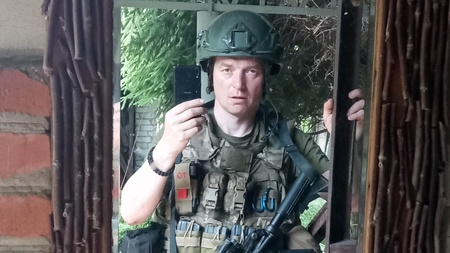

A University of Aberdeen neuroscientist who fought in Ukraine has returned to the country - this time as part of a scheme to strengthen academic links with the UK.
Rowett Institute researcher Dr Sergiy Sylantyev was one of ten people picked for the programme by The Fund of the President of Ukraine for Education, Science, and Sports.
UK Professors Will Teach at 10 Ukrainian Universities
The university’s strong performance in the “International Outlook” indicator in the Times Higher Education rankings was a significant factor in winning the honour.
Dr Sylantyev says he is “proud to represent an institution that recognizes international scientific partnerships as a vital component of higher education”.
The British scientist of Ukrainian origin recently travelled to Odesa National University, where he gained his Masters, to teach cellular and molecular neurophysiology.
Dr Sylantyev’s decision to serve as a soldier on the frontline early in the conflict was featured in prestigious science journal Nature and was an experience he says “profoundly changed my understanding of resilience and responsibility”.
‘In case I die, I need to publish this paper’: scientist who left the lab to fight in Ukraine
Now he is glad to be contributing in a different way.
“Ukraine requires not only military support and humanitarian assistance, but also a long-term strategy for sustainability,” he says.
“Such sustainability can be achieved only through deep and durable integration with Europe. This integration must extend beyond economics and security policy. Scientific and educational collaboration is equally essential because modern universities are key institutions that shape innovation, human capital, and international partnerships.
“Collaborative teaching, joint research projects, student exchanges, and institutional partnerships are therefore not peripheral activities: they are strategic investments in Ukraine’s future.
“I travelled to Ukraine to deliver lectures in neurophysiology and neuropharmacology at Odesa National University. I also supervised scientific work and contributed to strengthening academic links between British and Ukrainian institutions.
“It was an interesting and useful experience,” he adds – noting that there are plans to repeat the call in the autumn as the first wave had been such a success.
Despite the ongoing military conflict, Dr Sylantyev is encouraged by the high number of applications to join the scheme.
“One particularly striking aspect of this programme is that it requires the physical presence of participating scientists in Ukraine. In the context of ongoing missile attacks and security risks, this might have discouraged applicants.
“Instead, the programme received approximately three times more applications than anticipated, requiring an additional selection stage. This demonstrates that many British academics are willing to support Ukraine not only symbolically, but through direct engagement,” he says.
“Ukraine’s path toward Europe will be shaped not only on battlefields or in diplomatic negotiations, but also in lecture halls, laboratories, and universities. Science remains one of the most powerful instruments of resilience, and collaboration remains one of Europe’s strongest commitments to Ukraine’s future.”
Rowett Institute deputy director Professor Lora Heisler says: “Sergiy is an outstanding scientist whose dedication extends far beyond the laboratory.
“His courage, integrity, and commitment to knowledge have been evident both in his research and in his service during the conflict. It is a privilege to see him now contributing his expertise to support Ukraine’s academic community and future resilience."