
Researchers at the University of Aberdeen will showcase cutting-edge developments in medical imaging during a special Founders' Week edition of Café Sci on 10 February,exploring how Aberdeen continues to shape the future of MRI.
The event will look back at the early pioneers of MRI in the city, who built the first full-body MRI scanner in the 1980s, and will highlight current work underway at the University of Aberdeen which is reshaping magnetic resonance imaging.
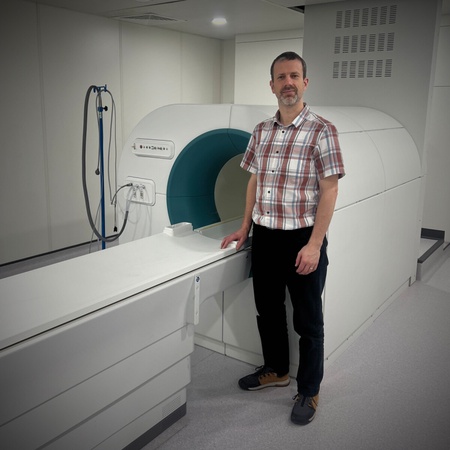
‘Aberdeen and the MRI’ will be led by Dr Lionel Broche and Dr Mathieu Sarracanie who will present two complementary research approaches being developed at the University - Field-Cycling Imaging (FCI) and Low-Field MRI - that could once again influence the future of medical imaging.
Dr Broche said: “Aberdeen is very famous for MRI. It has been one of the homes of medical MRI from the very beginning. The first ever clinical MRI scan was made here, and that legacy still shapes what we do today.”
Field-Cycling Imaging allows researchers to vary the magnetic field during a single scan, revealing information about tissue that cannot be detected using conventional MRI systems operating at a fixed field strength. This approach enables scientists to observe how biological tissues behave across multiple magnetic fields, offering new insight into disease processes.
Dr Broche said: “With standard MRI, you’re working at one strong magnetic field. That gives you great images, but you only see part of the picture. With Field-Cycling Imaging, we can change the magnetic field during the scan, and that lets us see information that’s completely invisible to conventional MRI.”
Alongside this work, researchers are developing Low-Field MRI systems that operate at a single, much weaker magnetic field, with the aim of improving access to imaging worldwide.
Dr Sarracanie said: “More than half the world’s population still does not have access to MRI at all and 80% struggle to have access to MRI. What really locks MRI into being big, expensive, and inaccessible is the magnet. To introduce options which are scalable, portable, and widely available, you have to reduce the magnetic field.”
Lower magnetic fields allow for simpler, quieter and more flexible scanners, with improved compatibility for patients with implants and prosthetics. Researchers in Aberdeen have assembled a range of prototype systems and are preparing for early patient studies.
Dr Sarracanie said: “There is a real sense that we are continuing something that began here, by challenging convention and applying that same spirit of invention to modern healthcare needs, and we are delighted to be able to share this progress at our Café Sci.”
‘Aberdeen and the MRI’ is free to attend and runs from 7pm to 8pm. To book your place visit https://www.abdn.ac.uk/events/23094/ or for more information contact peru@abdn.ac.uk.