

FRSE
Chair in Zoology
- About
-
- Email Address
- x.lambin@abdn.ac.uk
- Telephone Number
- +44 (0)1224 273259
- Office Address
Room 408 Zoology building Tillydrone Avenue Aberdeen AB24 2TZ Scotland UK
- School/Department
- School of Biological Sciences
Biography
2016 Elected Fellow of the Royal Society of Edinburgh FRSE
2015 Elected Fellow of the Royal Society of Biology FRSB
2004 Professor of Ecology, University of Aberdeen
1994 Lecturer, Senior Lecturer (1999), Reader in zoology (2002) University of Aberdeen
1993 NATO/Royal Society Research Fellow at Institute of Terrestrial Ecology, Banchory field Station
1992 PhD University of Louvain & Univ British Columbia, Personal Reseach Fellowship National Foundation for Scientific Research (Belgium)
1988-1991 Visiting Graduate Student, University of British Columbia1986 BSc Zoological Sciences, University of Louvain, First class
1988 MSc Biology, University of Louvain, First class
1987 Visiting Graduate Student, University of Oslo
Recruiting a PhD student in population ecology for October 2026 Start
We are inviting applications for our fully funded, cross institution PhD on
Predicting and managing the spatially asynchronous pulses of herbivorous rodent abundance cascading through ecosystems.
Memberships and Affiliations
- Internal Memberships
-
Prof Lambin is currently:
A member of REF 2029 Strategy Group
A member of Anthony & Margaret Johnston Centre for Doctoral Training in Plant Executive Board
- External Memberships
-
Prof Lambin is currently:
A member of REF2029 subpanel A5 Biological Sciences
A member of NatureScot's Scientific Advisory Committee
A member of Orkney's Native wildlife Project Independent Technical Advisory Group
Scientific advisor to and a member of Scottish Invasive Species Initiative Steering Group
A member of the Flow Country World Heritage Site Advisory Group
A member of Cairngorm's National Park Authority and Nature Scot Capercaillie emergency plan scientific advisory Group
Prizes and Awards
2025 Nature of Scotland Awards: Innovation, Reducing the Impact of Predation with Diversionary-Feeding for work led by Jack Bamber Highly Commended
2024 Project CONTAIN Research prize - University of Aberdeen Principal's Prizes for Research & Engagement Interdisciplinary Research Award (joint winners) (2024)
2019 RSPB Nature of Scotland Conservation Science Award Highly Commended: Large scale participatory control of invasive mink in Scotland (representing consortium)
2017 Winner of the NE Scotland Biodiversity partnership 20th anniversary Collaboration project award.
2016 Watson Raptor Science Prize for the best paper on raptor science published in an international peer reviewed journal in 2015 as senior author of paper led by PhD student Sarah Hoy.
2015 University of Aberdeen Principal prize for public engagement with research “Outstanding achievement senior award”
2011 Certificate of recognition SNH “Special contribution to species conservation in Scotland”, Minister of the Environment, Scottish government.
- Research
-
Research Overview
I conduct ecological and multi-disciplinary socio-ecological research aimed at providing strong empirical evidence for practical solutions to pressing conservation issues.
My ecological research aims are to understand
the contribution of dispersal to the dynamics of populations,
to understand how the outcome of trophic interactions is modified by dispersal and
to apply population ecology to wildlife management and conservation.
I achieve these aims by conducting large scale, often long-term field studies with birds and mammals as well as by linking theoretical insights with empirical findings using state of the art statistical techniques.
I work with e.g. water vole metapopulations, cyclic field voles, their birds of prey predators, food plants and parasites in commercial forests and non-native American mink culled as part of conservation efforts, forest ecosystem managed for timber or transformed for rewilding, rats in Madagascar, non-native pines wasps and mink in South America and people.
I am invested in conservation biology, including the management of invasive species and rewilding. I research how to optimise the impact of conservation volunteers. I collaborate with multiple NGOs over many years.
Research Areas

Research Specialisms
- Applied Statistics
- Community Ecology
- Ecology
- Population Biology
- Population Ecology
Our research specialisms are based on the Higher Education Classification of Subjects (HECoS) which is HESA open data, published under the Creative Commons Attribution 4.0 International licence.
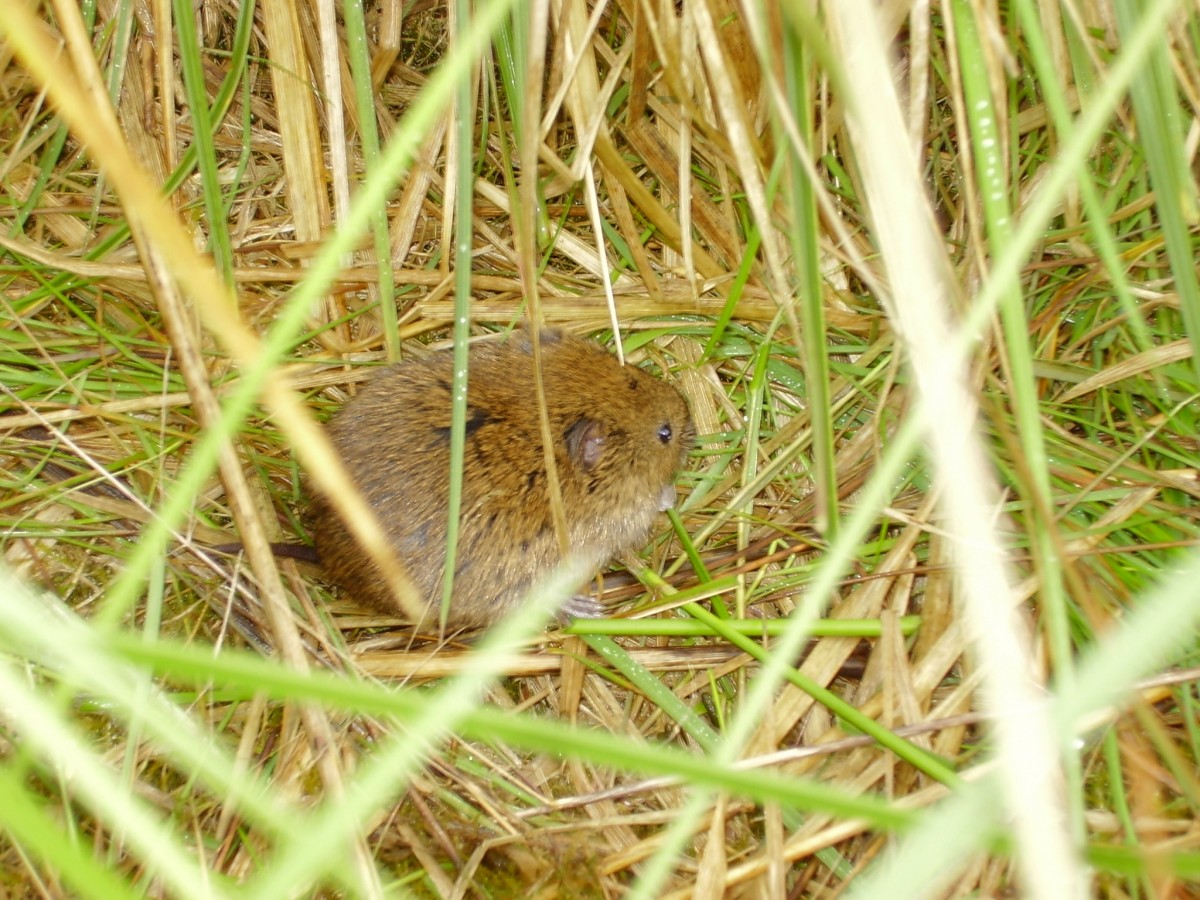
Density-dependent recruitment but not survival drives cyclic dynamics in a field vole population
For 101 years, ecologists have sought to explain the 3-4 years multi-annual cycles of voles and lemmings. Oddly, debates on the demographic phenomenon that underpin multi-annual cycles have largely taken place in the absence of demographic data. In our paper, we find that Density-dependent recruitment, especially early in the breeding season, but not survival drives cyclic dynamics in a field vole population, overturning accepted wisdom.
Collaborations
Dr Sandra Telfer (water vole metapopulations, disease dynamics); Prof Mike Begon (University of Liverpool)
Cyclic Vole demography
Prof Madan Oli University of Florida
Statistical ecology
Dr Chris Sutherland (Univ St Andrews);
Kenny Kortland (pine martens, wood ants, squirrels, Forest Scotland)
Supervision
My current supervision areas are: Biological and Environmental Sciences.
Current students
- Anna Kellner (2021-2026) Rewilding and the return of interacting meso-predators: Understanding, modelling and monitoring predator-prey dynamics in non-equilibrium ecosystems. Lead
- Elouise Mayall (2022-2026) Searching for a bit of peace and quiet despite unreliable cues: dispersal, settlement, and fitness of a top predator in multi-use forests. Lead
- Albert Bonet Bigata (2022-2026) Optimising the long-term control of invasive American mink from catchment to coast: how many mink is too many? Lead
- Leah Gray (2022-2026) Developing effective agricultural wetland management to reduce predation and improve wader breeding outcomes. 2nd supervisor
- Amber Cowans (2022-2026) How do recreational activities alter spatiotemporal species interaction networks, and can this knowledge assist in promoting pro-environmental behaviour? 2nd supervisor
- Emily Legge (2022-2026) The effect of Changing Soundscapes on Trophic Interactions. 2nd supervisor
- Rosie Irwin-Holbrey (2023-2027) When is a wild-living cat a wildcat? Using carnivore guild interactions to decipher ecological function. Lead
- Seunyeon Lee (2024-2028) The demography and dynamics of Tawny owl populations linked by dispersal and experiencing spatially variable food limitation and predation: a 40 year study. Lead
- Oliver Hartley (2024-2028) Developing an efficient and accessible “data-to-decision” pipeline for remotely sensed biodiversity monitoring data. 2nd supervisor
- Sarah Rehman (2024-2028) Dispersal and local selection in metapopulations 2nd supervisor
- Eleonor Foster Native, or invasive? Ancestry, drivers of population density, and public perceptions of feral pigs in Scotland. 2nd supervisor
Past PhD and MPhil students 42 PhD and 6 MRes students supervised with 100 % completion rate within 4 year timeline. 29 now as academic or researchers in universities private sector or government.
Sandra Telfer MSc (1997); Wendy Stewart MSc (1997); Jason Matthiopoulos (1998); Andrew DC MacColl (1998); James L MacKinnon (1998); Shahrul Anuar Mohd Sah (1998); Julie MacKnight (1999) MSc; Isla M Graham (2001); Sandra Telfer (2000); Arjun Amar (2001); Ann Humble MPhil (2002); John Durban (2002); Torbjørn Ergon (2003); Miriam Brandt (2003) MSc; Kerry Lock (2004); Stijn Bierman (2004); Sarah Burthe (2004); Sevvandi Jayakody (2005); Kenneth Kortland (2005) MSc; Ros Bryce (2005); Michelle Sims (2006); Matthew J Smith (2007); Eduardo Tedesco (2010); Ali Abdullah M Shati (2007); Anna Renwick (2009); Nacho Villar (2010); Anna Evely (2010); Chris Sutherland (2013); Elaine J Fraser (2013); Claire Davies (2014); Ewan Weston (2014); Sarah Hoy (2015); Marie Pages (2016); Rupert Houghton (2017); William Morgan (2018); Ewan McHenry (2018); Ruth Rodriguez (2018);Richard Hassall (2019); Deon Roos (2021); Ruben Bernardo Madrid (2021); Joseph Drake (2021); Cristian Navarro Waggershauser (2021); Kathryn Scobie (2022); Irilena Linardaki (2023) MRes; Keziah Hobson (2023); Katie August (2023); Laura MacKenzie (2023); Holly Accacia Broadhurst (2023); Jack Bamber (2025)
Supervisees
- MS ANNA KELLNER
- MR ALBERT BONET BIGATA
- MISS LEAH GRAY
- ROSIE IRWIN HOLBREY
- MISS CLARE PITT
- MS ELOUISE MAYALL
- MS SEUNGYEON LEE
Funding and Grants
Current funding
2025-2028 Impact of mink on seabirds Ossian Offshore Wind Farm Limited
2024-2026 Ecosystems in flux: synthesising a 40 year multi species study Leverhulme Trust
2024-2031 NETGAIN: developing the science and practice of nature markets for a net positive future; NERC DLA Consortium PhD award
2024 Hebridean Mink Project – Strategic Review; Scottish Natural Heritage
- Teaching
-
Teaching Responsibilities
I am presently on research leave
- Publications
-
Page 2 of 5 Results 51 to 100 of 214
Quantifying the contribution of immigration to population dynamics: a review of methods, evidence and perspectives in birds and mammals
Biological Reviews, vol. 94, no. 6, pp. 2049-2067Contributions to Journals: Articles- [ONLINE] DOI: https://doi.org/10.1111/brv.12549
- [OPEN ACCESS] http://aura.abdn.ac.uk/bitstreams/d606a1c5-d8ea-4e22-9dc3-3cdf00e59dc1/download
- [ONLINE] View publication in Mendeley
Numerical response of a mammalian specialist predator to multiple prey dynamics in Mediterranean farmlands
Ecology, vol. 100, no. 9, e02776Contributions to Journals: Articles- [ONLINE] DOI: https://doi.org/10.1002/ecy.2776
- [OPEN ACCESS] http://aura.abdn.ac.uk/bitstreams/621d6d02-b060-4a2f-b180-9b99d80a1517/download
- [ONLINE] View publication in Mendeley
- [ONLINE] View publication in Scopus
Colonisation dynamics during range expansion is poorly predicted by dispersal in the core range
Ecography, vol. 42, no. 6, pp. 1142-1151Contributions to Journals: Articles- [ONLINE] DOI: https://doi.org/10.1111/ecog.04180
- [OPEN ACCESS] http://aura.abdn.ac.uk/bitstreams/2c51c4f1-b51b-40b8-914c-40a2a1d79d2a/download
- [ONLINE] View publication in Scopus
- [ONLINE] View publication in Mendeley
Advances in population ecology and species interactions in mammals
Journal of Mammalogy, vol. 100, no. 3, pp. 965-1007Contributions to Journals: Articles- [ONLINE] DOI: https://doi.org/10.1093/jmammal/gyz017
Zoonotic pathogens in fluctuating common vole (Microtus arvalis) populations: occurrence and dynamics
Parasitology, vol. 146, no. 3, pp. 389-398Contributions to Journals: ArticlesUnintentional effects of environmentally-friendly farming practices: arising conflicts between zero-tillage and a crop pest, the common vole (Microtus arvalis)
Agriculture Ecosystems & Environment, vol. 272, pp. 105-113Contributions to Journals: ArticlesDrivers of survival in a small mammal of conservation concern: An assessment using extensive genetic non-invasive sampling in fragmented farmland
Biological Conservation, vol. 230, pp. 131-140Contributions to Journals: ArticlesEmpowered communities or "cheap labour"?: Engaging volunteers in the rationalised management of invasive alien species in Great Britain
Journal of Environmental Management, vol. 229, pp. 102-111Contributions to Journals: ArticlesPopulation-level manipulations of field vole densities induce subsequent changes in plant quality but no impacts on vole demography
Ecology and Evolution, vol. 8, no. 16, pp. 7752-7762Contributions to Journals: Articles- [ONLINE] DOI: https://doi.org/10.1002/ece3.4204
- [OPEN ACCESS] http://aura.abdn.ac.uk/bitstreams/732134bc-e2bd-473f-9a58-ee3041487ff1/download
- [ONLINE] View publication in Scopus
Ecological traps for large-scale invasive species control: Predicting settling rules by recolonising American mink post-culling
Journal of Applied Ecology, vol. 55, no. 4, pp. 1769-1779Contributions to Journals: Articles"Got rats?" Global environmental costs of thirst for milk include acute biodiversity impacts linked to dairy feed production
Global Change BiologyContributions to Journals: Letters- [ONLINE] DOI: https://doi.org/10.1111/gcb.14170
- [OPEN ACCESS] http://aura.abdn.ac.uk/bitstreams/b0a70ee4-6745-41db-a45e-db21955ce977/download
The enemy of my enemy is my friend: Native pine marten recovery reverses the decline of the red squirrel by suppressing grey squirrel populations
Proceedings of the Royal Society of London. B, Biological Sciences, vol. 285, 20172603Contributions to Journals: ArticlesThe contribution of flight capability to the post-fledging dependence period of golden eagles
Journal of Avian Biology, vol. 49, no. 1, e01265Contributions to Journals: Articles- [ONLINE] DOI: https://doi.org/10.1111/jav.01265
- [ONLINE] View publication in Scopus
Control of an invasive species: The American mink in Great Britain
Biology and Conservation of Musteloids. Macdonald, D. W., Newman, C., Harrington, L. A. (eds.). Oxford University Press (OUP), pp. 357-369, 13 pagesChapters in Books, Reports and Conference Proceedings: Chapters- [ONLINE] DOI: https://doi.org/10.1093/oso/9780198759805.003.0016
- [ONLINE] View publication in Scopus
The population dynamics of bite-sized predators: Prey dependence, territoriality, and mobility
Biology and Conservation of Musteloids. Macdonald, D. W., Newman, C., Harrington, L. A. (eds.). Oxford University Press (OUP), pp. 129-148, 20 pagesChapters in Books, Reports and Conference Proceedings: Chapters- [ONLINE] DOI: https://doi.org/10.1093/oso/9780198759805.003.0004
- [ONLINE] View publication in Scopus
Irruptive mammal host populations shape tularemia epidemiology
PLoS Pathogens, vol. 13, no. 11, e1006622Contributions to Journals: ArticlesBoom-bust dynamics in biological invasions: towards an improved application of the concept
Ecology Letters, vol. 20, no. 10, pp. 1337-1350Contributions to Journals: Review articles- [ONLINE] DOI: https://doi.org/10.1111/ele.12822
Density-dependent increase in superpredation linked to food limitation in a recovering population of northern goshawks, Accipiter gentilis
Journal of Avian Biology, vol. 48, no. 9, pp. 1205-1215Contributions to Journals: Articles- [ONLINE] DOI: https://doi.org/10.1111/jav.01387
- [OPEN ACCESS] http://aura.abdn.ac.uk/bitstreams/29d2153a-e100-4324-b208-0c30c8ac4915/download
Density-Dependent Prevalence of Francisella tularensis in Fluctuating Vole Populations, Northwestern Spain
Emerging Infectious Diseases, vol. 23, no. 8, pp. 1377-1379Contributions to Journals: ArticlesRelationship type affects the reliability of dispersal distance estimated using pedigree inferences in partially sampled populations: A case study involving invasive American mink in Scotland
Molecular Ecology, vol. 26, no. 15, pp. 4059-407Contributions to Journals: Articles- [ONLINE] DOI: https://doi.org/10.1111/mec.14154
- [OPEN ACCESS] http://aura.abdn.ac.uk/bitstreams/a44a8597-5497-426a-8549-e9a82ff9ec81/download
The large-scale removal of mammalian invasive alien species in Northern Europe
Pest Management Science, vol. 73, no. 2, pp. 273-279Contributions to Journals: Review articles- [ONLINE] DOI: https://doi.org/10.1002/ps.4224
- [OPEN ACCESS] http://aura.abdn.ac.uk/bitstreams/a794210d-77c5-45f0-ab91-a65311c08046/download
- [ONLINE] View publication in Scopus
Size-mediated, density-dependent cannibalism in the signal crayfish Pacifastacus leniusculus (Dana, 1852) (Decapoda, Astacidea), an invasive crayfish in Britain
Crustaceana, vol. 90, no. 4, pp. 417-435Contributions to Journals: Articles- [ONLINE] DOI: https://doi.org/10.1163/15685403-00003653
- [OPEN ACCESS] http://aura.abdn.ac.uk/bitstreams/3ff0c398-49c2-4933-a815-3363a622de27/download
- [ONLINE] View publication in Scopus
Rate of exposure of a sentinel species, invasive American mink (Neovison vison) in Scotland, to anticoagulant rodenticides
Science of the Total Environment, vol. 569-570, pp. 1013-1021Contributions to Journals: ArticlesThe compensatory potential of increased immigration following intensive American mink population control is diluted by male-biased dispersal
Biological Invasions, vol. 18, pp. 3047-3061Contributions to Journals: Articles“Living on the edge”: the role of field margins for common vole (Microtus arvalis) populations in recently colonised Mediterranean farmland
Agriculture Ecosystems & Environment, vol. 231, pp. 206-217Contributions to Journals: ArticlesHierarchical spatial segregation of two Mediterranean vole species: the role of patch-network structure and matrix composition
Oecologia, vol. 182, no. 1, pp. 253-263Contributions to Journals: ArticlesStrong inference from transect sign surveys: combining spatial autocorrelation and misclassification occupancy models to quantify the detectability of a recovering carnivore
Wildlife Biology, vol. 22, no. 5, pp. 209-216Contributions to Journals: Articles- [ONLINE] DOI: https://doi.org/10.2981/wlb.00146
- [OPEN ACCESS] http://aura.abdn.ac.uk/bitstreams/588f9a27-8ba2-4587-afb5-de7e8e112e85/download
Food availability and predation risk, rather than intrinsic attributes are the main factors shaping the reproductive decisions of a long-lived predator
Journal of Animal Ecology, vol. 85, no. 4, pp. 892-902Contributions to Journals: ArticlesGenetic markers validate using the natural phenotypic characteristics of shed feathers to identify individual northern goshawks Accipiter gentilis
Journal of Avian Biology, vol. 47, no. 3, pp. 443-447Contributions to Journals: Articles- [ONLINE] DOI: https://doi.org/10.1111/jav.00794
- [OPEN ACCESS] http://aura.abdn.ac.uk/bitstreams/c7e94ef3-f5f1-4307-acdc-39f139696ef5/download
- [ONLINE] View publication in Scopus
Hunted predators: Charisma confounds
Science, vol. 349, no. 6254, pp. 1294Contributions to Journals: Letters- [ONLINE] DOI: https://doi.org/10.1126/science.349.6254.1294-a
Tularemia Outbreaks and Common Vole (Microtus arvalis) Irruptive Population Dynamics in Northwestern Spain, 1997-2014
Vector Borne and Zoonotic Diseases, vol. 15, no. 9, pp. 568-570Contributions to Journals: Articles- [ONLINE] DOI: https://doi.org/10.1089/vbz.2015.1770
Density- and age-dependent reproduction partially compensates culling efforts of invasive non-native American mink
Biological Invasions, vol. 17, no. 9, pp. 2645-2657Contributions to Journals: Articles- [ONLINE] DOI: https://doi.org/10.1007/s10530-015-0902-7
Range expansion of an invasive species through a heterogeneous landscape - the case of American mink in Scotland
Diversity and Distributions, vol. 21, no. 8, pp. 888-900Contributions to Journals: Articles- [ONLINE] DOI: https://doi.org/10.1111/ddi.12303
- [OPEN ACCESS] http://aura.abdn.ac.uk/bitstreams/159821eb-e6ee-426f-b05b-4053ba39f41d/download
What does conservation research do, when should it stop, and what do we do then? Questions answered with water voles
Wildlife Conservation on Farmland Volume 1: Managing for nature on lowland farms. Macdonald, D. W., Feber, R. E. (eds.). Oxford University Press, pp. 269-290, 22 pagesChapters in Books, Reports and Conference Proceedings: ChaptersAge and sex-selective predation moderate the overall impact of predators
Journal of Animal Ecology, vol. 84, no. 3, pp. 692-701Contributions to Journals: ArticlesA demographic, spatially explicit patch occupancy model of metapopulation dynamics and persistence
Ecology, vol. 95, no. 11, pp. 3149-3160Contributions to Journals: Articles- [ONLINE] DOI: https://doi.org/10.1890/14-0384.1
Controlling invasive species by empowering environmental stakeholders: ecotourism boat operators as potential guardians of wildlife against the invasive American mink
Oryx, vol. 48, no. 4, pp. 605-612Contributions to Journals: Articles- [ONLINE] DOI: https://doi.org/10.1017/S003060531300046X
Silicon, endophytes and secondary metabolites as grass defenses against mammalian herbivores
Frontiers in plant science, vol. 5, 478Contributions to Journals: ArticlesMycobacterium microti Tuberculosis in Its Maintenance Host, the Field Vole (Microtus agrestis): Characterization of the Disease and Possible Routes of Transmission
Veterinary pathology, vol. 51, no. 5, pp. 903-914Contributions to Journals: Articles- [ONLINE] DOI: https://doi.org/10.1177/0300985813513040
Multi-season occupancy analysis reveals large scale competitive exclusion of the critically endangered European mink by the invasive non-native American mink in Spain
Biological Conservation, vol. 176, pp. 21-29Contributions to Journals: Articles- [ONLINE] DOI: https://doi.org/10.1016/j.biocon.2014.05.002
Host-parasite biology in the real world: the field voles of Kielder
Parasitology, vol. 141, no. 8, pp. 997-1017Contributions to Journals: Literature ReviewsDampening prey cycle overrides the impact of climate change on predator population dynamics: a long-term demographic study on tawny owls
Global Change Biology, vol. 20, no. 6, pp. 1770-1781Contributions to Journals: Articles- [ONLINE] DOI: https://doi.org/10.1111/gcb.12546
- [OPEN ACCESS] http://aura.abdn.ac.uk/bitstreams/bbe09715-7419-4b4c-a849-c8d3c2b7796e/download
To be or not to be associated: power study of four statistical modeling approaches to identify parasite associations in cross-sectional studies
Frontiers in cellular and infection microbiology, vol. 4, 62Contributions to Journals: ArticlesInvasive crayfish reduce food limitation of alien American mink and increase their resilience to control
Oecologia, vol. 174, no. 2, pp. 427-434Contributions to Journals: Articles- [ONLINE] DOI: https://doi.org/10.1007/s00442-013-2774-9
Dispersal, landscape and travelling waves in cyclic vole populations
Ecology Letters, vol. 17, no. 1, pp. 53-64Contributions to Journals: Articles- [ONLINE] DOI: https://doi.org/10.1111/ele.12207
Experimental evidence that livestock grazing intensity affects cyclic vole population regulation processes
Population Ecology, vol. 56, no. 1, pp. 55-61Contributions to Journals: ArticlesDetermining Content for Unknown Users: Lessons from the MinkApp Case Study
Third International Conference on Natural Language GenerationContributions to Conferences: PostersDetermination of minimal age of five species of Chusquea bamboos through rhizome analysis as a tool to predict the flowering in southern Chile
Revista Chilena de Historia Natural, vol. 86, no. 4, pp. 423-432Contributions to Journals: ArticlesWhen do young birds disperse?: Tests from studies of golden eagles in Scotland
BMC Ecology, vol. 13, 42Contributions to Journals: ArticlesMetapopulation dynamics of a burrowing herbivore drive spatio-temporal dynamics of riparian plant communities
Ecosystems, vol. 16, no. 7, pp. 1165-1177Contributions to Journals: Articles- [ONLINE] DOI: https://doi.org/10.1007/s10021-013-9677-9
