

The domed rooftop area of Fraser Noble plays host to nesting Oystercatchers from May to July.
However, with the artificial grass on the rooftop providing a poor source of food, previous years have seen some chicks fail to thrive. In the last few years, Avril Rossiter from the School of Engineering has supplemented their food intake by providing dried mealworm each day, which has helped chicks to thrive, grow and successfully fledge.
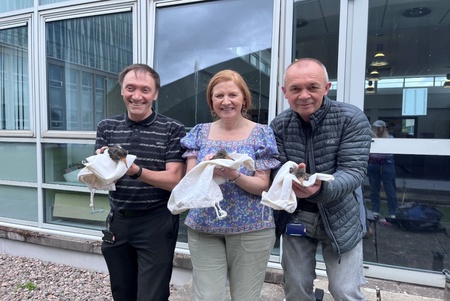
Visited by Raymond Duncan from The British Trust for Ornithology (BTO) and Rachael Clark, PGR student in the School of Biological Sciences, our three current chicks were ringed this summer to allow their tracking and their behaviour to be studied.
Raymond and Rachael enlisted the help of Grant Cordiner, Avril Rossiter, and Ian Young from the School of Engineering to help hold the chicks to allow for ringing. Raymond said:“The British Trust for Ornithology coordinates all the bird ringing in the UK.
"Aberdeen is the capital city for roof nesting Oystercatchers in the world! This is due to the abundance of flat gravel roofs built back in the 1970s and 80s. Accompanying well-kept grass verges and fields around universities, hospitals and industrial estates, the Oystercatcher evolved and adapted from nesting on the ground to nesting up on roofs. At their peak I think there were over 300 pairs of Oystercatchers nesting in and around Aberdeen City. Their almost unique behaviour amongst wading birds is to feed their young, most wading bird youngsters feed themselves, but this feeding behaviour allows the Oystercatchers to thrive in this environment. Well done to you for supplementing their feeding, it does help them out.
"My colleague, Alistair Duncan, has ringed and studied Oystercatchers for many years. From ringing we know that many of our chicks migrate South and West over winter to Wales, Ireland and Southern England and return to breed on roofs three or more years later. The oldest Oystercatcher on record is over 40 years old!”
Rachael added: “I got involved with bird ringing in November last year through sessions that were being held in the Cruickshank Botanic Gardens and loved it so much! I've always enjoyed birds, so to get to see them in the hand is really special. I enjoyed the ringing so much, I felt that I should put it all towards something so I applied for my trainee ringing permit with Raymond as my trainer!”
From watching the nesting adults and helping to feed the chicks, staff in the School of Engineering and the Institute of Mathematics have grown to enjoy sharing their workspace with these incredible birds and look forward to their return each year.