Endometriosis Awareness Week begins on 3 March, providing an important opportunity to highlight a chronic condition that affects around 1 in 10 women and people who menstruate.
Endometriosis occurs when cells similar to those in the lining of the womb (uterus) grow elsewhere in the body, often causing severe pain and significantly affecting quality of life. Whilst there is currently no cure, symptoms can be managed by medication and surgeries (NHS, 2026).
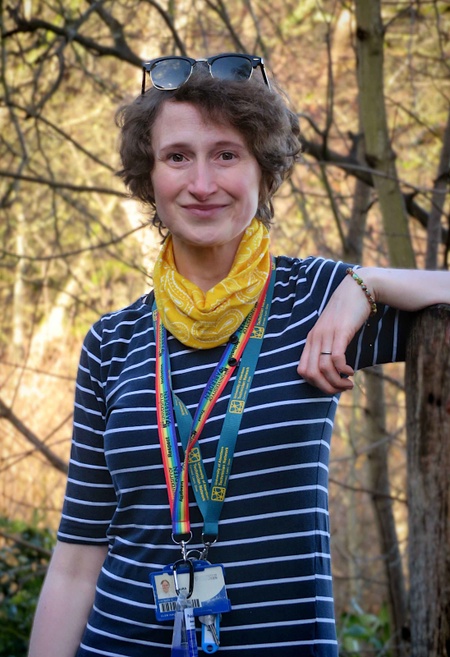
Laura Howell, Technician in Medical Education shares her experience of living with endometriosis and how it has shaped her working life.
Having been impacted by endometriosis my entire adult working life, raising awareness for the condition is a cause close to my heart.
I’d always had really painful periods. I began work at the University in 2009 as a teaching technician, setting out experiments for student practicals. It's a hands-on role that is often physically demanding. When I first started, endometriosis was something very few people had heard of.
Early in my career, I started to experience some rather alarming symptoms. After almost 7 years of complaining to my GP about worsening, debilitating, irregular pelvic pain and heavy irregular prolonged periods of bleeding. Enduring numerous trips to A&E, fruitless scans and trialing countless medications, I was eventually officially diagnosed with endometriosis at the age of 24 via laparoscopy, where they also performed excision surgery. I remember feeling so validated when I got that diagnosis: everything I was experiencing wasn’t in my head. Finally, I had an answer to why I'd often feel faint, and why with every movement it felt like my internal organs were glued together: it was because they were!
On the whole my laparoscopic excision surgery treatments were successful, however, endometriosis can unfortunately grow back, continue to bleed and scar tissue can form.Hormonal related treatments gave me an element of control over my symptoms, mainly control over my periods. As endometriosis grows in response to oestrogen, one of the current treatment options include a range of hormone blockers and alternative hormonal contraceptive pills that can be offered on the NHS. These unfortunately also came with a lot of side effects, and it took a lot of trial and error to find the best option for me. I did eventually manage to find a hormonal drug that gave me a better balance, but it was by no means perfect. Endometriosis would still continue to form, and I had to have further surgery. It wasn't until a shock diagnosis of breast cancer, where I was told I could no longer take any hormones, that endometriosis came back with a vengeance. I have since had a hysterectomy, where it was discovered that I had also been battling with adenomyosis and fibroids.
The main issues over the years for me were that, due to prolonged and excessive bleeding, I suffered from anaemia, chronic pain, fatigue and brain fog. My periods could last for weeks. It got to the point where excruciating flare ups could spike at any moment. Because it was also growing around my bladder, kidneys and bowels, it had the potential to affect the function of these organs too. This had dietary implications. I spent years trying to eliminate certain foods that triggered painful flare ups, trying to find ways to function better in everyday life. This pain would often result in me feeling very lightheaded, to the point I'd sometimes even lose consciousness. Due to where my endometriosis was growing, it eventually even affected my ability to walk. I was often on strong pain killers just to get through the day. At its worst, everyday life felt like a relentless, exhausting battle.
Managing work during flare ups has, at times, been incredibly challenging. Due to the erratic nature of my symptoms, I’d often force myself to go into work on days I wasn’t sure I should. Existing in constant pain is simply exhausting. I’d end up so burnt out by the end of the working day that I'd miss out on social occasions which impacted on my home life as I struggled with managing pain and fatigue. I’d also have to take time off to recover from surgery. However, thanks to increasing awareness of the condition over the years, the available assistance and understanding of the condition has improved immensely.
The University has been incredibly supportive: Offers of phased returns, flexible working hours, reasonable adjustments to work duties, particularly during those times I was recovering from surgery, have all helped me find a better balance. The University also offers a free counselling service, and Students’ Union has even recently started offering Myoovi devices to help students (and staff) manage symptoms. With menstrual wellbeing events and menopause workshops, it is encouraging to see the progression in showing understanding towards supporting others with a variety of menstrual and pelvic pain conditions. I’ve also been incredibly fortunate to have some amazing colleagues and very understanding line managers. It is also thanks to their support, I have found ways of still being able to carry out my work duties over the years.
If you're experiencing debilitating pelvic pain, or symptoms that affect and impact your ability to function in your everyday life, and have reached out to your GP, don’t be afraid to seek out a second opinion. Endometriosis can affect people in different ways, so it can be helpful to keep a symptom diary, taking note of triggers and tracking times of flare ups. There are a range of useful symptom tracking apps nowadays too. This can be so helpful in advocating towards further investigation for a firm diagnosis.
With as many as 1 in 10 people suffering from this condition, there is support out there, but more research and better treatments are still desperately needed. I hope that with continuing awareness, support options and understanding will continue to improve.
With leaps and bounds in research in recent years thanks to awareness raising charities like Endometriosis UK, online support groups, and increasing support from Women’s Health advocates such as Dr. Nighat Arif (who posts lots of really informative short videos on Instagram), we may see revolutionary changes in how endometriosis is diagnosed, managed and treated.''
If you are suffering from conditions like endometriosis, fibroids, PCOS and IBS, staff and students can loan a Myoovi device - drug-free pain relief option from the Students’ Union. Contact ausa@abdn.ac.uk for more information.
You should also speak to Student Advice and Support about any reasonable adjustments you may be entitled to. These conversations can help ensure you have the support you need to manage your health alongside your studies.