Ground-breaking research by a prominent Aberdeen academic has revealed compelling evidence pointing to the true location and character of Ancient Ithaca
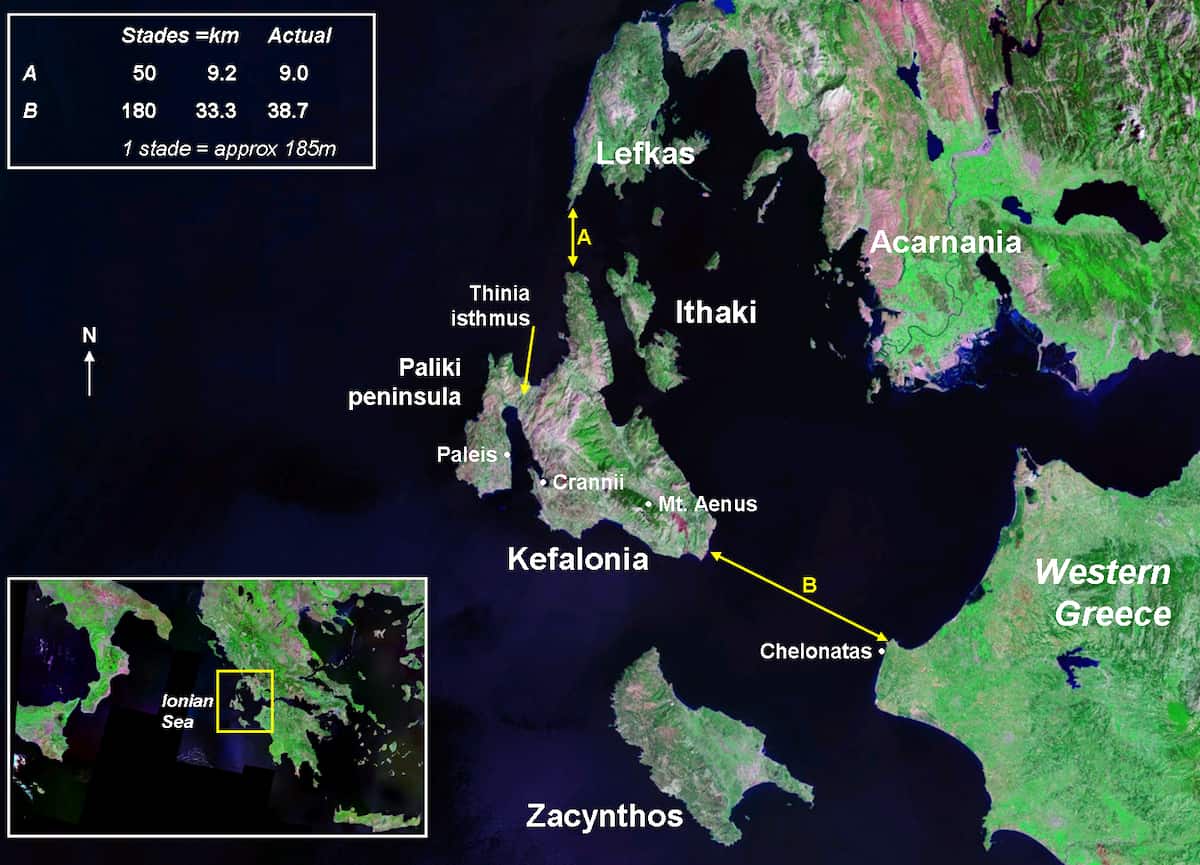
Around are many islands, close to each other, Doulichion and Same and wooded Zacynthos. Ithaca itself lies low, furthest to sea Towards dusk; but they [the three islands just mentioned], apart, face dawn and sun.
Odyssey 9.23-26 (trans. Diggle, Antigone)
The Search for Ancient Ithaca
John Underhill presents at SPE summer reception
28 August: Prior to a screening of 'The Odyssey' at Cineworld Aberdeen, Professor Underhill outlined how interdisciplinary research undertaken at the University has been used in the search for ancient Ithaca.
John Underhill discussed the geoscientific basis for and implications of relocating Odysseus' homeland, Ancient Ithaca in his keynote speech at the 87th EAGE annual Conference & Exhibition on Wednesday 10 June.
Our latest article has garnered attention across the media including discussion by Mary Beard in the Times Literary Supplement and in The Conversation. See the 'Media' section below.
Background
As interest in Homer’s poems grows with the release of Christopher Nolan’s acclaimed movie adaptation of The Odyssey in July 2026, there is renewed interest too in one of the great unsolved mysteries of Homeric study – the location of Odysseus’ homeland of Ithaca.
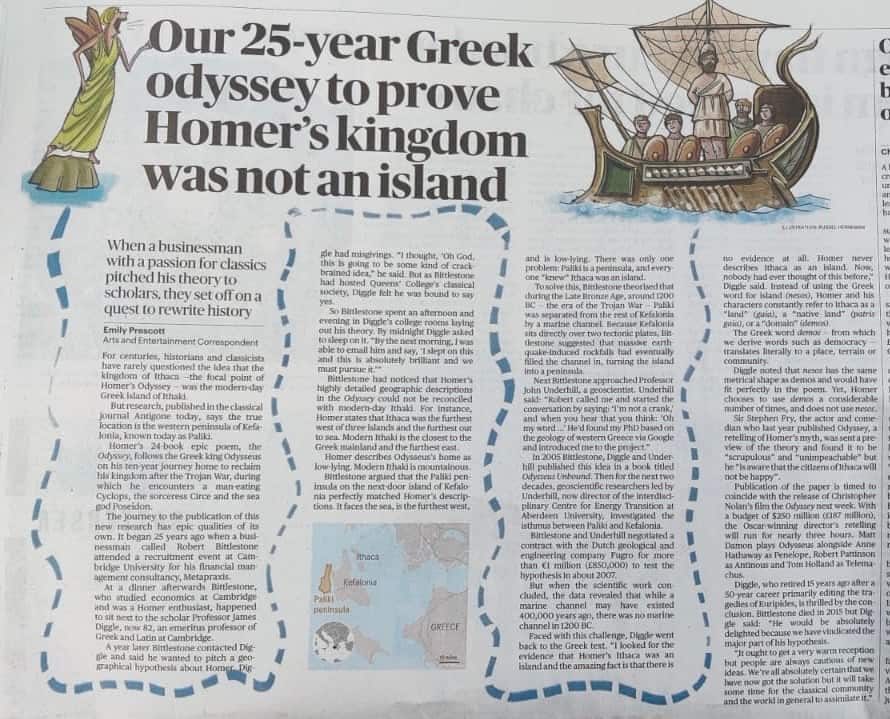
For over twenty years, Professor James Diggle CBE and Professor John Underhill have been part of a team that has been researching the idea, first proposed by Robert Bittlestone in his widely acclaimed book Odysseus Unbound, that the western peninsula of Kefalonia, called Paliki, was Ithaca and not, as is usually assumed, the modern-day island of Ithaki.
Homer's epic poems The Iliad and The Odyssey describe Odysseus’ 20-year journey to, and return from, the Trojan War around 3000 years ago. They include descriptions of a number of Bronze Age (Mycenaean) sites, the locations of which have long been sought by archaeologists and classical Greek Scholars.
While Troy, Mycenae and Tyrens have been found and excavated, the location of Odysseus’ homeland, Ancient Ithaca, has remained elusive. Whilst an island today bearing the name of Ithaki lies in the Ionian Sea, it lacks evidence of a major Bronze Age settlement. Moreover, there is a striking geographic inconsistency since Ithaca was described as low-lying and situated to the west (outboard) of Same (Kefalonia), Doulichion and Zakynthos. Consequently, the western peninsula of Kefalonia, Paliki, is a better candidate.
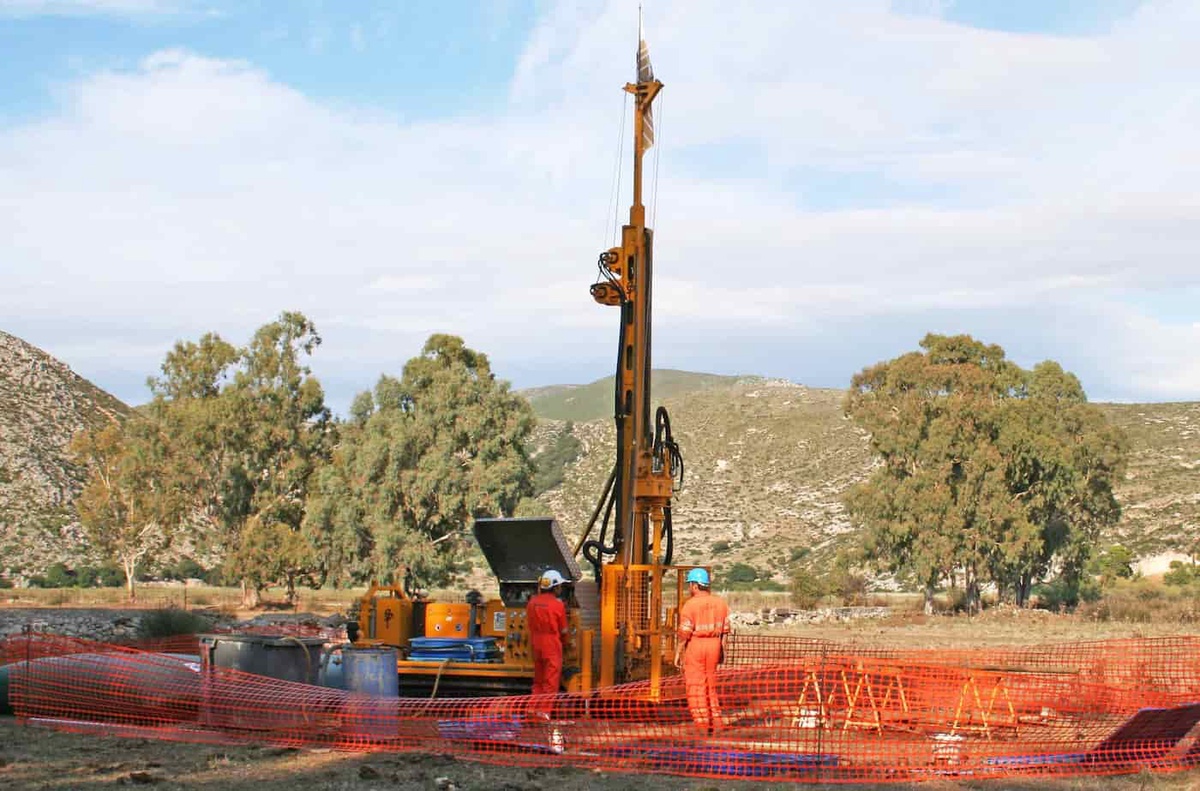
Given that Ithaca was always thought to be an island, we deployed an array of geoscientific methods in the Thinia Valley, a narrow (6km x 2km) land bridge connecting Paliki with the rest of Kefalonia, in order to test whether a throughgoing marine channel existed in the Bronze Age which would have rendered today's single island into two distinct bodies.
As the data and evidence emerged, it became evident that the marine channel theory did not hold water. Instead, another explanation presented itself, involving an overland watercourse comprising northward- and southward-flowing rivers occupying incised valleys formed during the last glacial maximum.
The results are consistent with Strabo’s description of the valley in Roman times, which mentions that at times water stretched from end to end, and would resolve the long-standing Classical mystery surrounding the location of Odysseus’ homeland, with consequent implications for Greek Scholarship and future archaeological investigations.
“The marine channel hypothesis does not hold up under scrutiny,” explains Professor John Underhill, who has led the geoscientific research since its inception. “What we see instead is a landscape carved not by a Bronze Age seaway but by rivers, most likely filling valleys carved during the last Ice Age. This resolves a key geological question while still supporting the geographic description of Paliki as the most plausible setting for Homer’s Ithaca.”
Was Homer’s Ithaca actually an island at all?
The team's discovery of this geological evidence prompted Professor James Diggle CBE, Emeritus Professor of Greek and Latin at Cambridge University, to re-examine Homer's original text in relation to the long-held belief that Odysseus' Ithaca was an island.
This important new research, published in the online journalAntigone on 5 July 2026, reveals that the assumption that Homer’s Ithaca was an island, held by scholars since antiquity, is incorrect.
In their paper Was Homer’s Ithaca an Island? Professor Diggle and Professor John Underhill of the University of Aberdeen present compelling evidence to dispel one of the most entrenched preconceptions of Homeric scholarship.
“Homer has many opportunities to call Ithaca an island,” says Professor Diggle, “but he never does so.”
Among the many examples from the texts that he cites:
Instead of ‘island’ (νῆσος/nisos), Homer, or his characters, refer to it constantly as ‘land’ (γαῖα/gaia), ‘native land’ (πατρίς/patris, πατρὶςαἶα/γαῖα/patrisgaia), or ‘country/region/area/domain’ (δῆμος’/dimos) even though νῆσος fits just as easily into the poems’ dactylic hexameter metre.
Homer uses the phrase “δῆμος of Ithaca” frequently in the poems, as when, for example, Odysseus makes landfall on his homeland at the end of his ten-year-long voyage:
Then the seafaring ship approached the island. On Ithaca there is a bay of Phorcys, The old man of the sea: in it, two headlands… Odyssey 13.95-97 (trans. Diggle, 2005)
This translation can be taken to imply that Ithaca is an island but, as Diggle now points out, Homer actually writes “In the δῆμος of Ithaca there is a bay of Phorcys”, that is: “In the domain of Ithaca there is a bay of Phorcys”, clearly implying that Ithaca is a part of the island that the ship is approaching.
Professor Diggle concludes that the poems’ texts demonstrate that Homer knew that Ithaca was not an island but, instead, the name of a part of a larger island, specifically the Ionian island of Kefalonia. Odysseus, after all, is described as the leader of “the gallant Cephallenians” (Iliad 2.631).
The case for Paliki as the location of Ithaca
Now that we know that Paliki was a peninsula in the time of Odysseus and that Ithaca was a low-lying, west-facing part of Kefalonia, the case for the identification of Paliki as Ithaca is further strengthened.
“We are confident”, say Professors Diggle and Underhill, “that an elegant explanation has emerged that unifies the geoscience, the Homeric texts and Strabo and is entirely consistent with Robert Bittlestone’s founding idea in his book Odysseus Unbound – that Paliki is the location of Homer’s Ithaca.”
Recent archaeological excavations by the Ephorate of Antiquities for Kefalonia and Ithaca of newly discovered Early Bronze Age sites on Paliki including Livadi Marsh, the proposed site for Odysseus’ harbour, has provided further encouraging evidence that Paliki was a significant Bronze Age location.
Since work began on proving Bittlestone's theory in 2005, the project has been featured in the media many times. Here is a small selection of mentions:
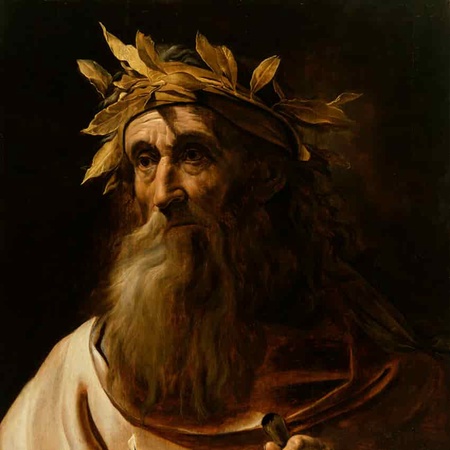
Homer is the legendary ancient Greek poet credited with writing the Iliad and the Odyssey, two of the most foundational works in Western literature.
He is believed to have lived sometime around the 8th century BCE, likely in Ionia (modern-day Turkey).
Who was Odysseus?
Odysseus was the legendary king of Ithaca whose cunning - most famously demonstrated by his invention of the Trojan Horse - won the Trojan War for the Greeks. Following the war, he spent ten gruelling years battling monsters, curses, and angry gods to survive and reclaim his family and kingdom.
Why might Ancient Ithaca and modern Ithaca be different places?
Evidence from old maps suggests that up until the end of the 18th Century the names of the islands in this area were Lefkada, Kefalonia, Zakynthos and Doulichion; there was no island called Ithaca. The island of Doulichion later assumed the name Ithaki.