






Reading deprivation
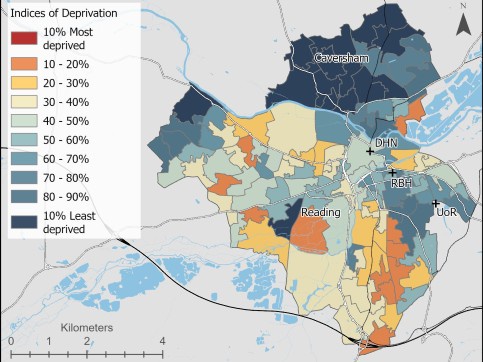
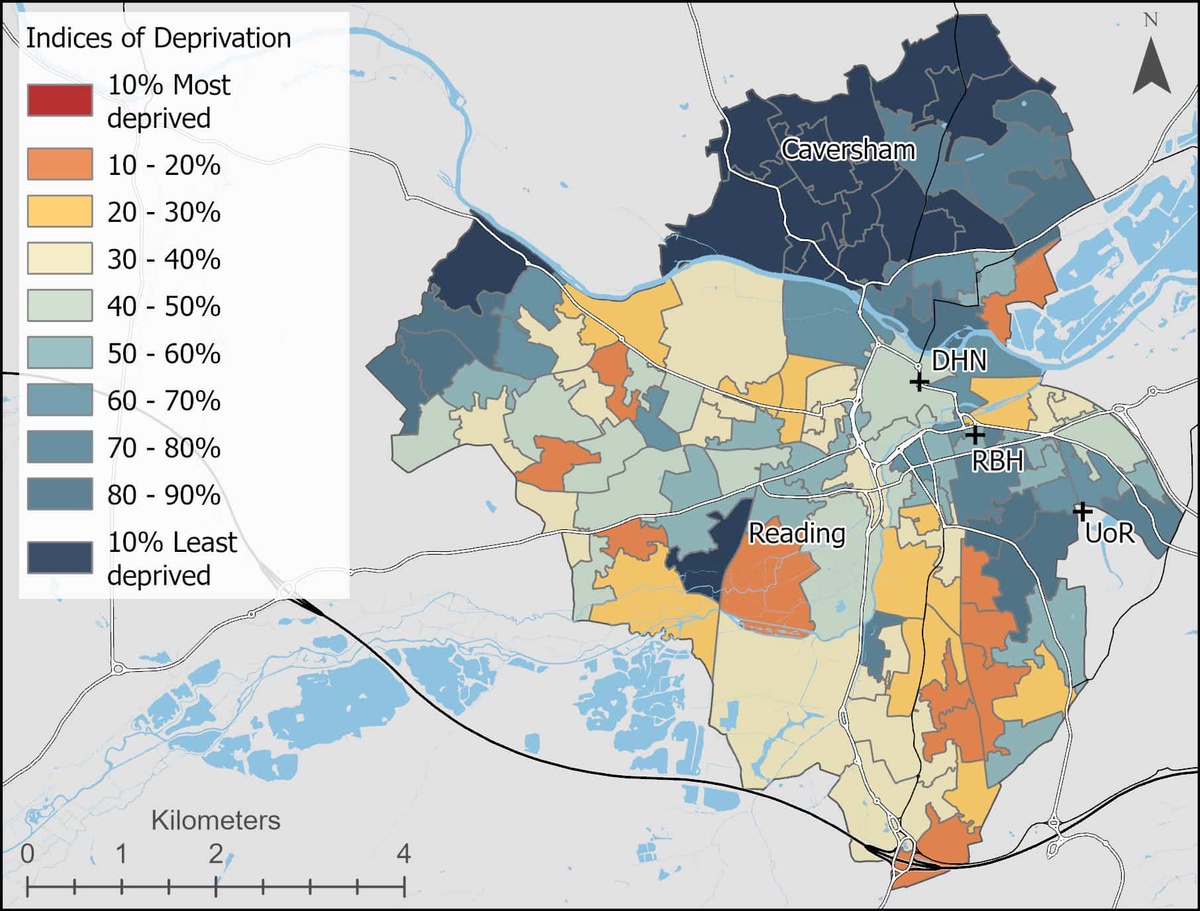
A map highlighting the spread of deprivation in Reading.
Working with Reading Council, Maid Energy, the University of Reading and the NHS we will look at how collective efforts can improve fuel poverty and local infrastructure.
You can read the full case profile here.
Image - Multiple Deprivation Index for Reading

At the core of the Reading case study is the challenge of moving beyond organisation-specific solutions toward a more inclusive, collective approach. This requires fostering strong collaboration among all local stakeholders and ensuring ethical community engagement. A key priority is to create accessible opportunities that enable all members of the community, regardless of capacity or resources, to actively participate in the transition to a net zero carbon future.
Photo - Conference with local energy communities, March 2026
.jpg)
In this context, Reading presents a unique opportunity due to its access to a substantial chalk aquifer, which offers potential as a natural heat source. In collaboration with Reading Borough Council, a team of researchers from the University of Reading is investigating innovative approaches to harness thermal energy from this aquifer and distribute it efficiently through a district heat network. This collaborative initiative aims not only to develop a technically viable low-carbon heating solution but also to ensure equitable access to clean heat. By adopting a community-oriented approach, it seeks to enable local stakeholders to actively participate in, and benefit from, the transition towards a net zero carbon future.
Photo - Borehole to access aquifer, on University of Reading campus
.jpg)
This engagement has been carried out through a series of public consultation activities, as well as targeted workshops and conferences. The overarching aim is to adopt a co-creation approach, working collaboratively with local partners and communities to develop inclusive and practical solutions for the equitable provision of low-carbon heat.
Photo - Infrastructure for the distribution of heat through heat network, on University of Reading campus
A map highlighting the spread of deprivation in Reading.
.jpg)
This borehole is for accessing the ground water to be used by a heat pump system in order to provide heat for the district heat network in the Whiteknights campus at the University if Reading.
.jpg)
This infrastructure for the distribution of heat through the district heat network is on Whiteknights campus, University of Reading, and will provide heat within the campus.

First Berkshire Energy Community Conference organised by the JUST-Systems team at the University of Reading, with attendance from local authorities, local energy communities and Community Energy Pathways team.