
Hi, my name is Kalanah, and I am a third-year Pharmacology student at the University of Aberdeen. Over the summer, I had the opportunity to work on a Hotstart research project at the Institute of Medical Sciences (IMS) at the University of Aberdeen, investigating the effects of alcohol and caffeine on planarian behaviour.
Planarians are small freshwater flatworms that possess a complex nervous system and are well known for their incredible ability to regenerate body parts. Planaria are also increasingly used as a model organism to study the effects of drugs on the nervous system, but how such substances impact planarian physiology (cell membrane potential) and any link to behavioural responses is unexplored.
My project investigated how 1% and 2% ethanol (depressant) and 5 µM and 25 µM caffeine (stimulant) influenced planarian locomotion and behaviour. I measured locomotion using a grid-crossing assay to record the number of grid lines crossed in 30 seconds. I repeated each experiment three times using five planarians per treatment.
It was interesting to watch their behaviour at each drug concentration. As predicted, increasing ethanol concentration caused a clear reduction in the movement of planarians, as at 1% their movement decreased by three times, and at 2% it decreased by ten times. They also adopted a distinctive scrunched body shape that wasn’t observed in the controls (no ethanol), which might be familiar to some after one too many cocktails. Surprisingly, despite its reputation for getting us moving in the morning, caffeine had a very small effect on locomotion at the concentrations tested. For comparison, 25 µM caffeine is around 0.3-0.4% of a cup of your average coffee. The different effects these drugs had on planarian locomotion and behaviour highlighted how drug effects differ according to their mechanism of action and their concentration.
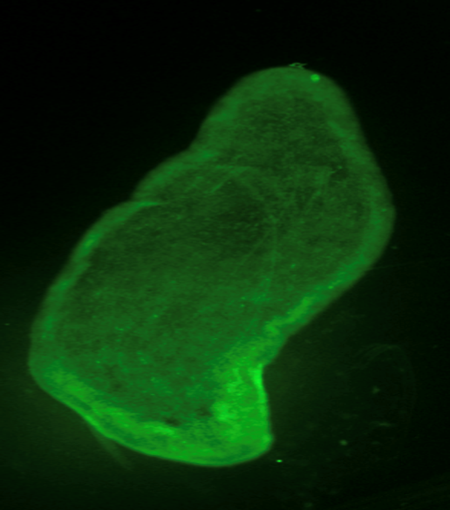
One of my favourite parts of the placement was learning to use the cutting-edge Zeiss Cell Discover 7 fluorescence microscope in the IMS Microscopy and Histology Facility. Using a voltage-sensitive fluorescent dye (DiBAC4(3)), I was able to visualise changes in the membrane potential of planarian cells after exposing them either to 25 μM caffeine or 2% ethanol. The planarian, under the influence of ethanol, had strong fluorescence (indicating membrane depolarisation) across its body, with the fluorescence particularly noticeable around the outer edges. The caffeinated planarian was markedly less fluorescent (with relatively depolarised membranes) compared to the ethanol-treated worm. Capturing high-quality fluorescence images of living planarians under the microscope to record their relative membrane polarisation and hyperpolarisation was something I had never experienced before. It was exciting to link what I was seeing at the cellular level with the fluorescence microscope to the behavioural changes I had observed during my locomotion experiments.
During this project, I learned a range of practical laboratory skills, including preparing solutions, experimental design, handling live organisms, microdissection, and analysing experimental data. Like most research projects, not everything went as expected.
One of the biggest surprises was that caffeine didn’t appear to have a noticeable effect on locomotion, even at 25 μM during one of my experiments. However, I did not accept these results straight away; instead, I carried out additional experiments, monitoring planarian movement every 30 minutes over a three-hour recovery period. This produced different results than I had previously observed, demonstrating that caffeine did affect movement, as movement increased after exposure to caffeine and gradually decreased over the three hours. Additionally, this experiment proved that the effects of the drugs were reversible over 30 min. This helped me to appreciate the importance of repeating experiments and thinking critically about the data before concluding.
There were also practical challenges; despite increased feeding during the placement, the planarians failed to grow bigger than around 4mm, which was too small for use in regeneration experiments (need ~ 6 mm worms). Therefore, I couldn’t study the impact of ethanol and caffeine exposure on head regeneration as planned. Growth suppression may have been caused by repeated exposure to light during experiments (worms are photophobic) or warm summer temperatures causing stress. Although these setbacks were frustrating, it gave me an appreciation of how research really works, as experiments don’t always go according to plan, especially when using live organisms.
Overall, this placement has been a rewarding experience. It has strengthened my practical laboratory skills, increased my confidence in carrying out independent research and confirmed my interest in pharmacology and neuroscience. I’m especially grateful to Dr Ann Rajnicek for allowing me to work in her research laboratory and for sharing her expertise throughout this project.
I would encourage any student thinking about a HotStart summer research placement to get involved. It’s a fantastic opportunity to develop new skills, experience research and gain insight into how scientific discoveries are made, while also having fun!