
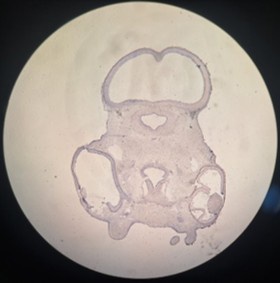
This summer, I had the opportunity to complete an 8-week research project with Professor Lynda Erskine, funded by a School of Medicine, Medical Sciences and Nutrition Hotstart scholarship. The project looked at the development of the anterior eye using chicken embryos. During development, the ciliary body plays an essential role in regulating eye growth. However, the mechanisms controlling the development of the ciliary body are not fully understood.
Previous work in the lab used RNA-seq on embryonic chicken eyes to identify genes whose expression is regulated by the developing lens. During the project, we investigated the expression of some of these genes during eye development. To investigate these genes, we designed primers and cloned them to generate riboprobe templates. We successfully generated riboprobes for YAP1, GNA12, TEAD1, TEAD3, TEAD4, and NF2, which are associated with the Wnt/Hippo pathway. The probes were then used for in situ hybridisation on sectioned chicken embryos at different developmental stages to compare gene expression in wild-type embryos and embryos following lens removal.
The ciliary body is important for regulating eye size through producing vitreal proteins. Production of the vitreous is essential for eye expansion. Whether the role of the vitreous in driving eye expansion is purely mechanical or also acts through changes in gene expression has not been established. We developed methods for draining the vitreous from the embryonic chicken eye using pulled glass rods. This was a technique that had not been done previously in the lab, and it was exciting to try different methods and figure out how to get this technique to work. We fixed the embryos 24 hrs after implanting the rods and measured the eyes, demonstrating that the intubated eyes were significantly smaller compared to the contralateral unoperated eyes. We also cut cryosections, which showed that the retina had become highly folded and the vitreal cavity was reduced in size in the intubated eyes (similar to the phenotype of lens-removed eyes). Interestingly, in an initial experiment, using in situ hybridisation, we found that expression of BNC1 and IL1RL1, which are downregulated in lens-removed eyes, was maintained in the intubated eyes. We would have liked to further examine the expression of other genes in the intubated eyes but ran out of time.
The project was an incredible experience, and it was a lot of fun learning new research skills, especially working through the challenges of getting the intubation technique to work. I enjoyed the in-depth look into this topic. The experience also gave me better insight into what a career in research could look like and the areas I might be interested in.