

Duration: Ongoing from 02 November 2021
Funder: British Society for Antimicrobial Chemotherapy
Chief investigators: Professor Gary Macfarlane , Professor Gareth Jones
Other co-investigators: Dr Callum Kaye (NHS Grampian), Dr Noha El Sakka (NHS Grampian)
Study coordinators: Dr Rebecca Parr , Jisha Babu , Jonathan Lock
Research Analyst: Dr Ross Macdonald
Project assistant: Jay Woods
Effective antimicrobial agents are a crucial component of modern medicine allowing the elimination or inhibition of growth of all microorganisms. However, their effectiveness is threatened by evolutionary development of certain microbes. According to the World Health Organisation (WHO), antimicrobial resistance is increasing world-wide, and compromising our ability to treat infectious diseases and undermining many other advances in health and medicine. The purpose of the UKAR is to answer a broad set of research questions around novel anti-microbial agents. It will allow us to describe the use of such novel agents throughout the UK and to quantify the clinical outcomes and safety profile associated with their use in a real world setting.
Enquiries about the study can be emailed to ukar@abdn.ac.uk .
You can find out more about the registry, including the latest study news, at the BSAC study webpages .
Expression of Interest
If you are a clinician who is interested in antimicrobial resistance, please complete the UKAR Study Expression of Interest form below. You can also access the form from this link.
Participating Study Locations
- News
-
Social Media Posts🎉👏 Huge congrats to the University Hospitals of Leicester NHS Trust team for reaching 100 participants in the #UKARStudy! Funded by BSAC & supported by Pfizer, Menarini & Shionogi — driving progress in tackling antimicrobial resistance & improving patient care. 💙🌍 #NHSResearch #BSAC #UKAR
— Epidemiology Group, University of Aberdeen (@uoaepi.bsky.social) 6 October 2025 at 15:55
[image or embed]📢STUDY UPDATE; 12-month extension to UKAR 🗓️ The #UKARStudy team are delighted to announce that the @nihr.bsky.social-supported UK Antimicrobial Registry has extended #Participant #recruitment to May 2027. Get involved in the @bsacandjac.bsky.social-funded #AMR study TODAY ➡️ tinyurl.com/4j7vs5tv
— Epidemiology Group, University of Aberdeen (@uoaepi.bsky.social) August 26, 2025 at 10:14 AM
[image or embed]The #UKAR team is lucky to work with some outstanding Principal Investigators across the UK! 🌟 Ceri Phillips, Consultant Antimicrobial Pharmacist & NICE panel member, leads the #UKARStudy team at Aneurin Bevan UHB. Here's why she got involved ⬇️ 🔗 www.linkedin.com/feed/update/...
— Epidemiology Group, University of Aberdeen (@uoaepi.bsky.social) 3 July 2025 at 17:08Great to see our #Epidemiology Group represented at May’s @bsacandjac.bsky.social Spring Conference! 👉Dr Rebecca Parr & Jisha Babu joined #UKAR Chief Investigators Profs Macfarlane & Jones to share insights from the #UKARStudy #AMR #AntimicrobialResistance #AMS www.linkedin.com/feed/update/...
— Epidemiology Group, University of Aberdeen (@uoaepi.bsky.social) 2 July 2025 at 12:54
[image or embed]“Antimicrobial resistance has not gone away.” – Prof Andrew Seaton, BSAC President @bsacandjac.bsky.social The recent #BSAC Spring Conference brought the #AMR community together to tackle these urgent challenges. 📽️ Highlights: www.linkedin.com/feed/update/...
— Epidemiology Group, University of Aberdeen (@uoaepi.bsky.social) 1 July 2025 at 15:11
[image or embed]👏 100 Participants and Counting!👏 @nhsgrampian.bsky.social & University Hospitals Birmingham NHS Foundation Trust have both recruiting 100 participants into the UK Antimicrobial Registry #UKARStudy — a significant achievement in our shared mission to tackle antimicrobial resistance 🦠🚫 ✨Huge thanks 🙏
— Epidemiology Group, University of Aberdeen (@uoaepi.bsky.social) 20 June 2025 at 09:37🩺Celebrating our #UKAR Research Nurses – not just on #InternationalNursesDay, but every day💙 In clinical research, they are the bridge between protocols & patients—bringing empathy, precision & dedication to every step. 🔗 www.linkedin.com/posts/epidem... @nhsgrampian.bsky.social #ClinicalResearch
— Epidemiology Group, University of Aberdeen (@uoaepi.bsky.social) 28 May 2025 at 15:07
[image or embed]📢Calling all #DataAnalysts and #ResearchFellows. The #UKARStudy team are #hiring! Use your #StatisticalAnalysis and #MathematicalModel know-how to assess #antimicrobialresistance as part of the @bsacandjac.bsky.social UK Antimicrobial Registry www.abdnjobs.co.uk/vacancy/rese... CLOSING 30-Apr-2025 🏃♀️
— Epidemiology Group, University of Aberdeen (@uoaepi.bsky.social) April 24, 2025 at 10:49 AM
[image or embed]🦠 We’re hiring! Join the fight against #antimicrobial #resistance with the UK Antimicrobial Registry #UKAR at @uniofaberdeen.bsky.social 🔬🧬 We're looking for a Research Fellow (Analyst) with experience in large-scale epidemiological data 📊💻 #AMR #ResearchJobs #Epidemiology #PublicHealth #Vacancy
— Epidemiology Group, University of Aberdeen (@uoaepi.bsky.social) April 15, 2025 at 2:42 PM
[image or embed]
src="https://www.linkedin.com/embed/feed/update/urn:li:ugcPost:7308851336656154625?collapsed=1" width="504" height="399" frameborder="0" allowfullscreen="">🌍 The #UKAR Study is now open at 51 hospital sites across the UK — including #England, #Scotland, #Wales, #NorthernIreland, and even an island off England’s south coast! 🏝️🏥🧪 Huge thanks to all #NHS teams & research partners making this possible! 💙 #AMR #HealthResearch #ClinicalResearch
— Epidemiology Group, University of Aberdeen (@uoaepi.bsky.social) March 24, 2025 at 2:59 PM
[image or embed]The #UKAR has added: ✔ Aztreonam/avibactam #Emblaveo ✔ Cefepime/enmetazobactam #Exblifep Now tracking 13 antibiotics to assess real-world safety 🦺 & effectiveness 👍 in patients with resistant infections 🔗 www.abdn.ac.uk/iahs/academi... ✉️ ukar@abdn.ac.uk #AMR #Antibiotics #Research
— Epidemiology Group, University of Aberdeen (@uoaepi.bsky.social) March 20, 2025 at 9:33 AM
[image or embed]📣 New #antibiotics added to the UK Antimicrobial Registry #UKAR! 💊🦠 In collaboration with @bsacandjac.bsky.social, #UKAR collects real-world data on drugs targeting #superbugs — #bacteria #resistant to antibiotics 🧫 😷 #AMR causes over 1.27 million deaths globally each year and is a growing threat
— Epidemiology Group, University of Aberdeen (@uoaepi.bsky.social) March 20, 2025 at 9:33 AM🎉The #UKARStudy is delighted to open our 50th hospital site for recruitment of consenting participants to the @bsacandjac.bsky.social collaboration. @frimleyhealth.bsky.social Wexham Park site are now part of the study looking into #antimicrobialresistance #AMR #getinvolvedinresearch #tackleAMR
— Epidemiology Group, University of Aberdeen (@uoaepi.bsky.social) February 7, 2025 at 12:10 PM
[image or embed]🚨Great article from @bsacandjac.bsky.social about the progress of the @uniofaberdeen.bsky.social UK Antimicrobial Registry (UKAR) Study. The #UKARStudy team work with hospitals and patients across the UK to collect data on antibiotics used for #antimicrobialresistance 🦠 bsac.org.uk/uk-antimicro...
— Epidemiology Group, University of Aberdeen (@uoaepi.bsky.social) February 3, 2025 at 9:46 AM
[image or embed]The #UKARStudy team are delighted that Dr Noha El Sakka @nhsgrampian.bsky.social and fellow delegates at the Westminster Health Forum Policy Conference included the @bsacandjac.bsky.social collaboration in their approach to tackling #antimicrobialresistance #AMR Learn more here: tinyurl.com/yhk7mt5p
— Epidemiology Group, University of Aberdeen (@uoaepi.bsky.social) January 31, 2025 at 2:34 PM
[image or embed]Congratulations to @NHSGrampian on recruiting their 100th participant to the #UKARStudy! 🎉 Thank you to the team for all of your support and hard work! 💪🔬 #AMR #AntimicrobialResistance #research pic.twitter.com/D5MlCrWLpF
— UoAEpidemiology (@UoAEpi) December 5, 2024It's @WHO World Antimicrobial Resistance Awareness Week, so a good day to highlight the UK Antimicrobial Registry #UKAR_Study.
— UoAEpidemiology (@UoAEpi) November 18, 2024
Currently recruiting above target, with 570 patients from 40 hospitals all over the UK.https://t.co/8JaAt2ac5J#WAAW2024 @BSACandJACTerrific Thursday. The #UKARStudy team are delighted to add @HywelDdaHB as a recruiting centre to the @BSACandJAC #AntimicrobialResistance registry. We are looking forward to working with you. To learn more about the #AMR study; https://t.co/UhrfD4dMqR & register your interest🩺
— UoAEpidemiology (@UoAEpi) November 14, 2024The #UKARStudy team are delighted to add @uclh and @SheffieldHosp as recruiting centres to the @BSACandJAC #AntimicrobialResistance registry. We are looking forward to working with you. The #AMR study has now achieved 46 of our 50 site target🥳but are still happy to talk to you🩺 pic.twitter.com/qku6Kfzkhr
— UoAEpidemiology (@UoAEpi) November 11, 2024The #UKARStudy team are feeling enthusiastic after a day of hard work on making the final touches to their latest project pic.twitter.com/JhBVvtvZzO
— UoAEpidemiology (@UoAEpi) October 31, 2024TALLY-TASTIC TUESDAY! The #UKARStudy team are delighted to announce that at the half-way point of participant recruitment to the @BSACandJAC #AntimicrobialResistance study, we have reached 50% of our recruitment target. Massive thanks to all our participating sites #ontarget #AMR pic.twitter.com/bBadF4eGNd
— UoAEpidemiology (@UoAEpi) October 8, 2024FAB FRIDAY: The #UKARStudy team are delighted to open our 43rd site for #participant recruitment to the @BSACandJAC UK Antimicrobial Registry. This week we welcome the team @LeedsHospitals . We're looking forward to working with you #AMR #AntimicrobialResistance #researchstudy pic.twitter.com/Ozumhz0eBu
— UoAEpidemiology (@UoAEpi) October 4, 2024The #UKARStudy are delighted to see UKAR Steering Committee member and @BSACandJAC President @raseaton66 discussing #AMR with @ITNBusiness . The UK Antimicrobial Registry is still open to participant recruitment. Find out more about the study here; https://t.co/UhrfD4dMqR https://t.co/2u8moJiKMU
— UoAEpidemiology (@UoAEpi) September 26, 2024FAB FRIDAY: The #UKARStudy team are delighted to open another site for #participant recruitment to the @BSACandJAC UK Antimicrobial Registry. This week we say hello to our first island site @IOWNHS . We're looking forward to working with you #AMR #AntimicrobialResistance #research pic.twitter.com/vydsEA2Qb3
— UoAEpidemiology (@UoAEpi) September 13, 2024The #UKARStudy team is delighted to welcome @DennisJisha as Assistant Study Coordinator. To #getinvolvedinresearch and learn more about being a recruiting centre for the @BSACandJAC collaboration, please get in touch with the team; ukar@abdn.ac.uk #antimicrobialresistance #AMR pic.twitter.com/3BMc7ztwE3
— UoAEpidemiology (@UoAEpi) August 28, 2024The #UKARStudy team bid a very fond farewell today to Study Coordinator @lauramoir66 who has been a dedicated member of the Epidemiology group for the past 6 years. We all wish Laura well as she embarks on her next role with @hsru_aberdeen #getinvolvedinresearch #clinicalresearch pic.twitter.com/VFPkz6hGfx
— UoAEpidemiology (@UoAEpi) August 23, 2024TERRIFIC THURSDAY: The #UKARStudy team are delighted to open another site for #participant recruitment to the @BSACandJAC UK Antimicrobial Registry. Today we say croeso & diolch to colleagues @CwmTafMorgannwg . We're looking forward to working with you #AMR #getinvolvedinresearch pic.twitter.com/H28rLg3Y3r
— UoAEpidemiology (@UoAEpi) August 22, 2024THANKFUL THURSDAY: The #UKARStudy team are delighted to open another site for #participant recruitment to the @BSACandJAC UK Antimicrobial Registry. Today we welcome colleagues from @StGeorgesTrust . We're really looking forward to working with you #AMR #getinvolvedinresearch pic.twitter.com/a5S0jhcbQU
— UoAEpidemiology (@UoAEpi) August 8, 2024The #UKARStudy team are delighted to announce that an introduction to the @BSACandJAC collaboration has been published in JAC-Antimicrobial Resistance | Oxford Academic (https://t.co/bSYLKJiCir ) https://t.co/YrtmDK4wo0
— UoAEpidemiology (@UoAEpi) August 6, 2024WONDERFUL WEDNESDAY: The #UKARStudy team are delighted to open another site for #participant recruitment to the @BSACandJAC UK Antimicrobial Registry. Today we welcome colleagues from Plymouth @UHP_NHS @RDInUHP We're looking forward to working with you #AMR #getinvolvedinresearch pic.twitter.com/2xs3AIznS1
— UoAEpidemiology (@UoAEpi) July 3, 2024The #UKARStudy are looking for a dynamic, dedicated, motivated team player with an interest in #antimicrobialresistance to come and work with us on the @BSACandJAC UK Antimicrobial Registry. Closing date 01-July-2024; https://t.co/a6LYNwTOMK
— UoAEpidemiology (@UoAEpi) June 25, 2024TERRIFIC TUESDAY: The #UKARStudy team are delighted to welcome Barnsley Hospital NHS Foundation Trust as a #participant recruiting centre in the @BSACandJAC UK Antimicrobial Registry. We look forward to working with you #antimicrobialresistance #AMR #getinvolvedinresearch pic.twitter.com/uNtH6G2PuH
— UoAEpidemiology (@UoAEpi) June 25, 2024NEW STUDY SITE: The #UKARStudy team are delighted to welcome @BucksHealthcare as a #participant recruiting centre in the @BSACandJAC UK Antimicrobial Registry. We look forward to working with you on this #antimicrobialresistance study. #AMR #getinvolvedinresearch pic.twitter.com/edcWqOhLsI
— UoAEpidemiology (@UoAEpi) June 17, 2024WONDERFUL WEDNESDAY: The #UKARStudy team are delighted to open another site for #participant recruitment to the @BSACandJAC UK Antimicrobial Registry. Today we welcome our 6th Scottish site @JubileeHospital with PI @thorburn_fiona . We're looking forward to working with you#AMR pic.twitter.com/DHWNcv6EaP
— UoAEpidemiology (@UoAEpi) June 12, 2024THRILLING THURSDAY: The #UKARStudy team are delighted to open another TWO site for #participant recruitment to the @BSACandJAC UK Antimicrobial Registry. Today we welcome @DarentValleyHsp and @RUHBath We're looking forward to working with you#AMR #getinvolvedinresearch pic.twitter.com/DnbQRPsd5J
— UoAEpidemiology (@UoAEpi) June 6, 2024FANTASTIC FRIDAY: The #UKARStudy team are delighted to open another site for #participant recruitment to the @BSACandJAC UK Antimicrobial Registry. Today we welcome @PHU_NHS . We're looking forward to working with you#AMR #getinvolvedinresearch #antimicrobialresistance pic.twitter.com/hCHWUagecN
— UoAEpidemiology (@UoAEpi) May 31, 2024A massive thank you and congratulations to the #UKARStudy team @KetteringHosp for reaching their participant recruitment target to the @BSACandJAC #AMR registry. We're also very grateful that you have agreed to continue participant recruitment to the study #getinvolvedinresearch pic.twitter.com/RfF68QNcU8
— UoAEpidemiology (@UoAEpi) May 30, 2024MAGIC MONDAY: The #UKARStudy team are delighted to open another site for #participant recruitment to the @BSACandJAC UK Antimicrobial Registry. Today we welcome @SwanseabayNHS @PharmacySBU Croeso & diolch, we're looking forward to working with you#AMR #getinvolvedinresearch pic.twitter.com/mr7CUMtrdo
— UoAEpidemiology (@UoAEpi) May 27, 2024The team at #BSACSpring2024 https://t.co/WlzpnAMytS
— UoAEpidemiology (@UoAEpi) May 16, 2024THANKFUL THURSDAY: The #UKARStudy team are delighted to open 2 more sites for #participant recruitment to the @BSACandJAC UK Antimicrobial Registry this week. Welcome to @RoyalDevonNHS and @DudleyGroupNHS . We're looking forward to working with you https://t.co/E8TH24x4B9 pic.twitter.com/tQlnbO2lFt
— UoAEpidemiology (@UoAEpi) May 2, 2024Since the Nov 2023 publication the @BSACandJAC #UKARStudy now has 226 participants recruited by the 28 recruiting centres across all 4 devolved nations of the UK. To learn more and to #getinvolvedinresearch follow the link: https://t.co/E8TH24x4B9 #AMR #AntimicrobialResistance https://t.co/QZj2rzdOej
— UoAEpidemiology (@UoAEpi) April 22, 2024Wonderful Wednesday: The #UKARStudy team is delighted to welcome Sandwell & West Birmingham NHS Trust @SWBHnhs @SWBH_RandD as a recruiting centre for the @BSACandJAC UK Antimicrobial Registry. We're looking forward to working with you. #AntimicrobialResistance #AMR #getinvolved pic.twitter.com/lL8Ai6BbPn
— UoAEpidemiology (@UoAEpi) April 3, 2024The @BSACandJAC #UKARStudy team are virtually attending the #ARUTI Living with Chronic and Complex UTIs conference today, to learn about the importance of #AMR research for people affected by #AntimicrobialResistance #silentpandemic #getinvolvedinresearch https://t.co/Eb0lzMS3Z9
— UoAEpidemiology (@UoAEpi) March 21, 2024FANTASTIC FRIDAY: The #UKARStudy team are delighted to open 2 more sites for #participant recruitment to the @BSACandJAC UK Antimicrobial Registry this week. Welcome to @ChelwestFT @WestMidHospital and Croeso & diolch to @AneurinBevanUHB We're looking forward to working with you. pic.twitter.com/lymUzyvneT
— UoAEpidemiology (@UoAEpi) March 15, 2024Wonderful Wednesday news: The #UKARStudy team is delighted to welcome @MidYorkshireNHS as our 25th recruiting centre for the @BSACandJAC UK Antimicrobial Registry. We're looking forward to working with you. #AntimicrobialResistance #getinvolvedinresearch https://t.co/uEonz4U5tx pic.twitter.com/pC7dzvHKoZ
— UoAEpidemiology (@UoAEpi) March 6, 2024Milestone Alert! @NHSGrampian have recruited 50 participants to the @BSACandJAC #UKARStudy - 50% of their target. Many thanks to @Micro_tweeter and the team. UKAR: The secrets of successful study site - The British Society for Antimicrobial Chemotherapy (https://t.co/32Qi6cMrW1 )
— UoAEpidemiology (@UoAEpi) March 5, 2024The #UKARStudy team is delighted to welcome @NorthumbriaNHS as a recruiting centre for the @BSACandJAC UK Antimicrobial Registry. We're looking forward to working with you. More here: https://t.co/Eb0lzMS3Z9 #AntimicrobialResistance #getinvolvedinresearch ; https://t.co/FZA7A4pAsI
— UoAEpidemiology (@UoAEpi) February 29, 2024The #UKARStudy team is delighted to welcome @HullHospitals as a recruiting centre for the @BSACandJAC UK Antimicrobial Registry. We are looking forward to working with you. More here: https://t.co/Eb0lzMSBOH #AntimicrobialResistance #getinvolvedinresearch ; https://t.co/FZA7A4pAsI
— UoAEpidemiology (@UoAEpi) February 23, 2024The UKAR team would like to thank @NHSNotts @NHSGrampian @ImperialNHS @RoyalPapworth @CV_UHB for attending our monthly study drop in session. We value your feedback and hope to see you all again at our next session on 20th March! pic.twitter.com/V0aa1QS53H
— UoAEpidemiology (@UoAEpi) February 21, 2024The #UKARStudy team is delighted to welcome @LivHospitals as a recruiting centre for the @BSACandJAC UK Antimicrobial Registry. We are looking forward to working with you. Learn more: https://t.co/Eb0lzMS3Z9 #AntimicrobialResistance #getinvolvedinresearch https://t.co/FZA7A4pAsI
— UoAEpidemiology (@UoAEpi) February 14, 2024Fantastic Friday - The #UKARStudy team is delighted to welcome 2 new sites @WalsallHcareNHS and @LandDHospital @bedfordhospital to the @BSACandJAC UK Antimicrobial Registry. This comes on the back of our top recruiting week to date; 11 new people bringing us to 133 participants
— UoAEpidemiology (@UoAEpi) February 9, 2024The #UKARStudy team is delighted to welcome @CV_UHB as a recruiting centre for the @BSACandJAC UK Antimicrobial Registry. Croeso & diolch! We are looking forward to working with you. Learn more here https://t.co/Eb0lzMS3Z9 #AntimicrobialResistance #getinvolvedinresearch pic.twitter.com/VdMAyU3mU5
— UoAEpidemiology (@UoAEpi) February 6, 2024Fantastic Friday - The #UKARStudy team is delighted to welcome @NHSForthValley as a recruiting centre for the @BSACandJAC UK Antimicrobial Registry. We are looking forward to working with you. Learn more here https://t.co/Eb0lzMS3Z9 #AntimicrobialResistance #getinvolvedinresearch
— UoAEpidemiology (@UoAEpi) February 2, 2024#UKARStudy team are delighted to welcome @ImperialNHSas as a recruiting centre for the@BSACandJAC UK Antimicrobial Registry Study. We look forward to working with you #AntimicrobialResistance #AMR #getinvolvedinresearch pic.twitter.com/K7ROFz4FKh
— UoAEpidemiology (@UoAEpi) January 17, 2024The @BSACandJAC #UKARStudy is registered with the @NIHRresearch Associate Principal Investigator (API) scheme. Learn more about the study, the scheme, and hear from @corrinea5h about the her experience of being an API @Leic_hospital :https://t.co/1s2wthu4jw #getinvolvedinresearch
— UoAEpidemiology (@UoAEpi) January 10, 2024The UK Antimicrobial Registry has recruited is 100th study participant.
— Gareth Jones (@hteraG_senoJ) January 11, 2024
Massive thanks and well done to the study team, and all staff at recruiting centres.
And now ... onwards and upwards.https://t.co/SoUVuWl3ik @BSACandJAC @jacquisneddons @UoAEpi @AberdeenEpi #UKARstudyThe @BSACandJAC #UKARStudy is registered with the @NIHRresearch Associate Principal Investigator (API) scheme. Learn more about the study, the scheme, and hear from @corrinea5h about the her experience of being an API @Leic_hospital :https://t.co/1s2wthu4jw #getinvolvedinresearch
— UoAEpidemiology (@UoAEpi) January 10, 2024Thanks to all the hard work at our research sites, the #UKARStudy recruited 21 new participants over December making last month a new record for the number of participants recruited in a single month!
— UoAEpidemiology (@UoAEpi) January 8, 2024Fantastic Friday - the #UKARStudy team are delighted to open NHS Lothian for recruitment of participants to the @BSACandJAC study, with @NIHRresearch APIs @amw_chung and @AnnaCTGordon pic.twitter.com/OdoYnNFtER
— UoAEpidemiology (@UoAEpi) December 15, 2023The #UKARStudy team is delighted to welcome @nhsuhcw as a recruiting centre for the @BSACandJAC UK Antimicrobial Registry. We are looking forward to working with you. #AntimicrobialResistance #AMR #getinvolvedinresearch pic.twitter.com/oPreyc76yE
— UoAEpidemiology (@UoAEpi) December 7, 2023The #UKARStudy team is delighted to welcome @uhbtrust as a recruiting centre for the @BSACandJAC UK Antimicrobial Registry. We are looking forward to working with you. #AntimicrobialResistance #AMR #getinvolvedinresearch pic.twitter.com/kbmMMCzKcf
— UoAEpidemiology (@UoAEpi) December 5, 2023The #UKARStudy team is delighted to welcome @NCICNHS as a recruiting centre for the @BSACandJAC UK Antimicrobial Registry. We are looking forward to working with you. #AntimicrobialResistance #AMR #getinvolvedinresearch pic.twitter.com/nQevRUvrix
— UoAEpidemiology (@UoAEpi) November 28, 2023The Epi Group all #goblueforAMR during #WAAW2023 whilst listening to a thoroughly thought-provoking talk by @Adam_Mart1n of @AUHE_Leeds pic.twitter.com/INZ8AqZDEJ
— UoAEpidemiology (@UoAEpi) November 22, 2023The @BSACandJAC @UoAEpi #UKARStudy site team @SouthernHSCT kick off #WAAW2023 and #GoBlueforAMR to promote Preventing Antimicrobial Resistance Together. #teamSHSCT #AMR #AntimicrobialResistance https://t.co/ffqiFkKc3Z pic.twitter.com/kSo8vxAksP
— rebecca parr (@reb_parr) November 18, 2023Calling all #UKARStudy site teams across the UK. Join the #UKARStudy office team, embrace #WAAW2023 , share the message and share your #goblueforAMR site study team photos. #AMR #AntimicrobialResistance https://t.co/6dJyXHc7cn pic.twitter.com/865FCKun9k
— UoAEpidemiology (@UoAEpi) November 20, 2023It has been a fantastic week for the #UKARStudy as we have been able to open 3 more sites for recruitment of participants to the @BSACandJAC UK Antimicrobial Registry. Many thanks to @NHSTayside @RoyalPapworth and @NHSNotts . We're looking forward to working with you. #AMR
— UoAEpidemiology (@UoAEpi) November 16, 2023The #UKARStudy team are very happy to open recruitment at 2 more UK hospital sites to the #antimicrobial @BSACandJAC registry. Welcome and thank you for coming onboard @NHSSussex and @SouthTees #JamesCookHospital #AntimicrobialResistance #AMR #getinvolvedinresearch pic.twitter.com/MGwq2pfH2l
— UoAEpidemiology (@UoAEpi) November 13, 2023The #UKARStudy team are delighted to announce that we are open to recruitment to the @BSACandJAC #antimicrobialresistance study in Northern Ireland as today we Green Light @SouthernHSCT . Many thanks to @NICRNCoordCentr , @angelboulosxo and all the team. #AMR #getinvolvedinresearch https://t.co/ofn34BtnAJ pic.twitter.com/qmaaikFA7T
— UoAEpidemiology (@UoAEpi) September 28, 2023FANTASTIC NEWS! The #UKARStudy team are delighted to welcome @MFTnhs and #Pharmacist PI @francesgarragh1 to the @BSACandJAC UK Antimicrobial Registry. We look forward to working with you as we move toward a better understanding of #antimicrobialresistance . https://t.co/4HxE4GOw9G
— UoAEpidemiology (@UoAEpi) September 15, 2023First Recruit Friday! The #UKARStudy are delighted to have our first recruit @Leic_hospital . Thank you to the team, PI David Jenkins @NatalieAyton & @corrinea5h . To learn more about how to #getinvolved in the @BSACandJAC study follow the link #AMR https://t.co/4HxE4GOw9G
— UoAEpidemiology (@UoAEpi) September 8, 2023The #UKARStudy is looking forward to working with @AnnaCTGordon of @NHS_Lothian who has registered with the @NIHRresearch Associate Principal Investigator scheme @NIHRcommunity . The scheme is a great way to #getinvolvedinresearch and develop your clinical research career. #AMR https://t.co/n2ZvkBbZnK
— UoAEpidemiology (@UoAEpi) August 24, 2023Great article from @BSACandJAC featuring the #UKARStudy , which represents an opportunity for pharmacists to #getinvolvedinresearch as Principal Investigators and @NIHRcommunity Associate Principal Investigators on an observational study looking into #AMR https://t.co/k40f100Bzg
— UoAEpidemiology (@UoAEpi) August 22, 2023Exciting News! Join us in celebrating a groundbreaking moment for #UKAR_Study & @UoAEpi ! Thrilled to announce @southernHSCT as the FIRST site in Northern Ireland to join in almost 20 years of studies. #HealthResearch #NI #Milestone @BSACandJAC Thanks to everyone involved! https://t.co/wziu0Fvy0f
— UoAEpidemiology (@UoAEpi) August 9, 2023Want to get involved in research?#nihr #AssociatePI scheme. The UKAR Study provides a great training opportunity. Work alongside the Local PI on an NIHR portfolio study, find out more here: https://t.co/tp8pauPIXs .
— UoAEpidemiology (@UoAEpi) August 2, 2023
Welcome to our newest #NIHR #AssociatePI @corrinea5h #UKARStudy pic.twitter.com/kQI7yUCQ48Fantastic to see the #UKARStudy on https://t.co/7umPF2XpXO . Thank you to the team @ResearchAwaren1 . Coincidentally, today we have our first participant @NHSGrampian Many thanks to PI @Micro_tweeter and the UKAR Study team. #AMR #antimicrobialresistance #getinvolvedinresearch https://t.co/smAevD058O
— UoAEpidemiology (@UoAEpi) July 20, 2023Are you interested in antimicrobial resistance?
— UoAEpidemiology (@UoAEpi) July 13, 2023
Do you want to be involved in UK-wide research into the effective use of new-to-market antibiotics?
The UK Antimicrobial Registry would like to hear from you. Learn more https://t.co/XC2SwFJUef @BSACandJAC #UKARStudy #AMR pic.twitter.com/aLUnLJ90Y8Great news! Green Light Day for the #UKARStudy and Royal Cornwall Hospitals Trust @RCHTWeCare @neilthepcist We look forward to working with you on the UK Antimicrobial Registry Study @BSACandJAC #UKARStudy #AMR #antimicrobialresistance #antimicrobialstewardship pic.twitter.com/g2dBT0KL1K
— UoAEpidemiology (@UoAEpi) July 11, 2023Congratulations to @KettGeneral for recruiting their first #UKARStudy participant. It only took 4 days from #GreenLight to recruit #1. Many thanks to the site study team for a great job. #AMR #AntimicrobialResistance #antimicrobialstewardship #getinvolvedinresearch @BSACandJAC pic.twitter.com/cJIb6phYn2
— UoAEpidemiology (@UoAEpi) July 4, 2023FANTASTIC NEWS! Green Light Day for the #UKARStudy and @KettGeneral Thank you to PI Ryan Hamilton and all the team - you guys are worthy of a ROSE Award. Looking forward to working together @BSACandJAC #AMR #antimicrobialresistance #antimicrobialstewardship #getinvolvedinresearch pic.twitter.com/klO4EPXiJ3
— UoAEpidemiology (@UoAEpi) June 30, 2023Fantastic Friday update - @NHSGGC have recruited 3 more participants to the #UKARStudy study this week. Many thanks to everyone involved; @raseaton66 you have a great team. #getinvolvedinresearch #antimicrobialresistance #AMR pic.twitter.com/UxoroxvJNw
— UoAEpidemiology (@UoAEpi) June 23, 2023The #UKARStudy is registered for the NIHR Associate PI scheme @NIHRcommunity . To find out how trainees in your NHS trust/board can be included, please email the team (ukar@abdn.ac.uk) and visit the link #getinvolvedinresearch #AMR #antimicrobialresistance https://t.co/iNXytbrGhf
— UoAEpidemiology (@UoAEpi) June 19, 2023Today the #UKARStudy team says goodbye to "Flemmy"! Many thanks to all the delegates from the @BSACandJAC Spring Conference that entered the "Guess the Antibiotic Emoji" quiz. All entrants got full marksCongrats to @Vaitehi who was the lucky winner to be pulled out of the#AMR pic.twitter.com/D2n5siYxZ8
— UoAEpidemiology (@UoAEpi) June 14, 2023GREAT NEWS! Green Light Day for the #UKARStudy and @NHSGGC . Today we are happy give the Green Light to PI @raseaton66 and the team at NHS Greater Glasgow and Clyde to start recruiting participants to the @BSACandJAC #UKARStudy . #AMR #antimicrobialresistance #getinvolvedinresearch pic.twitter.com/6c8AyF0fbk
— UoAEpidemiology (@UoAEpi) May 23, 2023BIG NEWS! Green Light Day for the #UKARStudy and @NHSGrampian . Today we are happy to Green Light NHS Grampian and our PI @Micro_tweeter to start recruiting participants to the @BSACandJAC #UKARStudy . #AMR #antimicrobialresistance #antimicrobialstewardship #getinvolvedinresearch pic.twitter.com/o8xMw1e1Of
— UoAEpidemiology (@UoAEpi) May 19, 2023Are you a clinician who's passionate about tackling #AMR ? If you're at the #BSACSpring2023 today, come and have a chat with the excellent @UoAEpi #UKARStudy team to discuss how you can get involved with the UK Antimicrobial Registry. https://t.co/ujZ6nAYkzF pic.twitter.com/Cpf3E0YrgM
— BSAC (@BSACandJAC) May 18, 2023Group members @hteraG_senoJ , Laura Moir and @reb_parr are in London today to represent the#UKARStudy team at #BSACSpring2023 with the latest from the @BSACandJAC
— UoAEpidemiology (@UoAEpi) May 18, 2023
UK Antimicrobial Registry #AntimicrobialResistance #AMR - pop along and say hello if you're in attendance! https://t.co/wbbPIVEcLXIndeed! For more about the UKAR, visit https://t.co/oddTcTrp6p . https://t.co/345mMiyvMp
— UoAEpidemiology (@UoAEpi) May 3, 2023Great to watch @jacquisneddons of @BSACandJAC discussing the importance of the #UKARStudy . For more information visit the UKAR Study websites at https://t.co/E8TH24xCqH and https://t.co/FZA7A4q8ig #AntimicrobialResistance #AMR https://t.co/EcU6lRgK0o
— UoAEpidemiology (@UoAEpi) May 4, 2023News Updates
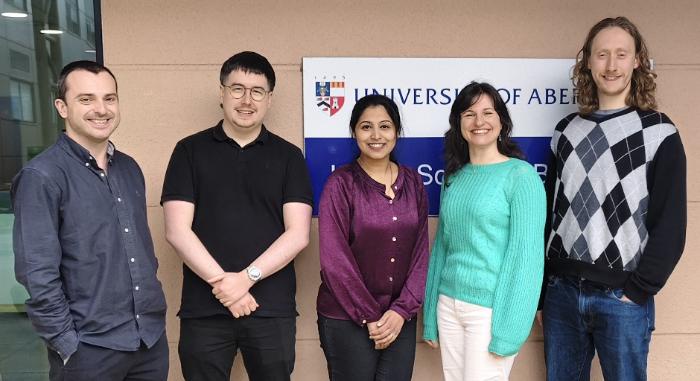
April 2026 News Update
UKAR Study - Expansion to include Antifungal Agent ✅
As of the 14-April-2026 the UKAR has been updated as follows:
1. Removal of dalbavancin as an eligible study drug
2. Addition of antifungal agent rezafungin to the eligible study drug list
3. Inclusion of outpatient prescriptions for all eligible study drugs
December 2025 News Update
As we wrap up 2025, we just want to say a huge thank you to all our hospital sites and collaborators for keeping the UKAR study moving forward and helping us hit some fantastic milestones this year.
Here’s a snapshot of what we’ve achieved together:
- Milestone unlocked: 1,000 recruited participants, 56 participating sites in total, with 10 sites added to UKAR in 2025
- 23 sites have achieved their recruitment targets, along with 3 sites celebrating more than 100 participants!
- 2 new Gram-negative drugs added, bringing the registry to 13 eligible study drugs
- First recruitment for Eravacycline in September 2025
- A no-cost 12-month extension, meaning recruitment is now open until May 2027
Sharing the science:
- Our UKAR manuscript: an overview of the first 20 months of hospital recruitment has been accepted by JAC-AMR.
- Manuscript of data from the Virtual Registry [Scotland] has been submitted to the JAC journal.
Connecting with the community:
-
UKAR Investigators’ Day held on 12 November 2025 with all stakeholders
The 2nd session recording is available via BSAC link here: UK Antimicrobial Registry (UKAR) Investigators meeting - The British Society for Antimicrobial Chemotherapy Also, it was great to connect with many of you at the British Society for Antimicrobial Chemotherapy (BSAC) Conferences in both spring and autumn
Team news:
-
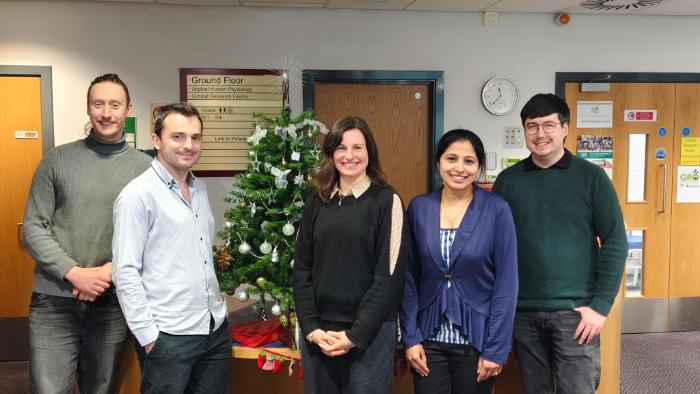
We welcomed Jonathan Lock as our new Assistant Study Coordinator in December 2025
Team photo attached — and finally, wishing everyone a happy festive season and a brilliant start to 2026. Thanks again for being part of the UKAR journey!
January 2025 Study Update - Looking back at 2024!
We thought we would have a look back over 2024 and bring you some highlights.
At the end of 2023 we had 16 sites open to participant recruitment, but by December 2024, we had added another 31 sites, taking us to 47 sites across the UK. A massive thank you to each and every one of you for helping us collect data about the effectiveness of vital antimicrobial drugs.
As to the number of participants in the study, we have gone from 101 at the beginning of January 2024, to 628 participants on 20th December 2024. That’s a fantastic achievement, so once again, thank you all so much.
And now to the numbers, our Top Ten Recruiting Centres by the end of 2024 were found in 3 of the 4 nations, with a very strong base in the English Midlands, with strong representation from Scotland and Wales:
Recruiting Centre
Number of participants
NHS Grampian
101
University Hospitals Birmingham NHS Foundation Trust
68
University Hospitals of Leicester NHS Trust
60
Royal Papworth Hospital NHS Foundation Trust
46
NHS Greater Glasgow and Clyde
30
Imperial College
30
Manchester University NHS Hospital Trust
29
Kettering General Hospital
24
Nottingham University Hospitals NHS Trust
20
Cardiff and Vale University Health Board
19
Sites who have reached their target.
Many thanks to the team at Nottingham for reaching your recruitment target and also to those sites who have reached and exceeded their recruitment target; Aberdeen, Aneurin Bevan, Imperial College, Papworth and Portsmouth. We’re very grateful to all of you who are able to go above and beyond.
September 2024 Study Updates
Happy September everyone! I hope you all had a great summer.
Ringing the changes!
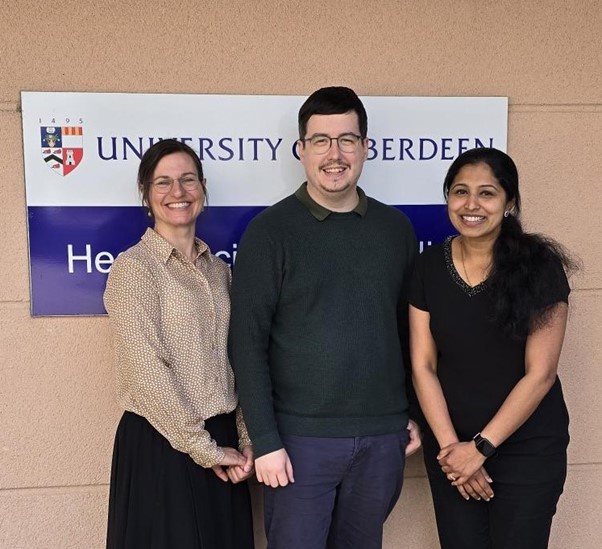
Our wonderful Study Coordinator, Laura Moir, has now left the UKAR to work on another clinical study. Laura's enthusiasm was infectious, and her experience and dedication will be sorely missed. Laura did pass on her wealth of knowledge to me and Jay during her time setting up and running the study, ensuring that the registry will continue to strive to meet the aims - understanding the effectiveness and safety of recently licensed antimicrobials used to treat real-world patients.
We are delighted to have Jisha Babu join us as Assistant Study Coordinator. Jisha has been managing the Epidemiology Group for nearly 3 years, organising us all and keeping us on track. We are looking forward to harnessing her fantastic coordination skills and her eternal optimism.
Read all about it.
The UKAR is once again in print! Please direct all interested participants and colleagues to the JAC-AMR introduction to the UKAR: Introducing the UK Antimicrobial Registry (UKAR) study: providing real world data on new antimicrobials to support antimicrobial stewardship and tackle antimicrobial resistance | JAC-Antimicrobial Resistance | Oxford Academic (oup.com)
Thank you!
Thank you for your continued support of the UKAR study, your involvement is crucial in gathering data that will hopefully contribute to combating antimicrobial resistance, a global health challenge.
Please get in touch with any queries.
Rebecca, Jay and Jisha
UKAR Coordination Team
Articles
29-May-2024: There's still time to get involved in this important AMR research
01-Feb-2024: UKAR: The secrets of successful study site
01-Jan-2024: P15 UK Antimicrobial Registry Study: progress to date
28-Apr-2023: University of Aberdeen scientists fight back against global public health emergency
18-Apr-2023: Aberdeen University researchers are collaborating with BSAC to create the first UK Antimicrobial Registry (UKAR)
- Why is this research important?
-
Antimicrobials are a vital part of modern medicine as they stop the growth of microorganisms that cause infection. The UKAR Study will help us look how widely these medicines are used across the UK, why they are being prescribed, and how effective they are.
Microorganisms are becoming resistant to treatment with commonly used antimicrobials. This means that it is becoming difficult to successfully treat some bacterial infections. It is estimated that, worldwide, deaths due to antimicrobial resistance are on the same scale as deaths due to major diseases such as HIV/AIDS and malaria (Lancet, 2022: Global burden of bacterial antimicrobial resistance in 2019: a systematic analysis ).
Links to Resources about AMR / antibiotics:
(206) The Evolution of Bacteria on a “Mega-Plate” Petri Dish (Kishony Lab) - YouTube
Antimicrobial resistance (who.int)
Stewardship & Surveillance - The British Society for Antimicrobial Chemotherapy (bsac.org.uk)
- How will the research benefit patients and society?
-
Being part of the UKAR Study does not affect the treatment that a patient receives. Therefore, individual patients do not directly benefit from participating in the study. However, the UKAR Study will provide important information about the study drugs. The study will help us see how often these drugs are used across the UK, and to look at how safe and effective they are. Lessons learnt from the registry will help doctors across the country decide how best to treat patients in the future.
- FAQs
-
What will this research involve?
We will ask that patients give us their consent to allow us access to their medical records and allow us to collect clinical data from their notes. No further participation is required, as the study does not include any participant surveys or questionnaires.
Clinical data will be collected during treatment with the antimicrobials included in the study, and then at 28 days, 6 months, and 12 months afterwards. We will collect information about the infections that the antimicrobials are being used to treat, why these antimicrobials were chosen and how effective they are at treating the infection. All of the information that we collect will be analysed so that we can better understand how effective the antimicrobials are at treating infections and tackling antimicrobial resistance. Participants will not be identifiable in any of the findings published from this research.
What is required of a participant in the UKAR Study?
We will ask the patient to give their consent for us to access their hospital notes. We will not ask anything further from the patient, as there are no participant surveys or questionnaires.
How will my information be used?
No personal or identifiable information about participants in the UKAR Study will be available to anyone outside of the UKAR Study team. Personal, identifiable information will be removed from the data before it is analysed.
You can find out more about how we use your information https://www.abdn.ac.uk/your-privacy and/or by contacting the University Data Protection Officer: dpa@abdn.ac.uk
Which drugs are included in the UKAR Study?
Antibiotic Agents
Gram Negative Gram Positive Aztreonam/avibactam Ceftaroline Cefepime/enmetazobactam Ceftobiprole Cefiderocol Delafloxacin Ceftazidime/avibactam Oritavancin Ceftolozane/tazobactam Eravacycline Imipenem/cilastatin/relebactam Meropenem/vaborbactam Dalbavancin has been discontinued as an eligible study drug as of 14-Apr-2026.
Antifungal Agents
Rezafungin
Who can take part in the study?
A patient must be 18 years old or older, and have been prescribed any of the eligible study drugs in a participating hospital.
The drug must have been prescribed within the last 60 days and the patient must have been treated with the drug for at least 24 hours.
As we are collecting health information, the study will ask for informed consent from patients. If a patient does not have the capacity to consent for themselves, an appropriate person will be asked to act on behalf of the patient.
If you have any questions about who can take part in the study, please email the UKAR Study team: ukar@abdn.ac.uk
How many participants does a site need to recruit?
Each site will meet with the UKAR study team to agree on an achievable recruitment target prior to joining the study.
What are the requirements of my site?
- Prescriptions of any antimicrobials included in the study.
- Identify patients who are prescribed antimicrobials included in the study.
- Receive informed consent from participants.
- Have a Principal Investigator take responsibility for running the UKAR Study at site.
The UKAR Study is registered with the NIHR Associate PI scheme - Associate Principal Investigator Scheme
In May 2023. Fran Garraghan, member of BSAC and former UKAR Study Principal Investigator at Manchester University NHS Foundation Trust recorded this video about setting up the study at site.
- Study team
-
The team responsible for delivering the study
Professor Gary Macfarlane - Co-Chief investigator
Professor Gareth Jones - Co-Chief Investigator
Dr Rebecca Parr - Study Coordinator
Ms Jisha Babu - Assistant Study Coordinator
Mr Jonathan Lock - Assistant Study Coordinator
Dr Ross Macdonald - Research Analyst
Mr Jay Woods - Project Assistant
Special thanks for the hard work of all previously involved with the UKAR study
Mrs Laura Moir - Study Coordinator
Dr Lili Xu - Data Analyst
Dr Marcus Beasley - Interim Study Coordinator
- Recruitment Centres
-
A full list of our study contributors can be downloaded here: UKAR Contributor List
- Publications and Plain Language Summary
-
Plain Language Summary
Publications
The UK Antimicrobial Registry (UKAR): an overview of the first 20 months of recruitment
P15 UK Antimicrobial Registry Study: progress to date
Conference Posters
UKAR Poster - BSAC 2026 Spring Conference (14th to 15th May)
Download Link: UKAR BSAC Spring Conference 2026 Poster
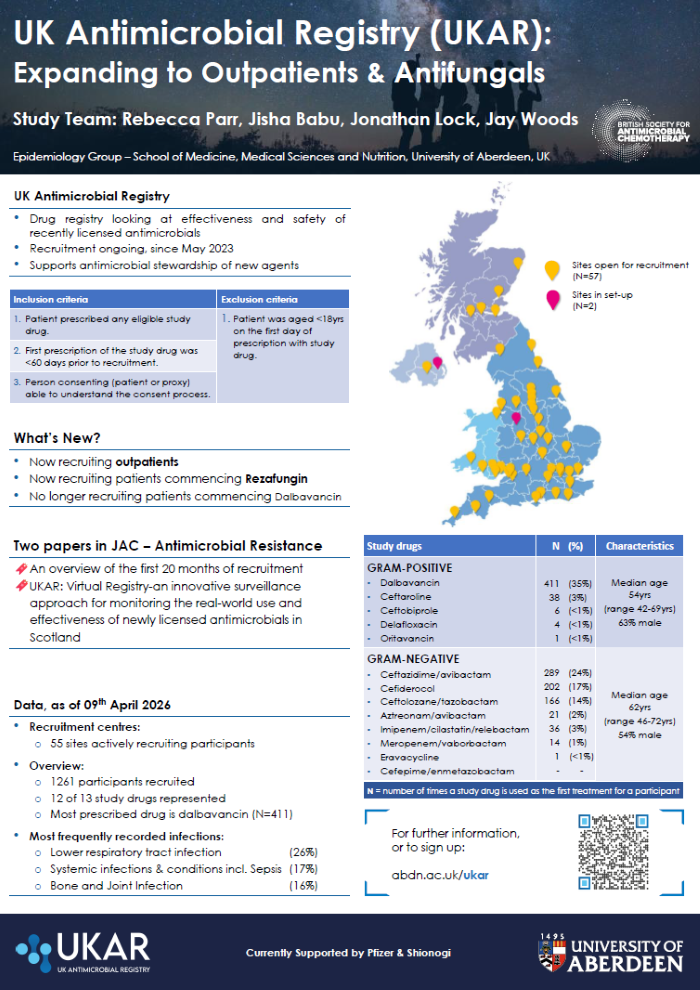
UKAR Poster - BSAC 2025 Winter Conference (27th to 28th October)
Download Link: UKAR BSAC Winter Conference 2025 Poster

UKAR Poster - BSAC 2025 Spring Conference (14th to 15th May)
Download Link: UKAR BSAC Spring Conference 2025 Poster

UKAR Poster - BSAC 2024 Winter Conference (4th to 5th December)
Download Link: UKAR BSAC Winter Conference Poster 2024

UKAR Poster - BSAC 2024 Spring Conference (16th to 17th May)
Download Link: UKARposterBSACSC_08-Apr-2024.pptx

UKAR Poster - BSAC 2023 Winter Conference (30th November to 1st December)
Download Link: UKARposterBSACWC_27-Nov-2023.pptx

- Contact details
-
If you are interested to learn more about the UKAR Study, please contact the team: ukar@abdn.ac.uk