Congenital Conditions in Scotland: Screening, Pregnancy Outcomes and Child Health Research
Informing policy and practice in antenatal screening, pregnancy and postnatal care in Scotland
This programme of research examines the implementation and impact of pregnancy screening changes on pregnancy, postnatal and child health outcomes of children with congenital conditions in Scotland. Our work explores changes to the antenatal screening programme, including the impact and experiences of introducing non-invasive prenatal testing (NIPT) in Scotland.
This research was initially funded as part of a Medical Research Scotland PhD Studentship (2021-2025), in partnership with Public Health Scotland, looking at historical trends and impact of the introduction of NIPT on pregnancy decisions and outcomes of babies with Down’s syndrome in Scotland.
The research is being continued with funding provided by the Roy Weir Fellowship at the University of Aberdeen (2025-2028). Find out more here.
Implementing non-invasive prenatal testing in Scotland: test pathway choices, experiences of non-invasive prenatal testing (NIPT), and first-line NIPT feasibility
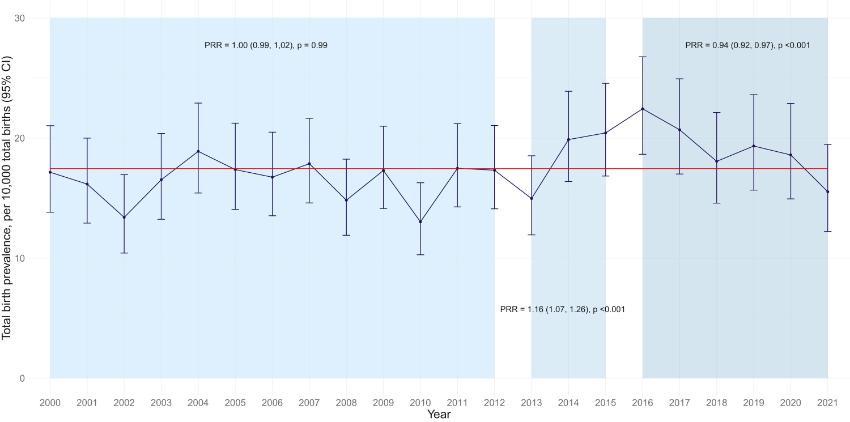
This research programme investigates how changes to prenatal screening for Down’s syndrome influence screening decisions, pregnancy outcomes, and service planning in Scotland. The work builds on findings from a Medical Research Scotland-funded PhD project conducted in collaboration with Public Health Scotland, which analysed national population data to understand long-term trends in Down’s syndrome diagnoses and births in Scotland between 2000 and 2021.
You can read more about the PhD research in the MRS PhD Project section below.
As part of the fellowship, the research will investigate the experiences of women and healthcare professionals involved in the screening pathway and assess the potential health and economic implications of introducing NIPT as a first-line screening test in Scotland, including an evaluation of its cost-effectiveness for the NHS. Find out more about each package of work here.
Together, this programme of research aims to provide evidence to support informed decision-making for pregnant women and to inform the future development of antenatal screening policy and services in Scotland.
Medical Research Scotland Funded PhD Project (2021-2025)
Introduction of Non-Invasive Prenatal Testing (NIPT) in Scotland: historical trends and impact on pregnancy decisions and outcomes of babies with Down’s syndrome
This doctoral project (2021–2025) was funded by the Medical Research Scotland (MRS) PhD Studentship Programme and conducted in collaboration with Public Health Scotland (PHS). The project aimed to investigate the impact of introducing non-invasive prenatal testing (NIPT) into the Scottish antenatal screening programme for Down’s syndrome.
The research used national population datasets, congenital condition registers, prenatal screening data, and genetic testing records to evaluate the real-world impact of NIPT implementation in Scotland. The project combined quantitative and qualitative methods to understand how changes to the screening pathway may influence screening uptake, diagnostic testing, pregnancy decisions, and outcomes for babies with Down’s syndrome.
This project builds on previous work by the Congenital Conditions and Rare Diseases Registration Information Service for Scotland (CARDRISS) team in Public Health Scotland, specifically the creation of the Scottish linked congenital conditions dataset (SLiCCD). This important resource captures data on all pregnancies and births diagnosed with a congenital condition in Scotland since 2000. Really, this is what makes the analysis in our project possible - the ability to look at a population level at the impact of changes to the Scottish screening programme for specific congenital conditions. - Dr Rute Vieira, Principal Supervisor of the Doctoral project
Key outputs from this research programme include:
National trends in Down’s syndrome prevalence in Scotland (2000–2021) using the Scottish Linked Congenital Conditions Dataset (SLiCCD). To access this publication click here.
A systematic review and meta-analysis examining the implementation and impact of non-invasive prenatal testing (NIPT) in antenatal screening programmes worldwide. This study identified NIPT implementation in at least 27 countries and demonstrated reductions in invasive prenatal diagnostic testing following its introduction. To access this publication click here.
Forthcoming publications
Exploring women’s experiences of NIPT within the NHS screening pathway
Examining changes in screening and diagnostic testing decisions following the introduction of NIPT in Scotland
Pregnancy and early childhood outcomes for babies with Down’s syndrome in Scotland (2000–2021) using national population data.
All outputs from this study can be found in the Resources and Publications sections below.
MRS PhD Project Team
PhD Student – Elinor Sebire, Institute of Applied Health Sciences, University of Aberdeen
Principal Supervisor – Dr Rute Vieira, Senior Lecturer in Medical Statistics at the University of Aberdeen and consultant for Public Health Scotland
Secondary Supervisor – Professor Amudha Poobalan, Professor of Public Health Education, based at the School of Medicine, Medical Sciences and Nutrition at the University of Aberdeen
External Supervisor – Dr Rachael Wood, Consultant in Public Health Medicine at Public Health Scotland
In Memoriam
Very sadly, Dr Sohinee Bhattacharya passed away in the summer of 2023. She was a treasured member of our team and, as secondary supervisor, was pivotal in the conception and progress of the project for the first years of the project. Sohinee brought her much respected clinical and academic expertise to this project, and her contributions and valuable insights to this work will be long remembered.
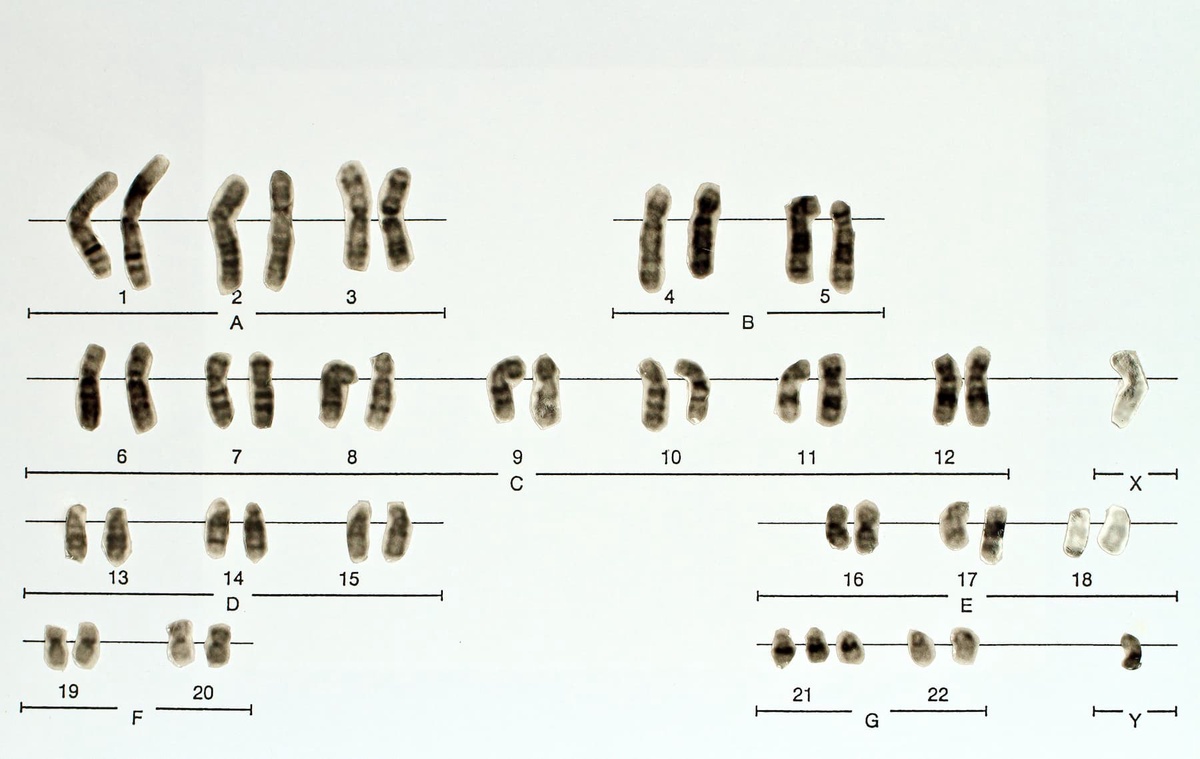
Down's syndrome is a condition where an individual has three full or partial copies of chromosome 21, otherwise known as trisomy 21. There are approximately 47,000 individuals living with Down's syndrome in the UK according to the Down's Syndrome Association (DSA).
Every child with Down's syndrome is unique, following the same developmental path as all children. Most individuals with Down's syndrome will have some form of learning impairment, and some will have more complex needs, although everyone is different.
Many people with Down's syndrome lead happy and fulfilled lives, living as independently as possible and pursuing activities and occupations into their 60s, 70s and beyond. More information and insight into the lives of people with Down's syndrome can be found through the following websites:
Non-invasive prenatal testing was introduced to the Scottish antenatal screening programme in September 2020.
Before September 2020
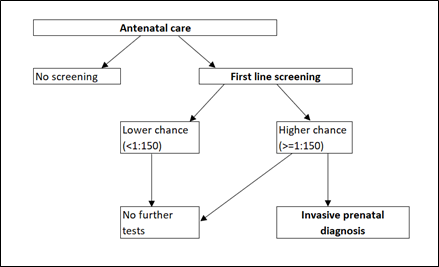
Routine screening was available for Down's syndrome only and was offered to all women with a singleton pregnancy. Women that opted for screening tests were given a chance score for the baby having Down's syndrome. This score was based on a combination of maternal blood samples and ultrasound measurements, depending on the gestation of pregnancy. Down's syndrome screening for twin pregnancies was only offered in the first trimester.
If a pregnancy was given a higher chance of Down's syndrome (i.e. >= 1 in 150), the mother was offered an invasive test to confirm the condition. These diagnostic tests (amniocentesis or chorionic villus sampling) have, however, a small risk of miscarriage.
At each stage, women could decide not to have any further testing.
This screening pathway for Down's syndrome is represented in Figure 1.
Figure 1: Flow diagram to represent the screening options for Down's syndrome for a singleton pregnancy before September 2020.
Since September 2020
All pregnant women booking for antenatal care are now offered screening for Down's, Edwards' and Patau's syndromes if they are in their first three months of pregnancy. Women that opt for screening tests, are given a chance score for the baby having either Down's syndrome or, separately, either Edwards' or Patau's syndrome, based on the same testing as before (now referred to as first line screening). Screening has also been extended to twin pregnancies in the first and second trimester for Down's syndrome.
If the chance of the baby having a specific condition is higher, women are offered another screening test called non-invasive prenatal test (NIPT), for which women only need to give a blood sample and will be told whether there is a high or low chance that the baby has the condition.
NIPT is a more accurate screening test for these three conditions, and it will hopefully reduce the need for pregnant women to undergo invasive tests. However, women can still choose to do an invasive test instead, or no further screening tests (Figure 2).
If the NIPT result is positive, women are then offered invasive testing, or no further testing.
Figure 2: Screening options available for singleton pregnancies for Down's syndrome following the September 2020 implementation of NIPT. First line screening test refers to the combined or quadruple screening available before NIPT was introduced.
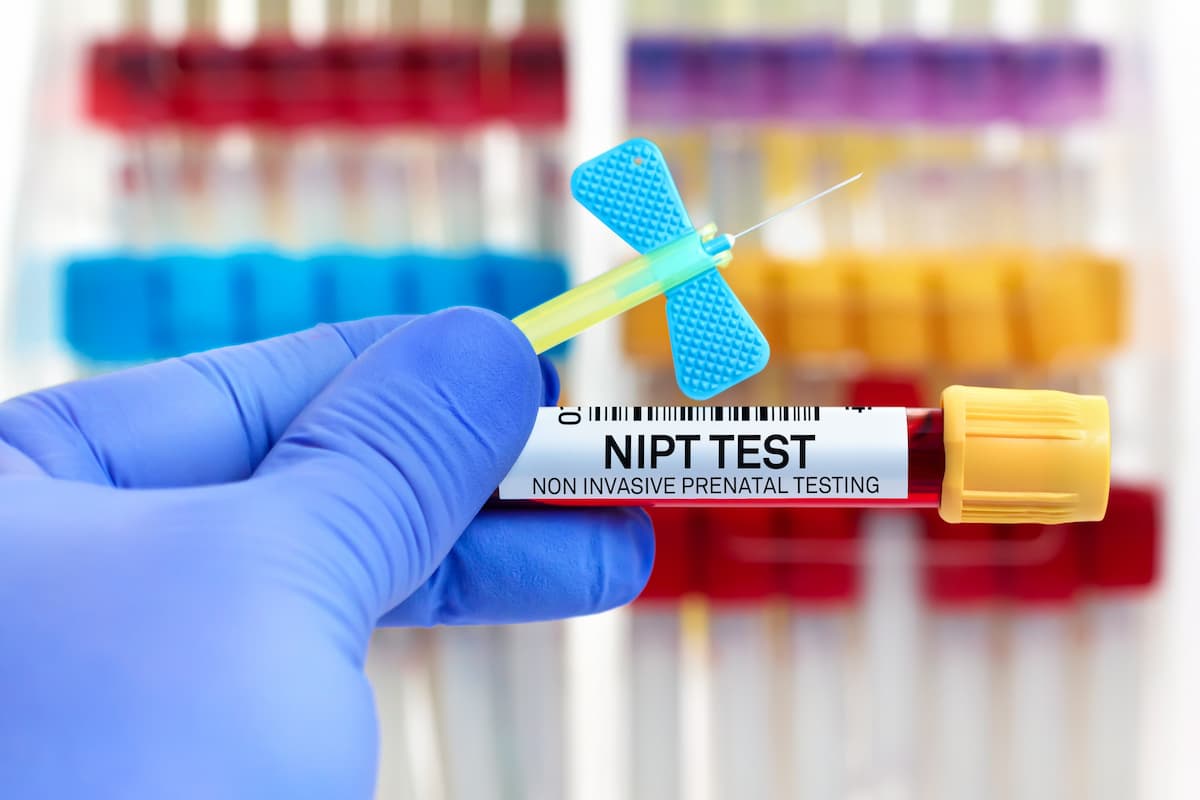
Non-invasive prenatal testing (NIPT) is a screening test that analyses genetic material released from the placenta, called cell-free DNA (cfDNA). cfDNA circulates in the maternal blood stream during pregnancy and can be used for NIPT from 11 weeks gestation.
When used as a screening test, NIPT has been found to have over 99% accuracy for Down's syndrome (Taylor-Philips et al., 2016), meaning it is much more accurate than the first line screening tests. However, this is still a screening test, and there is a very small chance of being incorrect. Therefore, NIPT is not enough to diagnose a baby with Down's syndrome. To get a definitive answer for whether a baby has Down's syndrome before birth, invasive testing such as amniocentesis or chorionic villus sampling, must still be used.
Total and live birth prevalence of singleton pregnancies with Down’s Syndrome in Scotland between 2000 and 2021: a population based study
Sebire, E., Wood, R., Calvert, C., Vieira, R. (2026) Total and live birth prevalence of singleton pregnancies with Down’s Syndrome in Scotland between 2000 and 2021: a population-based study. The Lancet Regional Health – Europe. https://doi.org/10.1016/j.lanepe.2026.101639
The implementation and impact of non-invasive prenatal testing (NIPT) for Down's syndrome into antenatal screening programmes: A systematic review and meta-analysis
Sebire E, Rodrigo CH, Bhattacharya S, Black M, Wood R, Vieira R (2024) The implementation and impact of non-invasive prenatal testing (NIPT) for Down's syndrome into antenatal screening programmes: A systematic review and meta-analysis. PLoS ONE 19(5): e0298643. https://doi.org/10.1371/journal.pone.0298643
Publications from this fellowship will be signposted here.
Other publications
Pregnancy, baby, and childhood outcomes from using anti-seizure medication during pregnancy
Moore, E., Millar, M., Merrick, R., Mueller, T., Stark, V., Jarvis, L., Kurdi, A., Hopkins, L., McTaggart, S., Vieira, R., Bennie, M., Wood, R. (2026) Pregnancy, baby, and childhood outcomes from using anti-seizure medication during pregnancy. Communications Medicine, vol. 6, 28. https://doi.org/10.1038/s43856-025-01285-9
Trends in neural tube defects in Scotland 2000-2021 prior to the introduction of mandatory folic acid fortification of non-wholemeal wheat flour: a population-based study
Kirolos, A., Vieira, R., Calvert, C., Griffiths, E., & Wood, R. (2025). Trends in neural tube defects in Scotland in 2000-2021 prior to the introduction of mandatory folic acid fortification of non-wholemeal wheat flour: a population-based study. Archives of disease in childhood, 110(11), 878–884. https://doi.org/10.1136/archdischild-2024-328295
Pregnancy Screening for Down's Syndrome, Edwards' Syndrome, and Patau's Syndrome in Scotland
Our public health research is strengthened through active collaborations with academic institutions and government agencies. These partnerships enable high-quality research, inform policy, and support evidence-based public health practice locally and nationally.
We welcome researchers and interested organisations who are keen to explore opportunities for collaboration - please get in touch with us to discuss potential collaborations.
The ECHO-S NIPT study is strengthened by advisory input from a range of stakeholders in the field. The advisory group members include those within academia, Third Sector charity representatives, and NHS maternity healthcare. Find out more about this project here.
Previous collaborations
Public Health Scotland
Co-supervised Medical Research Scotland PhD Studentship (2021 - 2025)
Statistical support for other Public Health Scotland projects:
Three work packages will be conducted as part of this project:
Work package 1
Continuing to Understand Our Data: Trends in Pregnancy and Postnatal Outcomes and Antenatal Screening Changes
This work package will analyse population-level data to describe baseline trends in pregnancy and postnatal outcomes of babies with Down’s syndrome in Scotland from 2000-2021. It will also examine patterns in prenatal screening and diagnostic history before and after the introduction of Non-Invasive Prenatal Testing (NIPT) for women who had a baby diagnosed with Down’s syndrome.
Cost-Effectiveness of NIPT as First-Line Screening in Scotland
This work package will investigate the cost-effectiveness of implementing NIPT as a first-line screening test in Scotland, when compared to current screening practice for antenatal screening for DS, ES and PS.
Aim: To understand the experiences of women and healthcare professionals of non-invasive prenatal testing (NIPT) delivered through the NHS in Scotland
Funded by the University of Aberdeen Roy Weir Fellowship (October 2025 – April 2028).
Background
During pregnancy in Scotland, women are offered screening tests to check if there is a chance of their baby having certain conditions, including Down’s syndrome (DS), Edwards’ syndrome (ES) and Patau’s syndrome (PS). These tests are optional and are usually offered early in pregnancy. Find out more from NHS Inform here.
Since 2020, a newer test called non-invasive prenatal testing (NIPT) has been introduced. This test is more exact than earlier screening tests and can lower the need for more intrusive procedures, which carry a small risk of pregnancy loss.However, adding this test into the screening process may make decisions harder for both women and the medical team. It may also affect how information is understood and how people feel during the process, particularly the high levels of upset at different stages of these decisions being made.
This study will involve online interviews with women and individuals with experience of pregnancy who were offered NHS NIPT and the medical team involved in delivering it in Scotland. We will chat about their experiences of screening, understanding of the information, and decision-making. Participation is voluntary and involves a one-hour online interview.
The findings will help identify ways to improve how screening is offered and communicated.
Interested in taking part in the ECHO-S NIPT study?
If you were offered or had NIPT whilst you were pregnant in Scotland through the NHS, or you are a Healthcare Professional involved in delivering NIPT then we want to hear your views.
You don't need to have accepted NIPT to take part.
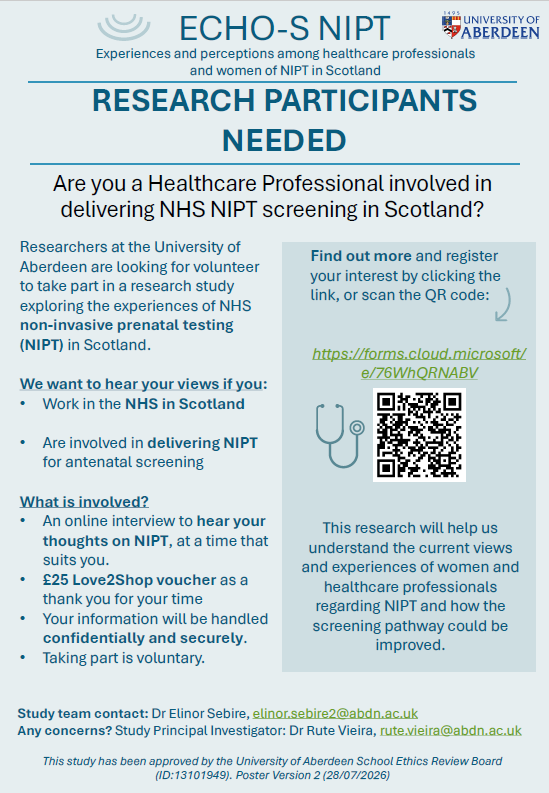
Our research is seeking participants for a one-to-one online interview, lasting approximately one hour and at a time that suits you. You will be offered a £25 LoveToShop voucher as a thank you for your time.
The participant information sheet will explain in detail who is eligible to take part in the study.
Please follow the link to read the relevant participant information sheet and consent form before registering your interest to participate in this study.
The University of Aberdeen School Ethics Review Board (SERB) has reviewed this study, ID: 13101949.
Findings from the ECHO-S study will be placed here.
ECHO-S NIPT study recruitment documents
Interested in taking part in this research?
If you were offered or had NIPT whilst you were pregnant in Scotland through the NHS, or you are a Healthcare Professional involved in delivering NIPT then we want to hear your views.
Our research is seeking participants for a one-to-one online interview, lasting approximately one hour and at a time that suits you. You will be offered a £25 LoveToShop voucher as a thank you for your time.
Please read the relevant participant information sheet and consent form in the tabs below before registering your interest to participate in this study.
The University of Aberdeen School Ethics Review Board (SERB) has reviewed this study, ID: 13101949.







_clean.png)