Chronic pain affects around 1 in 5 people worldwide and is a major cause of disability. There is growing interest in whether what we eat might affect pain - possibly through inflammation, gut health, blood sugar control, or weight. However, most previous studies have looked at only one way of measuring ‘diet quality’ at a time, which may miss the bigger picture when taking a number of factors into consideration.
What did we want to find out?
We wanted to investigate whether people with better quality diets are less likely to have pain, and whether this differs depending on how their ‘diet quality’ is measured, or the type of pain someone has.
What did we do?
We looked at data from over 55,000 UK Biobank participants who had completed a detailed food diary.
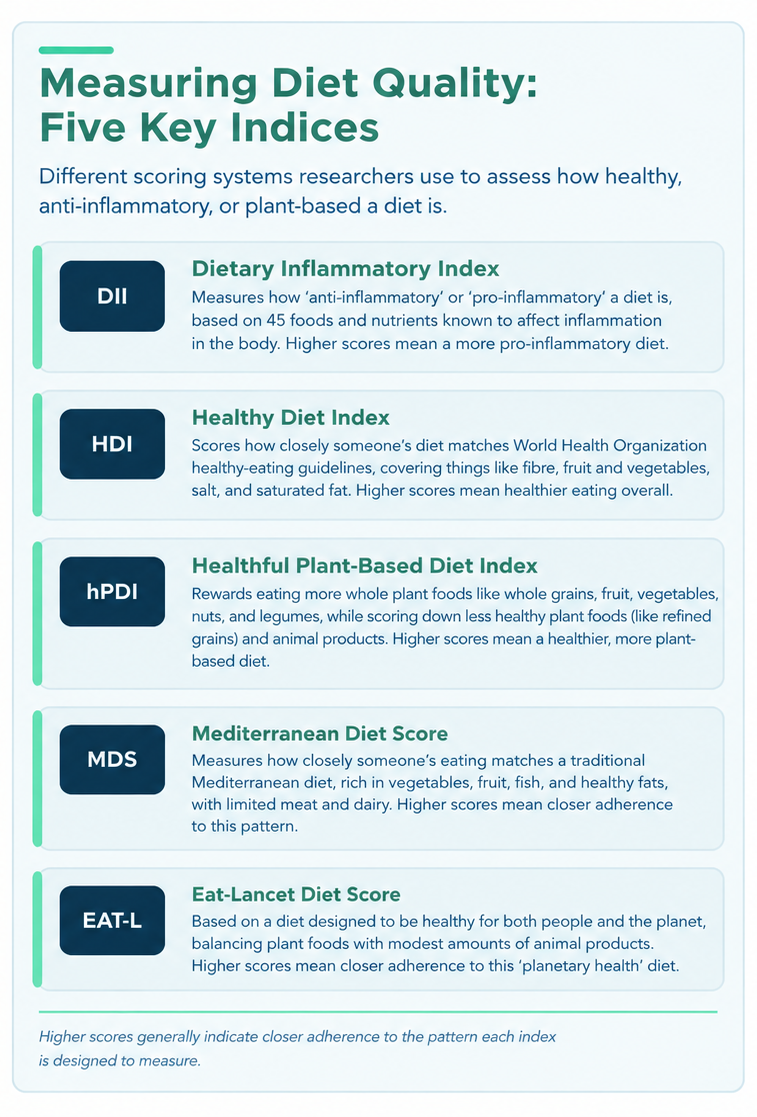
We scored each person's diet in five different ways:
how anti-inflammatory it was
how closely it matched general healthy-eating guidelines
how plant-based and whole-food it was
how Mediterranean it was
how closely it matched the "planetary health" EAT-Lancet diet
We compared these scores between people with chronic pain (pain lasting more than three months), people with short-term pain, and people with no pain, taking into account other factors such as age, sex, weight, smoking, activity levels, sleep, and other health conditions.
What did we find?
People with higher-quality diets (particularly plant-based, Mediterranean, or EAT-Lancet style diets) had somewhat lower odds of having chronic pain. This held true even after accounting for other lifestyle and health factors.
A more pro-inflammatory diet, on the other hand, was linked to higher likelihood of widespread pain (pain all over the body) and pain outside the joints and muscles, such as headaches or stomach pain.
Plant-based and EAT-Lancet diets were more closely tied to lower odds of localised joint and muscle pain. The effects were modest for any one person, but similar in size to other well-established lifestyle factors like physical activity.
Why does this matter?
This suggests diet could be one modifiable factor worth considering alongside other lifestyle changes in the prevention and management of chronic pain, and that different diet patterns may matter for different types of pain. Because the study only looked at people at a single point in time, it can't prove that diet causes reduced pain (for example, people in pain might also change their eating habits in response to it). Longer-term and trial-based research is needed to confirm whether changing diet actually reduces pain.
Who authored this study?
The study was led by the Pain Science Research Group at Bournemouth University, and was authored by Ömer Elma, Christopher Long, Jo Nijs, Sumanto Haldar, Jonathan Williams, Marcus Beasley, Xue Jiang, and Gary J. Macfarlane, based at Bournemouth University, the University of Aberdeen, and the Vrije Universiteit Brussel.
Who funded this work?
The study was funded by Bournemouth University's internal Pump-Prime Research Funding grant.
Where can I read more?
The full paper, "The association between diverse dietary quality measures and the presence of acute or chronic pain in the UK Biobank," is published in The Journal of Pain and is available here.