Introduction
Anthropology at Aberdeen is the study of the diversity of human communities and cultures around the world. It brings together theories about ‘being human’ from a wide range of Western and non-Western thinkers to understand human action, culture and thought, as studied through long-term international research with the communities themselves. You can study it with Language and Linguistics to give you a unique range of learning and opportunities and careers.
Did you know? Anthropology at Aberdeen is ranked 1st in the UK for Overall Student Satisfaction (National Student Survey 2024)
Study Information
At a Glance
- Learning Mode
- On Campus Learning
- Degree Qualification
- MA
- Duration
- 48 months
- Study Mode
- Full Time
- Start Month
- September
- Location of Study
- Aberdeen
- UCAS Code
- QL16
Language & Linguistics will introduce you to, among other things, how human language and speech may have evolved, the complex functions and structures of language in its role as a bridge between sound and meaning. You will study the ways in which we acquire languages as children and adults, the ways in which languages vary and the mechanisms by which they change over time.
Through your Anthropology courses you will be able to examine the connections among all aspects of life – family and kinship, economic systems, political and religious institutions, human-animal and ecological relations – and the way in which they come together to create whole ways of living within an increasingly global and postcolonial world.
You will also develop essential skills in critical thinking and analysis, and gain a deeper understanding of human behaviour, all of which can be applied in business and many other fields. Many of our graduates now work in research, teaching, media, politics, or in business or public sector organisations in a host of roles with international and cultural contexts.
Aberdeen Global Scholarship
The University of Aberdeen is delighted to offer eligible self-funded international on-campus undergraduate students a £6,000 scholarship for every year of their programme.
View the Aberdeen Global ScholarshipWhat You'll Study
- Year 1
-
Compulsory Courses
- Getting Started at the University of Aberdeen (PD1002)
-
This course, which is prescribed for level 1 undergraduate students and articulating students who are in their first year at the University, is studied entirely online, is studied entirely online, takes approximately 2-3 hours to complete and can be taken in one sitting, or spread across the first 4 weeks of term.
Topics include University orientation overview, equality & diversity, MySkills, health, safety and cyber security, and academic integrity.Successful completion of this course will be recorded on your Transcript as ‘Achieved’.
- Introduction to Anthropology: Peoples of the World (AT1003)
-
15 Credit Points
Anthropology explores ways of life in societies and cultures around the world. Through fieldwork in the places people live, anthropologists connect global issues with everyday lives. In this course you’ll learn about the key topics of anthropology and its research methods. Lectures introduce anthropological research topics such as ritual, climate change and indigenous rights. Small group tutorials will allow you to debate the issues and share your perspectives.
- Introduction to Anthropology: Questions of Diversity (AT1502)
-
15 Credit Points
In this course students will be offered an extended introduction to social anthropology and will focus on topics: language and culture, belief and religion, gender and sex, kinship, and race. Students will develop and refine their understanding of major issues in the discipline of social anthropology through staff lectures, tutorials, and ethnographic films.
Optional Courses
Plus two courses from the following LN courses, plus further courses of choice to make up 120 credit points.
- LN 1006 Language Myths 15 credits
- Living Language (LN1005)
-
15 Credit Points
How does the way we use language shape our lives, and how does the way we live shape the language we use? Moving beyond strict notions of structure, this course explores communication in practice, examining how language works in various contexts and cultures. It addresses contemporary social issues that are principally or partly communicative in nature, challenging common misconceptions and giving students an understanding of the contribution awareness of language can make to numerous fields.
- English Past and Present (LN1008)
-
15 Credit Points
How do we get from Beowulf to ‘bae’? From Chaucer to ‘sashay away’? This course will look at the development of English over the last millennium and beyond, examining language changes in sound, structure and meaning. You will also be introduced to present-day study of English, its spread as a truly global language, and how all of this can add to our understanding of language in the modern world and in the past.
- Year 2
-
Compulsory Courses
- Key Debates in Anthropology (AT2010)
-
30 Credit Points
This course explores some of the key questions that anthropologists have debated: what it is to be human, the nature of human interaction with other humans and with other species, the role language plays in thought and culture, and the different ways that people perceive the world and act within it. Themes that will be discussed in this course include rationality, language, species difference, race, and place and community.
- Reimagining Colonialism (AT2515)
-
30 Credit Points
This course will explore contemporary colonial expressions from an anthropological perspective. It will be split into two main themes: Material Histories; and Mediated Histories. Within these themes it will address topics such as the "capturing" of cultures in museums, kinship and politics, gendered colonialism, economic development, media, aboriginal rights and contemporary resistance movements.
- Language in Society (LN2008)
-
30 Credit Points
Language is central to our humanity. Language and society are inextricably linked. Language unites; language divides. This course will develop your understanding of the social nature of language, providing insight into, among other things, the relationship between gender and language, language death and the issue of language policy and planning.
- Elements of English (LN2515)
-
30 Credit Points
We perceive language as an integrated whole, but in fact it exists on many levels. This course investigates these layers of structure through examination of speech sounds, word formation, and sentence construction. We will consider the theory behind these areas of phonology, morphology, and syntax, looking at how they function independently and interact. Students will gain skills to undertake analysis of language structure and think critically about structural elements fundamental to English.
- Year 3
-
Compulsory Courses
- Anthropological Theory (AT3027)
-
30 Credit Points
This course explores theoretical issues and key debates in contemporary anthropology. We begin with the questioning of the central concepts of culture and society in anthropology during the 1980s. Following this, we ask: how can anthropology proceed if the targets of its investigation can no longer be understood as objective entities? How can anthropology proceed if the anthropologist themselves is inevitably implicated in and part of those very targets? To look for possible answers, the course examines current anthropological interest in power and history, political economy and phenomenology, experience, embodiment and practice, ontology and things that speak.
Optional Courses
Plus one Term 2 level 3 Anthropology course from the
Anthropology Annexe and 60 credit points from level 3 course(s) in Language and Linguistics. - Year 4
-
Optional Courses
Either
AT2027 and one Term 2 level 4 Anthropology course from the Anthropology Annexe
OR
LN4501 and one Term 1 level 4 Anthropology course from the Anthropology Annexe and One Term 2 level 4 Anthropology course from the
Anthropology Annexe- Joint Honours Dissertation in Anthropology (AT4047)
-
30 Credit Points
This course is open to joint honours students in anthropology. Having chosen a topic for their study, students will be allocated a supervisor and carry out readings, research and writing under the guidance of their supervisor. Students will write a 10,000-word dissertation based on library research.
- Dissertation in Language and Linguistics (LN4501)
-
30 Credit Points
Once you have successfully completed three years of university-level study of Linguistics, this course allows you to develop and carry out an independent piece of research on a topic of your choice. It might be that a particular taught course has inspired you to explore a topic in more depth; your own reading might have prompted you to wonder about a particular question. You will be supervised by a member of the department who will be happy to give advice and support as you complete your dissertation of 7000-8000 words.
Dissertations are completed in HS2 (spring), but students will be offered research training workshops in HS1 (autumn), and will be expected to submit a short research proposal for their dissertion in December.
We will endeavour to make all course options available. However, these may be subject to change - see our Student Terms and Conditions page. In exceptional circumstances there may be additional fees associated with specialist courses, for example field trips.
How You'll Study
Learning Methods
- Individual Projects
- Lectures
- Research
- Tutorials
Assessment Methods
Students are assessed by any combination of three assessment methods:
- coursework such as essays and reports completed throughout the course;
- practical assessments of the skills and competencies they learn on the course; and
- written examinations at the end of each course.
The exact mix of these methods differs between subject areas, years of study and individual courses.
Honours projects are typically assessed on the basis of a written dissertation.
Why Study Anthropology and Language & Linguistics?
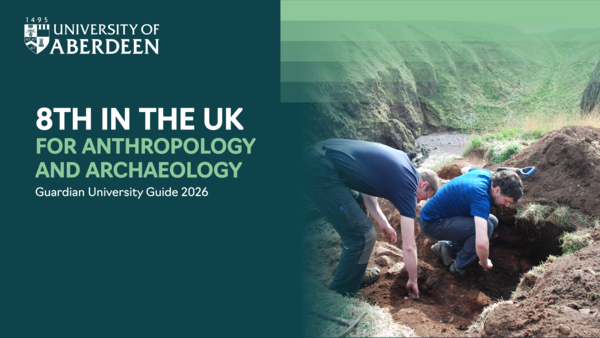
- Study at a nationally and internationally renowned university for Anthropology. The University of Aberdeen is ranked 3rd in the UK for Anthropology and Archaeology (Guardian University Guide 2025), 4th in the UK for Anthropology (The Times and Sunday Times Good University Guide 2025) and in the Global Top 100 for Anthropology (QS World University Rankings by Subject 2024)
- Study at a university with a national reputation for an excellent student experience. Aberdeen is ranked 1st in the UK for Overall Student Satisfaction in Anthropology, 1st in the UK for Student Positivity in Linguistics, and 1st in Scotland for Overall Student Satisfaction in Linguistics (National Student Survey 2024)
- Immerse yourself in a vibrant linguistics research and teaching community. Aberdeen is 7th in the UK for Languages & Linguistics (Guardian University Guide 2025)
- You will gain a deep knowledge and understanding of human behaviour, which can be applied in business and many other fields
- Researchers revealing new insight into how spoken English is changing, including evidence gathered from tracking TV and radio soaps over the years
- The University approaches the study of anthropology from an international perspective, meaning you will have unique insights into the infrastructure of companies from other countries and cultures
- Major research partnerships such as the study of witness testimonies following the 1641 Irish Rebellion, with language revealing the social, economic, cultural and political situation in 17th century Ireland, giving clues on sectarianism today
- The social, political and economic context in which you will study anthropology at Aberdeen will provide you with a cross-cultural understanding of how current affairs are perceived by international businesses
- Access the award-winning Sir Duncan Rice Library with top-class study facilities and literary treasures collected over 500 years charting the power of the written word from ancient papyri and medieval manuscripts to contemporary e-books and other media
Entry Requirements
Qualifications
The information below is provided as a guide only and does not guarantee entry to the University of Aberdeen.
General Entry Requirements
- 2025 Entry
-
SQA Highers
Standard: BBBB
Applicants who have achieved BBBB (or better), are encouraged to apply and will be considered. Good performance in additional Highers/ Advanced Highers may be required.
Minimum: BBC
Applicants who have achieved BBC at Higher and meet one of the widening participation criteria above are encouraged to apply and are guaranteed an unconditional offer for MA, BSc and BEng degrees.
Adjusted: BB
Applicants who have achieved BB at Higher, and who meet one of the widening participation criteria above are encouraged to apply and are guaranteed an adjusted conditional offer for MA, BSc and BEng degrees.
We would expect to issue a conditional offer asking for one additional C grade at Higher.
Foundation Apprenticeship: One FA is equivalent to a Higher at A. It cannot replace any required subjects.
More information on our definition of Standard, Minimum and Adjusted entry qualifications.
A LEVELS
Standard: BBC
Minimum: BCC
Adjusted: CCC
More information on our definition of Standard, Minimum and Adjusted entry qualifications.
International Baccalaureate
32 points, including 5, 5, 5 at HL.
Irish Leaving Certificate
5H with 3 at H2 AND 2 at H3.
Entry from College
Advanced entry to this degree may be possible from some HNC/HND qualifications, please see www.abdn.ac.uk/study/articulation for more details.
- 2026 Entry
-
SQA Highers
Standard: BBBB
Applicants that present with BBBB will usually receive an unconditional offer.
Where we have more applicants than places we may need to ask for more than the minimum so continued engagement in school is recommended.
Widening Access: BBC
Applicants who meet one or more of our widening access metrics and present with BBC, are guaranteed an unconditional offer.
Foundation Apprenticeship: One FA is equivalent to a Higher at A. It cannot replace any required subjects.
Note: We do not double count a Higher and Advanced Higher in the same subject, but we do consider that a B grade at Advanced Higher is equivalent to an A grade at Higher.
National 5 English (or equivalent) is required at Grade C or above.
A LEVELS
Standard: BBC
Widening Access: CCC
GCSE English (or equivalent) is required at Grade C/4 or above.
BTEC LEVEL 3 EXTENDED DIPLOMA
DMM in related subjects.
Note: BTEC Level 3 Extended Certificate (Subsidiary Diploma) achieved at Distinction level, is normally acceptable in lieu of one A Level at grade B.)
GCSE English (or equivalent) is required at Grade C/4 or above. GCSE Mathematics at Grade C/4 is also required for Accountancy, Economics and Finance programmes.
IRISH LEAVING CERTIFICATE
Five subjects at Higher at H3.
INTERNATIONAL BACCALAUREATE
32 points including 5, 5, 5 at HL.
SL in English is also required.
The information displayed in this section shows a shortened summary of our entry requirements. For more information, or for full entry requirements for Arts and Social Sciences degrees, see our detailed entry requirements section.
English Language Requirements
To study for an Undergraduate degree at the University of Aberdeen it is essential that you can speak, understand, read, and write English fluently. The minimum requirements for this degree are as follows:
IELTS Academic:
OVERALL - 6.0 with: Listening - 5.5; Reading - 5.5; Speaking - 5.5; Writing - 6.0
TOEFL iBT:
OVERALL - 78 with: Listening - 17; Reading - 18; Speaking - 20; Writing - 21
PTE Academic:
OVERALL - 59 with: Listening - 59; Reading - 59; Speaking - 59; Writing - 59
Cambridge English B2 First, C1 Advanced or C2 Proficiency:
OVERALL - 169 with: Listening - 162; Reading - 162; Speaking - 162; Writing - 169
Read more about specific English Language requirements here.
Fees and Funding
You will be classified as one of the fee categories below.
| Fee category | Cost |
|---|---|
| EU / International students | |
| Tuition Fees for 2026/27 Academic Year | £20,800 |
| Tuition Fees for 2026/27 Academic Year (Self-funded Students *) | £14,800 |
| Home Students | |
| Tuition Fees for 2026/27 Academic Year | £1,820 |
| England, Wales, Northern Ireland, and Republic of Ireland | |
| Tuition Fees for 2026/27 Academic Year | £9,790 |
Scholarships and Funding
UK Scholarship
Students from England, Wales and Northern Ireland, who pay tuition fees may be eligible for specific scholarships allowing them to receive additional funding. These are designed to provide assistance to help students support themselves during their time at Aberdeen.
Aberdeen Global Scholarship
The University of Aberdeen is delighted to offer eligible self-funded international on-campus undergraduate students a £6,000 scholarship for every year of their programme. More about this funding opportunity.Funding Database
View all funding options in our Funding Database.
Careers
- Civil Service Officer
- Curator
- Social Researcher
- Information Officer
- Translator
- Public Relations Officer
- Speech and Language Therapist
Our Experts
Information About Staff Changes
You will be taught by a range of experts including professors, lecturers, teaching fellows and postgraduate tutors. However, these may be subject to change - see our Student Terms and Conditions page.
Discover Uni
Discover Uni draws together comparable information in areas students have identified as important in making decisions about what and where to study. You can compare these and other data for different degree programmes in which you are interested.
Get in Touch
Contact Details
- Address
-
Student Recruitment & Admissions
University of Aberdeen
University Office
Regent Walk
Aberdeen
AB24 3FX