
£1m investment in geothermal pilot to unlock heat beneath our feet
The Aberdeen Geothermal Feasibility Pilot (AGFP) is an ambitious city-wide collaboration to explore Aberdeen’s geological potential and pave the way for low-carbon heating solutions.
A University of Aberdeen research initiative exploring the potential for geothermal energy in Aberdeen and beyond.
The University of Aberdeen is leading an exciting project to reveal the potential of the heat that lies beneath our feet. This multi-phase project will couple borehole data with a city-wide geological model, necessary to de-risk future geothermal investment and accelerate Aberdeen’s transition to a sustainable energy future. The data we collect will be openly available, helping other places predict their own geothermal potential, while reaffirming the University’s position as a global leader in sustainable energy research and education.
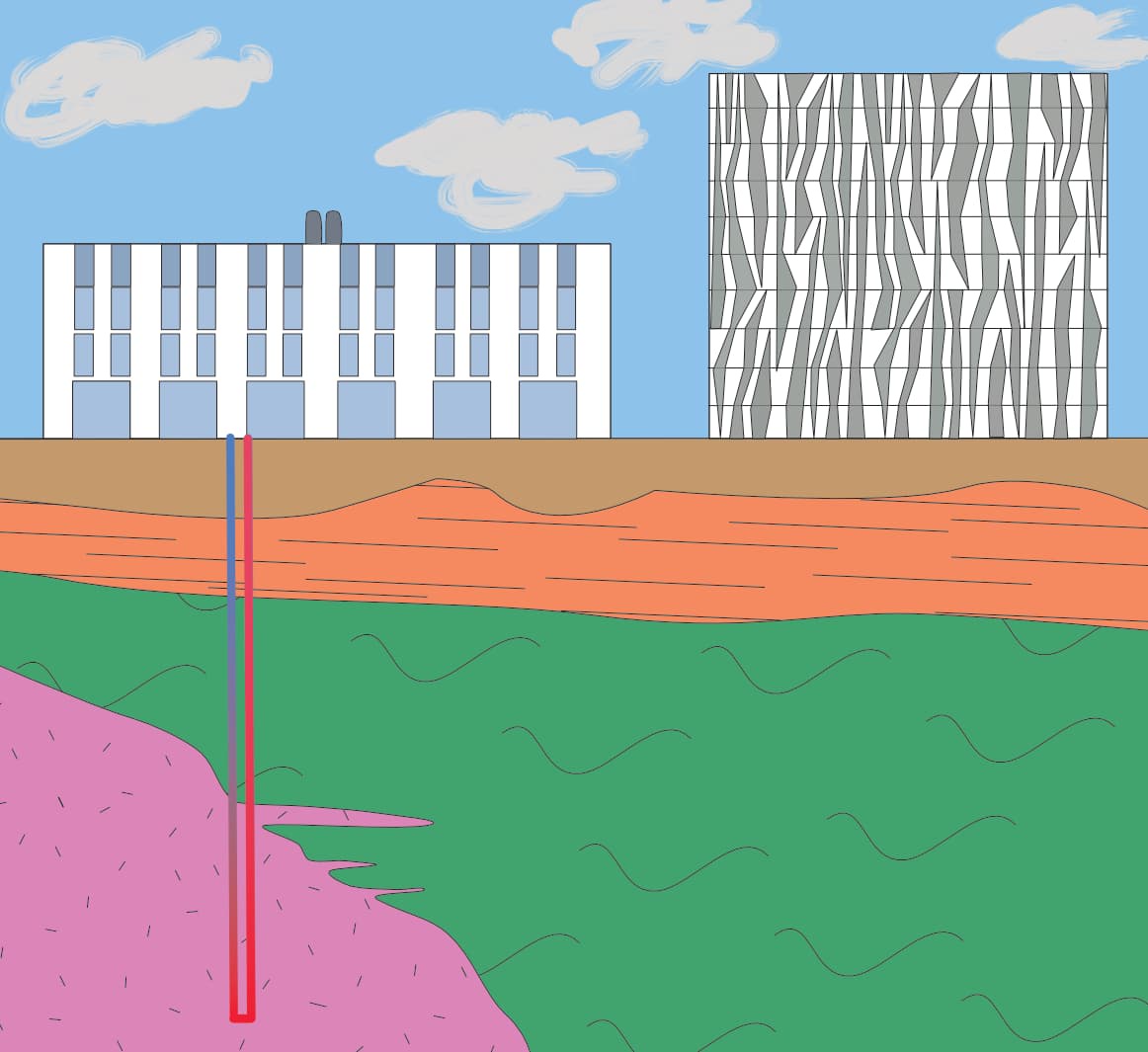
This geothermal schematic graphic shows how heat could be extracted in the future by pumping hot water from depth to the surface to heat buildings before circulating the cooler water back to depth to be re-heated.
The Aberdeen Geothermal Feasibility Pilot (AGFP) is an ambitious city-wide collaboration to explore Aberdeen’s geological potential and pave the way for low-carbon heating solutions.

We have deployed 32 seismic nodes across the University campus, ahead of our city-wide deployment in early 2026.

The Aberdeen Geothermal Feasibility Pilot (AGFP) will be presenting at Geothermal 2026 in March, organised by SPE and in our home city of Aberdeen.
Project kickstarted with an online meeting with 50 attendees, including partners and industry representatives.
Borehole plan submitted to Aberdeen City Council. We plan to drill a 500m deep borehole on campus to provide an observatory for measuring rock properties and temperature.
Formal announcement of the award of a £1m capital grant from UKRI - NERC to drill a research borehole on the University of Aberdeen campus to explore the geothermal potential of our city.
Initial seismic node deployment on the University campus. 32 seismic nodes will collect ambient seismic noise data over the festive period to test subsurface conditions. A city-wide node deployment will follow in the early 2026.
Since our initial project launch seminar, we’ve built a 53 strong (and growing) community of organisations who have expressed support for geothermal in Aberdeen, and a core group of 10 partners all passionate about advancing geothermal in Aberdeen (and beyond).
We’re striving to engage communities as well as organisations in our project to accelerate geothermal in Aberdeen. We have launched this website, received a motion in the Scottish Parliament (S6M-20095), and been active in radio, TV and news articles.
If you live in Aberdeen you can fill in this simple form to register your interest in hosting one of our seismic nodes for 1-2 months that will help image the rocks under Aberdeen city. You will need to have access to a small green space and give us your name and postcode.
The Aberdeen Geothermal Feasibility Pilot (AGFP) is a transdisciplinary research and infrastructure project that directly addresses strategic priorities in Earth science, environmental change and sustainable energy.
AGFP will generate the first high-resolution geological and geothermal datasets for the Aberdeen granite pluton and surrounding rocks. By drilling and instrumenting a research borehole (>500 m) and deploying ~100 passive seismic nodes, the project will create open datasets on crustal heat flow, hydrogeology and subsurface structure of national and international research value.
Geothermal feasibility demonstration with innovative drilling and geophysical methods, coupled with public awareness, will enable replication and application to all urban locations.
Heating is a major source of UK greenhouse-gas emissions. By quantifying the geothermal potential of the Aberdeen granite, the project provides the scientific evidence base for a new renewable heat source, contributing to UK Net Zero targets and commitment to climate solutions.
All seismic, borehole and heat-flow data will be curated as open-access assets for the UK research community, creating a permanent “living laboratory” that supports future funding applications, PhD projects and cross-disciplinary collaborations (e.g. hydrogeology, geochemistry, geomechanics).
The AGFP consortium links the University of Aberdeen with the British Geological Survey, NHS Grampian, Aberdeen City Council, University of Leeds, Robert Gordon University, Aberdeen Heat and Power, TU Delft, the National Geothermal Centre, the Net Zero Technology Centre, Aberdeen Renewable Energy Group, and industry partners, providing an exemplary model of research-to-impact. Future skills training and a public “fuel-poverty and heating atlas” project phases ensure the science is embedded in community decision-making.

AGFP is supported by a broad consortium of collaborator and partner organisations including Aberdeen Renewable Energy Group, NHS Grampian, Aberdeen City Council, Aberdeen Heat and Power, Robert Gordon University, the University of Leeds Campus Geothermal Project, the British Geological Survey, TU Delft, National Geothermal Centre, and the Net Zero Technology Centre, alongside several experienced and skilled geothermal industry partners and individuals.