

Music Education (BMus)
Introduction
Music Education at Aberdeen gives you the brilliant opportunity to learn, compose and perform with world-renowned composers and musicologists, working in all genres, styles and periods, with unrivalled opportunities to grow as a musician and performer and to specialise in the skills to inspire a new generation through music education in schools.
Study Information
At a Glance
- Learning Mode
- On Campus Learning
- Degree Qualification
- BMus
- Duration
- 48 months
- Study Mode
- Full Time
- Start Month
- September
- UCAS Code
- WX33
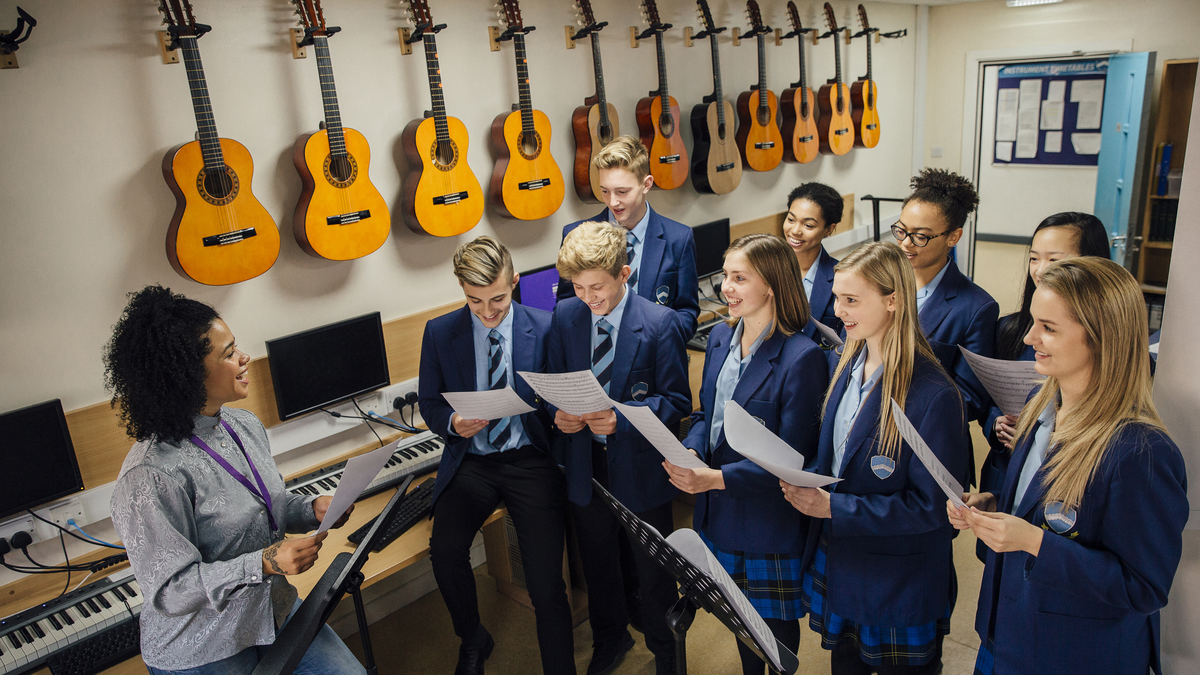
Aberdeen is the ideal environment and location in which to study music, with 500 years of outstanding musical history and heritage and a vibrant cultural identity which celebrates the traditional while embracing the modern, playing a huge role in the cultural life of north-east Scotland.
Our highly-regarded BMus programme gives the benefit of broad foundation in music before choosing to specialise in teaching in the BMus (Education) programme, or the BMus (Music and Communities) opening opportunities for working with music in non-formal settings.
In your first three years of your BMus (Education) programme, you will study performance, composition, theory, musicianship and a broad overview of music history which serves as the foundation for future study and specialising in your final year.
You will then combine the study of music with a qualification to teach in Scottish secondary schools, including school placements in your final year.
You will graduate perfectly prepared for a career in teaching music, with the additional option of applying your all-round knowledge and transferable skills should you decide to purse an alternative career such as in the media, or the music business.
What You'll Study
- Year 1
-
Year 1: Compulsory Courses
- Academic Writing for Language & Literature (AW1008)
-
This compulsory evaluation is designed to find out if your academic writing is of a sufficient standard to enable you to succeed at university and, if you need it, to provide support to improve. It is completed on-line via MyAberdeen with clear instructions to guide you through it. If you pass the evaluation at the first assessment it will not take much of your time. If you do not, you will be provided with resources to help you improve. This evaluation does not carry credits but if you do not complete it this will be recorded on your degree transcript.
- Getting Started at the University of Aberdeen (PD1002)
-
This course, which is prescribed for level 1 undergraduate students and articulating students who are in their first year at the University, is studied entirely online, takes approximately 2-3 hours to complete and can be taken in one sitting, or spread across the first 4 weeks of term.
Topics include University orientation overview, equality & diversity, MySkills, health, safety and cyber security, and academic integrity.
Successful completion of this course will be recorded on your Transcript as ‘Achieved’.
- Performing and Composing 1 (MU1027)
-
15 Credit Points
This course will engage students in practical music making, developing skills in performing and composing. Students will receive 10 hours of tuition with a specialist instrumental / vocal tutor, and attend lectures on topics such as genre, performance style, composing and arranging techniques, rehearsal etiquette, and stagecraft.
In groups of 5-8 performers, students attend a series of rehearsal sessions, where they will plan and manage a group creative project, culminating in a 10-minute performance as part of a mini festival in December.
Students will be expected to attend live performance events and participate in a range of music-making.
- Writing About Music (MU1028)
-
15 Credit Points
In this course you will explore ways of writing and talking about music. Lectures will focus on recent work in music studies, showcasing the kind of scholarship you will encounter later in your degree. Tutorials will provide opportunities for experimenting in a range of formal and informal styles, working both individually and in small groups. By the end of the course you will gain a deeper understanding of both established writing conventions and emerging forms of multi-media communication.
- Introduction to Music Theory and Harmony (Education) (MU1041)
-
15 Credit Points
In this course, basic concepts of Western tonal music such as primary triads, cadences, idiomatic chord progressions, and voice leading are taught using exercises in harmonic analysis, figured bass, and part writing. More advanced concepts such as secondary dominants and chromatically altered chords are also introduced. In parallel to lectures and tutorials, students will work with software designed to reinforce key concepts such as clefs, intervals, key signatures, and scale structures. The lectures will be taught to students on a range of programmes, but the tutorial will be for Music Education students only. This will allow for tailored support from staff with expertise in using theory and harmony skills as part of classroom pedagogy.
- Introduction to Music Studies (Education) (MU1540)
-
15 Credit Points
This course will examine key ideas and methodologies in music studies, incorporating approaches from a range of ‘disciplines’ such as musicology, ethnomusicology, performance studies, music education and community music. We will discuss a diverse range of topics including: cross cultural definitions of music; the role of music in society; different methodological approaches to the study of music history; how music is learnt in different places and times; and the relationship between music, economics and technology. The course will draw on case studies from musics both within the ‘western’ canon (such as European art music and popular music), as well as musical traditions from across the globe. The lectures will be taught to students on a range of programmes, but the tutorial will be for Music Education students only. This will allow for tailored support from staff with expertise in embedding music studies in classroom pedagogy.
- Performing and Composing 2 (MU1527)
-
15 Credit Points
Building on MU1027 Performing and Composing 1, this course will engage students in practical music making, developing skills in performing and composing. Students will receive 10 hours of tuition with a specialist instrumental / vocal tutor, and attend lectures on topics such as ensemble playing, group decision-making, and creative negotiation.
In groups of 5-8 performers, students attend a series of rehearsal sessions, where they will plan and manage a group creative project, culminating in a 10-minute performance as part of a mini festival in May.
Students will be expected to attend live performance events and participate in a range of music-making.
- Digital Musicianship: Music Making in the Digital Age (MU1538)
-
15 Credit Points
Combining key components in digital technology and musicianship, Digital Musicianship encourages music students to acquire basic digital skills that will help them explore a wide range of music making in the 21st century, through skill building in the applications of technology to the discipline of Music. This hands-on, project-based course introduces basic knowledge in digital music technology, and key issues related to the music making in the 21st century.
Year 1: Optional Courses
Plus 30 credit points from courses of choice.
- Year 2
-
Year 2: Compulsory Courses
- Performing 1 (MU2054)
-
15 Credit Points
This course focusses on student-led ensemble and solo performance. Students will receive 10 hours of tuition with a specialist instrumental / vocal tutor, and attend lectures on performance practice, style & genre, successful ensemble performance, practising, rehearsal etiquette, and stagecraft.
Students will be given the chance to present individual concepts for an ensemble performance project. Each successful bid will be allocated a group of 5-8 performers, who will develop each concept into a 10-minute public performance, as part of a mini-festival at the university in December.
- Performing 2 (Education) (MU2540)
-
15 Credit Points
This course focusses on solo performance alongside the development of core classroom performance skills. Students will receive 5 hours of tuition with a specialist instrumental / vocal tutor, as well as 10hrs of group tuition in Keyboard Skills, and 10hrs of group tuition in Vocal Skills.
Students will also have the opportunity to attend lectures on performance practice, interpretation, style & genre, practice regimes, managing performance anxiety, presentation and stagecraft. Students will be given opportunities to perform during performance lectures, receiving feedback from their peers and teaching staff, and honing their abilities to critique and evaluate performances.
- The Artist as an Agent for Change (Education) (MU2531)
-
15 Credit Points
The Artist as an Agent for Change explores the power music has to create and strengthen communities through activist approaches to social change. This interactive, activity-based course will bring together the academic and practical approaches to the field of Community Music through engagement with research, practical workshops and reflective dialogues.
This is an interactive, activity-based course that merges the academic and practical studies of Community Music.
Year 2: Optional Courses
Plus 30 credit points from Level 1 or 2 courses of choice.
Plus 30 credit points from the following level 2 courses:
- MU2055: Analysing Music (15 credits)
- MU2058: Global Music History (15 credits)
- MU2560: Music, Culture and Society (15 Credits)
Plus 15 credit points from Level 2 Music courses of choice (including any course listed above not already taken) and the following approved option:
- EF2501: Scottish Folklore and Oral Traditions (15 credits)
- Scottish Folklore and Oral Traditions (EF2501)
-
15 Credit Points
This course introduces students to the principal aspects of Scottish oral traditions from historical times to the present. It should appeal to both international and local students who are interested in learning more about traditional culture in Scotland, as well as the disciplines of Ethnology, Folklore, and Ethnomusicology.
- Analysing Music (MU2055)
-
15 Credit Points
Students will develop a critical awareness of form and structure in music by studying various approaches to musical analysis. The course will draw on a range of analytical methods and musical genres, such as functional harmony and classical form, pitch-class set theory, rhetoric in music, and computer-aided analysis.
- Global Music History (MU2058)
-
15 Credit Points
Ranging widely across space and time, this course introduces some of the reasons and methods for studying the musical past in a global context. Students will encounter case studies from across world history, with lectures summarising key topics and tutorials allowing for deeper discussion. Students will also consider how historical knowledge about music is itself the product of a global past and will be encouraged to question how we tell the stories of those who made music before us.
- Music, Culture and Society (MU2560)
-
15 Credit Points
Music plays an important part in our daily lives and is interwoven into the fabric of human social and cultural life. This course introduces students to key concepts in the study of music, culture and society (such as identity, place, religion, politics and globalisation) through a combination of lectures summarising key topics and tutorials allowing for deeper discussion. Students will approach these topics through a range of case studies from different musical genres and traditions.
- Year 3
-
Year 3: Compulsory Courses
- Music Education Studies 1 (MU3033)
-
15 Credit Points
This course will introduce students to learning and teaching in music education contexts. Through reflection and practical engagement, students will begin to develop a range of skills essential for teaching in the secondary school.
- Performing 3 (Education) (MU3062)
-
30 Credit Points
This course focusses on solo performance alongside the development of core classroom performance skills. Students will receive 10 hours of tuition with a specialist instrumental / vocal tutor, as well as 20hrs of group tuition in Keyboard Skills, and 20hrs of group tuition in Classroom Instruments and Vocal Skills.
Students will have the opportunity to attend lectures on performance practice & interpretation, style & genre, practice regimes, managing performance anxiety, presentation and stagecraft. Students will be given opportunities to perform during performance lectures, receiving feedback from their peers and teaching staff, and honing their abilities to critique and evaluate performances.
- Music Education Studies 2 (MU3533)
-
15 Credit Points
This course will introduce students to learning and teaching in music education contexts. Through reflection and practical engagement, students will begin to develop a range of skills essential for teaching in the secondary school.
Year 3: Optional Courses
Plus 30 credit points from Music courses of choice which may include the following approved options:
- FS3017: Film and Music (30 credits)
- ME33PE: Music, Health and Wellbeing (Public Engagement) (30 credits)
- FS3535: Eurovision: Media, Memory, Euphoria & Identities (30 Credits)
Plus 30 credit points from courses of choice.
- Film and Music (FS3017)
-
30 Credit Points
Music has been fundamental to the way that cinema tells stories. Whether through a specially-composed soundtrack or through the careful selection of existing pieces, music cues characters, evokes a sense of place or atmosphere, be it suspense, horror, nostalgia, or romance. This course will offer students the opportunity to critically engage with some of the most emblematic film soundtracks in the history of cinema.
This interdisciplinary course is suitable for students of Film & Visual Culture or Music. You do not need to be experienced in the study of both subjects to take this course.
- Music, Health and Wellbeing (Public Engagement) (ME33PE)
-
30 Credit Points
This course will explore practices and research from the fields of music, therapy, public health and medicine, to rigorously explore the relationship between music, health and wellbeing.
The course differs from its 15 credit counterpart through its extended work in conjunction with NHS Grampians Public Engagement team in the design and implementation of music, health and wellbeing interventions.
- Eurovision: Media, Memory, Euphoria & Identities (FS3535)
-
30 Credit Points
Eurovision is the largest musical event in the world, followed by 70 million people every year. Since its beginnings in 1956, the concept of Eurovision has been changing over the years and through different historical periods, especially with regard to conflicts and European identity and sense of belonging.
The popularity of the event makes it globally recognized by the general public, but what is hidden behind the festival? what meanings do the performances and visual representations have? how are countries, different cultures and folklore represented? Is Eurovision political? How does Eurovision represent national identity?
The purpose of this course is to study the different representation methods offered by the Eurovision Song Contest through not only its history, but also analysing the most recent examples of the festival, focusing especially on the new millennium, with the arrival of new countries into the contest.
- Year 4
-
Year 4: Compulsory Courses
ED40XP: Learning and Teaching in Schools (Music)
- School Experience 1 and 2 (ED402Q)
-
60 Credit Points
As part of the PGDE (Secondary) programme, this professional placement provides an opportunity for students to apply their knowledge of issues in Scottish Education and pedagogical theory in a practical context.
- Learning and Teaching in Schools: Developing Professional Practice 1&2 (ED402R)
-
60 Credit Points
As part of the PGDE Secondary programme, this campus-based course provides a variety of learning experiences which develop students’ knowledge and understanding of current issues in Scottish Education. Students will engage with pedagogical theory to support the development of professional values and skills in preparation for School Experience.
We will endeavour to make all course options available. However, these may be subject to change - see our Student Terms and Conditions page. In exceptional circumstances there may be additional fees associated with specialist courses, for example field trips.
How You'll Study
Learning Methods
- Individual Projects
- Lectures
- Research
- Tutorials
Assessment Methods
Students are assessed by any combination of three assessment methods:
- Coursework such as essays and reports completed throughout the course.
- Practical assessments of the skills and competencies they learn on the course.
- Written examinations at the end of each course.
The exact mix of these methods differs between subject areas, years of study and individual courses.
Honours projects are typically assessed on the basis of a written dissertation.
Why Study Music Education?
- Academic staff who are internationally recognised experts in composition, performance, musicology, music in schools and communities, including many rising student stars.
- Specialist facilities including three state-of-the-art Electroacoustic Composition studios as well as Music Technology workstations.
- A wonderful collection of historic instruments including a 1771 Kirkman harpsichord, also full Balinese Gamelan, Steel Pans and Samba/Salsa instruments.
- Instrumental/vocal courses available in all years of the programme, with tuition costs normally covered by the University.
- University Symphony Orchestra, Chamber and Chapel choirs with growing international reputations, Choral Society, String Ensemble, Viol Consort, Recorder Consort, New Music Group, Baroque Ensemble, Concert Band, Big Band, Opera Society, chamber groups and many more.
- Excellent performance opportunities with the early sixteenth-century Chapel often used for services and performances of sacred and concert music.
- Our Chapel boasts an all-mechanical pipe organ built by the French builder Aubertin – the first by this builder in the UK.
- Opportunities to perform at University ceremonies, graduations, recitals, VIP visits, formal dinners and festivals.
- The prestigious Ogston Music Prize, and a range of scholarships and special support for outstanding students.
- Aberdeen city is known as a lively centre for music, and links with the BBC Scottish Symphony Orchestra, Aberdeen City Music School, North East of Scotland Music School, the Sound Festival and other organisations continue to develop.
- Opportunities to take part in masterclasses led by visiting musicians.
- A packed campus programme of student and public events, exhibitions, seminars, invited speakers and the annual May Festival which welcomes internationally acclaimed musicians, choirs and orchestras to campus every spring.
Interested in this programme?
Entry Requirements
Qualifications
The information below is provided as a guide only and does not guarantee entry to the University of Aberdeen.
General Entry Requirements
- 2026 Entry
-
SQA Highers
Applicants who achieve BBBB in four distinct disciplines are encouraged to apply. We do not double count a Higher and Advanced Higher in the same subject.
Higher Music is preferred.
Foundation Apprenticeship: One FA is equivalent to a Higher at A. It cannot replace any required subjects.
Higher English is required at Grade C or above.
National 5 in Mathematics or Applications of Mathematics is required at Grade C or above.
Applicants must also meet the General Teaching Council of Scotland (GTCS) requirements before entry to the fourth year their degree.
Candidates are required to demonstrate a strong interest in the study of music and secondary music teaching as a profession. Entry to the programme will be assessed on the strength of the candidate’s academic record, performance skills and personal statement. Candidates are required to have a competence on an instrument or voice as well as basic piano skills. Graded qualifications on instrument or voice are welcome but are not essential. Candidates will be invited to interview.
A Protection of Vulnerable Group (PVG) check through Disclosure Scotland will be conducted by the University. This is required of all applicants who firmly accept an unconditional offer of admission (so their status is UF), even those who have been checked previously.
A LEVELS
Three A Levels at BBC. A Level Music is preferred.
GCSE Mathematics is required at Grade C/4 or above.
GCSE English Language and GCSE English Literature are required at Grade C/4 or above.
Applicants must also meet the General Teaching Council of Scotland (GTCS) requirements before entry to the fourth year their degree.
Candidates are required to demonstrate a strong interest in the study of music and secondary music teaching as a profession. Entry to the programme will be assessed on the strength of the candidate’s academic record, performance skills and personal statement. Candidates are required to have a competence on an instrument or voice as well as basic piano skills. Graded qualifications on instrument or voice are welcome but are not essential. Candidates will be invited to interview.
A Protection of Vulnerable Group (PVG) check through Disclosure Scotland will be conducted by the University. This is required of all applicants who firmly accept an unconditional offer of admission (so their status is UF), even those who have been checked previously.
IRISH LEAVING CERTIFICATE
Five subjects at H3. Music at Higher preferred.
O4 Mathematics and H3 English are required.
Applicants must also meet the General Teaching Council of Scotland (GTCS) requirements before entry to the fourth year their degree.
Candidates are required to demonstrate a strong interest in the study of music and secondary music teaching as a profession. Entry to the programme will be assessed on the strength of the candidate’s academic record, performance skills and personal statement. Candidates are required to have a competence on an instrument or voice as well as basic piano skills. Graded qualifications on instrument or voice are welcome but are not essential. Candidates will be invited to interview.
A Protection of Vulnerable Group (PVG) check through Disclosure Scotland will be conducted by the University. This is required of all applicants who firmly accept an unconditional offer of admission (so their status is UF), even those who have been checked previously.
INTERNATIONAL BACCALAUREATE
32 points at 5, 5, 5. Music at HL5 or above is preferred.
SL in Mathematics or Mathematics Studies at 4 or above and HL in English at 5 or above are also required.
Applicants must also meet the General Teaching Council of Scotland (GTCS) requirements before entry to the fourth year their degree.
Candidates are required to demonstrate a strong interest in the study of music and secondary music teaching as a profession. Entry to the programme will be assessed on the strength of the candidate’s academic record, performance skills and personal statement. Candidates are required to have a competence on an instrument or voice as well as basic piano skills. Graded qualifications on instrument or voice are welcome but are not essential. Candidates will be invited to interview.
A Protection of Vulnerable Group (PVG) check through Disclosure Scotland will be conducted by the University. This is required of all applicants who firmly accept an unconditional offer of admission (so their status is UF), even those who have been checked previously.
Additional Information
Entry from College (Articulation)
Year 2 entry: Satisfactory completion of HNC Music (120 SCQF credit points), Interview, Audition, PVG Check, Higher English and Nat5 Maths (or equivalent).
Studying Music or Music Education at the University of Aberdeen requires an ability to read and write musical notation. Entry to these degrees is conditional on your academic achievements so far, as well as your performance at interview and audition.
For the audition, you will be expected to play or sing a short piece of music of your choice. Choose something that enables you to demonstrate your technical ability on your instrument or voice, and be prepared to answer questions about the piece you have chosen. Your interview will focus on the breadth and depth of your knowledge of music and your interest in it. Be prepared to be asked about music in different genres to the one that you have performed, including classical music (which is an important ingredient of the Music and Music Education degrees at Aberdeen, amongst many other styles and genres).
Year 3 entry: Satisfactory completion of HND Music (240 SCQF) credit points, Interview, Audition, PVG Check, Higher English and Nat5 Maths (or equivalent).
For the audition, you will be expected to play or sing a short piece of music of your choice. Choose something that enables you to demonstrate your technical ability on your instrument or voice, and be prepared to answer questions about the piece you have chosen. Your interview will focus on the breadth and depth of your knowledge of music and your interest in it. Be prepared to be asked about music in different genres to the one that you have performed, including classical music (which is an important ingredient of the Music and Music Education degrees at Aberdeen, amongst many other styles and genres).
The information displayed in this section shows a shortened summary of our entry requirements. For more information, or for full entry requirements for Music degrees, see our detailed entry requirements section.
Fees and Funding
You will be classified as one of the fee categories below.
- EU / International students
-
- Tuition Fees for 2026/27 Academic Year
- £20,800
- Tuition Fees for 2026/27 Academic Year (Self-funded Students *)
- £14,800
-
The above fee includes the £6,000 Aberdeen Global Scholarship provided to self-funded international students. Full terms and conditions apply.
- Home Students
-
- Tuition Fees for 2026/27 Academic Year
- £1,820
- England, Wales, Northern Ireland, and Republic of Ireland
-
- Tuition Fees for 2026/27 Academic Year
- £9,790
-
The UK Government has confirmed that the RUK fee cap will continue to increase each year to reflect inflation. Tuition fees will increase in line with the Government fee cap each year, and this should be taken into account when budgeting.
Scholarships and Funding
UK Scholarship
Students from England, Wales and Northern Ireland, who pay tuition fees may be eligible for specific scholarships allowing them to receive additional funding. These are designed to provide assistance to help students support themselves during their time at Aberdeen.
Aberdeen Global Scholarship
The University of Aberdeen is delighted to offer eligible self-funded international on-campus undergraduate students a £6,000 scholarship for every year of their programme. More about this funding opportunity.
Funding Database
View all funding options in our Funding Database.
Careers
There are many opportunities at the University of Aberdeen to develop your knowledge, gain experience and build a competitive set of skills to enhance your employability. This is essential for your future career success. The Careers and Employability Service can help you to plan your career and support your choices throughout your time with us, from first to final year – and beyond.
- More information on employability at the University of Aberdeen
- More information on the Careers and Employability Service
What our Alumni Say
Our Experts
Information About Staff Changes
You will be taught by a range of experts including professors, lecturers, teaching fellows and postgraduate tutors. However, these may be subject to change - see our Student Terms and Conditions page.
Discover Uni
Discover Uni draws together comparable information in areas students have identified as important in making decisions about what and where to study. You can compare these and other data for different degree programmes in which you are interested.
Get in Touch
Contact Details
- Address
-
Student Recruitment & Admissions
University of Aberdeen
University Office
Regent Walk
Aberdeen
AB24 3FX