
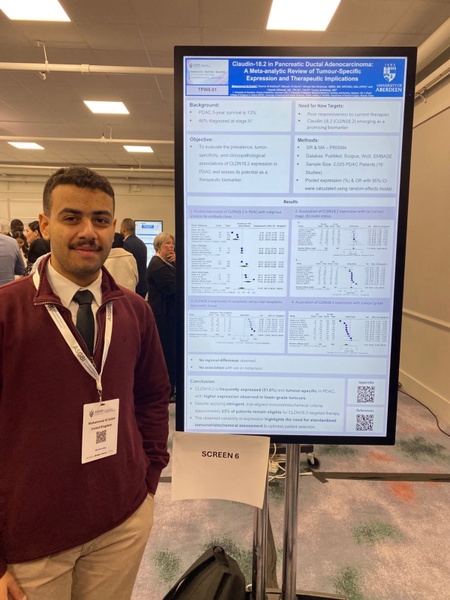
This May, I had the opportunity to present two pieces of research at the Association of Surgeons of Great Britain and Ireland (ASGBI) Annual Conference in Brighton. I delivered one of the pieces as an oral presentation and the other as a talking poster.
Do we need to close the wounds from keyhole surgery?
In laparoscopic, also known as keyhole, surgery, instruments are inserted into the abdominal cavity through small cuts in the abdominal wall, which are known as port sites. These port sites come in different sizes depending on the type of instrument needed for different surgeries. A longstanding debate exists as to whether this surgically created cut to the deeper layer of tissue, the fascia, should be stitched closed or not. Leaving the cut open risks a port-site hernia, a defect through which abdominal contents can protrude, but closing it might add time and complexity to the procedure.
Our systematic review and meta-analysis, which is now published in Hernia (2026), included six studies with over 1,000 patients. We found that fascial closure was associated with a 62% relative reduction in port-site hernia risk. However, the absolute benefit was just 1%, with approximately 100 port-site closures needed to prevent a single hernia. This discrepancy between relative and absolute risk reflects the rarity of port-site hernia. Furthermore, fascial closure did not increase infection, bleeding, or operative time. In conclusion, our findings suggest that routine closure might not be necessary for everyone; instead, a selective, risk-based approach might be more appropriate. More high-quality randomised controlled trials are needed to strengthen the evidence base.
A new target for one of surgery's hardest cancers
The second study, now published in Frontiers in Medicine (2026), addressed a very different problem: pancreatic ductal adenocarcinoma, or PDAC. This malignancy is one of the most aggressive cancers we face, with a five-year survival rate of just 13% and nearly half of patients diagnosed at an advanced stage. The search for new therapeutic targets is urgent due to the limited effectiveness of current treatments.
Our meta-analysis of 16 studies and over 2,000 patients evaluated Claudin-18.2 (CLDN18.2) expression in PDAC. CLDN18.2 is a protein increasingly recognised as a promising target for cancer-directed therapy. We found that CLDN18.2 is expressed in more than half of PDAC patients. Applying the strict criteria used in clinical trials, approximately 23% of patients would still be eligible for CLDN18.2-targeted therapy. Interestingly, CLDN18.2 is highly tumour-specific, meaning healthy tissue is largely spared. Expression was higher in lower-grade tumours, and we found no association with sex, nodal status, or metastasis.
Finally, I would like to express my gratitude to the University of Aberdeen for supporting me to attend and present at this high-profile conference. Additionally, I would like to thank my supervisor Dr Younis Al-Mufargi and all my co-authors.
To read full text:
- Al-Mufargi, Y., Al Subhi, M., Al-Yousufi, M. et al. Fascial closure versus non-closure of laparoscopic port sites: a systematic review and meta-analysis. Hernia 30, 175 (2026). https://doi.org/10.1007/s10029-026-03675-x
- Al Subhi M, Al-Nabhani D, Al Sarmi M, Abd Elrahman A, AlSawafi Y, Sirasanagandla SR and Al-Mufargi Y (2026) Expression of Claudin-18.2 in pancreatic ductal adenocarcinoma: a systematic review and meta-analysis. Front. Med. 13:1809374. doi: 10.3389/fmed.2026.1809374