Quick Links
Navigate the JUST-Systems Website
JUST-Systems is a UKRI-funded £5.6 million, five-year research programme designed to place people and communities at the heart of the Net Zero transition.
Delivered through a partnership between the Universities of Aberdeen, Stirling, Strathclyde, Edinburgh, Reading, and Warwick, the programme will work closely with five regional case studies - Aberdeen, Clackmannanshire, East Ayrshire, Reading, and Wales.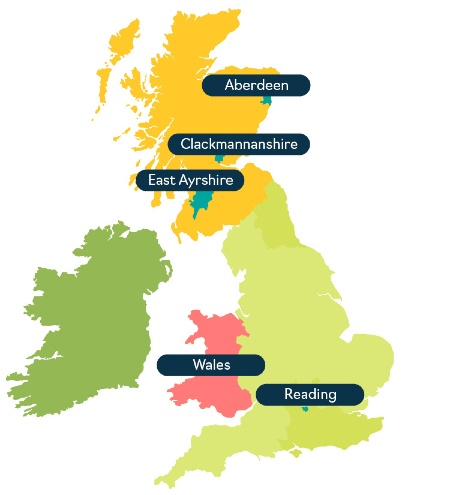
Achieving Net Zero is one of the defining challenges of our time, but it is also a source of growing tension. While technical innovations are accelerating decarbonisation, the wider social benefits for communities remain unclear. The UK’s green economy is expanding, yet many households are experiencing a cost-of-living crisis, deepening poverty, and rising inequality. Energy insecurity continues to embed fuel poverty in vulnerable areas, while regional infrastructure and housing remain unfit for a low-carbon future.
In this context, the concept of a Just Transition—ensuring fairness, equity, and inclusion in climate action—has taken centre stage in both climate and regional policy. A Just Transition calls for stronger links between green technologies and improved livelihoods, skills, wellbeing, and vibrant local economies.
There is growing interest in place-based approaches that support decarbonisation while delivering community wealth and resilience. However, many of these initiatives remain isolated or limited in scale, constrained by fragmented systems of planning, finance, infrastructure, and social values.
By applying systems thinking and co-developing place-based solutions, JUST-Systems aims to accelerate decarbonisation while delivering tangible benefits in local economies, public health, and social justice, ensuring Net Zero works for people as well as the planet.
About JUST-Systems
Funded by UK Research and Innovation Building a Green Future, strategic theme grant number UKRI357 2025-2030.
- Our Mission Statement
-
JUST-Systems will design and deliver systems approaches that support and build capacity for interventions that achieve a Just Transitionto Net Zero, focusing on people and place.
JUST-Systems will place people at the centre of change, accelerating action on decarbonisation, vibrant local economies, wellbeing and social justice. We want to identify alternative framings and interventionsfor just transitions,include a diversity of voices including from marginalised and excluded communities, improve the evidence base for transitions and scale up action on co-benifts.
JUST-Systems will facilitate dialogues and partnerships with communities and stakeholders and support shared learning and capacity building at scale drawing on holistic systems thinking to drive change.
- Our Objectives
-
Understand the perspectives, values and visions for Net Zero through the lens of people and place.
Align people 'centric' visions with evidence to understand pathways and trade-offs around interventions for achieving Net Zero that enhance co-benefits in health and wellbeing, local infrastructure and community wealth.
Apply the learning from five case studies that represent a diversity of Net Zero challenges to build pragmatic, people centred and robust solutions at scale and across sectors.
Build local capacity and resilience and accelerate action to achieve the 2030 UK climate targets.
Case Studies
Our case studies will contribute to understanding key issues in local places and as exemplars for more widespread action. Centred around capacity building, learning and engagement the cases include:
Community energy as a pathway to local just transition.
Heat networks, local communities and energy justice.
Sustainable retrofit, homes and health.

Aging in place, domiciliary care and decarbonisation.
Green recovery and rural transformation.
Work Packages

- WP1
-
- Project oversight & governance
- Coordination of interdisciplinary science & impact
- WP2
-
- Energy, carbon, economic modelling (MOHRES +) + new social, built and health metrics
- Development of public interface for Net Zero Systems Platform
- WP3
-
- Deep local engagement with stakeholders with emphasis on marginalised and unrepresented groups
- Exploring alternatives & options and interventions that are socially acceptable
- WP4
-
- Synthesis of 5 case studies into wider context
- Aligning policy and governance with whole systems approaches around key challenges
- WP5
-
- Capacity building & collective learning across the 5 case studies & partners
- Delivery of Capacity Building Fund
News and Updates
For live updates, commentary and blogs on the project visit the JUST-Systems LinkedIn page