
Numerical Modeling of Sand Injectite Formation
Research is concentrated at the moment on modelling various shapes of sand intrusions by using Finite Difference Method. It enables to model in a very simple way hydraulic fracturing caused by overpressured sand - pore fluid mixture. Fracturing occurs when the tensile strength of the rock is exceeded by maximum principal stress. This is Mode 1 fracture criterion (Griffith's criterion). The basis for the code is elasticity theory describing stresses and strain rates. The code was developed in cooperation with PGP - Oslo, Norway.
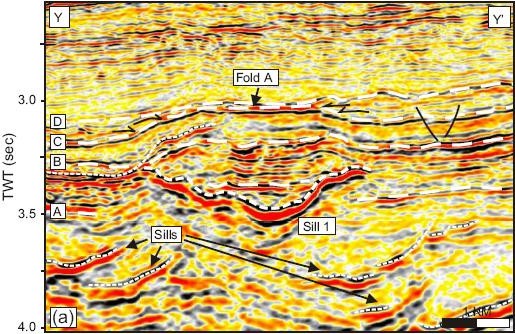
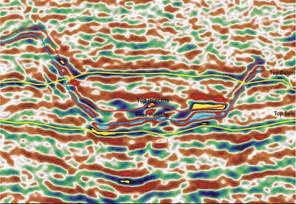
Initial models are similar to those run for igneous intrusions. Observations indicate numerous similarities between sand and igneous intrusions, especially with regards to their shape and size, despite differences in rheological properties. This has lead to a hypothesis that the main factor underlying formation of intrusions is the stress field present in the host rock at the time of the intrusion emplacement.
Another step in modelling will be development of Finite Element Code enabling to construct more complicated geometries, which should provide more realistic results.
The third code that is used for modelling sand injectites is the SAGE code developed at Los Alamos National Laboratory, which is a multiphase, multi-material code which utilizes a self refining mesh. Models can be run in 1D, 2D and 3D as well as in various coordinate systems (Cartesian, cylindrical and spherical).
Illustrations of seismic-scale igneous (left) and sand intrusions (right).
 |
 |