
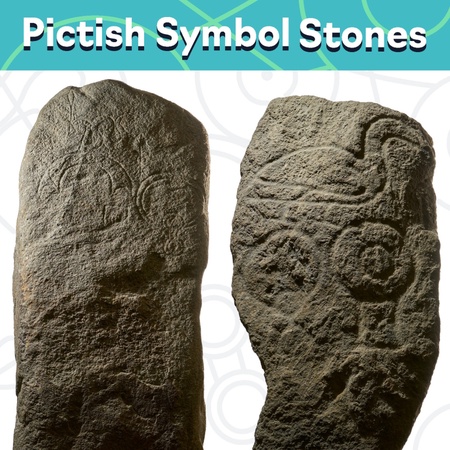
From now until the end of the year, visitors to the University Campus can follow a trail to see eight Pictish Symbol Stones from the Collections. Pick up a leaflet from the Library, Zoology Museum and other venues on campus.
The Picts and Their Symbols
The Picts, the “painted people”, first mentioned in Roman sources, emerged as a dominant power in northern Britain from around AD 300 to 900. Their territory stretched from north of the Firth of Forth into the Highlands and Northern and Western Isles. Although written evidence about them is limited, the Picts left a remarkable artistic legacy in their carved stones.
The most distinctive feature of Pictish art is its symbol tradition: a collection of abstract and naturalistic designs, including animals and recognisable objects such as mirrors and combs. More than 200 examples are known, particularly across eastern and northern Scotland. Symbols also appear on metalwork, bone, cave walls and other objects.
What did these symbols mean? Their precise meaning remains uncertain. Suggestions have included religious beliefs, rank, group identity, marriage alliances and memorials. Some evidence, particularly from Christian cross-slabs, suggests that symbols may have identified individuals, perhaps conveying names or the identities of important people.
As you explore the Pictish stones at the University of Aberdeen, look closely at the symbols and ask: what stories, identities or meanings might these remarkable carvings have conveyed?
Where you can see the stones

Pictish Symbol Stones Trail Leaflet
- Hosted by
- Venue
-
If you would like more information you can contact us at uoacollections@abdn.ac.uk
- Add to Calendar