

BA, PGDHS, MA, PhD, FHEA, FRHistS, OSS 大将軍
Senior Lecturer
- About
-
- Email Address
- bradford.bow@abdn.ac.uk
- Office Address
- More Contact Information
- School/Department
- School of Divinity, History, Philosophy & Art History
Biography
Dr Bradford Bow is an intellectual historian of America, Scotland and Britain during the long eighteenth century, with a broader interest in the global contexts of Enlightenment intellectual and moral culture. Dr Bow completed a PhD in the fields of Enlightenment History and Scottish Diaspora Studies at the University of Edinburgh in 2012. During the 2012-13 academic year, he held a postdoctoral fellowship at the Institute for Advanced Studies in the Humanities (IASH) and an adjunct lecturing position at Edinburgh University. At that time, he also served as the Acting Director of the MSc Intellectual History programme and organised research activities for the Carnegie Trust funded project ‘Scotland’s Trans-Atlantic Relations’ (STAR). Following this, he held the inaugural Jack Miller Center-Huntington Research Fellowship at the Huntington Library. Dr Bow returned to the University of Edinburgh during the 2013-14 academic year as a Teaching Fellow in Enlightenment History and Deputy Director of the MSc Intellectual History programme. Afterwards, he was an Assistant Professor of Global Intellectual History at Yonsei University (Seoul, South Korea) between 2014 and 2019. Dr Bow joined the School of Divinity, History and Philosophy in August 2019. He is a Fellow of the Royal Historical Society, Fellow of the Higher Education Academy, and Distinguished Shinhan Professor at Yonsei University.
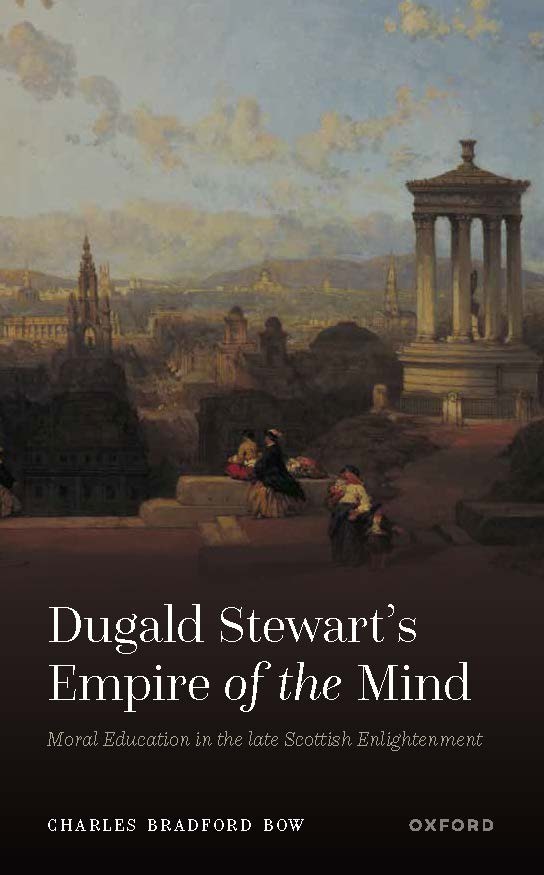
Dugald Stewart's Empire of the Mind: Moral Education in the late Scottish Enlightenment (OUP, 2022).
Dugald Stewart's Empire of the Mind recasts the cultivation of a democratic intellect in the late Scottish Enlightenment. It comprises an intellectual history of what was at stake in moral education during a transitional period of revolutionary change between 1772 and 1828. The democratization of Stewart's didactic Enlightenment—the instruction of moral improvement—in a globalizing, interconnected nineteenth-century knowledge economy is examined in this book.
- Research
-
Research Overview
My research interests centre on the global intellectual history of Scottish Enlightenment philosophy during the long eighteenth century (1660-1840). From a transnational and global perspective, I address questions concerning the conception, diffusion, and reception of the Scottish philosophical tradition of teaching metaphysics as moral philosophy, applied ethics, and political economy.
Current Research
The two strands of my current research centre on two large-scale book projects that examine the global intellectual history of the Scottish Enlightenment in the British imperial world and the intellectual history of Aberdonian common sense.
My book project on the eastern frontiers of the Scottish Enlightenment during its supposed decline in the British Isles is a comparative study of Scottish empiricism amongst British philosophical and literary societies at Madras, Calcutta and Bombay from c.1784 to 1833. It aims to shed new light on the role of Scottish Enlightenment naturalism within an interconnected British imperial world.
My book manuscript, The Wise Club: The Aberdeen Philosophical Society in the Scottish Enlightenment, explores different versions of ‘common sense’ that the Wise Club, which included Thomas Reid (1710-96), George Campbell (1719-96), John Gregory (1724-73), Alexander Gerard (1728-95), and James Beattie (1735-1803), set forth in their unpublished philosophical discourses and debates at taverns in Aberdeen between 1758 and 1773.
Past Research
My monograph, Dugald Stewart's Empire of the Mind, published by Oxford University Press in August 2022 sets forth a new understanding of the late Scottish Enlightenment in its transatlantic contexts. It comprises an intellectual history of what was at stake in moral education during a transitional period of revolutionary change in Scottish intellectual culture and within a globalising knowledge economy between 1772 and 1828. Seminal works in this field identify continuity of thought in the ‘spirit’ of a distinctive Scottish School of philosophy and a cross-generational ‘democratic intellect’ that took shape through the Scottish philosophical tradition in higher education. However, the legacy of Scottish philosophy in nineteenth-century education is largely misunderstood due to the scholarly marginalisation of Stewart’s educational doctrine. My book argues that Stewart’s novel and historically significant systematic approach to lifelong education democratised the Scottish Enlightenment pattern of philosophical thinking in the nineteenth-century Atlantic world and reformed the moral economy of the British imperial world.
Building on a very well-received podcast series that I coordinated, my co-edited volume with Michael Brown, 525 Years in the Pursuit of Truth: A New History of the University of Aberdeen, which is in production with Aberdeen University Press, explores the University’s transnational transmission of ideas since the foundation of King’s. And my edited volume, Common Sense in the Scottish Enlightenment, published by Oxford University Press in 2018 established a new understanding of the most influential philosophical system in the Scottish Enlightenment.
- Teaching
-
Programmes
- Postgraduate, 3 year, January start
- Postgraduate, 1 , September start
- Postgraduate, 1 , September start
- Undergraduate, 4 year, September start
Courses
- The Enlightenment in Global History (HI407D)
Teaching Responsibilities
Areas of PG Supervision
I welcome approaches from prospective postgraduate students with an interest in eighteenth- and nineteenth-century Scottish, British, American, Atlantic, Global, and Enlightenment History.
- Publications
-
Page 1 of 5 Results 1 to 10 of 41
Introduction: Witherspoon in His Transatlantic Contexts
Journal of Scottish Thought, vol. 14, no. 1Contributions to Journals: Articles- [ONLINE] DOI: https://doi.org/10.57132/jst.419
- [OPEN ACCESS] http://aura.abdn.ac.uk/bitstreams/e12ace38-0319-4e34-be1d-4d48ac174f30/download
Witherspoon and Beattie on the Philosophy of Common Sense Abolitionism
Journal of Scottish Thought, vol. 14, no. 1, pp. 94-110Contributions to Journals: ArticlesThe Scottish Enlightenment
Chapters in Books, Reports and Conference Proceedings: Entries for Encyclopedias and DictionariesReview of Paul Wood, Thomas Reid and the University (Edinburgh University Press, 2021)
Journal of Scottish Philosophy, vol. 22, no. 3, pp. 237Contributions to Journals: Reviews of Books, Films and ArticlesAntti Lepistö. The Rise of Common-Sense Conservatism: The American Right and the Reinvention of the Scottish Enlightenment.: Chicago : University of Chicago Press , 2021 . Pp. 261 . Cloth $40.00.
American Historical Review, vol. 129, no. 2, pp. 744-745Contributions to Journals: Reviews of Books, Films and Articles- [ONLINE] DOI: https://doi.org/10.1093/ahr/rhae027
Becoming White in the American Enlightenment
Journal of Scottish Philosophy, vol. 22, no. 2, pp. 149-172Contributions to Journals: ArticlesA Commonwealth Union for Anglo-Atlantic Empire: Sir William Keith on the Political Economy of Publick Spirit
Journal of Imperial and Commonwealth HistoryContributions to Journals: ArticlesReview of Craig Beveridge, Recovering Scottish History: John Hill Burton and Scottish National Identity in the Nineteenth Century (Edinburgh: Edinburgh University Press, 2022)
Scottish Historical Review, vol. 103, no. 1, pp. 200-201Contributions to Journals: Reviews of Books, Films and Articles- [ONLINE] DOI: https://doi.org/10.3366/shr.2024.0663
Review of Onur Ulas Ince, Colonial Capitalism and the Dilemmas of Liberalism (Oxford University Press, 2018)
Intellectual History Review, vol. 34, no. 2, pp. 514-516Contributions to Journals: Reviews of Books, Films and Articles- [ONLINE] DOI: https://doi.org/10.1080/17496977.2023.2218052
Dugald Stewart's Empire of the Mind: Moral Education in the late Scottish Enlightenment
Oxford University Press (OUP). 254 pagesBooks and Reports: Books- [ONLINE] Book