
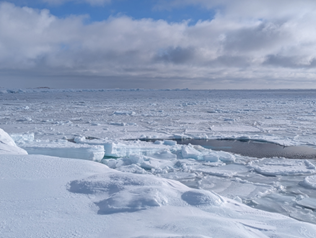

For many Arctic communities and ecosystems, one of the most impactful consequences of climate warming is the deterioration of coastal sea ice which forms along its coastline during winter and spring. This sea ice or siku is of immense importance to Indigenous Arctic communities, as it provides a crucial marine mammal and seabird habitat, is used extensively for travelling between otherwise isolated communities, and provides a key platform for subsistence hunting and fishing. For Inuit, sea ice is closely interconnected with social and cultural identity and around the Circumpolar North, sea ice has been and remains a recurring motif in art history and contemporary Inuit visual culture.
Dr Isabelle Gapp, Interdisciplinary Fellow in the Department of Art History and Co-Director of the Centre for the North at the University of Aberdeen, leads the British Academy Knowledge Frontiers: International Interdisciplinary Research Project titled ‘From the Floe Edge: Visualising Local Sea Ice Change in Kinngait, Nunavut’. The project examines the effects of Arctic sea ice change and its impacts on local communities in collaboration with Dr Sarah Cooley (Duke University) and co-partner West Baffin Co-operative, including Kinngait Studios, Canada’s longest-running print studio. The researchers and co-operative partners are bringing together printmaking and drawing with satellite imagery to transform innovative art historical and geographical research into stories, memories, scientific knowledge, and visual histories of local sea ice conditions.
This work has spawned a new partnership with Amundsen Science and the icebreaker the CCGS Amundsen, and in November 2026, the co-curated exhibition Drawn to the Edge will open at Metro Studio in Toronto (part of the West Baffin Co-operative) featuring drawings, prints, and photographs of the sea ice in Kinngait. Closer to home, on the 19th February we will host the Multi-Disciplinary Arctic Sea Ice Workshop featuring speakers from the UK, North America, and Europe discussing the scientific, geopolitical, linguistic, and cultural dimensions of Arctic sea ice. Register here.