
Page 1 of 171 to 10 of 165 Past Events
2026
August
July
-
Interdisciplinary seminar by Alex Groh
-Speaker: Alex Groh (University of Aberdeen) Title: A data driven approach to hospital length of stay prediction and capacity modelling Abstract: The uncertainty about the volume and the length of stay (LOS) of non-elective admissions poses a substantial barrier to efficient hospital organisation and planning. Predictive modelling of LOS using electronic health...
-
ACES Seminar - Dr Lizzie Driscoll
-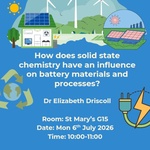
"How does solid state chemistry have an influence on battery materials and processes?"
-
Additional seminar by Dr Thea Newman
-Speaker: Dr Thea Newman (Solaravus Consulting). Title: Third Escape: perspectives on academic culture and management (after eight years on the lam). About the speaker: Thea Newman is an interdisciplinary scientist with a background spanning theoretical physics, biology, research leadership, and science communication. For over two decades, she has applied approaches from physics...
-
Interdisciplinary seminar by Dr Thea Newman
-Speaker: Dr Thea Newman (Solaravus Consulting). Title: First and Second Escapes: i) austere beauty in diffusion and ii) striking insights from a null model of metastasis. Abstract: In this talk I will explain some striking results from two papers published quite some time ago. The first topic concerns very high critical dimensions...
June
-
Encoding BDI Syntax with Theories in Event-B
-
Best paper award at ABZ 2026
-
Interdisciplinary seminar by Dr Marlijn Besten
-Speaker: Dr. Marlijn Besten, University Medical Center Groningen, Groningen Title: Breaking the cycle: the effects of therapeutic intervention techniques on cognitive and affective processes in individuals vulnerable to depressive relapse Abstract: Depression is one of the most common psychiatric disorders, and the risk of depressive relapse is high after having experienced a...
March
-
Interdisciplinary seminar by Dr Stephen Reynolds and Dr Christopher Dixon
-Speakers: Dr Christopher Dixon, Dr. Stephen Reynolds, University of Dundee Title: Green Hydrogen projects in rural Angus and elsewhere: Potential impacts of intermittency and constrained grids Abstract: A steady flow of projects incorporating Green Hydrogen based in eastern Scotland have been proposed over the past decade. Although few have reached completion, commercial...
-
Interdisciplinary seminar by Dr Takayoshi Yamamoto
-Speaker: Dr Takayoshi Yamamoto, Tokyo Gakugei University, Japan Title: From Diffusion to Mechanics: Multiscale Control of Embryonic Patterning Abstract: During embryogenesis, morphogens are secreted from localized sources and form concentration gradients that determine cell fates, ultimately leading to axis formation in the embryo. Traditionally, these gradients have been explained by simple diffusion models—much like milk dispersing...