
Page 1 of 21 to 100 of 165 Past Events
2026
August
July
-
Interdisciplinary seminar by Alex Groh
-Speaker: Alex Groh (University of Aberdeen) Title: A data driven approach to hospital length of stay prediction and capacity modelling Abstract: The uncertainty about the volume and the length of stay (LOS) of non-elective admissions poses a substantial barrier to efficient hospital organisation and planning. Predictive modelling of LOS using electronic health...
-
ACES Seminar - Dr Lizzie Driscoll
-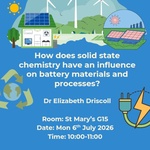
"How does solid state chemistry have an influence on battery materials and processes?"
-
Additional seminar by Dr Thea Newman
-Speaker: Dr Thea Newman (Solaravus Consulting). Title: Third Escape: perspectives on academic culture and management (after eight years on the lam). About the speaker: Thea Newman is an interdisciplinary scientist with a background spanning theoretical physics, biology, research leadership, and science communication. For over two decades, she has applied approaches from physics...
-
Interdisciplinary seminar by Dr Thea Newman
-Speaker: Dr Thea Newman (Solaravus Consulting). Title: First and Second Escapes: i) austere beauty in diffusion and ii) striking insights from a null model of metastasis. Abstract: In this talk I will explain some striking results from two papers published quite some time ago. The first topic concerns very high critical dimensions...
June
-
Encoding BDI Syntax with Theories in Event-B
-
Best paper award at ABZ 2026
-
Interdisciplinary seminar by Dr Marlijn Besten
-Speaker: Dr. Marlijn Besten, University Medical Center Groningen, Groningen Title: Breaking the cycle: the effects of therapeutic intervention techniques on cognitive and affective processes in individuals vulnerable to depressive relapse Abstract: Depression is one of the most common psychiatric disorders, and the risk of depressive relapse is high after having experienced a...
March
-
Interdisciplinary seminar by Dr Stephen Reynolds and Dr Christopher Dixon
-Speakers: Dr Christopher Dixon, Dr. Stephen Reynolds, University of Dundee Title: Green Hydrogen projects in rural Angus and elsewhere: Potential impacts of intermittency and constrained grids Abstract: A steady flow of projects incorporating Green Hydrogen based in eastern Scotland have been proposed over the past decade. Although few have reached completion, commercial...
-
Interdisciplinary seminar by Dr Takayoshi Yamamoto
-Speaker: Dr Takayoshi Yamamoto, Tokyo Gakugei University, Japan Title: From Diffusion to Mechanics: Multiscale Control of Embryonic Patterning Abstract: During embryogenesis, morphogens are secreted from localized sources and form concentration gradients that determine cell fates, ultimately leading to axis formation in the embryo. Traditionally, these gradients have been explained by simple diffusion models—much like milk dispersing...
February
-
Al-Āmmīyah (Colloquial Arabic) and Generative AI - a snapshot of its emerging text-to-text abilities: experiments and evaluation results
-The Arabic language provides an extraordinary wealth of comparative material. It functions in four major registers: the daily language (Colloquial Arabic), the language of media (Modern Standard Arabic), the language of literature (Classical Arabic), and the religious language (Qurʾānic Arabic), all four with various degrees of overlapping. Further, the Colloquial...
-
Interdisciplinary seminar by Dr Melvyn Tyloo
-Speaker: Dr Melvyn Tyloo, University of Exeter. Title: How to pick the right mathematical model? Using optimal control for closed-loop model discrimination. Abstract: Mathematical modelling is the primary tool to predict and control the evolution of complex natural and engineered systems. However, sometimes many different models might predict similar behavior. This might...
January
2025
December
-
Interdisciplinary seminar by Joseph Thomas
-Presenter: Joseph Thomas, University of Aberdeen. Title: Schrödinger’s Niche: Exploring Quantum Analogies in Ecological Modelling Abstract: The niche is a cornerstone concept in ecology and is paramount to understanding how species interact and respond to their environments. The Hutchinsonian definition of the niche, commonly used for modeling species' ecology, is a multidimensional geometry (hypervolume)...
-
Understanding Modern Deep Learning from First Principles: Training Dynamics and Neural Scaling Laws
-The 2024 Nobel Prizes in Physics and Chemistry were awarded to pioneers of AI for their groundbreaking work in deep learning and its applications. Yet, a long-standing debate persists: Is deep learning an alchemy or science? Despite its remarkable successes, deep learning often depends on engineering heuristics and lacks a...
-
Interdisciplinary Seminar by Iacopo Caporossi
-Presenter: Iacopo Caporossi, University of Siena. Title: A nonlinear dynamical approach to the symptoms graph. Abstract: This talk presents a theoretical and data-driven investigation into the temporal evolution of psychological disorders through the lens of dynamical systems and network theory. We first introduce a mathematical framework designed to capture the time-dependent behaviour of...
November
October
-
Physics undergraduate summer student presentations
-Five undergraduate summer students who did summer research projects in the Department of Physics funded by the Worthington Fund will present their work. 1300-1305: Introductory remarks. 1305-1320: Ion and neutral uniformity in SF6 plasmas with tailored voltage waveforms (remote). 1320-1335: Electromagnetic control schemes for semiconductor processing plasmas using NF3. 1335-1350: Understanding Waveguide Grating Couplers...
-
Cyber Security in Cyber-Physical Systems: A Journey
-Cyberphysical Systems (CPS) are transforming the way we interact with the physical world around us. However, CPS systems present unique challenges due to the complexity, constraints, and dynamic nature of the interactions. Cyber security is a major concern in CPS systems, particularly due to the large amount of sensitive data...
-
Towards LLM-powered social assistants
-Research in multi-agent systems has a long history of borrowing social concepts from human society and developing computational counterparts, with the aim of promoting orderly social interactions in societies of autonomous agents. As human communication and coordination becomes increasingly mediated by software, this raises the question of whether we can...
-
Interdisciplinary seminar by Dr Andrii Iakovliev
-Interdisciplinary seminar by Dr Andrii Iakovliev (University of Edinburgh). Title: Identifying putative drug targets via aggregated genetic effects on distant gene function. Abstract: Genetic studies have historically fallen short of their promise for drug target discovery due to an oversimplified understanding of disease mechanisms. Existing approaches typically assume that disease-associated genetic variants primarily affect nearby...
September
July
-
Interdisciplinary Seminar by Xinmiao (Anna) Hu
-Interdisciplinary seminar by Xinmiao (Anna) Hu (University of Oxford). Topic: Effect of bottom thermal forcing on Baroclinic instability in a Jupiter GCM Note: Location is MT317 (Physics common room) not MT311 as usual. The atmospheric circulation of Jupiter is shaped by a complex interplay between deep internal processes and cloud-level dynamics. Numerical simulations...
-
Interdisciplinary Seminar by Dr Craig Stark
-Interdisciplinary seminar by Dr Craig Stark (University of Glasgow) Topic: Brown dwarf & exoplanetary atmospheres: a laboratory for plasma physics Abstract: Brown dwarfs are fascinating astrophysical objects, straddling the awkward transition from low-mass stars to gas giant exoplanets. As a result, brown dwarfs exhibit overlapping properties such as strong magnetic fields, dust cloud formation,...
June
-
Interdisciplinary seminar by Dr Silke Henkes
-Interdisciplinary seminar by Dr Silke Henkes (University of Leiden). Topic: Cell sheets as soft active matter Note: Location is MT317 (Physics common room) not MT311 as usual.
-
Interdisciplinary Seminar by Dr Rodrigo García
-Interdisciplinary Seminar by Dr Rodrigo García (University of Edinburgh). Topic: Integrating Experimental and Computational Approaches to Understand Stem Cell Regulation Strategies. Maintaining and regenerating adult tissues requires precise regulation of stem cell numbers, proliferation, and differentiation. Dysregulation of these processes can lead to stem cell exhaustion or uncontrolled overgrowth, yet the mechanisms coordinating...
-
GRASP - Generative ReAsoning beyond Scaling uP
-Processing and generating language in ways that align with human expectations—both in communication and reasoning—requires computational representations that approximate how humans understand, abstract, and manipulate knowledge. Generative Large Language Models (LLMs), powered by vast data and extensive parameters, have achieved impressive alignment with human-like outputs. Though not explicitly trained for...
May
-
Many Minds are Better Than One: Towards a Dialogical Turn in Logic
-Both the ancient Greek and Indian traditions primarily conceived of logic as an inherently dialogical process. However, it is the Enlightenment conception of logic as providing prescriptive guidance for individual agent reasoning that has come to dominate research into logics for AI. In this talk I will argue for a renewal...
-
Multimodal Scientific Content Generation with LLMs
-Generating scientific images (e.g., scientific figures) by hand can often be a time-consuming laborious task, where some popular coding languages such as TikZ come with a steep learning curve. Automatizing this process promises to facilitate and accelerate scientific multimodal content production. In this talk, I will discuss our recent approaches...
April
March
February
2024
November
-
ACES seminar from Hydrogen Capability Network
-Please join us in Meston Lecture Theatre 6 (MT6) at 14:00. Our speaker will be a representative of the Hydrogen Capability Network from the Aerospace Technology Institute. The Hydrogen Capability Network aims to ensure that there is collaboration, coherence and efficiency for the aerospace sector to enable hydrogen...
-
Interdisciplinary Seminar by Dr Thomas Hiscock
-Interdisciplinary Seminar by Dr Thomas Hiscock (University of Aberdeen). Topic: How does a finger get its knuckles? Reaction diffusion models in the tetrapod limb and beyond
-
BDI Agents in Natural Language Environments
-Developing autonomous agents to deal with real-world problems is challenging, especially when developers are not necessarily specialists in artificial intelligence. This poses two key challenges regarding the interface of the programming with the developer, and the efficiency of the resulting agents. In this talk, we cover a recent work to...
-
Interdisciplinary Seminar by Dr Scott Doyle
-Interdisciplinary Seminar by Dr Scott Doyle (University of Aberdeen). Topic: Beyond Sparks: Plasma Science at Aberdeen
October
-
Interdisciplinary Seminar by Dr Victoria Volodina
-Interdisciplinary Seminar by Dr Victoria Volodina (University of Exeter): The importance of uncertainty quantification for model credibility
-
Interdisciplinary seminar by Dr Daniel Chaves
-Interdisciplinary seminar by Dr Daniel Chaves (Federal University of Pernambuco, Brazil). Topic to be confirmed.
-
Summer student presentations for projects supported by the Worthington Fund
-Presentations by 3rd year undergraduate University of Aberdeen Physics and Mathematics students on their 3-month summer research projects carried out in the Department of Physics. These projects were supported by the Worthington Fund. Anticipated schedule: 1305-1325: "Inference or Gene Regulatory Networks from RNA-seq data"; 1325-1345: "Dynamics of coupled logistic maps"; 1345-1405: "Androgen Receptor Signalling".
July
-
Towards understanding 3D poses and gestures of multiple hands
-Hands are primary interacting tools that provide humans an ability to interact with their outer environments. Therefore, recognizing poses and actions (gestures) of hands from images and videos is essential to comprehensively understand the daily human intentions. Challenges occur when more than one hand appear in an image, due to...
-
A journey of the adoption of Blockchain in IoT Environments: Opportunities and Challenges
-Blockchain technology has emerged as a solution for providing transparency and trusted information in a decentralized and resilient manner. Particularly, there are significant potential benefits in integrating blockchain technology with the Internet of Things (IoT). However, adopting blockchain in hardware-constrained environments presents challenges. This integration introduces new issues, especially in...
May
April
-
Safety in conversational AI: Meaning is massively influenced by context
-While the NLP community has traditionally explored the ethical issues of text-based models (such as hate speech detection, inherent biases of the system etc), real-world conversations and dialogues differ significantly from structured, written text documents, and this brings with it its own unique set of safety challenges. From an understanding...
-
Multi-Agent Equilibria: From Verification to Modification and Beyond
-The classical notion of correctness in formal verification is not appropriate for multi-agent systems–-it does not capture the strategic behaviour of rational agents. As such, a different notion of correctness was proposed through the concept of rational verification. In doing so, we transform multi-agent systems into multi-player games and use...
March
-
Exploring TransNational Education (TNE) with Aberdeen Institute as a case study
-For decades, TNE existed in one form or another with USA often leading the field in innovative and accessible education aligned to the home-country educational standards but provided locally. In recent years, this form of education has been recognised by many countries as strategic framework to collaborate in developing necessary...
-
"A Day in the Life" of a digital forensics investigator
-
Craig Porter from the OpenText company will present a talk about “A Day in the Life” of a digital forensics investigator. Delving into the captivating world of digital investigations, Porter will shed light on the methodologies, challenges, and pivotal role of a digital forensics investigator. Moreover, Craig will showcase their...
-
On the Practices for Evaluating Generative AI
-Recent years have seen remarkable advancements in Generative AI, ranging from text-to-text models like ChatGPT, to text-to-image models like DALLE3, and most recently, text-to-video models like Sora. With groundbreaking innovations in unsupervised learning and scalable architectures, these generative models demonstrate wide-ranging capabilities in understanding textual instructions and producing responses in...
2023
December

November
-
Critical Infrastructure Protection: Current Challenges and Solutions
-
Join us for an informative seminar with Prof. Leandros Maglaras, one of the world's top cybersecurity experts, as he delves into the evolving challenges and solutions surrounding the protection of our critical digital infrastructures.
-
Expressive Automated Planning via Satisfiability Modulo Theories
-Planning is a fundamental activity, impacting our daily lives in many and varied ways. The planning task consists of selecting a sequence of actions to achieve a specified goal from specified starting conditions. This type of problem arises frequently in many contexts. Consider, for example, holiday planning. Various interleaved elements...
-
Wearable Activity Trackers and Privacy: Assessment of the Risks, Threats, and Countermeasures
-
Join us for an enlightening session with Dr. Noé Zufferey, postdoctoral fellow at the University of Lausanne as he delves into the privacy threats related to the use of wearable activity trackers.
-
Uncovering Implicit Inferences for Improved Relational Argument Mining
-Argument mining seeks to extract arguments and their structure from unstructured texts. Identifying relations between arguments (such as attack, support, and neutral) is a challenging task because two arguments may be related to each other via implicit inferences. This task often requires external commonsense knowledge to discover how one argument...
-
CyberForce: A Federated Reinforcement Learning Framework for Malware Mitigation
-
Join Chao Feng from the University of Zurich as he unveils the CyberForce framework, a novel approach in malware mitigation for IoT devices using federated reinforcement learning.
-
HW/SW Co-design for Security Systems
-
Tune in to our online seminar with Huimin Li from Delft University of Technology, Netherlands. Unpack the details of HW/SW co-design and its impact on constructing resilient security architectures. Understand how intertwining hardware and software methodologies can result in enhanced and secure electronic solutions.
-
Towards a Robust, Effective, and Resource-Efficient Machine Learning Technique for IoT Security Monitoring
-
Join us for a seminar by Dr. Idris Zakariyya, a renowned cybersecurity professional, as he delves into the challenges and solutions for employing Deep Neural Networks in IoT security monitoring.
October
-
It's more than just money: The real-world harms from ransomware attacks
-
Join Nandita Pattnaik in a comprehensive exploration of the aftermath of ransomware attacks, revealing the intricate spectrum of damages that span beyond monetary losses.
-
Beyond Bytes and Bugs: Navigating the Human Side of Cybersecurity
-
Join cybersecurity veteran Paul Baird as he delves beyond technicalities to unravel the humanistic aspects of cybersecurity, emphasizing the often-overlooked non-technical attributes crucial for success in the industry.
-
A First Look at Digital Rights Management Systems for Secure Mobile Content Delivery
-
Join Amir Rafi as he delves into the intricate world of Digital Rights Management (DRM) systems on mobile platforms, offering a comprehensive security assessment of major DRM technologies in the era of cloud-based content delivery.
-
High-Profile Data Breach: An In-Depth Analysis of Crypto-Wallet Case.
-
Join us for an enlightening session with Assistant Professor Svetlana Abramova as she delves into the repercussions of a data breach on crypto-wallet users. Discover key findings, challenges, and valuable lessons from this real-life incident.
July
May
April
March
-
Chemistry seminar - Dr Yi Yu
School of Pharmaceutical Sciences, Wuhan University, China Further details to follow.
-
Towards Closed-Loop Interactive Autonomous Systems: Understanding People and their Impacts on Decision Making
-At my dissertation defense, I presented Planning and Recognition Together Close the Interaction Loop (PReTCIL) as one of the first ways to integrate algorithms from artificial intelligence (AI) planning and plan, activity, and intent recognition into a single method for adaptive closed-loop interaction in autonomous systems. Despite PReTCIL working out...
-
What's next for nematic liquid crystals?
-Professor Helen Gleeson OBE from the University of Leeds' Soft Matter Physics Group
-
ChatGPT "passing" things: A(nother) story of cherry-picking, ignoring errors and hope
-In Nov 2022 OpenAI released the new ChatGPT language model, taking the world by storm with it. Today, we are flooded by tweets and articles claiming ChatGPT is reaching human-level performance in many tasks. But what tasks? Is ChatGPT ready to assist (or replace) humans? In this talk, we'll cover...
February
-
Natural products as a treasure trove against COVID-19
-Dr Mostafa Rateb, University of the West of Scotland COVID-19 is a recent pandemic that put all nations under a major panic, with many mortalities in 2020 and 2021. Although vaccine development was ongoing, finding treatment that affects the virus would be of great help to combat the viral mutation. Once...
-
Achieving collective action through explicit reasoning about expectations
-Abstract: This work studies the collective action problem: identifying and implementing mechanisms that allow members of a community to coordinate their actions in order to achieve a social, rather than individual, benefit. Rather than applying the traditional tools of game theory, we are investigating how maintaining explicit social knowledge encoded in...
2022
October
September
June
-
Accelerating Research Software Understandability Through Knowledge Capture
-Research Software is key to understand, reproduce and reuse existing work in many disciplines, ranging from Geosciences to Astronomy or Artificial Intelligence. However, research software is usually difficult to find, reuse, compare and understand due to its disconnected documentation (dispersed in manuals, readme files, web sites, and code comments) and...
-
Decolonising science
-The phrase “decolonising the curriculum” very much seems like a buzzword, but what does it really mean? In particular, what does it mean for sciences? I intend to explore the background to “decolonising science”, address some of the issues that this raises, and look at some ideas which not only...
-
A Personal Perspective on Impact
-Most of our funders would like to see non-academic "impact" from the projects they support. In this talk, I'll give a personal perspective on impact, looking at both successes such as the Arria NLG spinout company and the simplenlg open-source package, and failures where expected impact did not materialise, such...
May
-
Representation Learning for Relational and Cross-Lingual Data
-Utilising real-world relational signals (e.g., structured knowledge) and understanding different languages are two (of the many) fundamental goals of Artificial General Intelligence. The corresponding explorations, however, have been relatively separate. In this talk, I will introduce our recent research outputs on bridging this gap: - We discovered the unnoticed connections between...
-
The challenge of adherence to digital healthcare - the case of ASICA
-Patient-directed digital healthcare delivery is becoming increasingly prominent and has received impetus from the recent COVID pandemic. Patient-directed digital healthcare is viewed positively by policy makers as a means to increase healthcare access, reduce costs and increase efficiency. Patient-directed digital healthcare also appears to be popular with certain patient groups....
April
March
February
2021
November
-
Machine Learning-based Anomaly Detection and Perturbation Analysis in Nuclear Reactors
-This talk will provide an overview and main results of a recently finished 4-year £5M EU-H2020 project (Sep 2017 – Aug 2021) entitled “Core Monitoring Techniques and Experimental Validation and Demonstration (Cortex - https://cortex-h2020.eu/)” that involved 20 partners from 11 countries (EU, Japan and US). Georgios was leading activities in...
-
Formal Argumentation, Dialogue, Users and Explanation
-In this talk I will describe several related strands of research around the use of argumentation and dialogue for human/machine interaction. These include its use in the context of explanation of program behaviour, as an explanatory mechanism for complex opaque systems such as planners and of computational reasoning process such...
October
-
Generating and Reasoning with Argumentation Graphs
-In argumentation theory, we study how to model reasoning through the construction and evaluation of arguments using, so called, argumentation semantics. However, this two steps process (generation and evaluation) have been shown to be limiting due to the large number of arguments generated from real-life knowledge bases. Moreover, although it...
-
CS Seminar: Evaluating Natural Language Generation
-A key challenge in Natural Language Generation (NLG) is evaluating the quality of texts produced by an NLG system. Robust and reliable evaluation is essential to determining whether a new NLG model or system advances state-of-the-art, understanding weaknesses of current NLG systems, and giving users a good understanding of what...
2020
March
-
Why is Physical Organic Chemistry Important in Pharmaceutical Chemical Process Development?
-The utility of applying approaches rooted in physical organic chemistry to the development of manufacturing processes for active pharmaceutical ingredients (APIs) will be demonstrated through three AstraZeneca case studies. These will illustrate applications to a reaction, work-up and to control a reaction occurring during the formation and crystallisation of a...
-
Chemistry Seminar - "Waking-up silent bacterial genes for natural product discovery"
-Mining bacterial genomes has revealed a vast number of gene clusters proposed to direct the biosynthesis of novel specialized natural products. However, many of these gene clusters remain silent, or are poorly expressed, in laboratory growth conditions.
February
-
Dr Gordon John Florence from St Andrews University
-Dr Gordon John Florence from St Andrews University
-
National Research Council of Canada (NRC) Metrology: who are we and what do we do?
-After a period of business-led research which was accompanied with a dramatic drop in publications and patents, National Research Council of Canada (NRC) turned the page over in 2016 and opened its doors to young scientists and new research ideas. I will briefly talk about NRC Metrology, what do we...
January
2019
November
October
September
August
2018
September
June
May
-
Computing Science Seminar. Soto on Using Fuzzy Sets in Data-to-Text systems: A High-Level View of Past and Current Projects
-Venue: Room 311, Meston Building
-
Computing Science Seminar. Zukerman on Interacting with Smart Devices: Acceptability and Trust
-Venue: Room 311, Meston Building
March
2016
April
March
-
Computing Science Seminar. Moncur on"The role of digital technologies in transitional life events"
-Abstract: Digital technologies are now used across the human lifespan. In this seminar, I'll discuss my HCI research that explores the current roles of digital technologies across transitional human life events (becoming an adult, becoming a parent, breaking up, retiring, end of life ), and the ways in which digital technologies could be designed...
-
Computing Science Seminar. de Ruiter on "How Not to Study Interaction"
-Abstract: In this talk I will argue that human interaction cannot be studied properly using the standard experimental methods that have been successful in other areas of the cognitive sciences. Of the many problems with these methods, I will focus on two important ones: (a) the trade-off between experimental control and ecological validity, and (b) profound...
-
Computing Science Seminar. Rovatsos on "Diversity-Aware AI - the next frontier?"
-Abstract: Recently, AI has produced impressive advances mostly by following a "standard model" based on data-driven exploration of large solution spaces and optimisation toward a well-defined objective function. Arguably, this process model has little in common with human intelligence, where objectives are often vaguely defined and conflicting, satisficing behaviour is often...