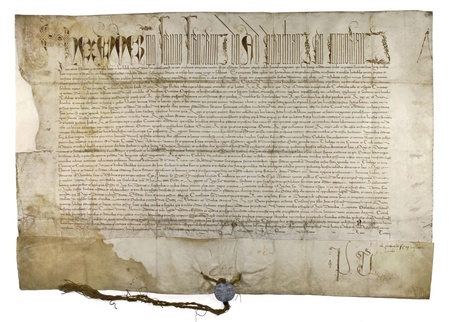

The foundation document which granted permission for the establishment of the University of Aberdeen has been recognised with UNESCO 'Memory of the World' status.
The Foundation Bull, dated 10 February 1495, is the permission granted by Pope Alexander VI for King James IV of Scotland to create a university in the town of Old Aberdeen in the north of Scotland.
The document – an exceptionally rare survival of the foundation document of a Renaissance university – set in motion an enterprise to create a centre of higher learning, formerly known as King’s College.
Its historic and cultural significance has now been recognised through its inscription on the UNESCO UK Memory of the World Register which lists documentary heritage that has world significance and outstanding universal value.
The Papal Bull has been in the care of the University ever since it was carried back to Scotland from Rome by its author William Elphinstone, the Bishop of Aberdeen, 531 years ago.
Prior to the Reformation, the patronage of higher education in Western Europe came under the authority of the church and so it was necessary to gain papal permission.
Elphinstone petitioned Rome for the authority to establish a University in Aberdeen, presenting an argument in the document for the need for a centre of higher learning in the North.
He stressed – or perhaps exaggerated - the remoteness of the region and the state of the people who he described as “rude, ignorant of letters and almost ungovernable” on account of their lack of education.
The Bull authorised the creation of a university which has continued to educate and perform research with an impact nationally and internationally.
University of Aberdeen Curator for Rare Books, Jane Pirie, said: “The Foundation Bull of the University of Aberdeen is a document unique in time and place.
“Elphinstone’s wording was perhaps exaggerated, but he understood the importance of geography and was also successful in emphasising the benefits of Aberdeen as ‘near enough to the northern islands and the foresaid mountains, and in which a temperate climate prevails and where are found abundance of victuals”.
“The document empowered Elphinstone, as the first Chancellor, to offer courses and award degrees in the Liberal Arts, and higher degrees of Theology, Civil and Canon Law and Medicine, based on the models of the universities of Bologna and Paris, establishing close involvement with European humanism.
“Aberdeen was the last university in the United Kingdom to require and receive papal authority for its foundation, an event recorded in this document. Although other universities in Scotland and England have an older date of foundation, the Foundation Bull of the University of Aberdeen (or the College of St Mary in the Nativity as it was known then) survives and is arguably unique in the United Kingdom.”
The Bull provides insights into the political, cultural and educational state of Scotland at the end of the 15th century. At the time the University of Aberdeen was founded, only the universities of Oxford, Cambridge, St Andrews and Glasgow were already in existence.
The creation of a university in Aberdeen highlights the complex political manoeuvres of King James IV and Pope Alexander VI.
Establishing a university in Aberdeen was part of James IV’s aim to unify his realm and to improve knowledge and education in Scotland. At this time, the Pope hoped that Scotland would align with his European ambitions.
The Bull provides early evidence for the uniqueness of Scottish law which continues today. As Elphinstone laid emphasis on the teaching of civil law where laymen, not churchmen were educated in secular laws.
Professor Peter Edwards, Principal and Vice-Chancellor of the University of Aberdeen, said: “We are delighted that our University’s Papal Bull has been recognised with inscription on the UNESCO UK Memory of the World Register.
“This important document records how the University came into being and shows us how Elphinstone persuaded Rome that a higher education institute in Aberdeen would have a huge influence on Scotland, northern Europe and world-wide.
“His assertion that it would encourage the exchange of scholars and ideas between Aberdeen and the continent bringing important education, money and innovation to Scotland and to the region still resonates today, just as it did when he set down his arguments 531 years ago.”