Introduction
History and Philosophy at Aberdeen is a great combination to add to your study of all aspects of human activity in the past with a fascinating exploration of how we as humans approach the ‘big questions’ of fundamental importance to us throughout the ages to the present day. You will gain a brilliant combination of academic and intellectual skills to make you a very attractive graduate with wide career options.
Study Information
At a Glance
- Learning Mode
- On Campus Learning
- Degree Qualification
- MA
- Duration
- 48 months
- Study Mode
- Full Time
- Start Month
- September
- UCAS Code
- VV15
- Pathway Programme Available
- Undergraduate Foundation Programme
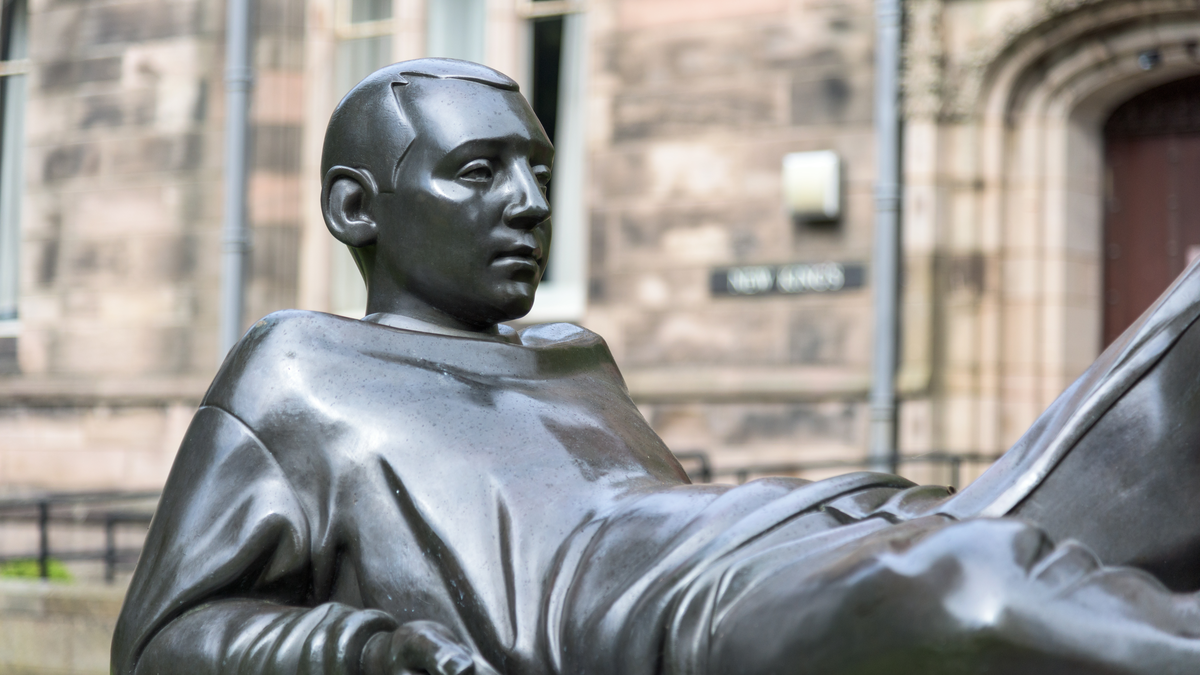
You will be enthused and inspired by teachers who are leaders in their fields, with expertise as diverse as medieval Scandinavia, early-modern Poland and modern East Asia and enthralled by our wonderful collections of historic treasures collected by distinguished alumni over the centuries.
Philosophers attempt to answer questions such as: What is knowledge? What is the nature of truth? Why should we act morally? Philosophy is just as much the study of reasoning and argument as it is the application of thought to specific problems.
What makes Philosophy at Aberdeen especially attractive is the breadth of courses, the user-friendly materials you will use and the experts who will teach you. In your first year alone, you will study topics such as How Should One Live? Controversial Questions, and Experience, Knowledge and Reality.
The skills you will develop through these subjects – including critical thinking and analysis – will be a great foundation for careers in all sector of business and the public sector, journalism, marketing, local and national government and much more.
Aberdeen Global Scholarship
The University of Aberdeen is delighted to offer eligible self-funded international on-campus undergraduate students a £6,000 scholarship for every year of their programme.
View the Aberdeen Global ScholarshipWhat You'll Study
- Year 1
-
Compulsory Courses
- Getting Started at the University of Aberdeen (PD1002)
-
This course, which is prescribed for level 1 undergraduate students and articulating students who are in their first year at the University, is studied entirely online, is studied entirely online, takes approximately 2-3 hours to complete and can be taken in one sitting, or spread across the first 4 weeks of term.
Topics include University orientation overview, equality & diversity, MySkills, health, safety and cyber security, and academic integrity.Successful completion of this course will be recorded on your Transcript as ‘Achieved’.
- Making History (HI1027)
-
15 Credit Points
This course will introduce students to the subject of university level history. Team taught lectures will introduce students to approaches, sources, and the dilemmas facing academic historians.
- Experience, Knowledge and Reality (PH1023)
-
15 Credit Points
How “real” is reality? How does the mind relate to the world? This course introduces two approaches to answering these questions: rationalism and empiricism. By reading Rene Descartes’ Meditations on First Philosophy, we learn about Descartes’ rationalist approach to knowledge, reality, mind-body dualism, and God’s necessary existence. Through David Hume’s Enquiry Concerning Human Understanding see how Hume grounds knowledge in experience. We read Hume on impressions and ideas, induction, causality, miracles and critically compare and examine Descartes’ and Hume’s arguments by drawing on readers and critics.
Optional Courses
Plus 30 credit points from available Level 1 History or History of Art courses.
Plus further courses of choice to make up 120 credit points
Plus 30 credit points from the following courses:
- Controversial Questions (PH1027)
-
15 Credit Points
We examine questions such as: Is eating animals immoral? Is being a good or bad person a matter of luck? If so, are we justified in punishing bad people? Should anyone be able to set limits on what you can do with your own body, even if it's ‘for your own good’? Should everyone be allowed to state their mind, even if their views are harmful or offensive? Is censorship ever justifiable? Do you have a moral obligation to help those worse-off? Are you unknowingly biased against underprivileged groups?
- How Should One Live? (PH1522)
-
15 Credit Points
What does it mean to live a good life? How do we determine what is good or bad, right or wrong? Are some ways of living better or worse for us? In this course we will look at some central philosophical approaches to answering these questions. Traditions we may engage with include virtue ethics, Chinese ethics, deontology, consequentialism, and feminist ethics. Along the way, we will read the original work of some of the most important scholars in the history of moral philosophy. Students will be encouraged to think deeply, and to explore their own views about what it means to live a (morally) good life.
- Logic and Argument (PH1518)
-
15 Credit Points
What makes an argument a good argument? What are the correct rules for reasoning? How should we revise our beliefs in the light of new evidence? What should we think about paradoxes?
This course provides an introduction to logic and tools for successfully evaluating arguments. Some of the topics covered include validity, soundness, consistency, entailment, provability, belief revision and paradoxes. The language of propositional logic and key ideas in Bayesian epistemology are introduced. The course develops the ability to symbolise English sentences into formal languages and to construct truth tables, truth trees and natural deduction proofs. Logical concepts are applied to everyday thinking as well as to philosophical puzzles and paradoxes.
- Environmental Ethics (PH1537)
-
15 Credit Points
We are living through an environmental crisis. This is well recognised and widely discussed. Most of this discussion focuses on what we should do to deal with the crisis, and rightly so. But it is also well recognised that the current crisis is deeply rooted in how we think of nature and the natural world and why we value it. Environmental Ethics helps us think about these foundational issues and get clear on why - and not just how - we should save the planet.
- Year 2
-
Optional Courses
60 credit points from available Level 2 History courses.
Plus further courses of choice to make up 120 credit points, 45 of which must be from level 2 Philosophy courses.
- Year 3
-
Compulsory Courses
- Thinking History (HI356J)
-
30 Credit Points
This course looks at how history is written. It considers the problems involved in studying and explaining the past, and the many dilemmas faced by historians in reconstructing it. By examining the ways in which history has been written from the Ancient Greeks to Postmodernism, it considers the limits of historical study, asks whether history can ever be a science, and reveals the assumptions behind the various approaches to history that inform its writing. It is designed to provide honours history students with an essential understanding of what they are doing when they study history.
Optional Courses
Plus 60 credits of level 3 Philosophy courses.
Plus 30 credit points from level 3 courses in History, or one of the following approved courses:
- History of Medicine (ME33HM)
-
30 Credit Points
The course will involve each student working individually on a historical project of his or her own choice, under the supervision of the course co-ordinator.
Students will be required to produce a research proposal and progress reports, to prepare an essay and make a presentation of their findings to the class. The aim of the option is to give students the opportunity to research and present, individually, in spoken and written forms, a history of medicine topic of their own choice, using both primary and secondary sources. - Architecture and Power (AH3014)
-
30 Credit Points
Architecture can be a synonym for power. Castles that loom over the landscape, the country house and its links with the British Empire and the Victorian prisons designed to incarcerate and extinguish hope. This course takes a thematic approach to the history of architecture to examine the institutions that define our landscapes and cities. Far from being neutral blocks of stone, brick and wood, the architecture of power is designed to define the ways we navigate the world, to intimidate and to reinforce institutions and power structures.
- Painting in Tudor and Early Stuart England (AH3517)
-
30 Credit Points
This course examines the use of art as a tool for propaganda, diplomacy and education in England between 1520 and 1640. It explores how paintings were commissioned, created and consumed in a world of changing religious and political circumstances, and considers the role of art in both consolidating and challenging power. Case studies range from Queen Elizabeth I’s construction of a distinct visual identity as a female monarch, and Peter Paul Rubens’ creation of a grand mural scheme for King Charles I, to the function of jewel-like portrait miniatures, and the recording through pictures of the first encounters between English colonialists and Indigenous American peoples.
- Year 4
-
Compulsory Courses
- Special Sub: Enlightenment Compared: Ireland, Scotland, Central Europe (HI4003)
-
30 Credit Points
This course examines the emergence and the variations of Enlightenment thinking in Scotland and Central Europe (with particular emphasis on the German and East Central European Enlightenment, to which the Scottish Enlightenment had strong historical links). It emphasises the varieties of the European Enlightenment, against the traditional assumption that the Enlightenment was exclusively 'located' in France.
- Special Sub.: Britain and Revolutionary Russia 1917 - 1924 (HI4012)
-
30 Credit Points
This course explores Britain's relations with Russia during the early years of the Soviet regime. It highlights a series of key developments in the relationship, especially major changes in British government policy that charted a course from military intervention to diplomatic recognition. Most of the seminars trace an aspect of the relationship within a fairly short time-frame, but some seminars investigate a particular issue through the whole period 1917–24. Several sessions will be used specifically for analysing gobbets. Knowledge of the Russian language is not required.
- Special Sub: the Child as Subject in the British World (HI401F)
-
30 Credit Points
Historians concur that ideas about the nature of children and the place of childhood have changed over time. This course explores both how modern societies have understood childhood and the way in which this has shaped the treatment of young people. It places a particular focus upon how ideas and understandings of childhood have spanned regional and national borders, as well as the ways in which the concept of youth has been adapted to suit new cultural contexts.
- Spec Sub: Court Society in Late Medieval Europe (C. 1300 – C. 1500) (HI401G)
-
30 Credit Points
The courts of kings and other rulers in the later middle ages (c. 1300 – c. 1500), in which they and their households lived and hosted their subjects as well as visitors from other lands, have been characterised by scholars as both a grand stage for a dying chivalric culture and a creator of conditions for the modern state. This course addresses this apparent paradox and examines the many facets of this phenomenon, using the Scottish royal court as its starting point but also making use of evidence from around Europe. It draws on theories and methods from a range of academic disciplines including sociology, anthropology, art history and literature. Topics include the household, the palace, the competition for status amongst elites at court and the court as a stage for presenting political messages. Students taking the course will emerge with a detailed understanding of the court and the different forms it took and a view on how it shaped the broader history of Europe.
- Special Sub:european Constitutional Monarchies in the Long 19thcentury (HI4023)
-
30 Credit Points
On the eve of the First World War Europe was a continent of monarchies. A long 19th century of revolutions, wars, growing literacy, an expanding public sphere, changes in social, economic, intellectual and technological life and imperial expansion lay behind them, but the continent’s monarchical systems had survived in surprisingly rude health. That monarchies had flourished throughout these profound transformations points to their suppleness and ingenuity. This course offers new perspectives on the political cultures of the states and societies of 19th-century Europe.
- Special Subject: History of the Israeli Palestinian Conflict (HI4025)
-
30 Credit Points
The course examines the origins of the history of the Arab-Israeli conflict and its developments from multiple angles in order to provide a comprehensive understanding of the complex dynamic that constitutes ‘the conflict’. The course will investigate the causes of the Palestinian refugee crisis and of the Arab-Israeli wars. It will introduce students to the Arab-Israeli peace process and familiarise students with the polarised historiography surrounding the Arab-Israeli conflict.
- Special Subject: Myths of the North (HI4026)
-
30 Credit Points
This course critically evaluates representations and functions of Old Norse myth and legend in both medieval and modern contexts. It will enable students to better understand the myths, beliefs and stories of Viking and medieval Scandinavia in their own historical contexts, and to analyse the political and cultural implications of their endurance, significance and popularity into the modern world.
Optional Courses
PLUS EITHER:
- Dissertation in History (HI4516)
- Philosophy Dissertation (PH402D) AND History in Practice II (HI4518)
Plus further courses of choice at level 3 and 4 in History and level 4 in Philosophy to make up 60 credits in each discipline. A minimum of 90 credits should be taken at level 4.
- History in Practice (HI4518)
-
30 Credit Points
History is not simply a dry, academic study of the past; it shapes a host of contemporary political, economic and cultural attitudes and is a central underpinning to the tourist and heritage industries - now one of the largest sectors of employment among mature western economies. This course is designed to give a critical understanding of the theoretical and practical links (as well as clear distinctions) between the practice of 'academic' History and 'public' History. This is done by having students assess how heritage and tourist businesses project a particular version of the past.
- Undergraduate Dissertation in History (HI4516)
-
30 Credit Points
The undergraduate dissertation is the final-year major research undertaking, based on primary and secondary material and providing a critical analysis of a specific subject chosen by the student. It is obligatory for Single Honours students, whereas Joint Honours students choose to write their dissertation in either of the two subjects. After initial sessions about the nature of the dissertation and research approaches, students develop a topic with the help of a member of staff, who will also supervise their project throughout.
- Dissertation (PH402D)
-
30 Credit Points
The dissertation is on a topic in philosophy. The specific topic will be chosen by the student with the approval of the supervisor. The choice of topics is restricted insofar as it must fall within the teaching competence of the supervisor.
Another dissertation or Project course must not be undertaken alongside the Philosophy Dissertation
We will endeavour to make all course options available. However, these may be subject to change - see our Student Terms and Conditions page. In exceptional circumstances there may be additional fees associated with specialist courses, for example field trips.
How You'll Study
Learning Methods
- Individual Projects
- Lectures
- Research
- Tutorials
Assessment Methods
Students are assessed by any combination of three assessment methods:
- Coursework such as essays and reports completed throughout the course.
- Practical assessments of the skills and competencies they learn on the course.
- Written examinations at the end of each course.
The exact mix of these methods differs between subject areas, years of study and individual courses.
Honours projects are typically assessed on the basis of a written dissertation.
Why Study History and Philosophy?
Why History
- Particular strengths in Irish and Scottish studies, Scandinavia, late medieval/early modern period, and research centres studying global empires, history and philosophy of science, technology and medicine, and Russian and Eastern European history.
- The inspiration of our beautiful historic campus in Old Aberdeen, where King’s College Chapel, begun in 1495 by University founder Bishop Elphinstone, is a treasure-house of history and religious turbulence.
- Major international treasures including 7,000 early printed books, the magnificent 12th century Aberdeen Bestiary, large Jacobite collection, works of the Scottish Enlightenment, and fascinating local records dating from the middle ages.
- A packed campus programme of student and public events, exhibitions, seminars, invited speakers and the annual WayWord literary festival.
- Spectacular, award-winning Sir Duncan Rice Library, combining top-class study facilities with state-of-the-art technology, and an online catalogue giving you access to thousands of books and millions of journal articles on the web.
Why Philosophy
- Famous philosophers who worked at the University include Thomas Reid, founder of the 18th century Scottish School of Common Sense Philosophy, and Alexander Bain, who helped lay the foundations for modern scientific psychology.
- The Aberdeen Philosophy in Education Group (APEG), which is unique in Scotland, trains students to discuss philosophical questions with local primary and secondary school pupils.
- Café Philosophique brings philosophers and the local community together, using popular films and novels to explore philosophical puzzles in an informal atmosphere.
- The Centre for the History and Philosophy of Science, Technology and Medicine acts as the focus for research, teaching and engagement in the history, philosophy, ethics, literature and museology of science, technology and medicine.
- The spectacular, award-winning Sir Duncan Rice Library offers superb collections, including early printed works of natural philosophy and medicine, the archives of Thomas Reid, and records of the Aberdeen Philosophical Society.
- We offer a packed programme of public events, lectures and debates, including the annual WayWORD literary festival, which attracts high-profile scientists, scholars, authors, actors and broadcasters to discuss and debate the big issues of today.
- The skills you learn in Philosophy—for example, to think and write clearly, to explain complex ideas, to challenge orthodoxy—lend themselves to many careers.
- Studying Philosophy will change how you think about things and how you approach life's challenges.
- Philosophy is interesting! Students from all disciplines often report that studying Philosophy was the most rewarding experience of their studies.
Entry Requirements
Qualifications
The information below is provided as a guide only and does not guarantee entry to the University of Aberdeen.
General Entry Requirements
- 2025 Entry
-
SQA Highers
Standard: BBBB
Applicants who have achieved BBBB (or better), are encouraged to apply and will be considered. Good performance in additional Highers/ Advanced Highers may be required.
Minimum: BBC
Applicants who have achieved BBC at Higher and meet one of the widening participation criteria above are encouraged to apply and are guaranteed an unconditional offer for MA, BSc and BEng degrees.
Adjusted: BB
Applicants who have achieved BB at Higher, and who meet one of the widening participation criteria above are encouraged to apply and are guaranteed an adjusted conditional offer for MA, BSc and BEng degrees.
We would expect to issue a conditional offer asking for one additional C grade at Higher.
Foundation Apprenticeship: One FA is equivalent to a Higher at A. It cannot replace any required subjects.
More information on our definition of Standard, Minimum and Adjusted entry qualifications.
A LEVELS
Standard: BBC
Minimum: BCC
Adjusted: CCC
More information on our definition of Standard, Minimum and Adjusted entry qualifications.
International Baccalaureate
32 points, including 5, 5, 5 at HL.
Irish Leaving Certificate
5H with 3 at H2 AND 2 at H3.
Entry from College
Advanced entry to this degree may be possible from some HNC/HND qualifications, please see www.abdn.ac.uk/study/articulation for more details.
- 2026 Entry
-
SQA Highers
Standard: BBBB
Applicants that present with BBBB will usually receive an unconditional offer.
Where we have more applicants than places we may need to ask for more than the minimum so continued engagement in school is recommended.
Widening Access: BBC
Applicants who meet one or more of our widening access metrics and present with BBC, are guaranteed an unconditional offer.
Foundation Apprenticeship: One FA is equivalent to a Higher at A. It cannot replace any required subjects.
Note: We do not double count a Higher and Advanced Higher in the same subject, but we do consider that a B grade at Advanced Higher is equivalent to an A grade at Higher.
National 5 English (or equivalent) is required at Grade C or above.
A LEVELS
Standard: BBC
Widening Access: CCC
GCSE English (or equivalent) is required at Grade C/4 or above.
BTEC LEVEL 3 EXTENDED DIPLOMA
DMM in related subjects.
Note: BTEC Level 3 Extended Certificate (Subsidiary Diploma) achieved at Distinction level, is normally acceptable in lieu of one A Level at grade B.)
GCSE English (or equivalent) is required at Grade C/4 or above. GCSE Mathematics at Grade C/4 is also required for Accountancy, Economics and Finance programmes.
IRISH LEAVING CERTIFICATE
Five subjects at Higher at H3.
INTERNATIONAL BACCALAUREATE
32 points including 5, 5, 5 at HL.
SL in English is also required.
Additional Information
Entry from College (Articulation)
Year 2 entry: Satisfactory completion of HNC Social Sciences (120 SCQF credit points). B in all Graded Units. Students should take units A and B of the discipline/s they wish to study at university e.g. Psychology A (FK8D 34) & B (J030 34). For joint honours programmes, students must take A and B for both disciplines.
The information displayed in this section shows a shortened summary of our entry requirements. For more information, or for full entry requirements for Arts and Social Sciences degrees, see our detailed entry requirements section.
English Language Requirements
To study for an Undergraduate degree at the University of Aberdeen it is essential that you can speak, understand, read, and write English fluently. The minimum requirements for this degree are as follows:
IELTS Academic:
OVERALL - 6.0 with: Listening - 5.5; Reading - 5.5; Speaking - 5.5; Writing - 6.0
TOEFL iBT:
OVERALL - 78 with: Listening - 17; Reading - 18; Speaking - 20; Writing - 21
PTE Academic:
OVERALL - 59 with: Listening - 59; Reading - 59; Speaking - 59; Writing - 59
Cambridge English B2 First, C1 Advanced or C2 Proficiency:
OVERALL - 169 with: Listening - 162; Reading - 162; Speaking - 162; Writing - 169
Read more about specific English Language requirements here.
International Applicants who do not meet the Entry Requirements
The University of Aberdeen International Study Centre offers preparation programmes for international students who do not meet the direct entry requirements for undergraduate study. Discover your foundation pathway here.
Fees and Funding
You will be classified as one of the fee categories below.
| Fee category | Cost |
|---|---|
| EU / International students | |
| Tuition Fees for 2026/27 Academic Year | £20,800 |
| Tuition Fees for 2026/27 Academic Year (Self-funded Students *) | £14,800 |
| Home Students | |
| Tuition Fees for 2026/27 Academic Year | £1,820 |
| England, Wales, Northern Ireland, and Republic of Ireland | |
| Tuition Fees for 2026/27 Academic Year | £9,790 |
Scholarships and Funding
UK Scholarship
Students from England, Wales and Northern Ireland, who pay tuition fees may be eligible for specific scholarships allowing them to receive additional funding. These are designed to provide assistance to help students support themselves during their time at Aberdeen.
Aberdeen Global Scholarship
The University of Aberdeen is delighted to offer eligible self-funded international on-campus undergraduate students a £6,000 scholarship for every year of their programme. More about this funding opportunity.Funding Database
View all funding options in our Funding Database.
Careers
There are many opportunities at the University of Aberdeen to develop your knowledge, gain experience and build a competitive set of skills to enhance your employability. This is essential for your future career success. The Careers and Employability Service can help you to plan your career and support your choices throughout your time with us, from first to final year – and beyond.
- More information on employability at the University of Aberdeen
- More information on the Careers and Employability Service
Our Experts
Information About Staff Changes
You will be taught by a range of experts including professors, lecturers, teaching fellows and postgraduate tutors. However, these may be subject to change - see our Student Terms and Conditions page.
Discover Uni
Discover Uni draws together comparable information in areas students have identified as important in making decisions about what and where to study. You can compare these and other data for different degree programmes in which you are interested.
Get in Touch
Contact Details
- Address
-
Student Recruitment & Admissions
University of Aberdeen
University Office
Regent Walk
Aberdeen
AB24 3FX