
Introduction
Theology and Religion includes both the study of Christian faith, life and doctrine in its historical, cross-cultural and contemporary contexts, and the comparative study of the major and local religious traditions of the world, which focuses on the origin, function, and meaning of religion.
The MA in Theology and Religious Studies at Aberdeen gives students a cutting-edge understanding of Christianity and the other major religious traditions of the world, including their historical development and contemporary importance. The degree also gives students the opportunity to explore a wide diversity of courses in the Arts and Social Sciences. The Master of Arts (MA) in Theology and Religious Studies may be taken as a Designated or Honours degree, and may also be studied part-time (in this case applications are made directly to the University, not through UCAS).
Part-time Study
Part-time study options are available for this programme.
What You'll Study
Theology and Religion at Aberdeen is a diverse programme that offers a range of courses relating to Christian theology and history, as well as exploring major and local religious traditions of the world.
- Year 1
-
Year 1: Compulsory Courses
During the first year of study, students take a number of Divinity and Religious Studies courses (a minimum of 60 credits) from a specified list.
Courses that you may study at level 1 may include:
- What it does it mean to be dead
- Theology from Jesus to Calvin
- The Holy Land? Ancient History and Modern Israel & Palestine
- Practice of Biblical Interpretation
Year 1: Optional Courses
Select at least 60 credit points from level 1 courses in Divinity or the following approved courses plus, select further credit points from courses of choice to gain a total of 120 credit points.
- Latin 1 (LT1009)
-
15 Credit Points
Latin 1 is an introductory, intensive course for those with little or no previous exposure to Latin. Students completing this course should have a Latin vocabulary of about 400 words and a basic understanding of Latin grammar and syntax. Students successfully completing this course will be adequately prepared to attend Latin 2. Students will very likely discover that their knowledge of English vocabulary and grammar/syntax is improved by their study of Latin. The etymological roots of many English words can be traced to the Latin language.
- Latin 2 (LT1507)
-
15 Credit Points
Latin 2 picks up where Latin 1 finished in first term. By the end of this course students should have a more or less comprehensive understanding of Latin syntax and grammar, a Latin vocabulary of 700-800 words, and should be capable of translating simple Latin texts into idiomatic English. Students will very likely discover that their knowledge of English vocabulary and grammar/syntax is improved by their study of Latin.
- Getting Started at the University of Aberdeen (PD1002)
-
This course, which is prescribed for level 1 undergraduate students and articulating students who are in their first year at the University, is studied entirely online, is studied entirely online, takes approximately 2-3 hours to complete and can be taken in one sitting, or spread across the first 4 weeks of term.
Topics include University orientation overview, equality & diversity, MySkills, health, safety and cyber security, and academic integrity.Successful completion of this course will be recorded on your Transcript as ‘Achieved’.
- Year 2
-
Year 2: Compulsory Courses
During the second year of study students take a number of Divinity and Religious Studies courses (a minimum of 60 credits) from a specified list.
Courses that you may study at level 2 may include:
- God, Power, Politics: Politics in the Public Square
- God, Sexuality and Identity
- Exploring the New Testament
- Ancient Empires
Year 2: Optional Courses
Select at least 60 credit points from level 2 courses in Divinity, plus further credit points from courses of choice to gain a total of 120 credits.
- Year 3
-
Year 3: Optional Courses
Select 120 credit points worth of courses of which 90 credit points must be from level 3 courses in Divinity.
Courses that you may study at level 3 may include:
- Wine, Revelry and Dangerous Women
- Major Themes in Christian Theology
- Christianity in Scotland
- Year 4
-
Year 4: Optional Courses
Select ONE of the following dissertation options:
- DR4044 Dissertation
- DR4544 Dissertation
Plus a further 90 credit points from level 4 courses in Divinity.
Courses that you may study at level 4 may include:
- Contemporary Issues in Practical Theology
- God, Power, Politics: Reading New Testament Letters
- Reformation, Reason and Revolt
- Dissertation (DR4044)
-
30 Credit Points
This course involves the writing of a dissertation in one of the sub-disciplines in Divinity and Religious Studies. Independent Research work is done under the supervision of a member of staff. The dissertation is an extended essay, of no more than 10,000 words inclusive of references. Please note the 10,000 words does not include the bibliography
- Dissertation (DR4544)
-
30 Credit Points
This course involves the writing of a dissertation in one of the sub-disciplines in Divinity and Religious Studies. Independent Research work is done under the supervision of a member of staff. The dissertation is an extended essay, of no more than 10,000 words inclusive of references. Please note the 10,000 words does not include the bibliography
We will endeavour to make all course options available. However, these may be subject to change - see our Student Terms and Conditions page. In exceptional circumstances there may be additional fees associated with specialist courses, for example field trips.
How You'll Study
The School has a flexible approach to teaching and assessment, utilising a combination of small and large group teaching assessed through examinations, essays and personal dissertation. The acquisition of communication, IT and team working skills is emphasised.
Learning Methods
- Group Projects
- Individual Projects
- Lectures
- Tutorials
Assessment Methods
Students are assessed by any combination of three assessment methods:
- coursework such as essays and reports completed throughout the course;
- practical assessments of the skills and competencies they learn on the course; and
- written examinations at the end of each course.
The exact mix of these methods differs between subject areas, years of study and individual courses.
Honours projects are typically assessed on the basis of a written dissertation.
Why Study Theology and Religion?
- Ranked 10th in the UK for Positive Responses in Theology and Religious Studies (National Student Survey 2026)
- Over 91.3% of DHPA graduates are in employment or further study 15 months after graduation. (Graduate Outcomes Survey 2026)
-
A wide variety of courses are on offer: from biblical languages to the Reformation in Scotland, and from Buddhist philosophy to the stories of the prophets in Islam.
-
You will become part of an international community of scholars, exploring all aspects of theology, ministry and religious studies. You will also benefit from the close links that the University has to religious studies specialists.
-
The Theology and Religious Studies teaching staff at Aberdeen have a range of professional and academic backgrounds and you will benefit from their unique insights into their subject areas.
-
By studying Theology and Religious Studies at Aberdeen, you will become part of a unique group of students who have studied at a university recognised for its tradition of theological excellence.
-
At Aberdeen, you will have access to the world-class teaching and research facilities that the University offers.
-
Through analysis and evaluation, you will develop a range of skills that will enable you to work in a variety of different sectors.
Interested in this programme?
Entry Requirements
Qualifications
The information below is provided as a guide only and does not guarantee entry to the University of Aberdeen.
General Entry Requirements
- 2026 Entry
-
SQA Highers
Standard: BBBB
Applicants that present with BBBB will usually receive an unconditional offer.
Where we have more applicants than places we may need to ask for more than the minimum so continued engagement in school is recommended.
Widening Access: BBC
Applicants who meet one or more of our widening access metrics and present with BBC, are guaranteed an unconditional offer.
Foundation Apprenticeship: One FA is equivalent to a Higher at A. It cannot replace any required subjects.
Note: We do not double count a Higher and Advanced Higher in the same subject, but we do consider that a B grade at Advanced Higher is equivalent to an A grade at Higher.
National 5 English (or equivalent) is required at Grade C or above.
A LEVELS
Standard: BBC
Widening Access: CCC
GCSE English (or equivalent) is required at Grade C/4 or above.
BTEC LEVEL 3 EXTENDED DIPLOMA
DMM in related subjects.
Note: BTEC Level 3 Extended Certificate (Subsidiary Diploma) achieved at Distinction level, is normally acceptable in lieu of one A Level at grade B.)
GCSE English (or equivalent) is required at Grade C/4 or above. GCSE Mathematics at Grade C/4 is also required for Accountancy, Economics and Finance programmes.
IRISH LEAVING CERTIFICATE
Five subjects at Higher at H3.
INTERNATIONAL BACCALAUREATE
32 points including 5, 5, 5 at HL.
SL in English is also required.
- 2027 Entry
-
SQA Highers
Standard: BBBB
Applicants that present with BBBB will usually receive an unconditional offer.
Where we have more applicants than places we may need to ask for more than the minimum so continued engagement in school is recommended.
Widening Access: BBC
Applicants who meet one or more of our widening access metrics and present with BBC, are guaranteed an unconditional offer.
Foundation Apprenticeship: One FA is equivalent to a Higher at A. It cannot replace any required subjects.
Note: We do not double count a Higher and Advanced Higher in the same subject, but we do consider that a B grade at Advanced Higher is equivalent to an A grade at Higher.
National 5 English (or equivalent) is required at Grade C or above.
A LEVELS
Standard: BBC
Widening Access: CCC
GCSE English (or equivalent) is required at Grade C/4 or above.
BTEC LEVEL 3 EXTENDED DIPLOMA
DMM in related subjects.
Note: BTEC Level 3 Extended Certificate (Subsidiary Diploma) achieved at Distinction level, is normally acceptable in lieu of one A Level at grade B.)
GCSE English (or equivalent) is required at Grade C/4 or above. GCSE Mathematics at Grade C/4 is also required for Accountancy, Economics and Finance programmes.
IRISH LEAVING CERTIFICATE
Five subjects at Higher at H3.
INTERNATIONAL BACCALAUREATE
32 points including 5, 5, 5 at HL.
SL in English is also required.
The information displayed in this section shows a shortened summary of our entry requirements. For more information, or for full entry requirements for Arts and Social Sciences degrees, see our detailed entry requirements section.
Fees and Funding
You will be classified as one of the fee categories below.
- EU / International students
-
- Tuition Fees for 2026/27 Academic Year
- £20,800
- Tuition Fees for 2026/27 Academic Year (Self-funded Students *)
- £14,800
-
The above fee includes the £6,000 Aberdeen Global Scholarship provided to self-funded international students. Full terms and conditions apply.
- Home Students
-
- Tuition Fees for 2026/27 Academic Year
- £1,820
- England, Wales, Northern Ireland, and Republic of Ireland
-
- Tuition Fees for 2026/27 Academic Year
- £9,790
-
The UK Government has confirmed that the RUK fee cap will continue to increase each year to reflect inflation. Tuition fees will increase in line with the Government fee cap each year, and this should be taken into account when budgeting.
Scholarships and Funding
UK Scholarship
Students from England, Wales and Northern Ireland, who pay tuition fees may be eligible for specific scholarships allowing them to receive additional funding. These are designed to provide assistance to help students support themselves during their time at Aberdeen.
Aberdeen Global Scholarship
The University of Aberdeen is delighted to offer eligible self-funded international on-campus undergraduate students a £6,000 scholarship for every year of their programme. More about this funding opportunity.
Funding Database
View all funding options in our Funding Database.
Careers
Our previous graduates have found employment in a wide range of areas, including the churches, media and journalism, teaching, public service and administration, the NGO sector, business, government and publishing.
Career Opportunities
- Charity Director
- Charity Fundraiser
- Development Officer
- NGO Worker (Charity Worker)
- Researcher
- Support Worker
- TEFL Teacher
- Teacher
- Youth Pastor
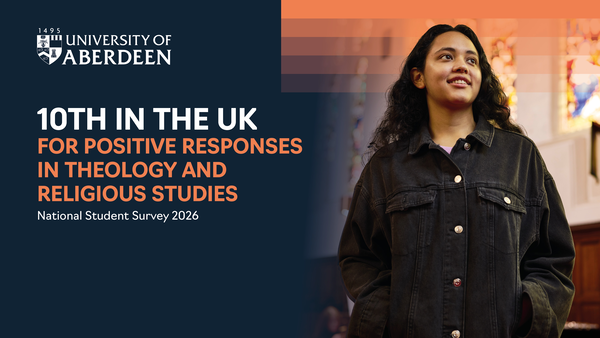
Ranked 10th in the UK for Positive Responses
In Theology and Religious Studies, National Student Survey 2026
Our Experts
Information About Staff Changes
You will be taught by a range of experts including professors, lecturers, teaching fellows and postgraduate tutors. However, these may be subject to change - see our Student Terms and Conditions page.
Facilities
Since the University was founded in 1495, it has been one of the centres of theological study in Scotland. This programme is taught in the late-medieval King’s College campus, which provides the perfect surroundings to learn about the history and culture of Christianity.
Discover Uni
Discover Uni draws together comparable information in areas students have identified as important in making decisions about what and where to study. You can compare these and other data for different degree programmes in which you are interested.
Get in Touch
Contact Details
- Address
-
Student Recruitment & Admissions
University of Aberdeen
University Office
Regent Walk
Aberdeen
AB24 3FX