
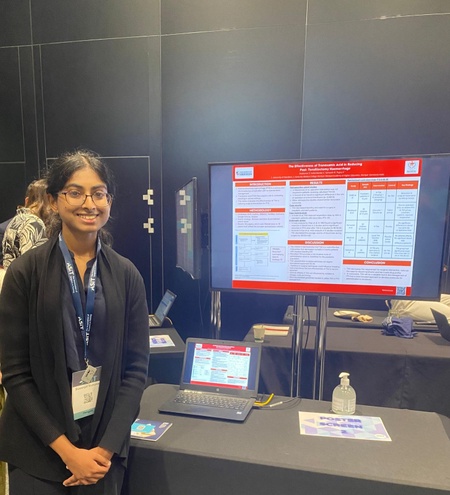
Earlier this year, I had the opportunity to attend and present at the Association of Surgeons in Training (ASiT) Conference in Belfast, which proved to be an exciting and inspiring experience. This conference provided me with a platform to immerse myself in the evolving world of surgical innovation and present my research project, which I worked on as part of my Year 5 elective.
My poster focused on a systematic review exploring the effectiveness of tranexamic acid in reducing post-tonsillectomy hemorrhage, which is a significant complication and potentially life-threatening following tonsillectomy. My project gathered data from a wide range of study designs including retrospective cohorts, randomised controlled trials, and case series, to evaluate the safety and efficacy of tranexamic acid. It was a privilege to share the findings from my project and contribute in a small way to the wider discussion of using evidence-based practices in surgery to improve patient outcomes.
The theme of the conference was ‘Learning from Trauma’ which echoed throughout the event with talks from surgeons fleeing their war-torn homelands to rebuild their careers abroad to brave surgeons diving headfirst into hostile conflict zones to deliver life-saving care. It was incredible to hear the lived experiences of surgeons who overcame adversity to achieve their goals. I also enjoyed the fact that the conference did not shy away from highlighting pertinent issues plaguing the surgical community, including gender disparities in surgery and the often-overlooked stigma around pregnancy loss and infertility among trainees. Hearing firsthand accounts from speakers who navigated these challenges highlighted their resilience in navigating personal struggles while balancing a career in surgery.
In addition to the insightful talks and diverse discourse, it was interesting to exchange perspectives with other medical students and surgical trainees. It felt like the gap between medical students and surgical trainees was diminished. The conference provided a safe space to facilitate a wide range of discussions, attend breakout workshops, get hands-on experience with the surgical kit, and speak to experts about advancing surgical innovation. Another unique session held during the conference covered a patient's journey through recovery after surgery, told from the perspective of a surgeon and a medical journalist. It was a powerful reminder that the end of surgery is not the end of the journey, and the emotional impact of surgical care continues long after the procedure itself.
I would like to thank my supervisor, Mr Vamsidhar Vallamkondu, for his support throughout the project. My sincere appreciation to Dr Rakshitha Samanth and Dr Kailesh Pujary, whose continued mentorship even after the completion of my elective in India played an important role in me reaching this stage. Thank you to the University of Aberdeen for its ongoing support. A heartfelt thank you to my family and friends near and far for their unwavering patience and belief in me throughout this journey.