Attending the European Association of Neurosurgical Societies (EANS) Congress in Vienna from 5–9 October 2025 was an inspiring and defining moment in my medical journey. I had the honour of presenting both an oral presentation and a poster, sharing research that reflects two areas I am deeply passionate about: neurodegeneration and the history of medical innovation.
My oral presentation focused on “Investigating the Role of Retinoic Acid Receptors in Motor Neuron Survival: Potential Therapeutic Insights for ALS.” Amyotrophic Lateral Sclerosis (ALS) is a progressive condition that leads to motor neuron death, and there is still no cure. Retinoic acid receptors are proteins involved in cell growth and survival, and my project explored whether these receptors may help protect motor neurons. By studying these pathways, we hope to identify new directions for future treatments. Presenting this work to experts from across Europe was both exciting and encouraging, especially as it sparked discussions about emerging therapeutic strategies.
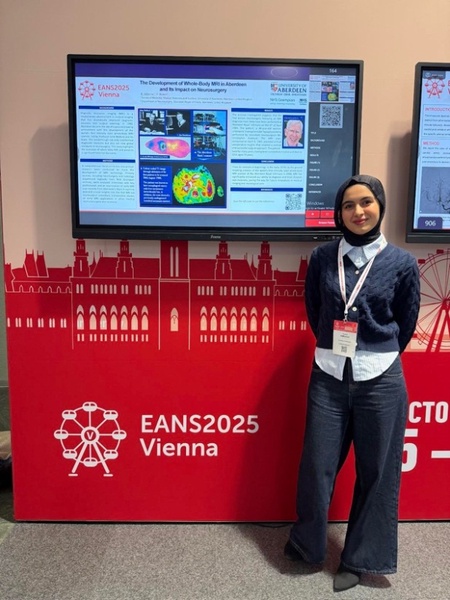
Alongside the oral session, I presented a poster titled “The Development of Whole-Body MRI in Aberdeen and Its Impact on Neurosurgery.” Many people are surprised to learn that the world’s first whole-body MRI scanner was developed in Aberdeen. This innovation transformed medical imaging and changed the way neurosurgeons diagnose and manage complex conditions. My project explored the history of this milestone, how the first known neurosurgery following an MRI diagnosis most likely have been performed at Aberdeen Royal Infirmary on the 6th of April 1983. The patient, a 46-year-old woman, underwent transsphenoidal hypophysectomy performed by consultant neurosurgeon Mr Christopher Blaiklock. The MRI scan, conducted on April 4 1983, provided critical preoperative insights that enabled a precise and successful surgical approach. The poster received great interest from clinicians and researchers who were fascinated by the story behind a technology we now use every day.
Beyond presenting, the conference was a chance to learn from leaders in neurosurgery, discover new research, and connect with colleagues from around the world. Sessions covered everything from brain tumour surgery and AI-assisted imaging to global neurosurgery and training pathways. Being surrounded by such a diverse and passionate community reinforced my motivation to pursue a career in neurosurgery and to continue building my academic skills.
EANS 2025 was more than an academic event, it was a moment of growth, inspiration, and affirmation. Sharing my work, receiving feedback, and learning from international experts has strengthened my commitment to research and clinical excellence. I left Vienna excited for the future, grateful for the opportunity to contribute, and motivated to continue working towards a career in neurosurgery.