
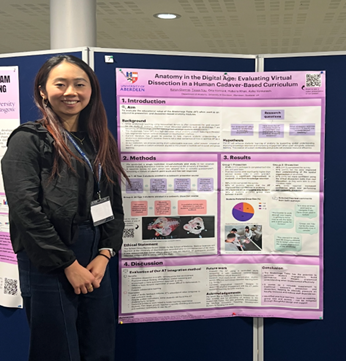
On the 17-19th of December 2025, I attended the Anatomical Society Winter Meeting held at the Anglia Ruskin University in Chelmsford, UK. I presented a poster entitled “Anatomy in the digital age: Evaluating virtual dissection in a human cadaver-based curriculum”. This project was completed during the second half of my intercalated year at the beginning of 2025.
My project explored the use of the Anatomage table (AT), a resource recently acquired by the University of Aberdeen anatomy department. The AT is a high-resolution virtual anatomy platform featuring a life-sized human cadaver displayed on a touchscreen interface. It allows students to select specific regions of the body and manipulate structures in three dimensions, providing a dynamic and interactive way to visualise anatomy. At the University of Aberdeen, students have traditionally learned anatomy through using human cadavers which are acquired through generous body donations from members of the public. Most degree programmes in Aberdeen, such as medicine, feature cadaveric prosection, which means the cadaver has already been dissected by an expert to isolate specific structures for students to study. Some degree programmes also feature cadaveric dissection, which allows students to carry out the dissection process themselves whilst studying the underlying anatomy in the process. Our project explored whether using the AT could be a useful adjunct to these established teaching methods, and whether it enhanced students’ understanding and engagement with anatomy.
The three-day conference consisted of a wide range of talks, workshops and social events. It was an incredible opportunity to learn about new advances in anatomy as well as network with fellow students and academics. There were plenty of memorable talks. One was a lecture on breast biomechanics and how understanding this can help us engineer more supportive bras to reduce breast pain. There was also a study on how ChatGPT and CoPilot and Claude coped with sitting an anatomy spotter exam (spoiler: they performed really poorly to my surprise!). My poster presentation was also well received by the attendees - many people were interested in our experience of using a virtual dissection table and the feedback we received from students. Presenting months of work to an academic audience helped me further develop my communication and presentation skills, which are essential for both research and my future career as a clinician.
Overall, this experience has been invaluable for my future career and has definitely strengthened my interest in anatomical research and medical education. I am grateful to my colleagues, Orla Vennard and Keryn Glennie, and to my supervisors Dr Asha Venkatesh and Dr Hubaira Khan for their continued support and guidance.