
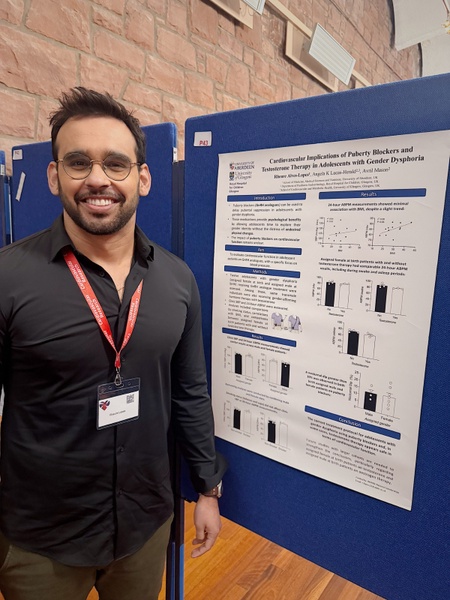
Attending the Foulkes Foundation’s 50th Anniversary Symposium at the Royal College of Physicians was a real honour. As a current Foulkes Foundation Fellow, I had the opportunity to present my research evaluating the short-term blood pressure safety of puberty blockers, medicines used to pause puberty in adolescents with gender dysphoria. My main message is simple: our findings show that puberty blockers appear safe for short-term blood pressure regulation in transgender adolescents, offering reassurance to young people, families and clinicians.
Puberty blockers are commonly prescribed to delay unwanted physical changes and give adolescents time to explore their gender identity. While their psychological benefits are well known, there is still limited evidence about their effects on cardiovascular health. In our study, funded by the INSPIRE National Centre of Excellence Scholarships and carried out under the supervision of Dr Avril Mason, Consultant Paediatric Endocrinologist at the Royal Hospital for Children in Glasgow, we assessed blood pressure in twelve adolescents receiving puberty blockers. We used clinic measurements and 24-hour ambulatory blood pressure monitoring (ABPM), which records blood pressure throughout the day and night.
Our results were reassuring. Blood pressure readings were similar between adolescents assigned male or female at birth, and there was no significant difference between smokers and non-smokers. Transmale adolescents on testosterone also showed comparable readings to those not yet receiving testosterone. Although there was a slight trend linking body mass index with average blood pressure, this was not statistically significant. Overall, the data support that puberty blockers do not appear to cause short-term cardiovascular harm, particularly in relation to blood pressure.
This research contributes to a growing evidence base supporting the safe use of puberty blockers as part of gender-affirming care. It reinforces the importance of routine, individualised blood pressure monitoring while giving families and clinicians valuable reassurance. Larger studies will be crucial, but these early findings already add meaningful clinical insight.
The Symposium itself was an inspiring milestone. The Foulkes Foundation Fellowship, which supports post-doctoral scientists entering medicine, has been transformative for my training. It has strengthened my CV, expanded my academic opportunities, and connected me with clinicians and researchers living the career I aspire to, the path of a clinician scientist. I am also very grateful to the University of Aberdeen, not only for funding this research but also for helping with the costs of attending the Symposium. Experiencing this event among such an accomplished community was motivating, encouraging, and a powerful reminder of the value of this Fellowship. I remain deeply thankful for the Foundation’s mission and the remarkable network it continues to build.