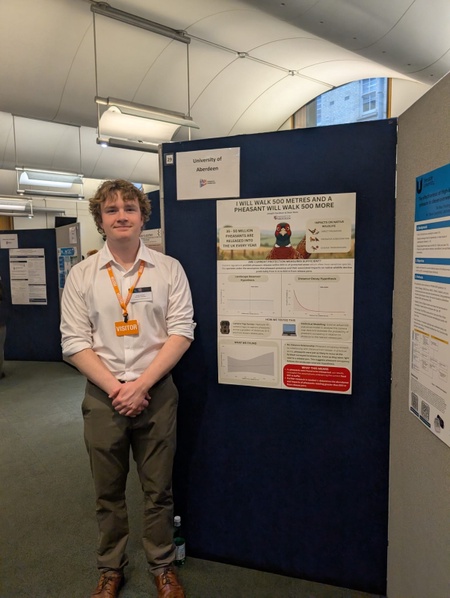
This year, I was fortunate enough to be the undergraduate student that the University of Aberdeen sent to Posters in Parliament. I attended to present the results of my honours thesis, “Post-release distribution of pheasants in Scotland: distance-decay or uniform occupancy?”, which explored long-term patterns of pheasant site use following annual releases and tested the assumptions underpinning current measures designed to protect biodiversity from the impacts of pheasant releasing. I presented my research in the form of a poster titled “I Will Walk 500 Metres, and a Pheasant Will Walk 500 More”.
Upon arriving at the event, I quickly got chatting to students from all over the UK. Everyone was presenting research from a wide range of disciplines, from testing designs for liquid cooling systems, to investigating the benefits of high-intensity interval training, to studying brain activity in order to understand what helps people stay focused and pay attention.
It was a great experience to present my research to people from such a wide variety of backgrounds. When you are surrounded by people from the same discipline, it is easy to forget that many others know very little about conservation or the issues you care deeply about. The event challenged me to adapt and explain my research in a way that was both interesting and accessible.
Presenting to politicians was a particularly valuable experience. I was fortunate that my project had direct relevance to policy, especially in relation to the guidelines that underpin pheasant releasing in the UK. The conversations I had on the day gave me a sense of how, if I were to continue pursuing this area of research, I could expand the project in ways that would make it more relevant to policy, what kinds of results are most useful to decision-makers, and how research needs to be communicated in a clear and actionable way if it is to catch the attention of policymakers and help shape policy that benefits biodiversity in the UK.
It was extremely rewarding to share a project that I had worked on for the best part of seven months. Having gone through the full research process, from planning the study, collecting data in the field, and processing the results, to writing up the thesis and finally presenting it in Parliament, I felt I gained a real sense of what it might be like to be a researcher and advocate. I think that experience will serve me well in the long run.
Overall, Posters in Parliament was a fantastic experience, and one that has left me even more motivated to pursue a career in research and to produce work that can make a meaningful difference. I would highly recommend taking part if you ever get the chance. I would also like to thank my supervisor Dr Deon Roos for his guidance with both my project and the poster, and Prof Michelle Pinard and the School of Biological Sciences for the opportunity.