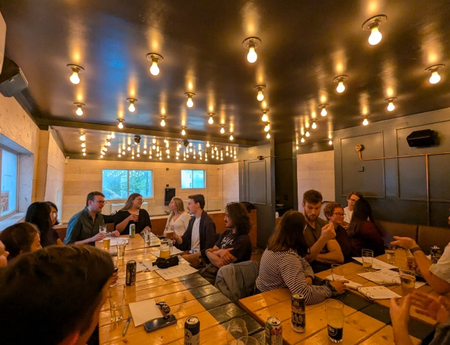
The NoWPaS (European – formerly Nordic – Workshop of Masters, PhD, and Post-Doctoral Fellows working on anadromous salmonids) aims to build and maintain an international network of early career researchers studying salmonid species such as Atlantic salmon, Arctic charr, and Brown trout. By sharing recent research findings, the workshop supports the conservation of these iconic species and provides valuable insights to fisheries managers to inform their decision-making. While the NoWPaS Workshop is traditionally held in Europe, this year marked a special occasion—our 25th workshop—which we celebrated by hosting it internationally in Canada. This shift aimed to foster broader global connections and collaboration among salmonid biologists worldwide.
The first NoWPaS workshop was held in 2005 in Norway, and has been held since in Sweden, Finland, Denmark, the United Kingdom, France, Ireland, Canada, Iceland, and France. Although it started out as a European initiative, due to the universal importance of salmonids, it has grown into a global meeting with both European and North American early-stage researchers regularly attending. The workshop is also organised by the attendants in democratic fashion; the committee of the 2025 workshop had members from the United Kingdom, North America, Norway, and France. These workshops have facilitated the sharing and dissemination of salmonid science. They have also been instrumental in initiating new international collaborations, as well as in identifying novel and timely topics for future research.
The NoWPaS workshop is entirely funded by sponsors, without whom the event would not be possible. Their generous support allows us to offer the conference free of charge—an important factor for students and postdocs who often have limited access to funding. Although the conference itself was free, I still needed to travel to Canada to attend. I would like to thank the School of Biological Sciences for awarding me an £800 travel grant, which covered the majority of my flight costs. This support allowed me to participate in the workshop where I had the opportunity to present my PhD research, allowing me to share my work with an international audience. This experience was incredibly valuable for receiving feedback, improving my communication skills, and gaining visibility within the global salmonid research community—an important step in my development as a PhD student.
As a member of the organising committee, it was especially important for me to be there in person. This experience has taught me valuable skills such as delegating tasks, managing a team, meeting deadlines, and balancing organisational responsibilities alongside my PhD work. I believe these skills will not only enhance my current PhD experience but will also be highly beneficial in my future career.
Being involved in this international event also gave me the opportunity to collaborate with other PhD students from around the world and build lasting friendships. If we all remain in the field, I look forward to reconnecting at future conferences and watching each other grow in our salmonid research careers. These connections are also a fantastic foundation for future collaborations.
We were delighted with how the conference turned out. 35 participants joined us from across Europe and Canada, representing a wide range of expertise within salmonid biology. This diversity greatly enhanced opportunities for knowledge exchange and networking.
To further encourage collaboration and learning, attendees took part in an excursion with the Nova Scotia Salmon Association. During the trip, we learned about their water liming facilities, the importance of preserving salmonid populations in Nova Scotia, and observed a demonstration of their rotary screw trap in action. We also spent a day exploring Nova Scotia, including a visit to the iconic Peggy’s Cove and enjoying lobster rolls in the picturesque town of Lunenburg. Additionally, we received a guided tour of Halifax University, where we visited their aquarium facilities and algae cultivation rooms. These excursions gave attendees the chance to experience the local area while also providing valuable time to connect and engage with one another—something we consider a key aspect of the NoWPaS workshop.
The workshop also featured four keynote speakers, all of whom are leading researchers in their respective fields. Their participation was invaluable, providing early career researchers the chance to engage with established scientists in a relaxed setting during meals and group outings. Each keynote gave a talk that offered insight into key developments in salmonid research from both Canadian and European perspectives.
Overall, the conference was a great success, and I would once again like to thank the School of Biological Sciences for their crucial support in helping me to attend the workshop.