-
Adriana - Spanish
-
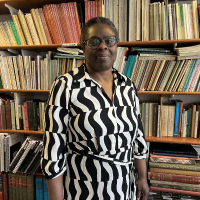
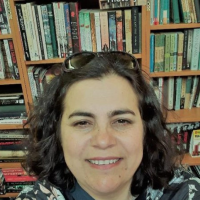
Adriana is originally from Colombia and is a native Spanish speaker. She left Colombia in her 20s and has since lived in the Middle East, the Far East, Argentina, the USA, England and now Scotland.
Adriana's experience
The advantage that I have, because of the many places where I lived, I is that I also learned different Spanishes. [ ... ] It was a big eye-opener I, because, when you speak a language, you think that everybody who speaks that language is going to speak it like you.
I don’t think many people, local people, are really aware of the level of multilingualism that exists in Aberdeen.
I think Aberdeen is getting a wake-up call because we are experiencing an explosion of multiculturalism, just like the rest of the world. I have always felt that frontiers, borders... they are just an imaginary concept. We know from climate change and the pandemic that everyone and everything is connected. But the perception of people in Aberdeen is changing, because the population is changing. And hopefully that’s best... hopefully that’s going to help, and support inclusion and mutual understanding.
-
Alec MacDonald - Gaelic
-
Alec MacDonald is originally from the North East part of the Isle of Skye and grew up in a Gaelic speaking family. He is known as Alec Valtis in the local community in Skye. He moved to Aberdeen in 2009 and has been here since. He visits Skye regularly and still calls it ‘home’, Gaelic being part of his everyday life and speaking it as part of his work and with his family weekly.
Alec's experience
[I was] born and raised on Skye to a family where crofting was the norm. Everybody in the village – the small village of ten, nine or ten houses – everybody, every single person, I think there must have been about 40 people, they were all Gaelic speakers... And the same old story, doors were never locked. People did not knock when they came in, and it's just open doors all the time, and everybody knew each other.... [After finishing school] I left Skye and went to Edinburgh to college, and I had different jobs in the interim period. Then I did my degree in Gaelic... I moved to Aberdeen in 2009 because my partner was here.
Gaelic was the language of my home. I remember the first time that I heard English was when my father's cousins came home from the Glasgow Fair. I must have been about 4 or 5. I didn't question, you know… at that age you wouldn't question. But I do remember hearing this language... But then the minute we went to school, although every member of staff, the head teacher, the two or three class teachers, the two cooks… everybody was fluent in Gaelic, we had very, very little Gaelic taught to us. We had our Lord's Prayer on a Monday morning... but that was it.
Growing up as a teenager, I can’t ever say that I felt proud of the fact that I was a Gaelic speaker… like getting up and shaving in the morning or washing your face, it’s just part of your life. It’s part of you, you’re not proud of that. It just is. But today I am, because I see just how uncertain things are with the language just now. But there’s always hope there. There has to be. The minute you give up, then everything is lost.
I've been living here [in Aberdeen] for almost 18 years. I don't feel that I've lost my Gaelic or that my Gaelic has weakened at all. I speak with family every day,... I'm in contact with friends regularly speaking in Gaelic, and all my work is in Gaelic... I think you could be living on the moon and have no contact with anybody, but you 're not going to lose your mother tongue.
-
Andrada Lilburn - Romanian
-
Andra is originally from Romania and moved to Aberdeen eight years ago to pursue her studies. After completing her Bachelor's degree, she stayed on to begin a Master's in Ethnology and Folklore at the Elphinstone Institute. She currently works as a relief Museum Assistant and a Research Assistant for Aberlangs.
Andrada's experience
Romanian is my first language, and English is my second; however, I feel like it's the exact opposite. I started learning English when I was about 4 years old. When I was older, around 6 or 7 years old, my parents took me to private English after-school classes. Once I moved to Aberdeen, I stopped speaking Romanian as much and English became the language I spoke in all spaces and I'd only speak Romanian on the phone with my family; so, I lost that deep connection with the language and I consider myself to be a really awkward Romanian speaker now, as silly as that may sound.
When I first came to Aberdeen, there definitely was a culture shock. The English I learnt back in Romania was not the English people spoke here... I didn't make many friends at first because I was too scared to speak in case I'd pronounce something wrong, and I preferred to just 'stand aside and observe' the language and how Aberdonians pronounce words. I think this helped me a lot in the long run.
In terms of my identity, there definitely was a bit of confusion at times due to losing touch with my heritage; but, whenever I go back to visit my family, I feel part of the culture and everything comes back naturally. When I'm in Scotland, I feel included and accepted within the culture and traditions so there's definitely a bit of duality going on, but I cherish and love both cultures equally.
I also dream in English. I rarely have dreams in Romanian and, when I do, the conversations in the dream are not that complex compared to my dreams in which everyone speaks English or Doric.
-
Anna Bukalska - Polish
-
Anna is originally from Poland and moved to Aberdeen over twenty years ago. She is a regular volunteer at the Polish Association Aberdeen which provides social and cultural support for the Polish community, including language provision and a permanent Polish library.
Anna's experience
Polish is my first language. English is my second. I also speak a little bit of Russian. [For my son’s sake], mostly we decide to speak Polish at home. I know families where they choose not to speak their first language at home, but their children don’t speak Polish, which is very upsetting for their grandparents, for the family in general, back in Poland.
Coming here first with almost no language, it was a very difficult thing. For me, because I knew I will stay here, it's not only a temporary decision... I knew I have to challenge myself, although it was difficult and, plus, Aberdeen dialect on the top of that... it was a nightmare.
I never lost my identity. I am proud of who I am, I am Polish. I love Scotland, Scotland is my home now, but my heritage and the language we always kept at home [was] Polish, even with our son. And, thanks to that, he’s bilingual […] and he can switch from one to another whenever he wants.
I dream in Polish and in English. When I had the first dream in full in English language – I was like, ‘wow, that was an experience’. It was like watching a movie... And I was one of speakers and I spoke in English.
-
Åshild Sand - Norwegian
-
Åshild is originally from Norway and has been living in Aberdeen for six years. She works at the Norwegian Seamen’s Church in Regent’s Quay (part of the Sjømannskirken) which supports Norwegian sailors visiting Aberdeen.
Åshild's experience
The ones we visit [with the Sjømannskirken], it is because they are Norwegians or Scandinavians. And also sometimes we have gatherings here in the church and what brings us together is the culture, the common Norwegian culture, and especially the language; but also some from Sweden and Denmark… but mainly Norwegians.
I live together with my Norwegian husband, so we speak Norwegian and, when we meet people who don't know Norwegian, we speak English. So, we use both the languages every day... Norwegian is the only language that I feel like a heart language and can express my feelings through. But I can do a certain amount in English, but not as much as Norwegian
The language is really important. So, when we visit ships, some some of the sailors, they can be the only Norwegian on the ship; or maybe there are two or three and the other crew are from the Philippines or Eastern Europe or other places. So, when we come, they can speak Norwegian and language is really important, and also the common culture: we can talk about TV programmes in Norway and stuff from Norway, and it's really enjoyable to talk.
-
Azraai Effendi - Malay
-
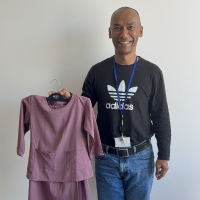
Azraai Effendi was born and grew up in Kuala Lumpur, Malaysia, moving to the USA at the age of 19 for his studies. In 2010, Azraai came to Dundee for his Master’s degree, being employed by Shell a year later, meeting his wife and moving to Aberdeen. Azraai has a young daughter: him and his wife involve her in the Malay culture and traditions, also teaching her the language.
Azraai's experience
[In Malaysia] I would say almost everybody would be able to speak Malay... whether you're born a Malay or Indian or Chinese or any other race, you tend to be able to speak Malay. So that's why I think I speak Malay because I was born in a Malay family... that's my mother tongue. And, although having said that, I went to an English preschool... [My dad] was an English teacher so I think when he had us, as children, he tended to want us to learn English. So, we speak English quite a bit at home as well. But then, because my mum speaks mostly Malay, we get a chance to speak both languages.
[For my daughter] I do want her to know the language... if we ever go back to Malaysia, or if she fancies working in Malaysia at some point, it's good for her to be able to at least understand the language [...] when she gets to speak to her grandparents, they tend to kind of share more of the traditional Malay songs and nursery rhymes... So, she gets exposed to that as well... Once in a while, we’ll get sent a Malay book... so we read Malay to her. Even though she can't read Malay, she listens to it.
Even though I'm fluent in English, I do speak Malay with my wife because there are, I suppose, parts of conversations or certain topics of conversation that feel more natural when you speak your mother tongue… You know, not everything delivers with the right impact if you're speaking in a foreign language. So, I think that's probably where I kind of make sure that I don't forget the language, I suppose.
I think Aberdeen itself, because it's got different dialects, I think that helped them kind of accept more diversity in languages because they themselves know when they speak English, they don't sound like English down south.
-
Harrison Stuart - German, French, Dutch, Doric
-
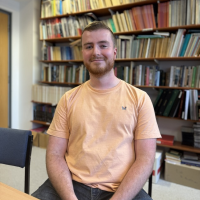
Harrison is an Aberdonian, born and raised in Aberdeen and Aberdeenshire. He studied for two years abroad, learning German, French, and Dutch and is currently a student at the University of Aberdeen. Out of all the languages he speaks, Harrison’s favourite is Doric. When he’s in Aberdeen, he says English comes second.
Harrison's experience
I started learning German, and I just got A after A in my spelling tests and vocabulary, so I knew I was going somewhere with it. So I picked up French, and I got an A. [...] I just kept getting As with my German throughout... I feel really proud about it. And that's what led me to just indulge in a bit of Dutch. I've been learning Dutch online, so I listen to lots of music. For some reason, I've ended up making Dutch my most-listened-to music for the past two years.
I can only really order a coffee in Dutch, and I can understand it very well because it's pretty simple... There are so many words in Dutch that are in Scots. We even see it in Aberdeen city places. [e.g. ‘Nether Kirk’: in Dutch, neder = ‘lower’ and kerk = ‘church’]
I had to tone down my identity when I was in France, for sure. I had to speak very slowly and very, like, in a standard way to children [while teaching them] when I was over there. [...] I standardised myself in France.
[On experience of Scots at school]: In the curriculum, there is lots of literature based on Glaswegian environments. mostly during the interwar period or post-war. And that's what we did learn in our National 5 course. But it's still not northeastern. It's like teaching people in Friesland Flemish literature: you know, it's just not their thing. Or teaching Jamaicans maybe South African English-speaking literature: you know, it's just not the same thing. Maybe it's not that extreme, but there is still a clear difference, I'd argue.
-
Ibidun Daramola - Yoruba, Efik, Housa, Swahili
-
Ibidun is originally from Nigeria and moved to Aberdeen 15 years ago to do her PhD at the University of Aberdeen. She is a minister with the Church of Scotland, currently serving as an interim moderator.
Ibidun's experience
I speak a few Nigerian languages. I grew up in the North, so I speak a bit of Hausa language. I connected with people from the South, called Calabars, so I speak a bit of Efik language. I speak Yoruba and, having lived in Kenya, I speak bits of Kiswahili. I spent three months in France with my husband to learn French language, but I'm not sure I can do that any longer. The problem with languages is when if you don't make use of it, you kind of lose it with time.
[My children] speak Yoruba like Scots. My husband is quite good at speaking to them in Yoruba... we discuss the culture with them and help them understand the differences sometimes when there are issues that pop up and we’re saying that ‘look, you are still an African’ and they are quite aware of that.
I think the initial tendency [within the community].. is to speak in English because we are in Scotland. But sometimes we do [switch between languages]. We have a lot of our songs. Some of the local songs are in vernacular – the local language. We could sing Yoruba songs. We could sing Hausa songs. Sometimes we sing the Ghanaian songs because it's an African community.
I’m very proud of my culture, and at home we still retain a large chunk of the culture like the language, the food, and the values of the community. […] And I work with the Church of Scotland so I work with people locally, so I have those two cultures.
-
Lesley Crerar - Sign language
-
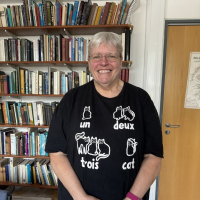
Lesley Crerar currently works as a registered sign language interpreter, also having a rich background in healthcare. She first learned sign language as part of her employment in order to understand one of her deaf patients and “one thing led to another and ended up training to become an interpreter”. Lesley was brought up in Torry and is the proud owner of a Torry passport.
Lesley's experience
I was quite broad (as a Doric speaker) for a long time. And then, as a nurse, I became a clinical tutor. And I was teaching all sorts of people from all different walks of life. And I felt like I had to speak in a way that everyone would understand me. So I couldn't use proper Doric words because people wouldn't understand it. So I had to modify my speaking. But then I would go home and speak to my mum and go back into it.
Sometimes I can sign things a lot quicker than it's said, but sometimes I can't. It just depends on what the meaning is. Sometimes, nobody knows the meaning, especially like songs. Because songs are full of metaphors, and I like to do songs so that I'm fitting the music, so I can maybe sign the metaphor very quickly, but I want to make it longer so that I'm starting and finishing at the same time as the singer. So that takes a lot of preparation.
It (British Sign Language) evolves like English, like spoken language… things change with the way that things look and how things are said and there are new words.
When I'm doing (i.e. BSL interpreting) something that's in Doric or something with a very strong accent, I think the fundamental of the sign translation is actually the meaning. So the meaning is the same, whether it's in Doric or whether it's in French. You know, it doesn't matter. But the attitude that I do it with is what indicates the Doric. So it's a change in register for my body language. And that's how I show the Doric.
-
Norris and Christina - Mandarin
-
Norris came to Aberdeen in 2005 for his Masters degree, settling in Aberdeen after his employment. His daughter, Christina, is currently in primary school and loves both English and Mandarin equally. They both maintain their heritage through family, cooking Chinese foods and attending events such as the Chinese New Year, and the Mid-Autumn Days.
Norris' experience
We learn English just as a default… There are English lessons everywhere in all the schools. But the thing is, because it's Chinese teaching students to learn English, the Chinese teacher is focusing on writing and reading and probably not focusing very much on speaking. So, I learned English when I was a school kid (probably primary five) and then we got English class in middle school and high school as well... but at that time I was exploring Western music… and I was watching lots of Western movies, so I would say I wasn’t struggling when I first came here, for speaking or reading or writing.
Although [Christina] can speak Mandarin, she's very poor at reading and writing, and we haven't got time to do some Chinese learning for reading or writing. And that's probably the downside for us just now.
For work, basically just English. And then at home, I speak to Christina or I speak to my mum just in Chinese.
I think just speaking Mandarin at home is very important... not forgetting Mandarin and then forgetting the culture... The hard thing is, sometimes you have a playdate with another Chinese kid and then we would just speak Mandarin. And then five minutes later they [the children] speak English... I take her to the events, for Chinese New Year, for the Mid-Autumn day, take her to China, seeing different things, and visiting different places, especially the culture and that part of things. Make sure, you know, she's not forgetting Mandarin and also her culture.
Christina's experience
[My favourite thing about being Chinese is] if someone else at school also speaks Mandarin, and if we want to keep something private, just us, then I can speak Mandarin.
When I was little, my first language was Mandarin, and my parents taught me. And then when school started, they taught me English. Sometimes I speak both, but most times I speak Chinese. At school, I speak English.
-
Sahar Abdulla - Arabic
-
Sahar is originally from Syria and studied Geosciences at Damascus University before joining Shell’s workforce in the city. She moved to Scotland with her family to study for a Masters in 2004, finally settling in Aberdeen where she forged a successful career in oil and gas before pivoting to community-focused work based around social inclusion and global citizenship. She speaks Arabic and English.
Sahar's experience
In Syria, to learn another language is compulsory… Where I was born originally, in the middle of Syria, French [often taught in Syria] wasn't that popular, so English was the mainstream language. So I was 12 when I first learned it. But I loved also my teacher. And since the age of 12/13, I love the language because of that. And that just grew with me and I kept up with English…
When when I came to Aberdeen to work in 2005, I didn't know any Arabic speaking people and I was working 9-to-5 for many years in an international companies with international people, so English was the only spoken language for me for years. And that in a way also limited my social exposure to the Arabic community. So I would say speaking English guided my social manoeuvres in the city – most of my network or friends were families through my son in schools or in the community centre. It was only in 2016 when I lost the oil and gas job and I tried to find another job, translation was the easiest because I speak both languages and refugees were starting to arrive to the northeast and Aberdeen... only at that point of time, 2016 till now, I started to use Arabic more.
Language probably is abstract. Concept is beautiful. But then as a practical means of communication and living, it's another world of a challenge, I guess.
When people ask you, ‘where are you from?’ I've never felt offended. I make fun of it. I say ‘guess’ because I consider all humanity are like refugees in a way or another. So we are just all individuals in this world.
-
Third Culture Kid - Russian, Dutch
-
Third Culture Kid was born in the Soviet Union and immigrated to the Netherlands in 1991. They grew up in the Netherlands, spending most of their life there. Their background is in Psychology and Law. They started their career in banking, later moving to the energy then education sector.
Third Culture Kid's experience
I started learning English at school from the age of five [...] In the Soviet Union, it would either be English, German or French. And so I started going to a school that specialised in English. And then when I moved to the Netherlands, I went to a special school where we had a lot of Dutch... so within six months, I was ready to go to a regular school... it was just like full-on Dutch, Dutch, Dutch.
[My schooling] was such an eye opener because I didn't realise that language reflects the culture so much... [In Dutch or English], some words were not translatable, if that makes sense. And, to me, that made me realise how we are formed as people, how our decisions were formed with our language, because our frame of mind is defined by the words that we have... [Learning languages] opened up different ways of thinking [...], at a certain point it clicks with you and you say, “but there are so many other ways of doing things, and this is also okay”... So that's how it was, I think, for me: like a realisation.
I speak English with an accent... when I came here, I came as an adult... I won't have a Scottish accent by the end of my life and that's okay [... but] I don't feel like speaking a different language or being from a different culture impacts me here [...] I wouldn't say I feel overly welcome, but I don't feel unwelcome... it's like you just get on with things.
What I do appreciate [is] how much art is not translated... how fortunate I am... just to be able to watch a movie in a different language, read a book in a different language [...] being able to read Russian literature in its original form or some of the Dutch movies have been really great in the last decade... I've been watching them and it’s so refreshing. And people here will never be exposed to them.