
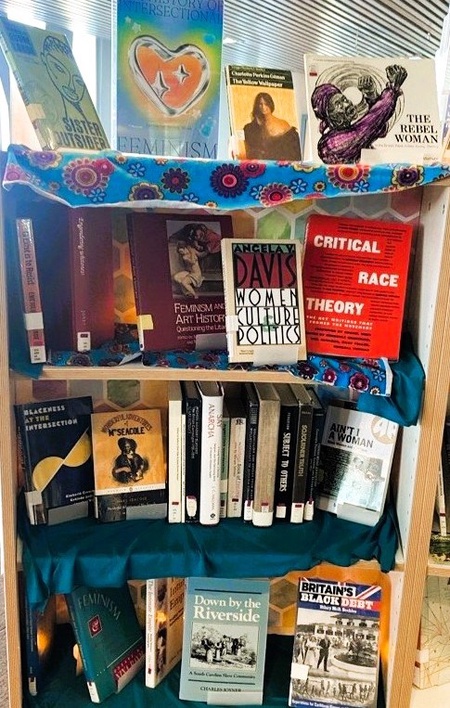
We are delighted to share the results of a recent volunteer project completed by Ruby Munro, a fourth-year history undergraduate. Ruby has created a blog post, a physical display, graphics, and a curated reading list designed to offer an introduction to the history of intersectional feminism.
We warmly invite you to explore the content by viewing the display on Floor 2 of the Sir Duncan Rice Library, borrowing the books if you'd like to read more, and consider the suggested online readings and perspectives presented in this blog post.
The inspiration for this reading list and display was J.C. Hallman’s Say Anarcha: A Young Woman, A Devious Surgeon, and the Harrowing Birth of Modern Women's Health, combined with a lifelong interest in feminist theory. Hallman’s book was recommended to me while I attempted to find work on Saartje Baartmaan, the enslaved woman who was held on display for centuries after her death. While intersectional feminism is a relatively new term, coined by Kimberle Crenshaw in 1989, Black Feminist theory shaped much of historical Feminism, and Crenshaw herself spent decades working in the field even before coining the term. Many of the articles included in both the display and reading list focus on the history of slavery, and there is reason for this.
Particularly in the U.S., many women abolitionists turned to suffrage after the Emancipation Proclamation. Even before this, women in Europe gained political leverage through abolition movements, such as the sugar boycotts led by Elizabeth Heyrick and the Quakers. So, the history of intersectional feminism is not necessarily a simple theoretical development over the last 30 years. It is, instead, the development of a long history of collaboration between women to work for liberation across racial and gendered lines.
However, not all women were interested in collaboration of this kind. White women, including those on both lines of suffrage, actively contributed to enslavement, owned slaves, justified enslavement both through theoretical means and judicial means, and contributed significantly to racial violence both before and after emancipation. Famously, white women victimised boys of colour like Emmett Till and utilised fear of men of colour to weaponise the American judicial system against men of colour. Both before and after abolition, white women actively sexualised and victimised both men and women of colour as part of a rewriting of people of colour as “exotic”. This collection makes no attempt to hide this – and work on the role of white women in enslavement features in both the display and the reading list as a matter of necessity in constructing media like this.
We cannot attempt to whitewash history: we must acknowledge it as it is, even though it makes us ashamed, uncomfortable, and angry. Further, a major shortfall of this collection, I feel, is that work on transgender inclusion in intersectional politics is quite new to this discipline. Some work exists on the inclusion of Jewish women and disabled women in intersectional feminism, but the true goal of intersectional feminism, for me, is the liberation of all women. In a time of growing transphobia, with racial tensions easing in the 5 years since 2020, it can seem a distant goal. However, can any woman truly be free while her sisters suffer? Racial justice is neither simple nor easy, and neither is gendered justice. But advocating for the liberation of all women is a start.