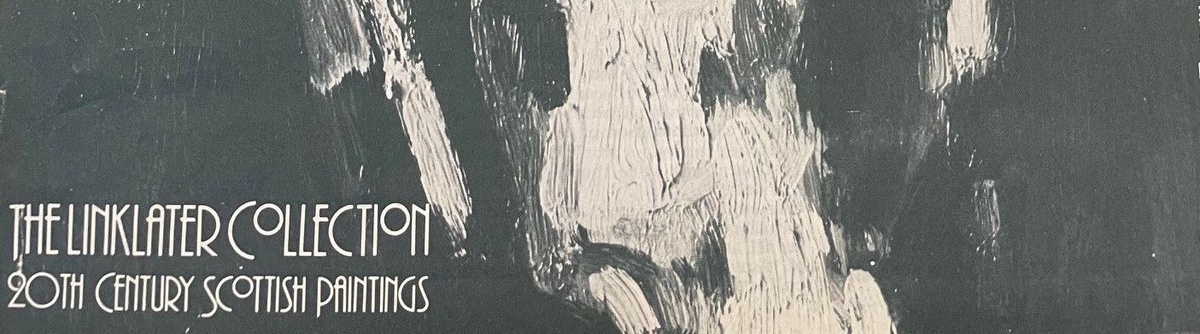
The project Aberdeen’s Artworlds, c.1976: The Linklater Bequest in Context reframes the painting collection as an instrument to promote Scottish art, and as a contribution intended to support art and culture in the North-East, at a time when Aberdeen’s artworld expanded significantly across different social registers.
Aberdeen’s Artworlds, 1976 is funded (2024-26) through a British Academy/Leverhulme Small Grant (SRG2425/251906) and a grant from the Association for Art History.
About the Project
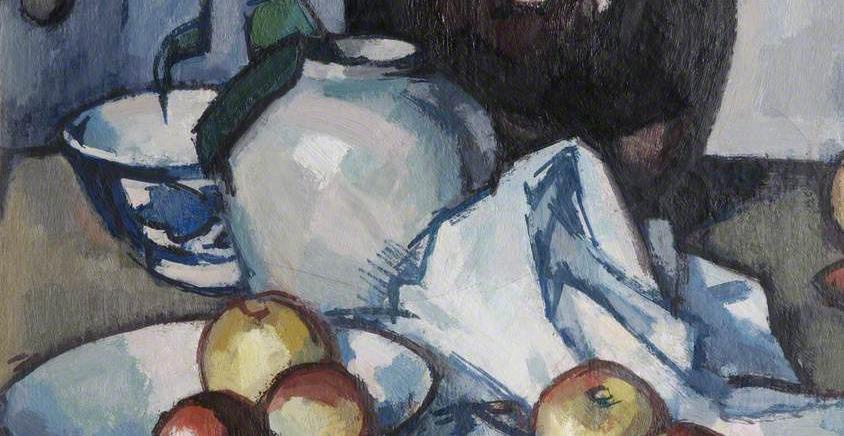
2026 marks the 50th anniversary of the Linklater Bequest of ten Scottish modernist paintings to the University of Aberdeen. The paintings were gifted by Marjorie Linklater (1909-1997), a political activist and philanthropist, in fulfilment of the wishes of her late husband Eric Linklater (1899-1974), a novelist and former Rector of the University of Aberdeen.
This project will document and contextualise the Linklater bequest. Through curation of an exhibition in collaboration with University Collections in the Sir Duncan Rice Library Gallery (February 2026), we are looking to reconstruct the motivations and strategies of the collectors, Eric and Marjorie Linklater, who were closely affiliated with social and nationalist causes in North-East Scotland and on Orkney. We are seeking to reframe the Linklater collection as an instrument to promote not only Scottish art, but Scottish artist-women in particular.
The project interprets the bequest as a contribution intended to support art and culture in the North-East, at a time when Aberdeen’s artworld expanded significantly across different social registers. Instead of seeing North-East Scotland as peripheral to the central belt, we are exploring the dynamics between the North-East and the Islands, arguing for the emergence of a dynamic regional art scene in the 1970s.
The period saw a rapid expansion of art institutions in the city, partially coinciding with the economic boom brought about by the exploitation of North Sea Oil, first discovered in 1970. While the UK experienced a severe recession, Aberdeen enjoyed a veritable gold rush that also benefitted the arts. The mid-1970s were a period of radical expansion and change for the arts in the Granite city. From 1971, the University of Aberdeen offered courses in Art History, with the first students graduating with a degree in the subject in 1975/6. In 1974, artists from Gray’s School of Art founded Peacock Visual Arts – a printmaking workshop that swiftly established itself as the leading contemporary arts organisation in the city. In 1976, plans for a new museum in Old
Aberdeen were approved. In this constellation, Aberdeen became an important hub for the cultural and artistic landscape in North-East Scotland, significantly diversifying the established civic artworld, which coalesced mainly around the Victorian foundation of Aberdeen Art Gallery. Collectors and benefactors, such as Marjorie Linklater, aimed to enhance this growing regional drive, and facilitated initiatives in the region (both on the mainland and islands), such as the establishment of the Pier Arts Centre in Stromness on Orkney in 1979, with Margaret Gardiner (1904-2005).
Aligned with the project’s main hypotheses, the curatorial and academic methodology is shaped by a commitment to: foundational research that fuses traditional archival work with anecdotal approaches from oral history; perspectives from feminist curating; approaches from regional studies that counter-map the flow of the Linklaters’ cultural advocacy, arguing that artistic landscapes within Scotland are networked in patterns that are not aligned with structures of power.
A research workshop will take place Friday 10 October in the Linklater Rooms, University of Aberdeen, where the bequest has been displayed since 1976.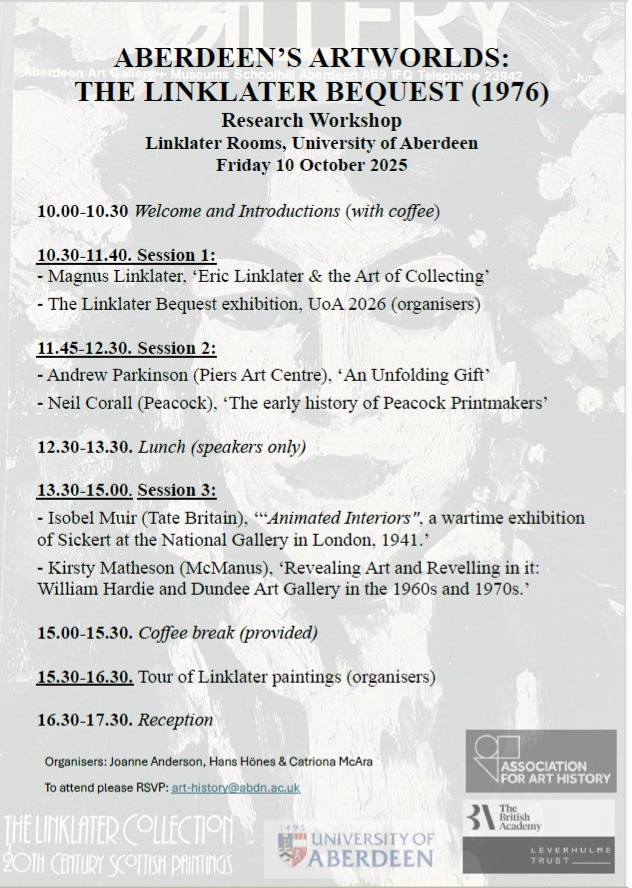
It brings together scholars and museum professionals from the Pier Art Centre in Orkney, University Collections and the Art History Department of the University of Aberdeen, Dundee City Art Gallery and Museum (‘The McManus’), Tate Britain in London, and the British Art Network.
The project’s findings will be conveyed through the curation of an exhibition in 2026 to celebrate the 50th anniversary of the bequest. The exhibition will showcase the paintings and contextualise them with related loans and archival material. It will be accompanied by an exhibition catalogue, published by Aberdeen University Press.
Project Team
Dr Hans Hönes, Senior Lecturer in Art History – Principal Investigator
Dr Joanne Anderson, Reader in Art History – Co-Investigator
Dr Catriona McAra, Lecturer in Art History – Co-Investigator
In collaboration with University Collections, University of Aberdeen