
Introduction
Anthropology and Sociology at Aberdeen is a great partnership, adding to your thorough grounding in what it means to ‘be human’ with a ‘sociological imagination’ exploring how society shapes us as individuals. This programme explores how we can understand ourselves, our relationships with others and the challenges we face in a changing world.
Anthropology will give you a thorough grounding in humanity, the differences in human cultures and communities, and how they have developed. You will gain insights into human behaviours, beliefs and attitudes all over the world, exploring connections between aspects of life such as family, economics, politics and religion.
In Sociology, you will deepen this knowledge through studying topics as wide-ranging as sociology of the family, work-life balance, religion and society. You will become skilled in the social research methods used to gather evidence to better understand aspects of society.
You will be taught by academic staff with international reputations for their research in conflict and peace, religion and secularisation, social movements, and global political sociology.
You will develop unique insights and critical thinking skills that have tremendous value to employers in all sectors. Recent Aberdeen graduates are working in business, journalism, management, marketing and advertising, local and national government, social and market research, teaching, health services, social work, charities and human resources.
What You'll Study
- Year 1
-
Year 1: Compulsory Courses
- Getting Started at the University of Aberdeen (PD1002)
-
This course, which is prescribed for level 1 undergraduate students and articulating students who are in their first year at the University, is studied entirely online, takes approximately 2-3 hours to complete and can be taken in one sitting, or spread across the first 4 weeks of term.
Topics include University orientation overview, equality & diversity, MySkills, health, safety and cyber security, and academic integrity.
Successful completion of this course will be recorded on your Transcript as ‘Achieved’.
- Introduction to Anthropology: Peoples of the World (AT1003)
-
15 Credit Points
Anthropology explores ways of life in societies and cultures around the world. Through fieldwork in the places people live, anthropologists connect global issues with everyday lives. In this course you’ll learn about the key topics of anthropology and its research methods. Lectures introduce anthropological research topics such as ritual, climate change and indigenous rights. Small group tutorials will allow you to debate the issues and share your perspectives.
- Introduction to Sociology I: Self, Identity & Society (SO1007)
-
15 Credit Points
Sociology is the study of human social groups. It particularly focuses on modern societies, analysing how they work and how the major social institutions in them (such as religion, the media, government and the economy) operate. The course provides students with a general introduction to the unique manner in which sociologists seek to understand contemporary societies. Students are presented with current and classical approaches to understanding the social processes that underlie self-construction, group formation and social interaction, within urbanizing and globalizing social contexts.
- Introduction to Anthropology: Questions of Diversity (AT1502)
-
15 Credit Points
In this course students will be offered an extended introduction to social anthropology and will focus on topics: language and culture, belief and religion, gender and sex, kinship, and race. Students will develop and refine their understanding of major issues in the discipline of social anthropology through staff lectures, tutorials, and ethnographic films.
- Introduction to Sociology II: Systems of Power (SO1509)
-
15 Credit Points
This course is an introduction to macro-sociology, which analyses the ways that people’s lives are shaped by large-scale forces, structures, and institutions. Students are introduced to the particular ways in which classical and contemporary sociologists understand social forces in the modern domestic and global environment and learn to think critically about those social forces that impact their everyday lives using the sociological imagination. Substantive topics likely to be covered in this course include the media, politics, religion, surveillance, education, class stratification, international inequalities, and the relationship between humans and other animals.
- Academic Writing for Social Sciences (AW1006)
-
This compulsory evaluation is designed to find out if your academic writing is of a sufficient standard to enable you to succeed at university and, if you need it, to provide support to improve. It is completed on-line via MyAberdeen with clear instructions to guide you through it. If you pass the evaluation at the first assessment it will not take much of your time. If you do not, you will be provided with resources to help you improve. This evaluation does not carry credits but if you do not complete it this will be recorded on your degree transcript.
Year 1: Optional Courses
Select a further 60 credit points from courses of choice.
- Year 2
-
Year 2: Compulsory Courses
- Key Debates in Anthropology (AT2010)
-
30 Credit Points
This course explores some of the key questions that anthropologists have debated: what it is to be human, the nature of human interaction with other humans and with other species, the role language plays in thought and culture, and the different ways that people perceive the world and act within it. Themes that will be discussed in this course include rationality, language, species difference, race, and place and community.
- Sociology of Everyday Life i: the Embodied Self (SO2006)
-
30 Credit Points
This follows on from level-one sociology. It is designed to highlight the ways that sociological theory informs the research endeavour, not only the questions sociologists raise, but also the particular modes through which we go about investigating them. The module examines these points in relation to a range of micro-level topics – the body, food and feeding, health and illness, the emotions, group behaviour, sex and gender, the life course and death and dying – all of which emphasise the nature of human interaction and sociological efforts to understand it.
- Reimagining Colonialism (AT2515)
-
30 Credit Points
This course will explore contemporary colonial expressions from an anthropological perspective. It will be split into two main themes: Material Histories; and Mediated Histories. Within these themes it will address topics such as the "capturing" of cultures in museums, kinship and politics, gendered colonialism, economic development, media, aboriginal rights and contemporary resistance movements.
- Sociology of Everyday Life II: Global Issues in the 21st Century (SO2509)
-
30 Credit Points
This macro-sociology course extends students’ understanding of large-scale social, as well as political and economic, processes and institutions. Particular focus is on the sociological analysis of global issues and socio-political controversies, many of which are subject to topical and, at times, contentious debate at the beginning of the 21st century. The substantive topics include areas of social and political concern such as globalisation; the changing nature of economy, work and leisure; risk and insecurity; multiculturalism; food production and security; social movements; nationalism and identities.
Year 2: Optional Courses
Plus further credit points from courses of choice to gain a total of 120 credits.
- Year 3
-
Year 3: Compulsory Courses
- Anthropological Theory (AT3027)
-
30 Credit Points
This course explores theoretical issues and key debates in contemporary anthropology. We begin with the questioning of the central concepts of culture and society in anthropology during the 1980s. Following this, we ask: how can anthropology proceed if the targets of its investigation can no longer be understood as objective entities? How can anthropology proceed if the anthropologist themselves is inevitably implicated in and part of those very targets? To look for possible answers, the course examines current anthropological interest in power and history, political economy and phenomenology, experience, embodiment and practice, ontology and things that speak.
Year 3: Optional Courses
Choose one of the following courses:
First Half-Session
- Thinking Sociologically (SO3066) OR Sociology of Religion (SO3070)
Second Half-Session
- Social Research Methods (SO3524) OR Ten Sociological Studies (SO3568)
- Plus select a further 30 credit points from one of the Level 3 Anthropology courses (AT35XX)
NOTE: If you intend to enrol on the Sociology research project at level 4, you must pass SO 3524 Social Research Methods at
level 3.- Sociology of Religion (SO3070)
-
30 Credit Points
This course provides students with an introduction to the sociological imagination as applied to the topic of religion. While the focus is on religion, it uses religion as means of thinking about core sociological concepts and key social processes, as well as the challenges to studying the world sociologically. We will discuss the key dimensions of religious belief, practice and institutions, and what we can learn from these that can be adapted and applied to other kinds of beliefs, practices and institutions.
- Thinking Sociologically (SO3066)
-
30 Credit Points
Thinking Sociologically is the department's core sociological theory module. The course offers our students an introduction to a range of key sociological thinkers and bodies of thought, both classical and contemporary, that inform sociological analysis of social life and social institutions. As such, this course is intended to provide our honours students with a conceptual 'toolkit', that can be applied to facilitate understanding, insight and informed critique with respect to a broad range of historical and contemporary social, political and economic phenomena.
- Social Research Methods (SO3524)
-
30 Credit Points
Sociologists use a range of methods and techniques to explore and test sociological theory. This module introduces many of these methods and techniques. It aims to ground students’ theoretical understanding of society through the practical analysis of a variety of data. It starts by introducing the varying philosophical starting points of research and goes on to provide foundation level critical analysis skills in the key quantitative and qualitative methods that sociologists have deployed to understand and ‘capture’ the social world.
- Ten Sociological Studies (SO3568)
-
30 Credit Points
This course bridges the theoretical emphasis of SO3066 and the methodological elements of SO3524. It presents sociology as a social science by having students examine and discuss in detail ten reports of sociological research. The goal of the course is to highlight the different ways sociological research combines theory and methods to examine and explain specific phenomena, events, or experiences of the world. Each of the ten studies will be chosen by one of the Sociology staff and present theoretical and methodological ideas and approaches that staff members use in their own work or believe to be pivotal to sociological research. Students will be required to read all ten of the chosen publications in preparation for the course each week.
- Year 4
-
Year 4: Optional Courses
You must choose one of the following dissertation courses:
- Joint Honours Dissertation in Anthropology (AT4047)
- Research Project Part 1(SO4068) and Research Project
- Part 2 (SO4568)
Plus a further 30 credit points from one of the semester 1 Level 4 Anthropology courses (AT40XX) and the semester 2 Level 4 Anthropology courses (AT45XX)
Plus select further credit points from level 4 courses in Anthropology and Sociology to gain a total of 60 credits in each discipline.
- Research Project Part 1 (SO4068)
-
30 Credit Points
This course is the first of two courses that comprise the Dissertation in Sociology. This first course affords students an opportunity to apply their sociological knowledge and research skills to an individual piece of research, focusing on a topic selected by the student and ethically approved by their Supervisor. Over the course of SO4068, with guidance from a member of staff, the project student will formulate an appropriate research question(s), conduct a critical literature review of relevant material, select appropriate research methods and prepare appropriate data collection tool(s) in order to commence their (online) research by the end of this course. Students will also get the opportunity to reflect on their presentation skills and prepare a 5-minute Panopto video on their project design for peer review. Particular emphasis will be given to helping students develop time management skills, a key transferable skill.
- Dissertation in Anthropology By Scholarship (AT4065)
-
30 Credit Points
In this course students will write a dissertation based on scholarship in Anthropology (e.g. library research) but not on primary fieldwork. The course is available to single honours students who decide not to do a fieldwork-based dissertation and to joint honours students who wish to do a dissertation in Anthropology. This dissertation can be taken by joint honours students who have not previously taken AT3538: Anthropological Research Methods and Research Design.
- Dissertation in Anthropology By Fieldwork (AT4563)
-
30 Credit Points
This course involves a dissertation based on anthropological fieldwork. It builds on the research proposal developed in AT3538 Anthropological Research Methods and Research Design.
- Dissertation in Anthropology By Scholarship (AT4565)
-
30 Credit Points
In this course students will write a dissertation based on scholarship in Anthropology (e.g. library research) but not on primary fieldwork. The course is available to single honours students who decide not to do a fieldwork-based dissertation and to joint honours students who wish to do a dissertation in Anthropology. This dissertation can be taken by joint honours students who have not previously taken AT3538: Anthropological Research Methods and Research Design.
We will endeavour to make all course options available. However, these may be subject to change - see our Student Terms and Conditions page. In exceptional circumstances there may be additional fees associated with specialist courses, for example field trips.
How You'll Study
Learning Methods
- Individual Projects
- Lectures
- Research
- Tutorials
Assessment Methods
Students are assessed by any combination of three assessment methods:
- Coursework such as essays and reports completed throughout the course.
- Practical assessments of the skills and competencies they learn on the course.
- Written examinations at the end of each course.
The exact mix of these methods differs between subject areas, years of study and individual courses.
Honours projects are typically assessed on the basis of a written dissertation.
Why Study Anthropology and Sociology?
- Aberdeen is one of the fastest growing Anthropology departments in the UK
- Our core staff specialise in regions as diverse as Canada, the Central Asian Republics, Iceland and Scandinavia, Siberia, Scotland and the UK, South America, Tibet and the Himalayas
- We offer innovative ideas and a fresh vision of the subject, with an emphasis throughout on work at the cutting-edge of the discipline and research
- Join the vibrant student anthropology society, which regularly organises academic and social events bringing together undergraduate and postgraduate students with staff outside the classroom
- The Department of Sociology has an international reputation for its research. It is recognised by the UK Government's Economic and Social Research Council (ESRC) as an outlet for research training and supervision for Masters and PhD students
- The Scottish Higher Education Funding Council judged the department to be "excellent" in its most recent Teaching Quality Assessment exercise: the highest grade possible
Interested in this programme?
Entry Requirements
Qualifications
The information below is provided as a guide only and does not guarantee entry to the University of Aberdeen.
General Entry Requirements
- 2026 Entry
-
SQA Highers
Standard: BBBB
Applicants that present with BBBB will usually receive an unconditional offer.
Where we have more applicants than places we may need to ask for more than the minimum so continued engagement in school is recommended.
Widening Access: BBC
Applicants who meet one or more of our widening access metrics and present with BBC, are guaranteed an unconditional offer.
Foundation Apprenticeship: One FA is equivalent to a Higher at A. It cannot replace any required subjects.
Note: We do not double count a Higher and Advanced Higher in the same subject, but we do consider that a B grade at Advanced Higher is equivalent to an A grade at Higher.
National 5 English (or equivalent) is required at Grade C or above.
A LEVELS
Standard: BBC
Widening Access: CCC
GCSE English (or equivalent) is required at Grade C/4 or above.
BTEC LEVEL 3 EXTENDED DIPLOMA
DMM in related subjects.
Note: BTEC Level 3 Extended Certificate (Subsidiary Diploma) achieved at Distinction level, is normally acceptable in lieu of one A Level at grade B.)
GCSE English (or equivalent) is required at Grade C/4 or above. GCSE Mathematics at Grade C/4 is also required for Accountancy, Economics and Finance programmes.
IRISH LEAVING CERTIFICATE
Five subjects at Higher at H3.
INTERNATIONAL BACCALAUREATE
32 points including 5, 5, 5 at HL.
SL in English is also required.
- 2027 Entry
-
SQA Highers
Standard: BBBB
Applicants that present with BBBB will usually receive an unconditional offer.
Where we have more applicants than places we may need to ask for more than the minimum so continued engagement in school is recommended.
Widening Access: BBC
Applicants who meet one or more of our widening access metrics and present with BBC, are guaranteed an unconditional offer.
Foundation Apprenticeship: One FA is equivalent to a Higher at A. It cannot replace any required subjects.
Note: We do not double count a Higher and Advanced Higher in the same subject, but we do consider that a B grade at Advanced Higher is equivalent to an A grade at Higher.
National 5 English (or equivalent) is required at Grade C or above.
A LEVELS
Standard: BBC
Widening Access: CCC
GCSE English (or equivalent) is required at Grade C/4 or above.
BTEC LEVEL 3 EXTENDED DIPLOMA
DMM in related subjects.
Note: BTEC Level 3 Extended Certificate (Subsidiary Diploma) achieved at Distinction level, is normally acceptable in lieu of one A Level at grade B.)
GCSE English (or equivalent) is required at Grade C/4 or above. GCSE Mathematics at Grade C/4 is also required for Accountancy, Economics and Finance programmes.
IRISH LEAVING CERTIFICATE
Five subjects at Higher at H3.
INTERNATIONAL BACCALAUREATE
32 points including 5, 5, 5 at HL.
SL in English is also required.
The information displayed in this section shows a shortened summary of our entry requirements. For more information, or for full entry requirements for Arts and Social Sciences degrees, see our detailed entry requirements section.
Fees and Funding
You will be classified as one of the fee categories below.
- EU / International students
-
- Tuition Fees for 2026/27 Academic Year
- £20,800
- Tuition Fees for 2026/27 Academic Year (Self-funded Students *)
- £14,800
-
The above fee includes the £6,000 Aberdeen Global Scholarship provided to self-funded international students. Full terms and conditions apply.
- Home Students
-
- Tuition Fees for 2026/27 Academic Year
- £1,820
- England, Wales, Northern Ireland, and Republic of Ireland
-
- Tuition Fees for 2026/27 Academic Year
- £9,790
-
The UK Government has confirmed that the RUK fee cap will continue to increase each year to reflect inflation. Tuition fees will increase in line with the Government fee cap each year, and this should be taken into account when budgeting.
Scholarships and Funding
UK Scholarship
Students from England, Wales and Northern Ireland, who pay tuition fees may be eligible for specific scholarships allowing them to receive additional funding. These are designed to provide assistance to help students support themselves during their time at Aberdeen.
Aberdeen Global Scholarship
The University of Aberdeen is delighted to offer eligible self-funded international on-campus undergraduate students a £6,000 scholarship for every year of their programme. More about this funding opportunity.
Funding Database
View all funding options in our Funding Database.
Careers
You can choose from a specialist career in Anthropology upon studying a further degree or you can choose a range of careers in sociology which could include health, counselling, business and marketing, writing and publishing and more. Together these subjects may offer a strong knowledge combination to work in a wide range of careers.
Useful Fact about this Degree
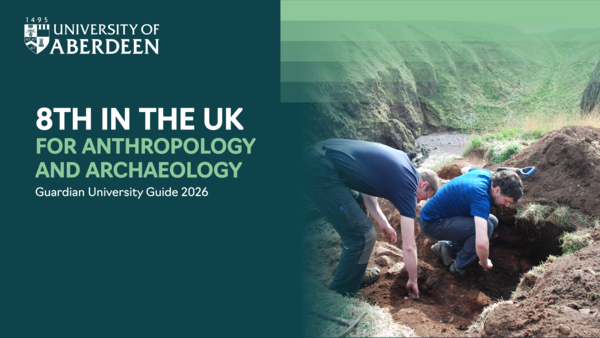
Aberdeen is ranked 8th in the UK and 2nd in Scotland for Anthropology (Guardian University Guide 2026) and in the Global Top 100 for Anthropology (QS World University Rankings by Subject 2026)

2nd in Scotland for Sociology
Aberdeen is ranked 2nd in Scotland for Sociology by the Times and Sunday Times Good University Guide 2026
Our Experts
Information About Staff Changes
You will be taught by a range of experts including professors, lecturers, teaching fellows and postgraduate tutors. However, these may be subject to change - see our Student Terms and Conditions page.
Discover Uni
Discover Uni draws together comparable information in areas students have identified as important in making decisions about what and where to study. You can compare these and other data for different degree programmes in which you are interested.
Get in Touch
Contact Details
- Address
-
Student Recruitment & Admissions
University of Aberdeen
University Office
Regent Walk
Aberdeen
AB24 3FX