
- Atmospheric physics
-
Atmospheric physicists study the atmosphere and climate of the Earth, and sometimes other planets. They want to understand the structure and dynamics of the atmosphere, how it evolves over time, and how humans and natural processes affect the climate. The weather has numerous direct consequences for everyday life.
This topic is highly interdisciplinary and overlaps with our other research in planetary astrophysics, fluid dynamics and microfluidics, nonlinear dynamics and chaos, and data science.
- Atmospheric predictability
- Data assimilation
- The atmosphere as a chaotic system
- Atmospheric turbulence
- Synchronisation phenomena
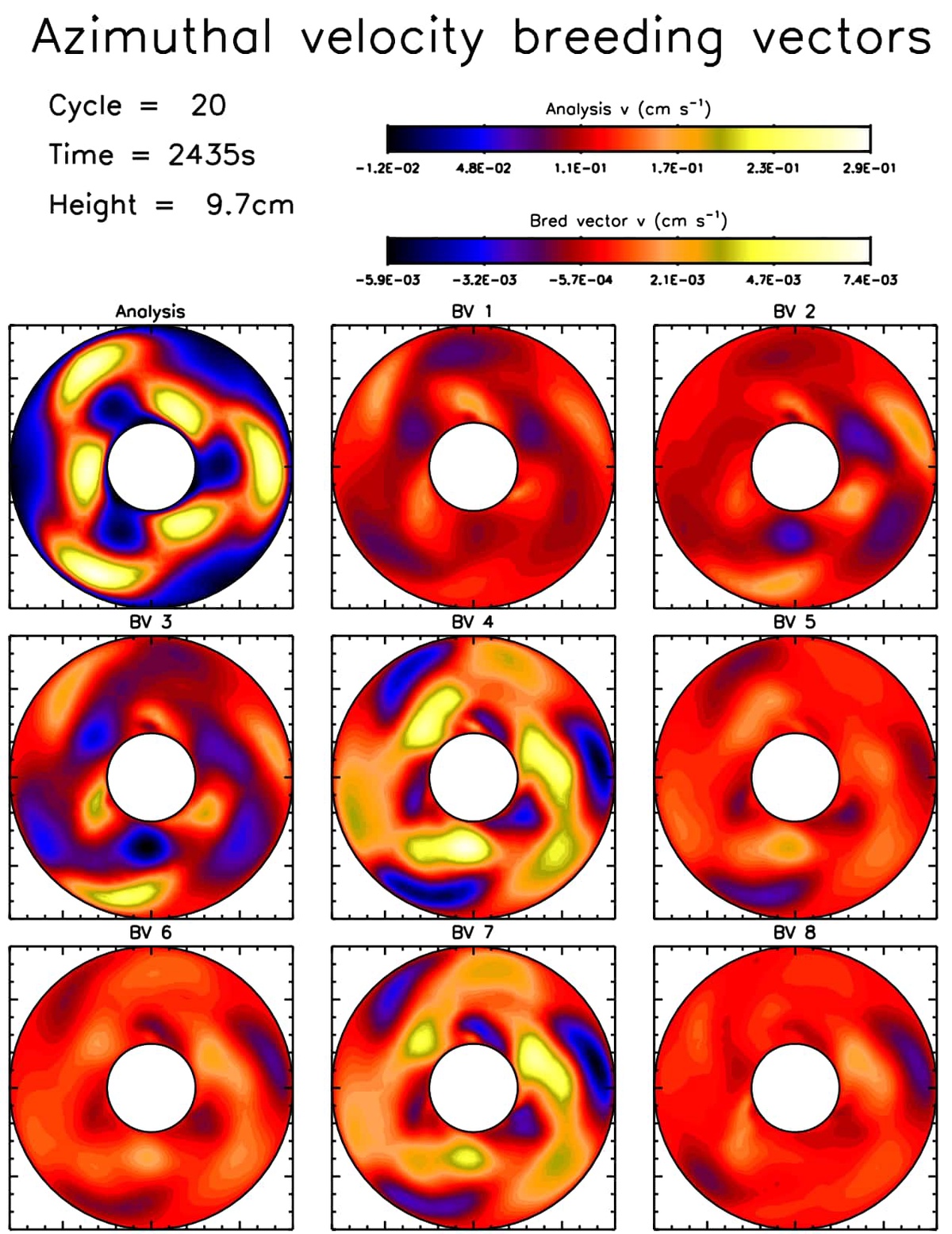
Right: Breeding vectors in a rotating annulus forecast, quantifying the growth of ensemble perturbations in the amplitude vacillation flow regime. From Young & Read (2016).
Staff contacts: Roland Young, Nicolas Rubido.
- Fluid dynamics and microfluidics
-
In microfluidics, small amounts of fluid are manipulated through channels of microscopic size. Also called lab-on-a-chip or organ-on-a-chip, this is a state-of-the-art technology which offers tremendous experimental possibilities.
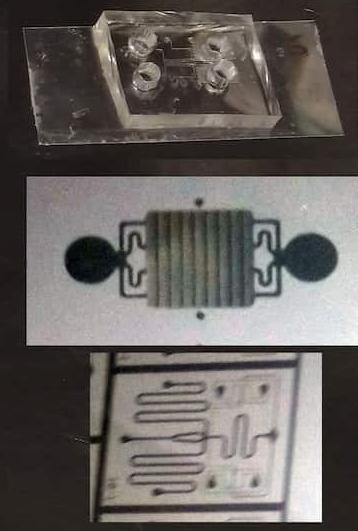
Right: Examples of manufactured chips from the microfluidics laboratory. Image credit: Claudiu Giuraniuc.
Fluid dynamics is the study of how liquids and gases flow. It has many applications throughout physics, chemistry, engineering, geosciences, medicine, biology, and elsewhere.
As an interdisciplinary topic, fluid dynamics underpins research in several of our other areas of interest. We are interested in fluid dynamics in the following contexts:
- Plasma phenomena
- Chaotic advection of flows
- Geophysical fluid dynamics
- Atmospheric turbulence
Staff contacts: Claudiu Giuraniuc, Scott Doyle, David McGloin, Alessandro Moura, Francisco Pérez-Reche, Roland Young.
- Plasma physics
-
Plasmas are a non-equilibrium soup of electrons, ions, neutral radicals, and molecular species, often referred to as the 4th state of matter. They play a critical role in modern society, including in semiconductor manufacturing and material synthesis, plasma solution activation for medicine, plasma driven solution electrolysis for agriculture, carbon capture and storage, plasma spacecraft propulsion, and nuclear fusion.
Collaboration with the Department of Chemistry and the Chemical Processes & Materials Group in the School of Engineering facilitates plasma source fabrication, experimental diagnosis, and industrial deployment.
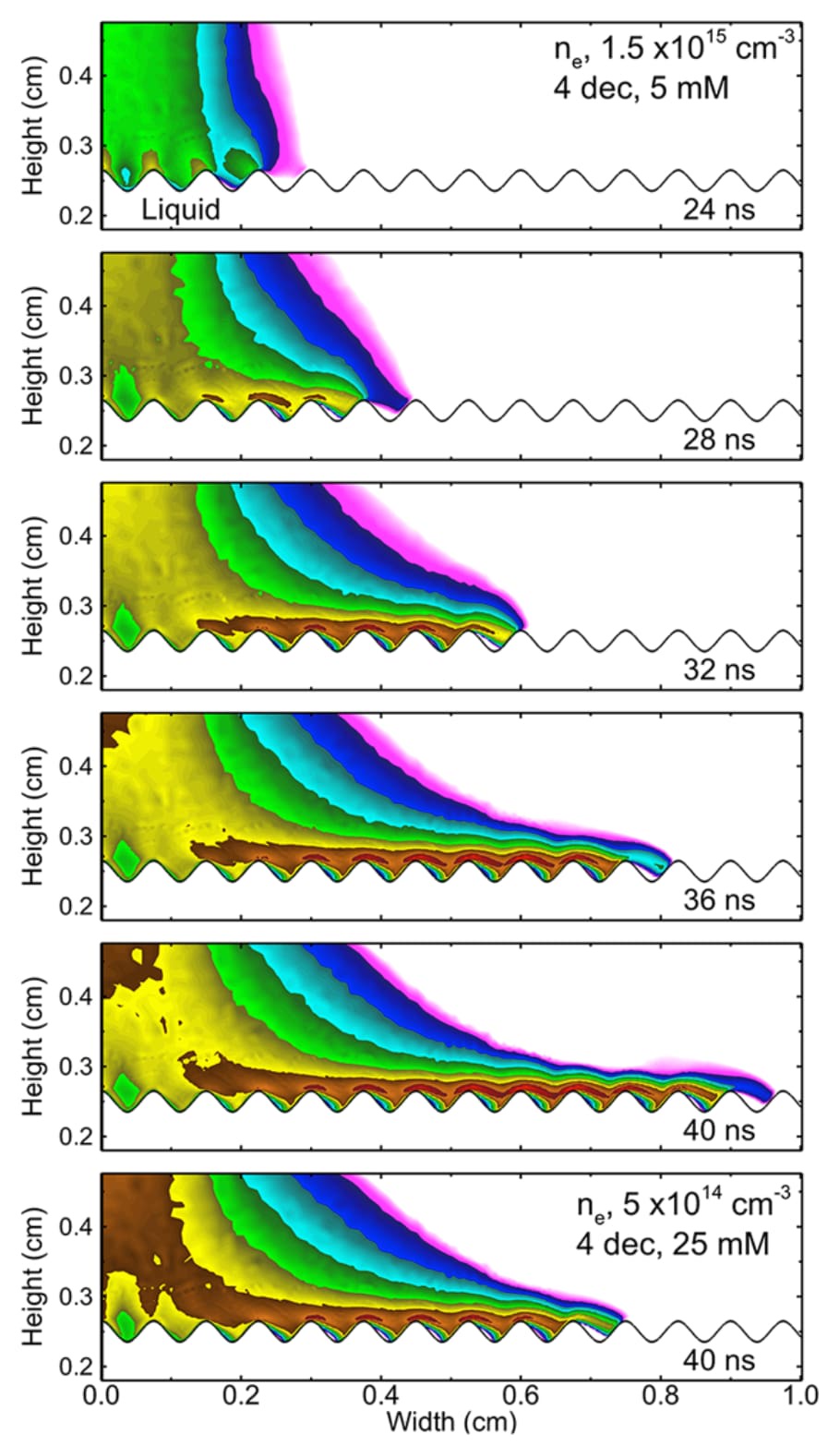
Right: Electron density in a simulated plasma impinging on the wavy surface of a silver nitrate solution. From Doyle et al. (2025).
Staff contacts: Scott Doyle, Claudiu Giuraniuc.
- Optics and photonics
-
Optics is the study of the propagation, manipulation, and detection of light, and its interaction with matter. The subfield of photonics deals with the propagation, manipulation, and detection of photons, and in particular the application of quantum mechanical principles to the development of practical optical devices.
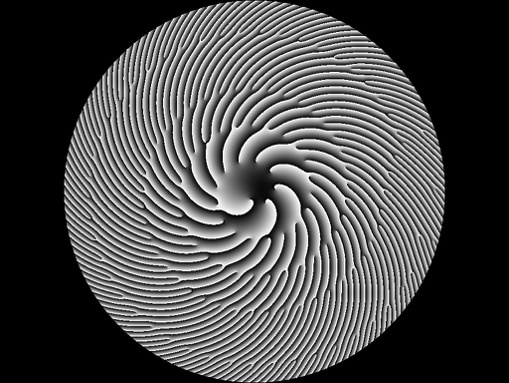
Finally, our work in cavity optomechanics investigates the interaction between optical and mechanical resonators via radiation-pressure coupling. This interdisciplinary field combines elements of photonics, mechanics, and nonlinear dynamics, offering exciting opportunities for both fundamental discovery and practical innovation.
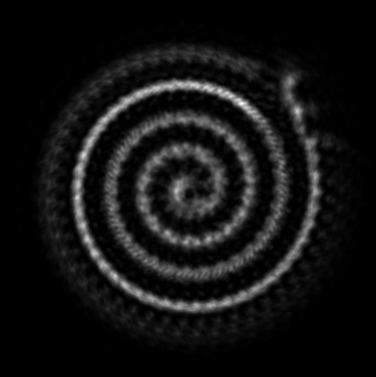
Right: Spiral laser beam produced by passing a laser through a spatial light modulator (top), and the computer-generated phase pattern used to create it (bottom). Images: David McGloin.
Staff contacts: Kapil Debnath, David McGloin, Murilo Baptista.
- Semiconductor physics
-
Semiconductors are materials whose conductivity can be modified by adding impurities, resulting in a material that behaves somewhere between an insulator and a conductor. They are particularly crucial in electronic circuits.
Our semiconductor research focuses on the use of Monte Carlo modelling to simulate the behaviour of Gunn diodes, investigating the behaviour of Gallium Nitride (GaN) and Gallium Arsenide for the purposes of terahertz radio frequency power generation.
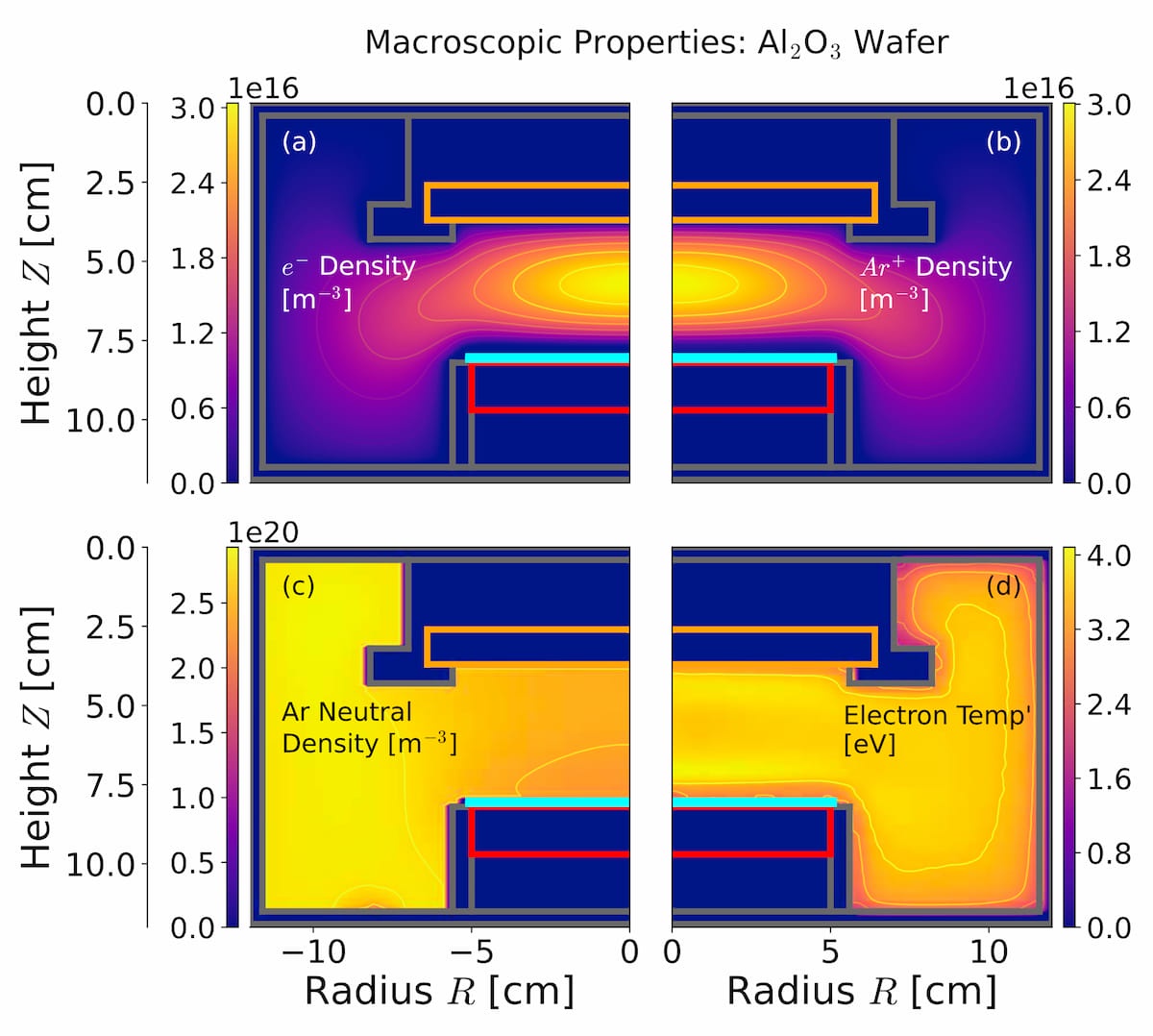
This research bridges fundamental plasma physics with industrial needs, supporting the development of next-generation materials such as SiC, GaN, and InP for emerging devices used in high-voltage systems, such as energy transmission and electric vehicle charging systems.
Right: Macroscopic properties of a simulated plasma above an aluminium oxide wafer from ongoing plasma surface studies within the Plasma Science Research Group. Image: Scott Doyle.
Staff contacts: Ross Macpherson, Scott Doyle.
Academic staff
Header banner image: A hollow cathode plasma source operated in Argon, viewed through light spectrum glasses. Image: Scott Doyle.