
The ACO will be home to the powerful 16" John Cruickshank Telescope, which the University acquired in 2024, alongside advanced imaging equipment.
This state-of-the-art facility will be primarily for University staff and students to use for educational and research purposes, with occasional access by members of the public and external visitors for public engagement. It will allow year-round astronomical observations that extend and enhance the University’s astrophysical teaching and research. The new observatory with modern on-site and remote-control systems will support the University’s BSc Physics with Astrophysics degree programme, delivered by the Department of Physics.
The ACO will support delivery of Aberdeen 2040 with interdisciplinary teaching, research, outreach, and public engagement related to astronomy. It will provide a space for learners and users with inclusive and practical accessibility. The large amounts of high quality data it provides will address interdisciplinary challenges including Data and Artificial Intelligence. It will further enhance public engagement by enabling more outreach opportunities through local schools and community groups, strengthening connections between the University and the wider community.
The University issued a press release with further details after planning permission was granted by Aberdeen City Council in early 2026.
Location and historical context
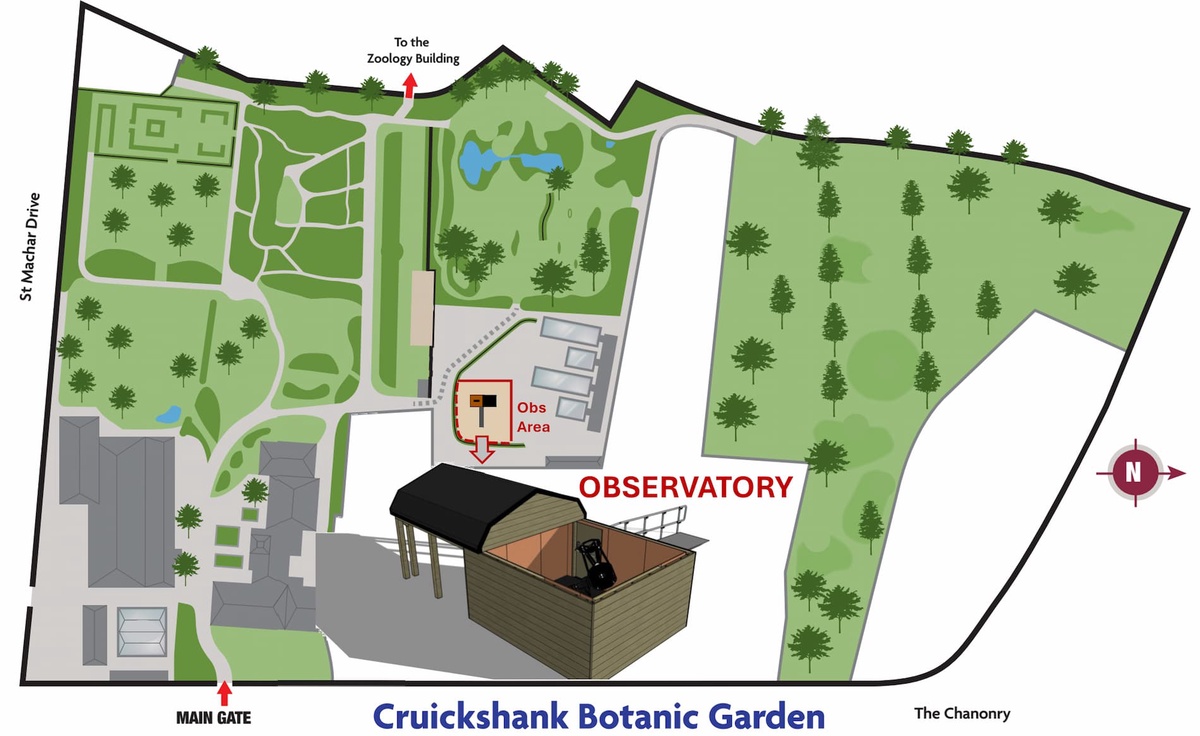
The site forms part of the Garden's Nursery, and is currently unused, presently laid to lawn, south of a group of glasshouses and utility buildings. The Nursery is bounded on three sides by mature hedging. It is not a public area, not visible from public roads, and is predominantly used for cultivation of new plants and general maintenance of the Garden. The observatory has been designed to sit alongside existing nursery structures, reflecting both their form and scale.
The new facility will build upon the 200-year heritage of astronomical and meteorological observatories at the University of Aberdeen. It will also inherit the legacy of John Cruickshank (1787-1875), who was not only Professor of Mathematics at Marischal College, but also responsible for maintaining the scientific apparatus which included telescopes that are now in the University Collections. He had a lifelong interest in astronomy and was an active astronomer in his day, publicising a number of planetary observations. His daughter, Anne Cruickshank (1820-1911), generously donated land, buildings and funds for the establishment of the Cruickshank Botanic Garden in 1898.
On her death, Anne Cruickshank bequeathed her whole estate to the University of Aberdeen via a special trust, with the provision that part of it be used to found a Lectureship in Astronomy, including Meteorology and Navigation, in honour of her father. For over a century, the holders of this title have been responsible for maintaining the University's Cromwell Tower Observatory along with active teaching, research and public engagement in astronomy.
Observatory design
The observatory will take the form of a timber shed with cementitious timber-effect fibre-cement cladding. It will feature a Gambrel roof mirroring the rooflines of nearby glasshouses. The entire roof of the building can be rolled away onto the adjacent support structure to permit viewing the sky from inside the building. The roof is rolled away only while the facility is in use, and is otherwise locked closed.
Low-level lighting will be installed within the structure and used occasionally for safety purposes; however, most observations will take place in complete darkness, in line with operational requirements. The ACO is highly energy efficient, featuring LED lighting and having no heating installed by virtue of its purpose. The telescope system is near-silent, as is the rolling roof mechanism.
Access for users will be on foot, via the University buildings, with no additional requirement for parking. On some occasions, the facility will be operated remotely and will make observations with no personnel on site. At this time, the facility will be remotely monitored via internal infrared night-vision cameras that require no visible light to operate.
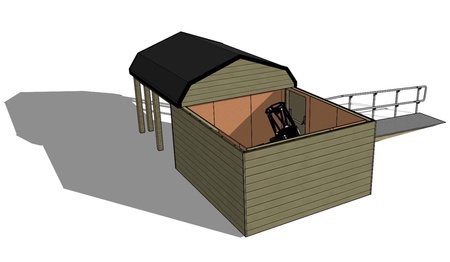
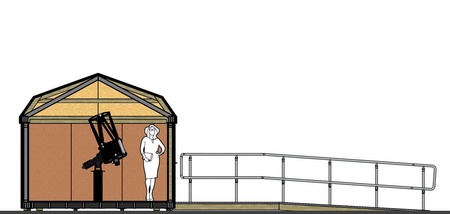
Design illustrations by Outsideology Limited.
Image credits: Map - University of Aberdeen and Outsideology Limited. Design illustrations - Outsideology Limited.
The ACO logo incorporates the following design elements: Telescope - illustrates the John Cruickshank Telescope to be permanently installed in the ACO. Polaris - shows the observatory roof opening direction aligned with north for optimal viewing. Gambrel roof - a unique aesthetic and functional design of the ACO given Aberdeen's wintry weather. Plants - echoes the observatory's beautiful location within the natural and conservation environments of Cruickshank Botanic Garden.
This project is being funded primarily through the generosity of Miss Anne H Cruickshank’s Special Trust and the Dr C Allan Young and Mrs Norma Young Fund.