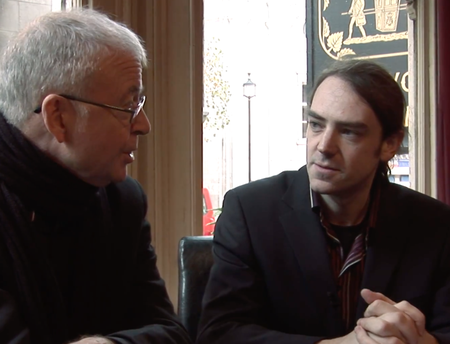
The philosopher Len Doyal (1944-2025) was born in Georgia, USA, and came to England in the 1960s, spending most of his working life in London. He was a highly regarded educator, authored many influential books and papers, and was Emeritus Professor of Medical Ethics at Queen Mary, University of London.
These brief recollections follow in the wake of a recent gathering of friends and family celebrating his life on Friday 22 May 2026 at the Royal London Hospital, after his passing in June 2025.
My first meeting with Len, who would go on to become one of my most valued friends, was what I can best describe as an agreeable disagreement. That is, we had a very agreeable first meeting, hitting it off together as people in a way that was probably mutually unexpected. As soon as we started talking, shared interests and a likeminded sense of humour sprung to the fore. The disagreement bit came toward the end. All this will need a bit of background explanation relating to an Irish giant, of all things.
The giant in question was Charles Byrne (1761-1783). Before knowing Len, I’d stumbled on his story as a student in Ireland, started digging into it, and become hooked and concerned in equal measure. Charles, who was originally from the north of Ireland, had a condition known today as acromegalic gigantism– it caused him to shoot up to a huge height, not much shy of 8ft.
Having made a name for himself in Georgian London as a popular human curiosity, Charles died tragically young in his early twenties. The medically brilliant but morally dodgy surgeon John Hunter (1728-1793) arranged for his body to be stolen on the way to its funeral. Hunter boiled the remains down to their bones, studied them, and put Charles’ enormous skeleton on display for the public to gawp at.
After Hunter’s death, his collection was passed to the Royal College of Surgeons, and housed in a memorial museum established in his honour (the Hunterian Museum, London). When as a much younger man I discovered that this largely forgotten Irish celebrity’s skeleton still remained on public display, and in a museum dedicated to the man who screwed him over no less, I was unimpressed.
A broke but optimistic Masters student in Belfast, I saved up and set out for a few days in London, in early 2011. I’d arranged to meet with the powers that be at the Hunterian Museum. My idealistic plan was to share some new research I’d done on Charles, politely outline why the right thing to do was to remove his remains from display, and explain that it would be even better for the Museum to go one further and organise a respectful burial for him (per his wishes).
The distinguished people I met with reassured me, one after the other, that the display was basically ok as was. I was told that I needed to go and see Professor Len Doyal, an eminent medical ethicist involved with the exhibit. He could put any remaining moral doubts I had to rest.
This brings us to the agreeable disagreement, above. Squeezed in before I dashed off to catch a flight back to Ireland, Len and I met for the first time over lunch at the Barbican, close to his home. The first thing that struck me was that he was very warm and human - my first Charles-related meeting of that kind on the trip.
Len was also extremely direct in how he approached things – at our lunch, and as I’d find subsequently, in life generally. Born in the USA’s deep south, when he sat at a table he brought a heart of gold, accompanied by a metaphorical pair of clenched fists with sleeves rolled up, ready to slug things out in the realm of thought on very important issues should the need arise.
A consummate debater, an exacting thinker.
Back in those days, I tended to be a good deal more deferential, consensual, and somewhat prone to editing out or watering down what I actually thought, so as not to risk offending or startling.
I credit Len with helping to knock these rough edges off me over the years. Given I work in the academic sector, where preposterous stuff is sometimes talked as if it’s Gospel Truth, it’s especially important to say what one really thinks.
Anyhow, back at the lunch table, we were having such a good time that it was only when desert was appearing that we steered matters onto the giant-shaped elephant in the room. Len spent time talking about his involvement in the ethical procedures relating to DNA that had been taken from two of Charles’ teeth and sequenced shortly before my arrival in London. That seemed fine and dandy to me, so Len started pressing me on what my overall problem with things was.
“If you ask me honestly I’ll have to tell you honestly”, I remember saying. I sensed a cumulative frustration at the Hunterian’s sustained deflection of the issues over the course of my visit coming to a head inside me.
Len kept pressing.
I remember pretty much verbatim what I rattled out. I have repeated it to friends many times since, most recently over conversation in the Old Library at London’s Garrod Building, at the beautiful celebration of Len’s life at the end of May this year. It was to the tune of the following:
if you folks at the Hunterian think it’s ethically ok for someone with a medical condition who’s died in pain and discomfort to have his remains stolen and stuck on display by a crooked surgeon, then kept on display as a strange public exhibit in the surgeon’s memorial museum, you need to go back to year one of your ethics degree and start over.
This led to a somewhat strained farewell as I departed the eminent medical ethicist, in a rush to catch my flight home.
What I hadn’t had time to get clear was that Len didn’t work for the Hunterian Museum, and his involvement in the Byrne exhibit only really related to the DNA/teeth research just mentioned and a few matters around that. He’d had nothing to do with the general ethics of the overall display, the historical treatment and presentation of Charles’ remains, or anything like that.
Two weeks later, sitting in my crummy student flat in south Belfast, my phone rang.
“Tom?” It was a lively US drawl. “It’s Len Doyal”.
That voice would go on to remind me often of my late dad- both were Americans, each speaking with an appealing and distinctive lilt, Len’s from Georgia, dad’s from Indiana.
“I’ve been thinking about what you said. How about we get Charles out of there?”
“Deal,” I replied.
*
All that was back in early 2011. From then on, a long mutual adventure began as Len and I worked to liberate Charles’ remains, in concert with a growing groundswell of public support. There were highs and lows along the way, lots of laughs too, and an endless array of shared experiences. We met many colourful and memorable people in person, in print, and over email as we pressed the case for Charles side by side across the years.
Success arrived in 2023 when the Hunterian finally caved to sustained pressure, doing the decent thing and removing Charles’ remains from public display. Len’s health was in difficulty at this time, but it didn’t prevent either of us from receiving the news with delight.
*
In the early days after our Barbican lunch, the cement in the brickwork of our activities and friendship was furnished by our amiable third colleague, Charles Byrne - a larger-than-life Irishman who we never met, exerting a sustained, formative influence over the pair of us in death.
But soon Charles stopped showing up so often, or at all. Long personal calls became normal. Our chats began to cover everything from the deep philosophical meaning of life to what we’d had for dinner that evening. Visits to Len’s home in London became as much and often more about hanging out and playing guitar together as they did about our Georgian comrade.
As a friend, Len was generous and caring. He instinctively wanted to improve the world. In my case, he kept me inspired and motivated enough to grit my teeth and get through a couple of periods of serious disillusionment with my day job. Without friends like this, I might have packed it in. And he linked me up with a spinal surgeon, helping me get my back sorted out. More could be said.
But perhaps above all, Len was someone who I could say exactly what I thought to on any subject. That is a rare gift.
We often talked about philosophy and literature. Oscar Wilde is said to have given us the following advice:
“Be yourself, everyone else is taken”.
Len was one of a kind - wholly himself. Loved, and irreplaceable.
Thomas L Muinzer
From our early days:
- Our first article together
Len Doyal, Thomas Muinzer, ‘Should the Skeleton of “the Irish Giant” be Buried at Sea?’, British Medical Journal (December 2011)
- Our first on-screen appearance, pressing the case in a short documentary for removal of Charles’ remains (2011):
https://www.youtube.com/watch?v=u5sRJgBQyz4
- Our first debates in print together (2012):