Navigating the Ontological Realities of the Green Transition
Reflections on my participation in the Energy Law in the light of the green transition towards net zero emissions (ELAWNET 2026).
By Santiago José Osorio Gracia, LLM Candidate in Energy Transition Law, University of Aberdeen
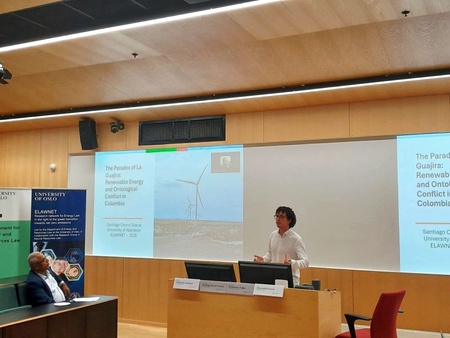
The LLM in Energy Transition Law at the University of Aberdeen consistently challenges us to question concepts that we, as lawyers, often take for granted. For me, a pivotal moment occurred in my renewable energy law class when we were presented with a striking premise: “Not all renewable energy projects are sustainable.” Addressing this statement in an essay motivated me to look beyond conventional legal frameworks and explore one of the most critical challenges facing large-scale infrastructure projects today: obtaining and maintaining a social license to develop renewable energy projects. This research allowed me to participate in the third annual ELAWNET Conference in Oslo, Norway, where I had the privilege of presenting my findings.
The Paradox of La Guajira
My research focused on La Guajira, Colombia, a region considered the epicentre of the country's ambitious green energy strategy. However, it is also home to the Wayuu, Colombia’s largest indigenous group. This region exemplifies a profound "ontological conflict" between two different worldviews. While Western legal and economic frameworks conceive the wind, sun, and land as resources to generate green energy, the Wayuu view them as intrinsic, spiritual elements of an ecosystem deeply interconnected with them. Both views raise a fundamental question: Can Western views of development coexist with indigenous conceptions of development when indigenous peoples, such as the Wayuu, conceive the land, the wind, and the sun as representing ontologically different realities?
Despite La Guajira's immense resource wealth, having historically developed the extraction of pearls, salt, gas, and coal, and now wind and sun, it remains one of the most economically deprived departments in Colombia. This region suffers from high rates of poverty and child malnutrition, and paradoxically, over 50% of Wayuu households lack access to electricity. Recognising that European jurisdictions face parallel societal challenges during their own planning and permitting phases, I realised that the lessons from La Guajira carried global relevance. This inspired me to submit an abstract to the ELAWNET Conference, titled: “The Paradox of La Guajira: Renewable Energy and Ontological Conflict in Colombia”.
Presenting the Framework
My presentation in Oslo was structured around two main themes: analysing the historical context of extractivism in La Guajira and proposing three pillars with the intention to improve social engagement.
First, I examined local Wayuu governance and leadership alongside the limitations of current Prior and Informed Consent (FPIC) mechanisms. Second, incorporating valuable fieldwork from institutions like the Stockholm Environment Institute, I outlined three pillars that developers, state actors, and legal practitioners might consider to achieve a just transition:
- A Holistic Concept of Territory: Moving past rigid physical or legal boundary definitions to understand territory as a lived, ancestral space where cultural identity, biophysical elements, and ecosystems are inextricably linked. The concept of territory transcends any legal or physical barrier.
- Maximising Information Access: Ensuring transparency and breaking down information asymmetries during the consultation phases, especially translating information into indigenous languages (Wayuunaiki) with accessible and digestible vocabulary for everyone.
- Reforming Benefit-Sharing and Fiscal Governance: Restructuring how economic benefits flow back into the community, while respecting and investing in internal indigenous organisational structures rather than imposing external corporate models.
Ultimately, I argued that a truly just energy transition cannot rely on standard corporate public relations. It requires heterogeneous, intercultural, and dynamic dialogues with the local communities who bear the immediate burdens of global net-zero infrastructure, despite having the minimal historical responsibility for climate change.
Reflections of a Masters Candidate
Presenting at an international conference at this stage of my academic career was an incredibly rewarding experience. Beyond sharing my own research, it allowed me to reflect on my learning during the conference, especially on topics like climate justice, planning and permitting, and participation. It highlighted the premise “Not all renewable energy projects are sustainable,” and underscored the importance of asking and involving communities in the construction of a concept that could be drawn by different colours in different contexts as a just energy transition.
Overall, conferences like ELAWNET are more than just a platform to discuss climate justice, it was a space for genuine professional networking and inspiration. The feedback and open dialogues with colleagues from different backgrounds are essential to develop better criteria to define and redefine concepts, such as participation, energy security, energy communities, the future of the grids, and strategic governance, among other topics that expand the curiosity of those who, like me, are passionate about these issues.
This journey highlighted the immense value and quality of the energy law program here at the University of Aberdeen. To my fellow Master's students, I strongly encourage you to be proactive. Look out for "calls for abstracts," seek collaboration with our faculty, and leverage the resources of the Aberdeen University Centre for Energy Law (AUCEL). Engaging with these opportunities will not only enrich your academic knowledge but also allow you to enjoy the deeply collaborative process of shaping the future of energy law.
For more information on our Masters Courses please click this link.