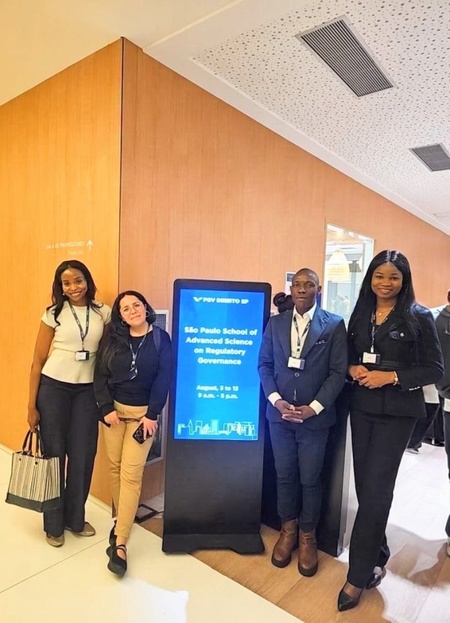
Several PhD students from the University of Aberdeen’s School of Law recently had the opportunity to attend the São Paulo School of Advanced Science on Regulatory Governance in São Paulo, Brazil.
The 10-day international conference brought together around 90 doctoral and post-doctoral researchers from Latin America, Africa, Europe, the UK, Australia and the United States, alongside more than 20 leading scholars and policymakers. The School provided an intensive programme exploring the institutional dynamics that have shaped, and continue to reshape, regulatory governance across Latin America and the wider Global South.
The programme covered a broad range of topics, including regulatory capacity and institutional change; agencies, autonomy and accountability; regulation and development; health, pharmaceuticals and wellbeing; the regulation of big tech, competition and infrastructure; central banking and financial regulation; the future of regulation in the Global South; and climate governance.
Among those who attended were PhD researchers Owabelemam Ibim, Felix Izuma Uzoma, Lizeth G. Moreno Marquez and Tayo Gbemi who reflected on how the experience contributed to their research, academic development and understanding of regulatory governance in different contexts.
Presenting research and receiving new perspectives
For Lizeth, one of the highlights of the School was the opportunity to present her doctoral research, “Conscientious Objection in Medicine in Mexico: The Doctrinal and Theoretical Challenges of Legal Regulation”, as an academic poster.
“One of the most rewarding moments for me was presenting my PhD research as an academic poster. I received constructive feedback and thoughtful questions that enriched the discussion and invited me to reflect more deeply on the issues raised.”
The experience also encouraged Lizeth to think further about the practical application of the regulatory framework she is developing.
“I received valuable feedback on how I could implement the regulatory framework that I am developing, particularly regarding its practical feasibility and the regulatory capacity required for its operation.”
Discussions at the School also highlighted additional areas within medicine where conscientious objection may arise. These conversations have encouraged Lizeth to consider a wider range of contexts in her research and ensure that the framework she proposes is responsive to the settings in which conscientious objection is likely to be exercised.
Developing research methods and communicating across disciplines
For Felix, the School provided an opportunity to strengthen both his research presentation skills and his thinking about methodology.
He presented a poster examining how climate law and policy can be made accessible in Nigeria, an aspect of his wider doctoral research. Presenting to researchers from a variety of academic and geographical backgrounds challenged him to communicate his research clearly and concisely.
“The conference improved my approach to presenting research, particularly through my poster session. Here, I had to communicate my research clearly and concisely to researchers from different backgrounds.”
The experience also prompted him to reconsider how different research methods could complement his existing socio-legal approach.
“Discussions during the conference particularly encouraged me to consider how quantitative methods could complement my socio-legal approach and strengthen the empirical dimension of my research.”
For Felix, these conversations have helped refine both the questions at the heart of his research and the way he approaches them.
“Exposure to leading scholars, together with discussions with researchers working in different jurisdictions and disciplines, introduced me to perspectives and approaches that I can draw on in developing my research.”
Perhaps most importantly, he says the experience reinforced the value of testing ideas through academic discussion.
“The questions I received, the conversations I had, and the different approaches I encountered have given me useful directions for developing my work further.”
Experiencing regulatory governance in a different context
For Owabelemam, attending the School offered an opportunity to engage directly with Brazil’s academic and research environment and to explore approaches to regulatory governance and development in the Global South.
“The School gave me the opportunity to experience Brazil’s dynamic academic and research environment, particularly its approach to regulatory governance and development in the Global South.”
One of the most interesting aspects was the opportunity to engage with research and policy perspectives emerging from Latin America.
“I found it especially interesting to engage with research and policy perspectives emerging from Latin America and to consider how regulatory institutions respond to local social, economic and political contexts while also engaging with global standards.”
The experience provided an important opportunity to think comparatively about regulation and the ways in which institutional approaches are shaped by different social, economic and political environments.
Situating energy regulation within regulatory governance
For Tayo, the School provided an opportunity to situate her research within the wider field of regulatory governance and to engage with leading scholars and researchers from different disciplines and jurisdictions.
“The opportunity to interact with leading scholars in regulatory governance and to situate my research in a much different comparative context was particularly valuable.”
The experience also developed her understanding of how regulatory capacity, institutional autonomy, accountability, responsiveness and legitimacy can cumulatively influence the effectiveness of regulatory frameworks. Engaging with doctoral students, early career researchers and established academics from Brazil, the UK, the US and other Latin American countries also created opportunities to exchange ideas, receive feedback and learn about research being undertaken across different disciplines and jurisdictions.
These perspectives have particular relevance to Tayo’s doctoral research, which comparatively examines legal and regulatory frameworks for environmental protection and public participation in wind energy licensing.
“The School encouraged me to situate my analysis of energy regulation within the field of regulatory governance. My research comparatively examines legal and regulatory frameworks for environmental protection and public participation in wind energy licensing, and the School helped me to think more critically about the institutional conditions that determine the effectiveness of frameworks and the importance of attentiveness to institutional and contextual differences when drawing comparative lessons.”
Beyond the immediate benefits to her doctoral research, Tayo says the School has expanded her academic network and introduced her to research communities with potential opportunities for future collaboration. It has also helped identify areas for further research at the intersection of regulatory governance, energy regulation, environmental governance and the green transition.
Bringing an international perspective back to Aberdeen
For all three researchers, the São Paulo School offered more than an opportunity to present their work. It provided a space to engage with scholars and researchers from across disciplines and jurisdictions, challenge existing assumptions and develop new perspectives on their doctoral research.
For Felix, the experience has helped situate his research within wider debates about regulation and compliance.
“I returned to the University of Aberdeen with a better sense of how my work sits within wider discussions on regulation and compliance.”
The opportunity to participate in an international academic environment also highlighted the value of collaboration and intellectual exchange in doctoral research.
“I am grateful to the University for supporting my participation and allowing me to take my research into an international academic setting and bring what I learned back to my doctoral work.”
The participation of Aberdeen’s PhD researchers in the São Paulo School demonstrates the value of creating opportunities for doctoral students to engage with international research communities. Through presenting their work, exchanging ideas and learning from different regulatory and institutional contexts, Owabelemam, Felix, Lizeth and Tayo have returned with new perspectives and ideas to inform their ongoing research.