
Astronomy at the University of Aberdeen
- Pioneers of Astronomy in Aberdeen
-
Aberdeen’s contribution to astronomy is reflected in the work of several influential figures, including:
- Duncan Liddel (1561–1613) who graduated from the University’s King’s College, pioneered teaching of modern astronomy, cultivated networks with astronomers in Europe, and donated to the University a wealth of original treatises, including the monumental De Revolutionibus by Nicolaus Copernicus (1473–1543).
- James Gregory (1638–1675) who graduated from Marischal College and was a renowned mathematician and astronomer and invented reflecting telescopes, crucial for modern observations. The largest operational optical telescope in the UK is named after him.
- James Clerk Maxwell (1831–1879), one of the most influential scientists of all time, who worked at Marischal College during 1856–1860, when he established fundamental achievements in planetary physics, statistical mechanics, and colour photography.
- From Historic Observatories to a Modern Future
-
Scotland’s first publicly funded observatory and the first observatory built by the University was the Castlehill Observatory situated in the Castlegate area of Aberdeen, founded by Professor Patrick Copland at Marischal College in 1781. It was used to carry out telescope observations until 1796 when the land at the Castlehill was requisitioned by the Government, and was succeeded by the Marischal College Observatory on the roof of the College building. High-quality observations aside, it contributed significantly to positional astronomy which helped establishing the precise latitude and longitude of Aberdeen. Unfortunately, Marischal College Observatory was closed in 1838 (with some of its telescope equipment now in University Collections) as the host old Marischal College building was demolished and replaced by today’s new College building.
The Cromwell Tower Observatory (CTO) located in the King’s College quadrangle was established in 1826 and served as a distinguished centre for teaching, research and public engagement in both astronomy and meteorology. However, the CTO has not been in practical use since around 2002, due to its limited accessibility and insufficient space needed to install a larger modern telescope.
The Anne H Cruickshank Observatory (ACO) is a new University facility officially opened on 30 September 2026 by Professor Catherine Heymans, Astronomer Royal for Scotland. The ACO brings the 21st century architecture and technology to the historic setting and scenic environment of Cruickshank Botanic Garden, whilst honouring Aberdeen’s 400-year legacy of astronomy and marking the bicentenary of the foundation of the CTO. It houses the powerful John Cruickshank Telescope with advanced imaging equipment and AI robotic automation to provide an inclusive space with wide accessibility that supports the University’s interdisciplinary teaching and research capabilities and enhances public and educational engagement opportunities.
Our Observatories
Public and educational engagements at The Anne H Cruickshank Observatory will be organised after the new facility is operational later in 2026.
The Anne H Cruickshank Observatory
The Anne H Cruickshank Observatory (ACO) is a new state-of-the-art facility at the University of Aberdeen (planned for completion in mid-2026), bringing modern astronomical research and teaching to the historic setting of Cruickshank Botanic Garden.
- About the Observatory
-
The Anne H Cruickshank Observatory is located within the grounds of Cruickshank Botanic Garden. After receiving planning approval from Aberdeen City Council in early 2026, the observatory has been constructed by Outsideology Limited in May 2026.
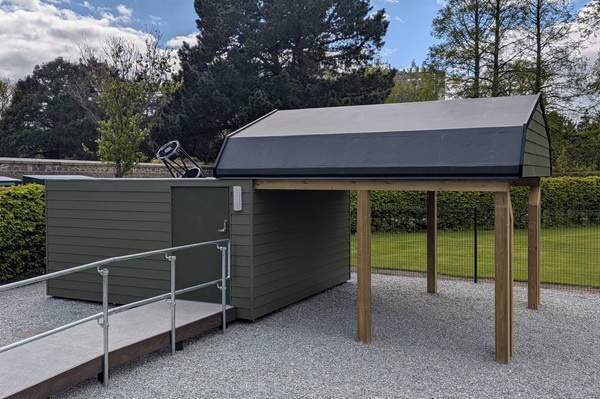
The Anne H Cruickshank Observatory (Image credit – Charles Wang)
The facility houses a powerful 16-inch reflecting telescope equipped with advanced imaging technology, supporting hands-on, remote and autonomous observation. Its design has been carefully developed to complement the scenic environment and historic character of the Botanic Garden, within the Old Aberdeen Conservation Area.
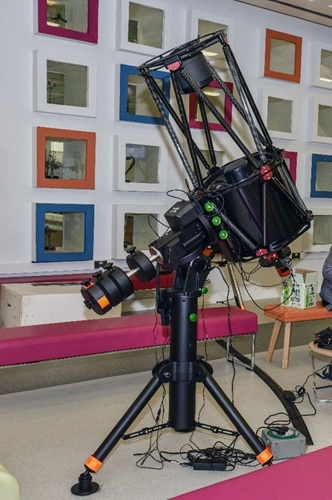
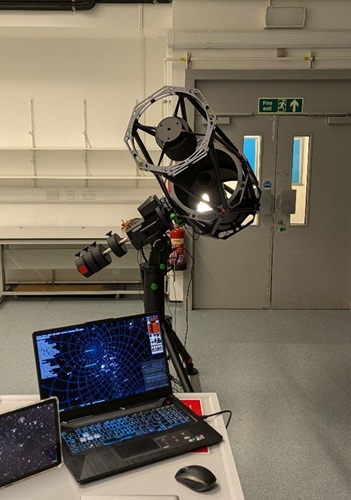
L-R: The John Cruickshank Telescope (JCT) side view (Image credit – Brian Stewart/UoA); The John Cruickshank Telescope (JCT) front view (Image credit – Charles Wang/UoA)
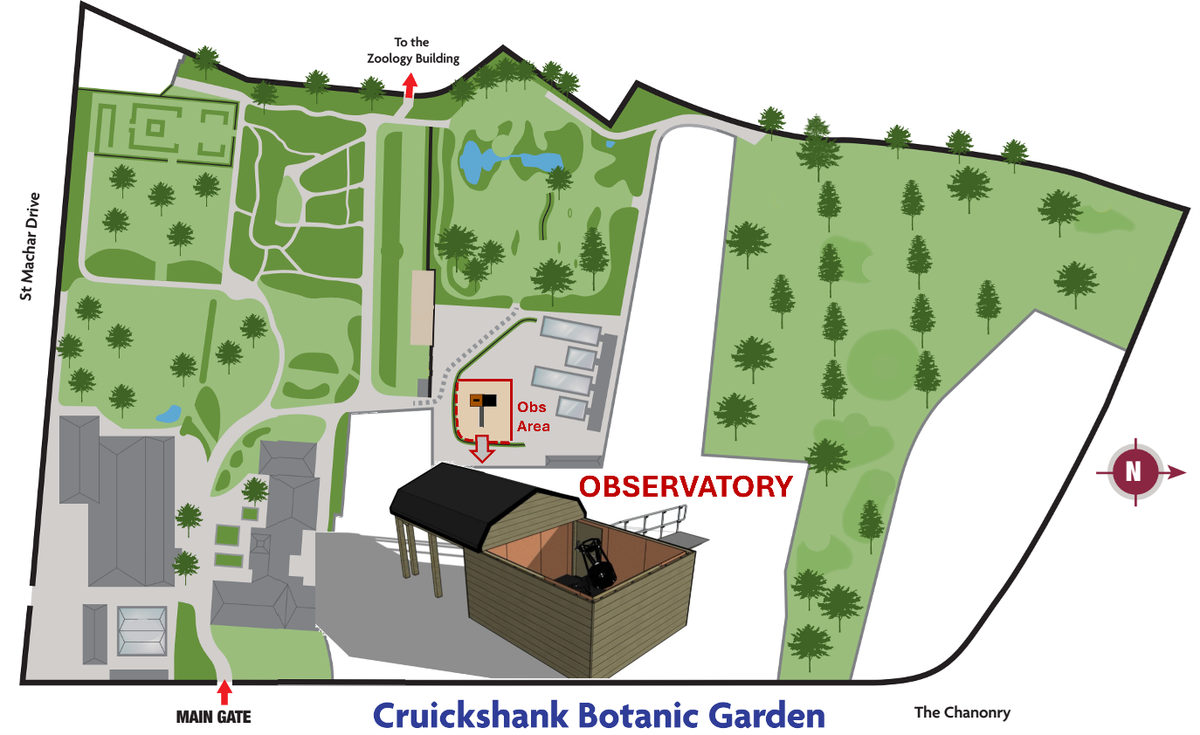
The Anne Cruickshank Observatory (ACO) location in Cruickshank Garden: (Image credit – UoA and Outsideology Limited)
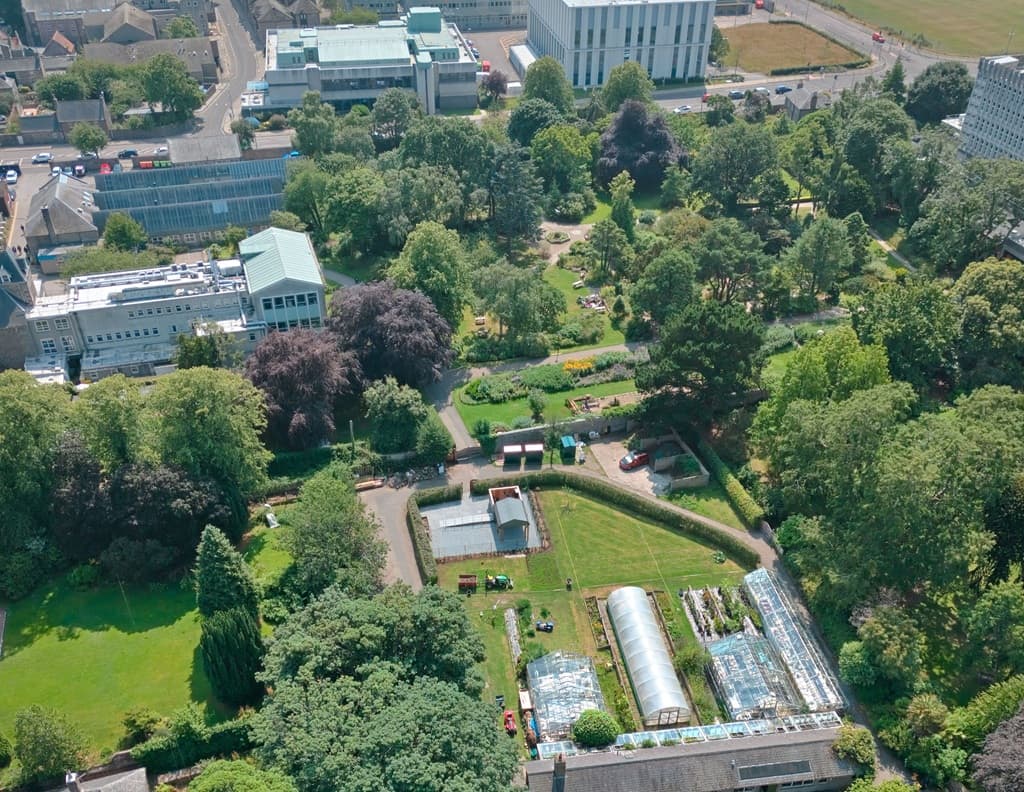
An aerial view of ACO taken by a drone showing ACO (lower-middle) in the Cruickshank Botanic Garden, with surrounding Science Teaching Hub (upper-right) and other University teaching and research buildings. (Image Credit: Timothy Wang)
- The Cruickshank Family Legacy
-
The Anne H Cruickshank Observatory inherits the legacy of John Cruickshank (1787–1875) who was not only Professor of Mathematics at Marischal College, but also responsible for maintaining telescopes that are now in University of Aberdeen Collections.
He was an active astronomer in his day, publicising a number of planetary observations. His daughter, Anne Cruickshank (1820–1911), generously donated land, buildings and funds for the establishment of the Cruickshank Botanic Garden in 1898.
On her death, she bequeathed her whole wealth via a special trust to the University of Aberdeen and founded the Cruickshank Lectureship in Astronomy in honour of her father.
- Impact and Benefits of the New Facility
-
The new facility with modern on-site, remote and AI-enabled autonomous robotic control systems will support the University’s BSc in Physics with Astrophysics degree programme, while providing an inclusive space for a wide range of users with its practical accessibility.
It will support the University’s teaching and research in astrophysics while creating new opportunities for interdisciplinary work in areas such as data science and artificial intelligence.
This facility is expected to transform the experience of astronomy students at the University providing hands-on access to modern observational tools and creating exciting opportunities to inspire the next generation of scientists. It will further enhance public engagement by enabling more outreach opportunities through local schools and community groups, strengthening connections between the University and the wider community.
The Department of Physics’ ACO webpage provides further information about this facility.
Below you can see a video of a demo for remote-controlled observation using the John Cruickshank Telescope.
You can find out more about the John Cruickshank Telescope imaging technology and its instruments in this document.
The following drone footage demonstrates the ACO Observatory system being remotely controlled. (Credit: Timothy Wang).
This video shows the rolling roof opens for the JCT telescope to unpark and slew to an observation position:
This video shows JCT parks before the roof is closed:
- Image Galleries
-
You will find relevant Anne H Cruickshank Observatory galleries below:
The Cromwell Tower Observatory
The Cromwell Tower Observatory (CTO) is the University of Aberdeen’s historic observatory, located at the top of Cromwell Tower at King’s College.
- About the Observatory
-
The Cromwell Tower Observatory (CTO) is University of Aberdeen’s historic observatory located at the top of the Cromwell Tower in the NE corner of the King’s College quadrangle. With its distinct dual conical telescope domes (north and south), the CTO was officially recognised as an astronomical observatory from 1826, making it one of the earliest purpose-built observatories in Scotland.
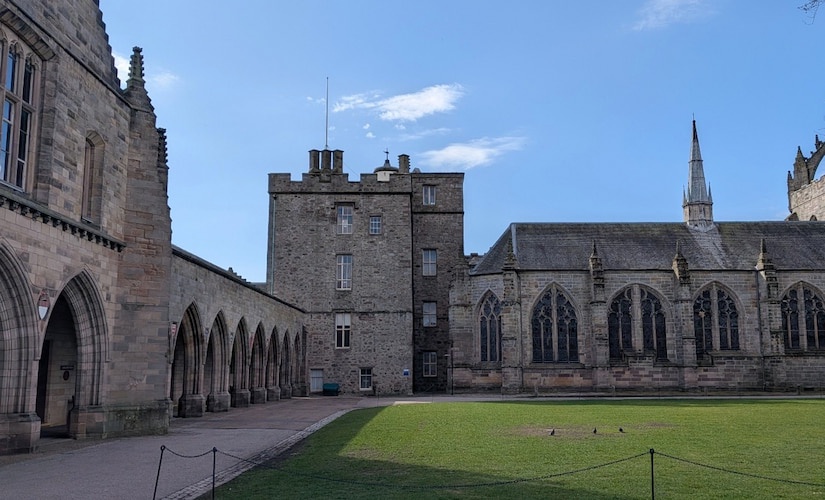
Cromwell Tower at King’s College. Its top fourth floor houses the Cromwell Tower Observatory (Image credit – Charles Wang/UoA)
It allowed King’s College to begin teaching astronomy to the natural philosophy class in 1827, with demonstrations within the CTO.
Although the CTO has not been operational since early 2000s, due to limitations in accessibility and a lack of space required to accommodate a larger modern telescope, it served as a distinguished centre for teaching, research and public engagement in both Astronomy and Meteorology throughout its history and will celebrate its bicentenary this year – 2026.
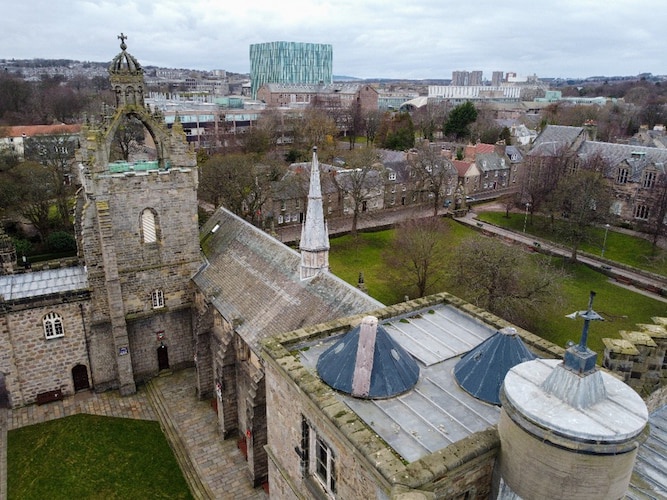
Drone footage showing the CTO with its dual conical observatory domes: (Image credit – Timothy Wang)
- Scientific and Civic Contributions
-
Among its notable contributions, Sir David Gill (1843–1914) and Professor David Thomson (1817–1880) used the CTO to synchronise a mean-time clock made by Sir David Gill, with accurate celestial time. Eventually, this system was expanded to provide precision timekeeping to Aberdeen City Centre, direct from the CTO to the Town House Clock – a service that was highly valued locally and played an important role in the city’s scientific and civic life in the late 19th Century.
- See an article below for a brief overview of Sir David Gill’s remarkable astronomical career and achievements.
- Learn more about the history of the CTO from Dr John Reid’s CTO webpage.
- The Department of Physics’ CTO webpage provides some recent updates about the CTO and the last working telescope (Schmidt-Cassegrain) installed at the CTO.
- Overview of Sir David Gill’s astronomical career and achievements
-
A brief overview of his astronomical career and achievements
Dr Charles Wang, University of Aberdeen, 12 March 2026
David Gill was born in Aberdeen in 1843 and lived at 48 Skene Terrace since childhood until 1872.[1] He was a student of James Clerk Maxwell at Marischal College, University of Aberdeen in the 1850s, who kindled his life-long interest in physics and astronomy. He then joined his father’s distinguished ‘Watchmakers to the Queen’ business in Aberdeen under a Royal Warrant. Following trainings in Aberdeen, England and Switzerland, Gill became a well-respected clock and watch maker. During the 1860s, he also worked with David Thomson at the Cromwell Tower Observatory (CTO) at King’s College, University of Aberdeen, bringing his horological skills to telescope astronomy. Among his notable contributions, he used the CTO to synchronise a mean-time clock he made with accurate celestial time. This system was expanded to provide precision timekeeping to Aberdeen City Centre, a service that was highly valued locally and played an important role in the city’s scientific and civic life in the late 19th Century.
Gill’s exceptional knowhow with telescopes and clocks propelled him to pioneer astrophotography, started in Aberdeen with a 12” aperture reflecting telescope driven by an accurate tracking clock made by himself.[2, 3] This allowed him to take one of the first high-quality photographs of the moon through a telescope in 1869.[3, 4] This achievement at an early stage of photography itself elevated Gill’s reputation as a competent local astronomer, and influenced the 26th Earl of Crawford, Lord James Ludovic Lindsay, to appoint him as the first Director of the Dunecht Observatory in Aberdeenshire.
Under Gill’s supervision, the Dunecht Observatory was built and equipped to be a state-of-the-art observatory in the 1870s,[4,5] crucially housing a 4” heliometer used to measure very small angular separations as seen through the telescope.[6] As a remark, Gill’s excitement about this precision instrument immediately amazed his newly wed wife Isobel, an intellectual daughter of a local farmer, who became a vital partner throughout the astronomical career of her husband.[7] It is also worth noting that Lord Lindsay’s later petitioning and donation of equipment, including the 4” heliometer, and books led to the opening of the Royal Observatory Edinburgh in 1896.[8]
With Lord Lindsay and Dunecht Observatory’s equipment including the heliometer, Gill went on an expedition to Mauritius Island in the Indian Ocean for the 1874 transit of Venus, aimed at measuring the distance to the Sun, i.e. 1 AU, through the solar parallax. From this expedition, he gained significant experience and reputation in astronomy.[9]
In 1876, Gill moved to London and in 1877, he with his wife Isobel alone conducted an expedition to Ascension Island in the South Atlantic Ocean [10] sponsored by the Royal Astronomical Society (RAS) for observing the close approach of Mars to Earth to better determine the AU through the solar parallax.[11] During this extraordinary expedition, she provided critical operational support allowing him to successfully measure the solar parallax with unprecedented accuracy, within 0.2% of the modern accepted value.[12] As a result, not only David Gill received international recognition, but also Isobel’s contributions were so widely respected that she received a standing ovation from the RAS when he announced the expedition’s success.[13]
In 1879, Gill was appointed by W. H. Smith, the First Lord of the Admiralty, to be Her Majesty’s Astronomer at the Cape of Good Hope, South Africa, which lasted for 27 years. As the Director of Royal Observatory at the Cape, he built it up from a previous rather run-down state to become a world-class observatory, recognised as the finest one in the Southern Hemisphere during that period. Gill was admired for his prolific contribution of accurate results.[14] Indeed, with the construction of a larger 7” heliometer at the Cape, Gill achieved more accurate value of the solar parallax by observing minor planets Iris, Victoria and Sappho during close approaches to Earth from 1888 and 1889.[15] Gill’s new value for the solar parallax 8.80 arcsec and the corresponding AU within 0.1% of the modern accepted value, was officially adopted as the international standard in 1896 at the important Conférence Internationale des Étoiles Fondamentales in Paris and incorporated by Simon Newcomb’s Astronomical Constants. This value remained the international benchmark for determining the scale of the solar system until the advent of radar-based measurements in the mid-20th century.[16]
At Royal Observatory Cape, Gill famously photographed the Great Comet of 1882 and created with Jacobus Kapteyn the first extensive star catalogue derived from photographic plates, including over 450,000 stars. He was an initiator of the biggest multi-national and multi-observatory project of the century, taking on the role of President of the International Commission overseeing the Carte du Ciel project.[13]
Gill was awarded the prestigious Gold Medal of the Royal Astronomical Society in 1882 and 1908, and he is still the only individual to have received this honour twice. In 1900, Gill was knighted by Queen Victoria for his significant contributions to the field of astronomy and his leadership as HM Astronomer at the Cape, with key achievements in Pioneering Astrophotography, Solar System Measurement, Star Cataloguing, and Geodetic Survey of Southern Africa. On his retirement in 1906, Sir David and Lady Gill moved to London, where he served for two years (1909–1911) as President of the Royal Astronomical Society.[13] He died in 1914 and was buried on the grounds of St. Machar's Cathedral, Aberdeen,[17] next to Isobel, who died in 1919.
Selected References
- https://emuseum.aberdeencity.gov.uk/sites/181/sir-david-gill
- Works – Sir David Gill – People/Institutions – eMuseum
- David Gill: clock maker to global astronomer - Astrophysics Data System
- https://archive.org/details/davidgillmanastr00forbrich/page/n7/mode/2up
- A History and Description of the Royal Observatory, Cape of Good Hope
- Heliometer made for Dunecht Observatory – Works – eMuseum
- Moore and P. Collins, Astronomy in Southern Africa (Howard Timmins/Robert Hale 1977)
- Private communication with Gillian Wright CBE, UK Astronomy Technology Centre/Royal Observatory Edinburgh (2022)
- The Biographical Encyclopedia of Astronomers, Thomas Hockey (Editor-in-Chief), Springer Science+Business Media, LLC (2007)
- Six months in Ascension, Isobel S. B. Gill (John Murray, London, 1880)
- Sir David Gill | Doric Columns
- Koorts, MNASSA 63, 3 & 4 (2004)
- David Gill FRS (1843–1914): The Making of a Royal Astronomer, J. S. Reid, J. History of Astronomy 49, 1 (2018)
- David Gill – Magnificent and Desirable Astronomer, J. S. Reid, Semantic Scholar (Physics, History) 11 Jan 2016
- S2A3 Biographical Database of Southern African Science
- R. Hinks, New measurements of the distance of the Sun, The Observatory 28, p. 348-354 (1905)
- Obituary: Sir David Gill, The Observatory 37, p. 115-117 (1914)