King's Lawn
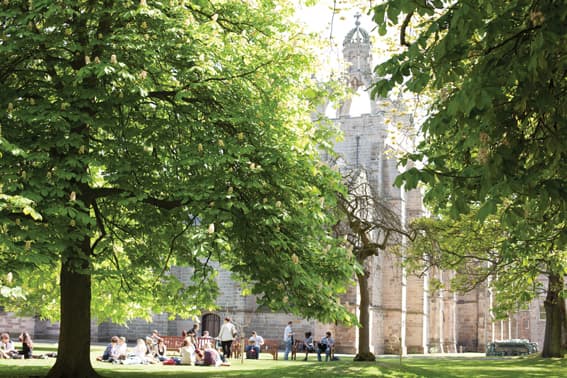
King's lawn, and King's College Chapel, situated in the centre of our Old Aberdeen campus.
King's lawn, and King's College Chapel, situated in the centre of our Old Aberdeen campus.
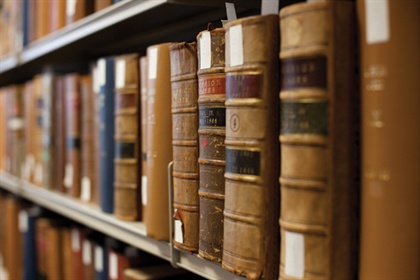
Get hands on experience with primary historical texts in the Sir Duncan Rice Special Collections.

Dunnottar Castle is one of many historical sites throughout the north-east of Scotland, and which students may have a chance to visit during their studies.
This course offers an exciting introduction to the history and culture of modern Scotland, tracing its story from the fourteenth century to the present day. Across twelve engaging classes and a programme of immersive extracurricular activities, students will explore the people, ideas, and traditions that have shaped Scotland’s distinctive identity.
Taught by expert staff from across the School of Divinity, History, Philosophy and Art History at the University of Aberdeen, the course brings together multiple perspectives to illuminate Scotland’s past and present. Some of the topics covered include:
Learning also extends well beyond the classroom through a carefully curated programme of extracurricular experiences in Aberdeen and the wider Aberdeenshire area. These may include guided walking tours, visits to places of local historical and cultural significance, and hands-on activities such as Scottish country dancing—offering students a unique opportunity to experience Scotland’s heritage first-hand.
25th July - 07th August
Medieval and Renaissance Scotland
Medieval and Renaissance Scotland is deeply associated with the wars of independence and figures like William Wallace and Robert Bruce, a land of castles, abbeys, and clans situated at the intersection of Gaelic, Scandinavian, and ‘Anglo-Norman’ cultures. This topic will explore buildings like King’s College Chapel, St Machar’s Cathedral and Provost Skene’s House in Aberdeen which are rich examples surviving from the period, and examine how the court of King James IV, patron of King’s College Aberdeen, illustrates the ways in which Scotland shaped its own renaissance.
Political Unions (1603 v 1707)
Since the SNP secured an overall majority in the Scottish Parliament in 2011, the question of the Union has dominated Scottish politics, yet the history of the union is often neglected. How many Scottish voters, for example, realise that 1707 was the third occasion in which Scottish MPs sat in a Parliament in Westminster? This class will look at the 1603 Union of the Crowns and the 1707 Act of Union, and think about fluctuations in attitudes towards the Union in Scotland (and England and Ireland) since the marriage of King James IV of Scotland with Margaret Tudor, the sister of Henry VIII, set Scotland and England on the path to union.
Scotland and the Jacobite Cause
This class explores the history of the Jacobite cause in Scotland, from the revolution of 1688-90 to the final defeat of the Jacobites at Culloden in 1746. It considers Jacobitism's ongoing significance in shaping Scottish culture and identity, and the legacies and (mis)representations of Jacobitism that persist in popular culture.
The Scottish Enlightenment
This class introduces students to the history of Scottish Enlightenment intellectual culture between c. 1690 and 1830. In Book I of his Treatise on Human Nature published in 1739, the Scottish historian and philosopher David Hume suggested that 'all the sciences have a relation, greater or less, to human nature [and t]here is no question of importance, whose decision is not compriz'd in the science of man'. Hume's extraordinary claim on the interconnectivity of human nature among different branches of knowledge responded to the transitional age in which he lived. With the 'Science of Man' in mind, this class will consider the various ways in which prominent Scottish Enlightenment thinkers such as Francis Hutcheson, Hume, Lord Kames, Thomas Reid, Adam Smith, and Dugald Stewart sought to discover the anatomy of the human mind, restore morality in 'polite' and commercial society, perfect the human constitution as a member of a political body, and reform the political economy of empire-building. In doing so, students will explore a range of Enlightenment themes in the study of empiricism, natural religion, philosophical scepticism, passions, and ethics.
Radical Scotland
This class examines the extent to which Scotland was influenced by republican ideas emanating from both America and France in an age of Atlantic Revolution. It uses both literary and historical evidence to trace the existence of radical organisations from the 1790s to the Insurrection of 1820. It will also identify the strength of the ancien régime state, highlighting both popular loyalism and the institutional response to the radical challenge.
Scottish emigration in the 19th and 20th centuries
This class will analyse the causes, consequences and legacies of Scottish emigration during a century that saw over 2 million people leave their homeland, primarily for North America, Australia and New Zealand. Using a variety of sources, we consider negative and positive motives; the mechanisms through which relocation was implemented; the practical challenges of forging a new life; and the implications of emigration for the participants' sense of identity.
Scotland and Poland: from the 16th century to the 20th century
Scotland’s links with Poland have flourished for centuries, and in the early modern period the expatriate Scottish communities within Poland were of a remarkable scale in terms of numbers and impacts. The seventeenth-century diary of General Patrick Gordon who commanded armies in Poland, Sweden and Russia, is a rich testament to and record of these linkages. In the modern period, the story of Wojtek the Bear, who was adopted by soldiers of the Polish army, and who eventually settled in Edinburgh Zoo, captures the Polish-Scottish links which have continued to flourish since the Second World War.
Children and Childhood in Scotland across 19th and 20th centuries
How did ideas about children, childhood, and youth change over the nineteenth and twentieth centuries? How and why did this period see increasing intervention within the (largely working class) home? This class will consider the changing portrayal of young people in modern Scotland and how this has shaped children's experiences.
Balmorality? Scotland and Monarchy in the Age of Victoria
This class will explore Scotland as a place of royal tourism, with a focus on Queen Victoria and her sentimental love of Highland culture.
Sport and Scottish culture and society:
Sport serves as an excellent mechanism for exploring key factors shaping modern Scotland, such as industrialisation, urbanisation and the relations between different ethnic and religious groups. Senses of identity, and class and gender issues, are also illuminated by sport. The development of a unique sporting culture will be examined in detail during this class.
All applicants must be aged 18 and over.
Academic Entry Requirements
No academic entry requirements required.
English Language Entry Requirements:
Applicants will need to demonstrate that they meet the necessary English language requirements.
We will accept a Statement of Language Level Form signed by their home institution, confirming that the student's level of English is B2 or above on the Common European Framework of Reference for languages in line with requirements for the Standard Visitor Visa.
Alternatively, we also accept any formal certification from the approved range of official qualifications listed at Undergraduate Degrees - English Requirements | Study Here | The University of Aberdeen.
These must have been issued within two years prior to planned commencement at Aberdeen.
£2,000
Price Includes:
Not included:
10 University of Aberdeen academic credits.
This is roughly equivalent to 5 ECTS or 2-3 US Semester credits.
Receiving applications up until March 31st
For more information about our programme, please consult our Scotland: History, Heritage and Culture Course Guide*.
You can also find out more about what your summer school programme might look like by viewing our Scotland: History, Heritage and Culture Timetable.*
If you have any questions about the details included here, don't hesitate to contact us at goabroad.incoming@abdn.ac.uk.
*For illustrative purposes only, subject to change.