
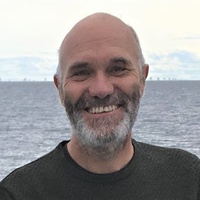
Chair in Zoology
- About
-
- Email Address
- paul.thompson@abdn.ac.uk
- Office Address
- School/Department
- School of Biological Sciences
Biography
I'm a Professor in the School of Biological Sciences, based at the University's Lighthouse Field Station where my group conducts long-term ecological studies of marine top predators and their responses to environment change.
Our work aims to improve the evidence-base required to sustainably manage protected seabird and marine mammal populations, with a particular focus on interactions with fisheries and offshore energy developments.


Qualifications
- PhD Zoology1987 - University of Aberdeen
Distribution and abundance of common seals
- BSc Biology1982 - University of York
External Memberships
Fellow of the Royal Society of Edinburgh
Latest Publications
Environmental heterogeneity and competition shape intraspecific variability of ecological niches in highly mobile marine species
Global Ecology and BiogeographyContributions to Journals: ArticlesHighly Mobile Seabirds Reveal Areas of Conservation Importance Across the Atlantic Ocean
Conservation Letters, vol. 19, no. 5, e70075Contributions to Journals: ArticlesFrom stable high costs to variable low costs: a continuum of non-breeding energy expenditure strategies in North Atlantic seabirds
Journal of Animal EcologyContributions to Journals: ArticlesEvidence of predation events by marine mammals at offshore wind farms
Scientific ReportsContributions to Journals: ArticlesTemporal changes in the dietary niche of sympatric seals provides insight into the role of competition in population declines
Oikos, vol. 2026, no. 6, e11875Contributions to Journals: Articles
Prizes and Awards
Marsh Award for Marine and Freshwater Conservation, 2015
- Research
-
Research Overview
Current research aims to assess how natural and anthropogenic environmental variations influence the behaviour, physiology and dynamics of marine mammal and seabird populations. These questions have been approached by conducting long-term and comparative studies of key populations; primarily in Scottish waters but including some work overseas. These studies have been used to address a range of applied and theoretical questions, often requiring an inter-disciplinary approach and regularly involving collaboration with other research groups both in the UK and abroad. Topics of particular interest have included interactions between wildlife populations and fisheries, the impact of anthropogenic noise on marine mammal biology, seal foraging and breeding strategies, and effects of changing prey stocks and climate change on the population dynamics of marine top predators.
Research Areas
Biological and Environmental Sciences
Research Specialisms
- Ecology
- Environmental Sciences
- Marine Sciences
- Acoustics
- Environmental Impact Assessment
Our research specialisms are based on the Higher Education Classification of Subjects (HECoS) which is HESA open data, published under the Creative Commons Attribution 4.0 International licence.
Current Research
Population ecology of marine mammals and seabirds; individual-based studies of focal populations of northern fulmars, harbour seals and bottlenose dolphins.
Moray Firth Marine Mammal Monitoring Programme [MMMP]; co-produced strategic research and monitoring programme to meet consent conditions for regional offshore wind developments.
PrePARED; consortium project on predator and prey responses to offshore structures, aimed at understanding cumulative environmental impacts and benefits of offshore windfarms.
SEATRACK; international collaboration to understand the at-sea distribution of seabirds in the NE Atlantic.
Knowledge Exchange
Knowledge exchange activities have involved regular consultancy work for industry and contributions to UK and International advisory groups. Current activities include membership of the DEFRA Strategic Underwater Noise Group and a Marine Scotland Strategic Marine Mammal Research Programme Steering Group.
Public engagement activities have built upon work at the Lighthouse Field Station, which has featured in a broad range of TV and Radio programmes and been the focus of Arts-Science collaborations such as SUBLIME.
Collaborations
Population ecology of marine mammals and seabirds; involves collaboration with the University of St Andrews Sea Mammal Research Unit and the University of Bangor.
Moray Firth Marine Mammal Monitoring Programme [MMMP]; involves collaboration with the University of St Andrews Sea Mammal Research Unit and CEFAS.
PrePARED; consortium led by Marine Scotland Science, including University of Exeter, SMRU Consulting, BIOSS, CEH, Nature Scot, Natural England & University of Aarhus.
SEATRACK; collaboration led by the Norwegian Polar Institute, Norwegian Institute for Nature Research and Norwegian Environment Agency. SEATRACK involves multiple partners working at over 50 seabird colonies encircling the Labrador, Greenland, Barents, Norwegian, North and Irish Seas.
Supervision
I've supervised around 25 PhD students who have gone on to work in a wide range of research, conservation and management roles.
You can find out more about their research projects and subsequent careers on the Lighthouse Field Station webpages.
I'm no longer taking on PhD students as a primary supervisor but remain open to involvement in supervisory teams for interesting project that relate to my current interests.
Funding and Grants
2022-2025, The Crown Estate Offshore Wind Evidence and Change Programme, PrePARED
2021-2022, BEIS, Cetacean responses to decommissioning noise.
2014-2022, Beatrice Offshore Wind Ltd, Moray Offshore Renewables Ltd, Marine Scotland, The Crown Estate, Highlands & Islands Enterprise, Marine Mammal Monitoring Programme for Moray Firth windfarm developments
2012-2024, Scottish Natural Heritage, Site condition monitoring for the Moray Firth Special Area of Conservation
2015-2016, DECC, Assessing cetacean responses to pile driving noise
2011-2012, Marine Scotland, Assessment of methods for monitoring marine mammals at marine renewable energy developments
2010-2012, Moray Offshore Renewables Ltd & Beatrice Offshore Wind Ltd, Development of a framework for assessing the impact of windfarm construction marine mammal populations.
2009-2013, DECC, Assessing the impact of seismic survey noise on cetaceans
- Teaching
-
Teaching Responsibilities
The Lighthouse Field Station research programme has provided unique opportunities for >30 cohorts of UG and PGT students to experience research-led teaching within marine mammal ecology and conservation.
In particular, Cromarty-based Honours and Masters projects have provided unique field-based training opportunities; resulting in a strong record for graduate recruitment and many alumni obtaining important leadership roles in the UK and overseas. Undergraduates can also visit the Field Station for the Biodiversity Field Course (BI25F7).
Several Aberdeen-based courses at levels 1-5 draw upon Lighthouse research, with contributions to Frontiers in Biology (BI1009), Fundamentals in Marine Biology (BI25Z2), Animal Population Ecology (ZO4920), Marine Biodiversity (ZO4820), Marine Conservation Management (ZO5809) and Marine EIA (ZO5510).
Since 2017, I have been developing more online material for blended delivery, and exploring digital approaches to enable virtual access to remote fieldwork. From April 2022, I may continue to appear in some of these digital resources, but my previous teaching commitments will be undertaken by Dr Jo Kershaw.
- Publications
-
Page 3 of 9 Results 51 to 75 of 208
Increasing trends in fecundity and calf survival of bottlenose dolphins in a marine protected area
Scientific Reports, vol. 9, 1767Contributions to Journals: Articles- [ONLINE] DOI: https://doi.org/10.1038/s41598-018-38278-9
- [OPEN ACCESS] https://aura.abdn.ac.uk/bitstreams/c95af31e-ddac-4d76-9cfc-55406b983837/download
- [ONLINE] View publication in Scopus
- [ONLINE] View publication in Mendeley
Variations in age- and sex-specific survival rates help explain population trend in a discrete marine mammal population
Ecology and Evolution, vol. 9, no. 1, pp. 533-544Contributions to Journals: Articles- [ONLINE] DOI: https://doi.org/10.1002/ece3.4772
- [OPEN ACCESS] https://aura.abdn.ac.uk/bitstreams/2044abea-fe43-4ded-9f51-f1123e0406f3/download
- [ONLINE] View publication in Scopus
- [ONLINE] View publication in Mendeley
Fine scale spatial variability in the influence of environmental cycles on the occurrence of dolphins at coastal sites
Scientific Reports, vol. 9, 2548Contributions to Journals: Articles- [ONLINE] DOI: https://doi.org/10.1038/s41598-019-38900-4
- [OPEN ACCESS] https://aura.abdn.ac.uk/bitstreams/eba69d39-c0fa-410d-9129-211ca8976d03/download
- [ONLINE] View publication in Scopus
- [ONLINE] View publication in Mendeley
Dead useful; methods for quantifying baseline variability in stranding rates to improve the ecological value of the strandings record as a monitoring tool
Journal of the Marine Biological Association of the United Kingdom, vol. 98, no. 5, pp. 1205-1209Contributions to Journals: Articles- [ONLINE] DOI: https://doi.org/10.1017/S0025315417000698
- [ONLINE] View publication in Scopus
Central place foragers and moving stimuli: a hidden-state model to discriminate the processes affecting movement
Journal of Animal Ecology, vol. 87, no. 4, pp. 1116-1125Contributions to Journals: Articles- [ONLINE] DOI: https://doi.org/10.1111/1365-2656.12830
- [OPEN ACCESS] https://aura.abdn.ac.uk/bitstreams/8779d7f0-212f-43df-8dfb-5cb66b4a8c30/download
- [OPEN ACCESS] https://aura.abdn.ac.uk/bitstreams/47247c42-3a24-4046-88b3-43241af2c1a0/download
- [OPEN ACCESS] https://aura.abdn.ac.uk/bitstreams/2b7590d8-0126-4c76-953a-eaeadf77ed41/download
- [OPEN ACCESS] https://aura.abdn.ac.uk/bitstreams/935c3a55-328c-401e-b331-0f687ef95555/download
Laser photogrammetry reveals variation in growth and early survival in free-ranging bottlenose dolphins
Animal Conservation, vol. 21, no. 3, pp. 252-261Contributions to Journals: ArticlesThe rate of telomere loss is related to maximum lifespan in birds
Philosophical Transactions of the Royal Society B: Biological Sciences, vol. 373, no. 1741, 20160445Contributions to Journals: ArticlesPredicting the impacts of anthropogenic disturbances on marine populations
Conservation Letters, vol. 11, no. 5, 12563Contributions to Journals: ArticlesResponses of bottlenose dolphins and harbour porpoises to impact and vibration piling noise during harbour construction
Ecosphere, vol. 8, no. 5, pp. 1-16Contributions to Journals: ArticlesDiurnal variation in harbour porpoise detection – potential implications for management
Marine Ecology Progress Series, vol. 570, pp. 223-232Contributions to Journals: ArticlesA new approach to estimate fecundity rate from inter-birth intervals
Ecosphere, vol. 8, no. 4, e01796Contributions to Journals: ArticlesCan the Camera Lie? A Nonpermanent Nick in a Bottlenose Dolphin (Tursiops truncatus)
Aquatic Mammals, vol. 43, no. 2, pp. 156-161Contributions to Journals: ArticlesState-space modelling of geolocation data reveals sex differences in the use of management areas by breeding northern fulmars
Journal of Applied Ecology, vol. 53, no. 6, pp. 1880–1889Contributions to Journals: ArticlesPhenological sensitivity to climate across taxa and trophic levels
Nature, vol. 535, no. 7611, pp. 241-245Contributions to Journals: ArticlesEcholocation detections and digital video surveys provide reliable estimates of the relative density of harbour porpoises
Methods in Ecology and Evolution, vol. 7, no. 7, pp. 762-769Contributions to Journals: ArticlesValidating the use of intrinsic markers in body feathers to identify inter-individual differences in non-breeding areas of northern fulmars
Marine Biology, vol. 163, pp. 1-12Contributions to Journals: ArticlesUnderwater noise modelling for environmental impact assessment
Environmental impact assessment review, vol. 57, pp. 114-122Contributions to Journals: ArticlesSoundscape and Noise Exposure Monitoring in a Marine Protected Area Using Shipping Data and Time-Lapse Footage
Chapters in Books, Reports and Conference Proceedings: Conference Proceedings- [ONLINE] DOI: https://doi.org/10.1007/978-1-4939-2981-8_85
Investigating individual growth rates in wild bottlenose dolphins using remote laser photogrammetry
21st Biennial Society for Marine Mammalogy ConferenceContributions to Conferences: PostersPredicting the effects of human developments on individual dolphins to understand potential long-term population consequences
Proceedings of the Royal Society of London. B, Biological Sciences, vol. 282, no. 1818, 20152109Contributions to Journals: Articles- [ONLINE] DOI: https://doi.org/10.1098/rspb.2015.2109
- [ONLINE] AAM in University of St Andrew's Repository
Intrinsic and extrinsic drivers of activity budgets in sympatric grey and harbour seals
Oikos, vol. 124, no. 11, pp. 1462-1472Contributions to Journals: Articles- [ONLINE] DOI: https://doi.org/10.1111/oik.01810
- [ONLINE] AAM in University of St Andrews Repository
Mark-resight estimates of seasonal variation in harbor seal abundance and site fidelity
Population Ecology, vol. 57, no. 3, pp. 467-472Contributions to Journals: Articles- [ONLINE] DOI: https://doi.org/10.1007/s10144-015-0496-z
Parallel declines in survival of adult Northern Fulmars Fulmarus glacialis at colonies in Scotland and Ireland
Ibis, vol. 157, no. 3, pp. 631-636Contributions to Journals: Articles- [ONLINE] DOI: https://doi.org/10.1111/ibi.12255
Estimating spatial, temporal and individual variability in dolphin cumulative exposure to boat traffic using spatially explicit capture-recapture methods
Animal Conservation, vol. 18, no. 1, pp. 20-31Contributions to Journals: Articles- [ONLINE] DOI: https://doi.org/10.1111/acv.12132
- [ONLINE] View publication in Scopus
Integrating passive acoustic and visual data to model spatial patterns of occurrence in coastal dolphins
ICES Journal of Marine Science, vol. 72, no. 2, pp. 651-660Contributions to Journals: Articles- [ONLINE] DOI: https://doi.org/10.1093/icesjms/fsu110
- [ONLINE] View publication in Scopus


