
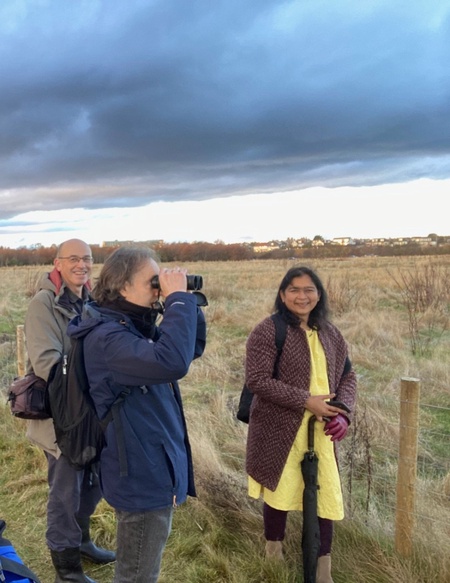

The University of Aberdeen has conferred a PhD posthumously on doctoral researcher Dr Vidyavathi Pamjula, recognising the originality, rigour and advanced stage of completion of her research on the evolutionary origins of infectious diseases.
The University of Aberdeen has conferred a PhD posthumously on doctoral researcher Dr Vidyavathi Pamjula, recognising the originality, rigour and advanced stage of completion of her research on the evolutionary origins of infectious diseases.
Dr Pamjula, a senior PhD student supervised by Dr Francisco Perez‑Reche and Professor Norval Strachan, successfully defended her thesis at viva and was undertaking her final corrections at the time of her death in November.
Her doctoral work, Elucidating the emergence of infectious diseases using coronavirus and Listeria as exemplars, applied advanced evolutionary and statistical genomic inference methods to investigate the emergence of SARS‑CoV‑2 and other pathogens.
A central contribution of her research was the identification of a likely spillover window for SARS‑CoV‑2 to humans between 2007 and 2019. This analysis drew on sophisticated phylogenomic and evolutionary modelling approaches, many of which Dr Pamjula independently acquired and refined during her studies. Her work demonstrated both technical depth and sustained intellectual commitment.
Dr Pamjula, daughter of Mr Ramanaiah Pamjula and Mrs Eswaramma Pamjula, brought an unusually wide-ranging academic foundation to her doctoral studies at the University of Aberdeen. She previously completed an MBA at the University of Aberdeen, an MSc in Foods, Nutrition and Diet Therapy at Sri Venkateswara University in India, and a Higher Diploma in Network‑Centred Computing from the National Institute of Information Technology, India. This diverse background informed her approach to evolutionary genomics and supported her ability to engage with complex computational and biological frameworks.
Throughout her PhD, Dr Pamjula showed consistent dedication to her research and a strong capacity for independent learning. Her viva examiners commended the quality and originality of her analytical work, requesting only structural and clarificatory revisions rather than changes to scientific content.
In awarding the PhD posthumously, the University acknowledges both the academic merit of Dr Pamjula’s thesis and the significant progress she had made toward its completion. While such awards are rare, this decision reflects the strength of her scholarship and the University’s commitment to recognising exceptional academic achievement.
Dr Francisco Perez‑Reche said: “Dr Pamjula’s work represents a meaningful contribution to the study of globally significant infectious diseases and stands as a testament to her perseverance, intellectual curiosity and commitment to research.
“Vidyavathi was a deeply engaged and thoughtful researcher who consistently rose to the challenges of her project. It has been a privilege to supervise her work and to see her contribution recognised.”
Professor Norval Strachan added: “Vidyavathi was a student with a strong intrinsic motivation who overcame significant academic and technical challenges, teaching herself advanced evolutionary genomics methods and applying them to research of global relevance. Her award sends a powerful and motivating message about what can be achieved through commitment, resilience and lifelong learning.”