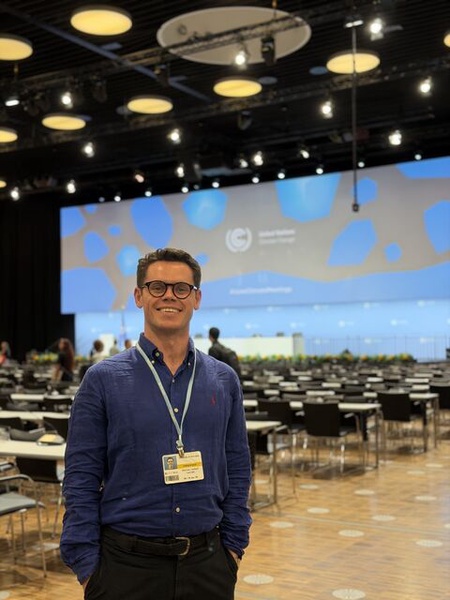

AUCEL Co-Director Dr Mitchell Lennan, an expert in oceans and climate change law, recently attended the 64th sessions of the United Nations Framework Convention on Climate Change (UNFCCC) Subsidiary Bodies (SB64) in Bonn, Germany.
Dr Lennan has participated in UN climate negotiations since COP26 in Glasgow in 2021 and regularly engages with governments, UN bodies and civil society organisations on the legal dimensions of ocean-based climate action.
Held midway between annual Conferences of the Parties (COPs), the Subsidiary Bodies are where much of the technical negotiation underpinning international climate governance takes place. The outcomes of SB64 will inform negotiations at COP31 in Antalya, Türkiye, later this year.
During the negotiations, Dr Lennan followed discussions on the Ocean-Climate Dialogue, just transition and agriculture, examining how these processes are shaping the role of the ocean within the implementation of the Paris Agreement. He also monitored the influence of the recent Advisory Opinion of the International Court of Justice on climate change across different negotiating streams.
The Advisory Opinion is expected to have lasting significance for international climate governance by clarifying States' obligations under general international law, climate change law, the law of the sea, biodiversity law and international human rights law. Alongside the well-established scientific consensus on climate change, it provides an increasingly robust legal foundation for the rapid transition away from fossil fuels.
Although Parties adopted the meeting agenda unusually quickly, negotiations became increasingly challenging as the session progressed. Discussions on mitigation, adaptation and just transition exposed persistent differences between Parties, and several negotiating tracks were unable to agree text to carry forward to COP31.
Alongside the formal negotiations, Dr Lennan met with representatives from UN organisations, national delegations and international research organisations to strengthen existing partnerships and explore opportunities for future collaboration. Building on relationships established through previous COP and SB meetings, these discussions will contribute to ongoing research on ocean-climate governance, future policy engagement and the development of collaborative projects.