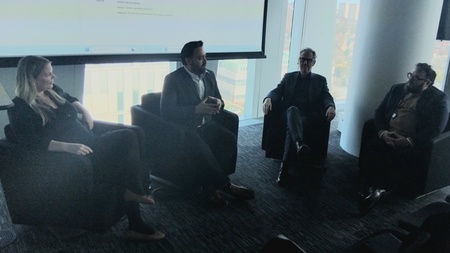

On 6 March, the Aberdeen Centre for Constitutional and Public International Law (ACCPIL) hosted an expert workshop on the theme: ‘Outlier or Leader?: Scotland’s Approach to International Law and Human Rights’. The workshop was organised by Dr Clare Frances Moran and Dr Erin Ferguson, two of the co-directors of the ACCPIL, and funded by the Scottish Council on Global Affairs as part of its State of the World project.
The aim of the workshop was to explore Scotland’s role in protecting human rights and supporting an international rules-based order at a time when human rights and international law are under threat. The workshop was organised around two panels and concluded with a fireside chat with Professor Alan Miller (Strathclyde) discussing the proposed Human Rights Bill for Scotland.
The first panel focused on the international rules-based order and featured contributions from Professor Gerry Simpson (LSE), Dr Frederick Cowell (Birkbeck), and Dr Eliza Bechtold (Bonavero Institute of Human Rights, Oxford). Reflecting on the conference theme, Professor Simpson asked whether we are witnessing the end of international law. Whilst recognising the serious breaches of international law that have occurred in recent years, he cautioned against declaring international law ‘dead’, reminding us that many aspects of international law are still functioning as intended. Dr Cowell drew on his expertise on treaty withdrawal to examine what this means for the international rules-based order and Scotland’s place in it. This contribution was particularly relevant in the light of the Conservative party’s pledge to withdraw from ECHR if it wins the next general election, with Dr Cowell reminding us that that the ECHR has very few democratic safeguards when it comes to withdrawal. Dr Bechtold concluded the panel with some reflections on recent developments in the United States and what the Trump administration’s disregard for international law means for the international community as well as the future of the US constitution. She argued that the US is not behaving as a rational actor and cannot be relied upon to respect the rule of law, prompting a wider discussion between the panellists and audience members on whether we are witnessing a moment of transformation in the international legal order.
The second panel examined Scotland’s approach towards human rights, with a particular emphasis on recent efforts to incorporate international treaties into domestic law in Scotland. This includes the UN Convention on the Rights of the Child (UNCRC), which was incorporated into domestic law in Scotland in 2024, and the potential incorporation of four additional international treaties through the Human Rights Bill for Scotland. Professor Katie Boyle (Strathclyde) provided some reflections on the impact of the UNCRC incorporation on children’s rights. She reminded us that despite recent efforts to strengthen human rights in Scotland, it is still ‘playing catch up’ compared to many other countries when it comes to embedding fundamental rights and making them fully justiciable. Professor Kasey McCall-Smith (Edinburgh) provided an overview of the long journey to incorporate the UNCRC in Scotland. She argued that Scotland has significant potential to be a leader in human rights, but that it can do more to bring the rest of the UK along. Dr Samuel White (UWS) concluded the panel on a hopeful note, reminding us that the majority of the public think that human rights are meaningful and that positive storytelling about human rights can act as counter-narratives to the scepticism we see in the media and in political debate.
During the fireside chat, Professor Miller shared his experiences as the Co-Chair of the National Taskforce on Human Rights Leadership, which has recommended the introduction of a Human Rights Bill for Scotland. He spoke of the need to expand human rights protections in Scotland to include economic, social, and cultural rights, as well as environmental rights, arguing that stronger socio-economic rights in particular are necessary to achieve the Scottish government’s goal of reducing poverty. He cautioned against the tendency to focus on the complexities of incorporation in a devolved context, reminding us that the ultimate aim of incorporating these treaties is to make people’s lives better.
Throughout the course of the day, speakers and participants reflected on the workshop theme, asking whether Scotland is an outlier or leader when it comes to human rights and international law? Or perhaps both, or neither? Dr White reminded us that despite political debates over the European Convention on Human Rights (ECHR) and the UK’s role within the ECHR system, public support for human rights remains high throughout the UK. In that regard, Scotland is not exactly an outlier. However, Scotland still has the potential to become a leader in the UK, particularly when it comes to the strengthening of economic, social, and cultural (ESC) rights.