Welcome to the astro-imaging album of the Anne H Cruickshank Observatory (ACO) at the University of Aberdeen. Every picture here was taken with the John Cruickshank Telescope (JCT), a 16-inch reflecting telescope, and was made by ACO AI, the observatory's artificial-intelligence operator. Using autonomous navigation, it steered the telescope to each target, checked its aim by matching the stars in the image against a star map, and took the exposures itself.
Faint objects such as glowing gas clouds are far too dim to show up in one short exposure. So ACO AI takes several and stacks them, adding them together to bring out fine detail and reduce the graininess. The camera is black-and-white to capture more light, so colour comes from taking separate exposures through coloured filters and combining them.
Several styles of colour picture appear in the album. Narrowband images use filters that pass only the light from particular glowing gases: hydrogen, oxygen and sulphur. In the Hubble palette (SHO) each gas is given its own colour, a false-colour view of where each one sits in the cloud. Astronomers have used this technique on many of the Hubble Space Telescope's best-known pictures. In the Natural palette the gases are shown closer to the colours they really glow, with hydrogen red and oxygen blue-green.
Galaxies and star fields are more often shown as LRGB composites: red, green and blue (RGB) Bessel broadband filters capture true colour - cool orange stars, hot blue stars, the warm core and cooler outer disc of a galaxy - while a separate, sharper set of unfiltered exposures supplies the luminance (L): the fine brightness detail and structure. The two are then fused, colour from the RGB data and detail from the L data, giving a picture that is both naturally coloured and crisply resolved.
For a few targets the two approaches are blended together into a hybrid composite: an LRGB image with a touch of narrowband data (usually hydrogen-alpha) mixed in to bring out a feature broadband colour alone can't show, such as a galaxy's star-forming outflow. Images captured without filters stand on their own too, shown in monochrome. Each image has a caption saying what it shows, roughly how far away the target is and how it was made.
Image: Charles Wang/ACO AI
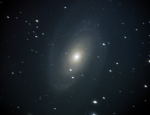
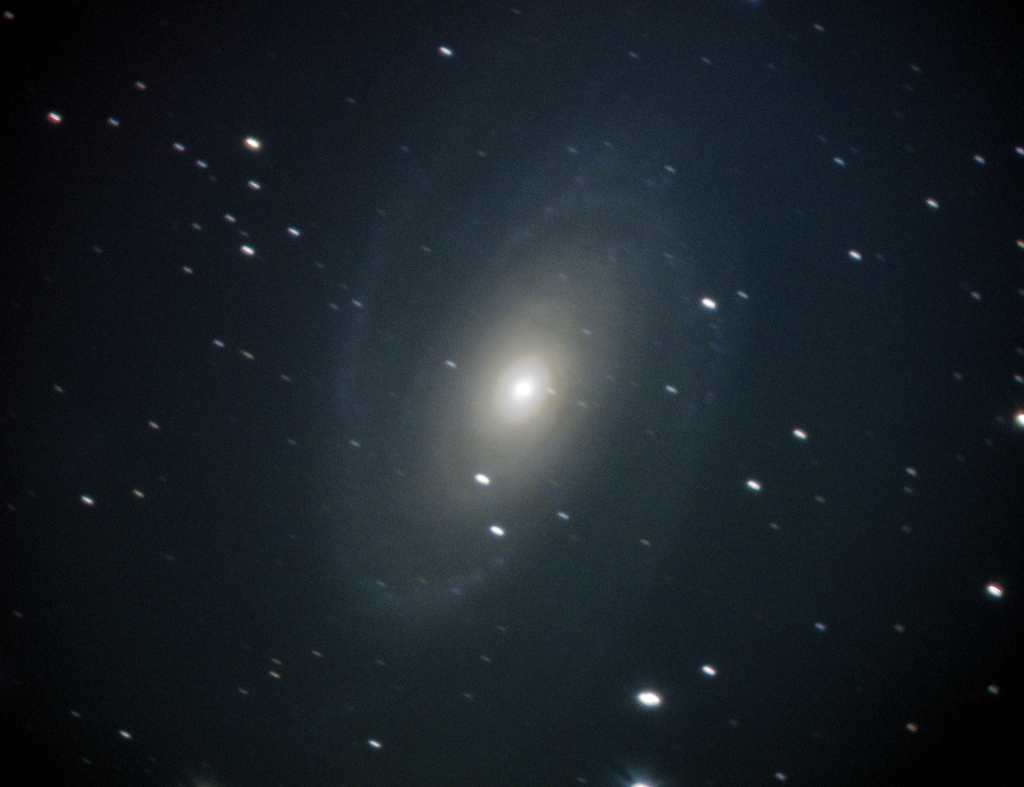 M81, also known as Bode's Galaxy, is a grand-design spiral galaxy in the constellation Ursa Major,
about 12 million light-years away. It's one of the most striking and well-studied spirals in the sky,
prized for its tightly-wound, clearly-defined arms winding out from a bright central bulge - visible
here as the warm glow surrounding the star-like nucleus, with the galaxy's disc fading into a cooler,
bluer haze further out. M81 anchors the M81 Group, a cluster of dozens of galaxies that includes its
smaller, chaotic neighbour M82 (the Cigar Galaxy, imaged at this observatory two nights earlier),
visible in the same binocular field. A close gravitational encounter between the two galaxies, tens of
millions of years ago, is thought to have triggered M82's intense burst of star formation while
leaving M81's own elegant spiral structure largely intact. North is up and East is left.
* * *
Imaged overnight on 18-19 October 2026 with the John Cruickshank Telescope (GSO 16-inch
Ritchey-Chretien) at the Anne H Cruickshank Observatory, University of Aberdeen (57.17 N, 2.10 W),
on a tracking equatorial mount (EQ8-R Pro), run headless/unattended by an autonomous capture script
with automatic error recovery. Zeus 455M PRO camera, gain 300, cooler held around -16 to -20 C
through the night against a -20 C target. The target was precisely centred beforehand via ASTAP
plate-solving rather than mount telemetry alone, and focus was set from a same-night EAF
step-position sweep (990 steps) rather than relying on a previously logged value.
- Field and scale: the image shown is 1920 x 1476 pixels, resized down for web display from a
6192 x 4760 pixel crop around the galaxy (full-frame composite at the camera's native ~0.24
arcseconds per pixel, no binning), covering a field of about 24.8 x 19.0 arcminutes.
- Luminance: a full-resolution median stack of 16 clean 60 s L (No Filter) subframes, individually
plate-solved and registered using each frame's own WCS rotation and scale, then given a
structure-revealing stretch to bring out the faint outer spiral glow without blowing out the
bright core, with a gamma adjustment (2.0) for a brighter midtone.
- Colour: R, G and B broadband data combined onto the luminance above via a hue/saturation
(HSV) combine - luminance (brightness and detail) comes entirely from the L stack; only colour
comes from this blend. Each colour channel was independently plate-solved and registered directly
onto the L reference frame (not just internally among themselves), then background-equalised (its
own sky level subtracted) before combining, and stacked by median rather than simple averaging.
Saturation was boosted by 45% (HSV S channel, applied to the full 16-bit data) to make the
colour contrast between the galaxy's warm core and cooler outer disc more visible. Overall
contrast was then increased by 25% (linear stretch about the midpoint, full 16-bit data) for a
punchier, less washed-out look.
- Capture times (BST), by filter, real timestamps from the saved subframes:
- L: 22:54:30 to 23:59:29 (16 subframes, 60 s each)
- R: 23:15:16 to 23:44:43 (6 subframes, 90 s each)
- G: 23:20:59 to 23:50:31 (6 subframes captured, 90 s each; 5 used after one frame failed to
plate-solve)
- B: 23:26:40 to 23:56:20 (6 subframes, 90 s each)
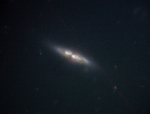
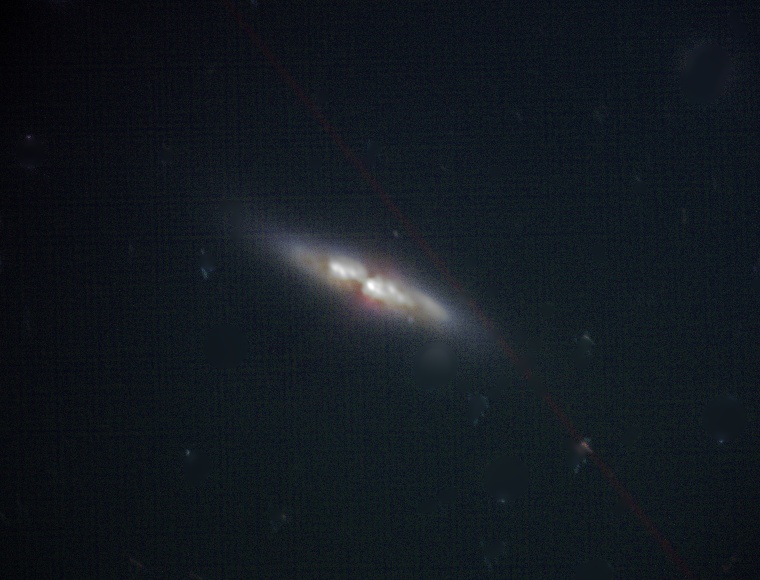 M82, nicknamed the Cigar Galaxy for its edge-on, elongated shape, sits in the constellation Ursa
Major about 12 million light-years away. It's the closest well-known example of a starburst galaxy
- one undergoing an exceptionally intense burst of star formation, here triggered by a close
gravitational encounter with its much larger neighbour M81, still visible nearby in the same binocular
field. That interaction compressed M82's gas and set off star formation at a rate many times faster
than a typical spiral galaxy, visible here as the mottled, knotty glow running along its disk. The
same burst of star formation drives a powerful galactic-scale outflow - gas blown out of the disk by
stellar winds and supernovae, glowing in hydrogen-alpha light and picked out here in red, extending
well above and below the galaxy's visible disk. M82's disturbed, irregular structure (it doesn't fit
neatly into the usual spiral/elliptical galaxy categories) is itself a direct result of its ongoing
gravitational tug-of-war with M81. North is up and East is left.
* * *
Imaged overnight on 15-16 October 2026 (about 01:00 to 05:08 BST) with the John Cruickshank
Telescope (GSO 16-inch Ritchey-Chretien) at the Anne H Cruickshank Observatory, University of
Aberdeen (57.17 N, 2.10 W), on a tracking equatorial mount (EQ8-R Pro), run headless/unattended by
an autonomous capture script, with real per-filter focuser offsets and automatic slip recovery.
Zeus 455M PRO camera; the cooler stayed at 0 C in this session.
- Field and scale: the image shown is 760 x 580 pixels, about 18.2 x 13.9 arcminutes, cropped
around the galaxy from a full-frame composite at the camera's native ~0.24 arcseconds per pixel
(no binning), downsampled 6x for this crop.
- Luminance: a full-resolution (unbinned) stack of all 32 captured L subframes (45 s, gain 100).
Each frame/filter round was individually plate-solved and registered, with the solved rotation
angle smoothed across the night (removing frame-to-frame solve noise while preserving a real,
gentle rotation drift from residual polar misalignment) rather than assuming every frame shares
one fixed orientation.
- Colour: R, G and B broadband data (13, 14 and 14 subframes respectively) combined with a modest
hydrogen-alpha boost into the red channel (21 Ha subframes) to bring out the galaxy's characteristic
outflow filaments, fused onto the full-resolution luminance above via a hue/saturation combine -
luminance (brightness and detail) comes entirely from the L stack above; only colour comes from
this blend. Each colour channel was background-equalised (its own sky level subtracted) before
combining, and stacked by median rather than simple averaging, rejecting one-off defects that a
plain average wouldn't. S(II) and O(III) narrowband data were also captured this session but not
used in this colour blend (faint for this target compared to Ha, and this isn't an emission nebula
where they'd be the main story).
- Starfield clean-up: the many background stars that stacked with a distracting elongated/fringed
appearance (real sub-to-sub tracking drift within each individual 45 s exposure, not a processing
artifact - confirmed by checking a single unstacked frame directly) were detected automatically and
removed from this crop, filled in from the surrounding sky/halo rather than left in. The galaxy
itself was never touched by this step.
- Capture times (BST), by filter, real timestamps from the saved subframes - each filter ran as a
recurring slot across the whole night rather than in one continuous block:
- L: 01:05:16 to 04:58:13 (32 subframes)
- SII: 01:12:14 to 05:03:37 (24 subframes, not used in this colour blend)
- Ha: 01:16:45 to 05:08:07 (24 subframes captured, 21 used after registration)
- OIII: 01:21:19 to 04:41:39 (21 subframes, not used in this colour blend)
- R: 01:25:59 to 04:45:12 (14 subframes captured, 13 used after registration)
- G: 01:31:01 to 04:48:51 (14 subframes)
- B: 01:34:38 to 04:52:19 (14 subframes)
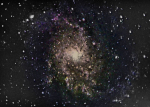
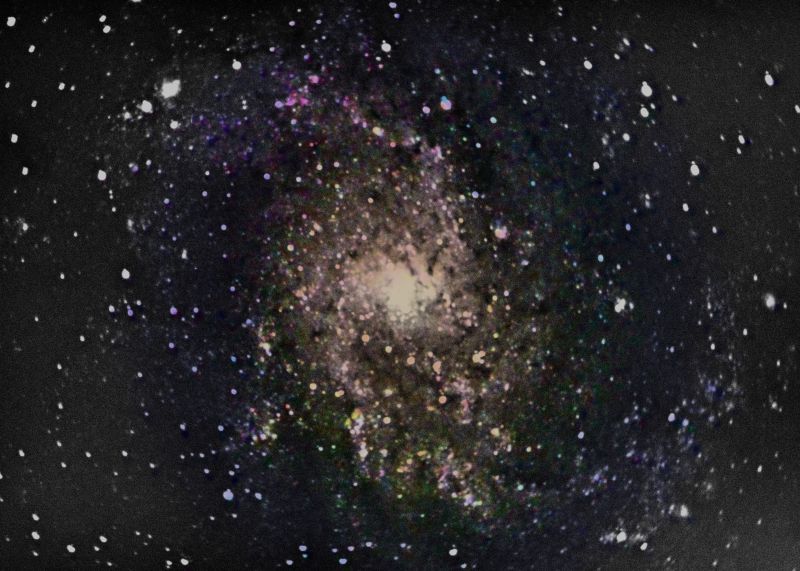 The Triangulum Galaxy (M33), a face-on spiral in the constellation Triangulum, about 2.73 million
light-years away, and the third-largest member of our Local Group after the Milky Way and Andromeda.
At roughly half the Milky Way's diameter, it's a genuine spiral in its own right rather than a
satellite of its larger neighbour Andromeda, though the two may have interacted in the past. Its
loose, patchy arms are threaded with pink star-forming knots, picked out here by blending in
narrowband hydrogen-alpha, oxygen-III and sulfur-II data on top of the natural broadband colour -
the brightest of these, NGC 604, is one of the largest known star-forming regions in the Local
Group, far bigger than the Orion Nebula. Under a dark enough sky M33 is one of the most distant
objects visible to the naked eye, though its light is spread thin enough across the sky that it can
actually be harder to pick out than the more compact, brighter-looking Andromeda Galaxy. North is
up and East is left.
* * *
Imaged overnight on 13-14 October 2026 (about 21:03 to 04:07 BST) with the John Cruickshank
Telescope (GSO 16-inch Ritchey-Chretien) at the Anne H Cruickshank Observatory, University of
Aberdeen (57.17 N, 2.10 W), on a tracking equatorial mount (EQ8-R Pro), run headless/unattended by
an autonomous capture script, with real per-filter focuser offsets and automatic slip recovery.
Zeus 455M PRO camera, cooled to -20 C.
- Field and scale: this web copy is 800 x 571 pixels (downsized for the web from a 7683 x 5488
full-resolution master), covering the same real field either way - about 30.7 x 22.0 arcminutes
(0.51 x 0.37 degrees), cropped from the full native frame (9576 x 6388 pixels) around the galaxy
and trimmed to a 1.4:1 aspect ratio. At this file's own pixel size that works out to about 2.3
arcseconds/pixel on screen, versus the camera's native ~0.24 arcseconds/pixel (no binning) in the
full-resolution master. A genuine 16-bit-per-channel master (48 bits per pixel, not the usual
8-bit-per-channel web image) is also available at the full resolution.
- Luminance: a fresh full-resolution (unbinned) stack of 46 of 48 L subframes (45 s, gain 100; 2
rejected as mis-registered outliers). Partway through the night the mount's own pier-flip (its
normal way of continuing to track the sky past the meridian) rotated every subsequent frame by
about 181 degrees relative to the frames taken before it; those post-flip frames are now
precisely rotated back into alignment and included in the stack, rather than discarded as in an
earlier version of this image. Stacked by star-pattern cross-correlation, background-gradient
flattened, contrast-enhanced and brightness-boosted without letting any pixel reach full
saturation.
- Colour: SII, Ha, OIII, R, G and B data, taken before the pier flip, combined and fused onto the
full-resolution luminance above, which supplies all of the final image's brightness. A small
number of background stars whose colour came out implausible after this fusion were individually
identified and desaturated back toward a neutral tone; none of M33 itself was touched.
- Capture times (BST), by filter, real timestamps from the saved subframes - each filter ran as a
recurring slot across the whole night rather than in one continuous block:
- L: 21:06:49 to 03:45:20 (spans the pier flip; 2 frames rejected as mis-registered)
- SII: 21:13:52 to 04:07 (last used frame 01:32:21)
- Ha: 21:18:33 to 04:07 (last used frame 01:36:52)
- OIII: 21:23:14 to 04:07 (last used frame 01:41:25)
- R: 21:28:00 to 04:07 (last used frame 01:45:12)
- G: 21:31:45 to 04:07 (last used frame 01:48:55)
- B: 21:35:24 to 04:07 (last used frame 01:52:26)
Colour filters stop at the pier flip; only luminance uses the whole night.
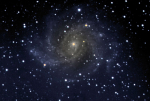
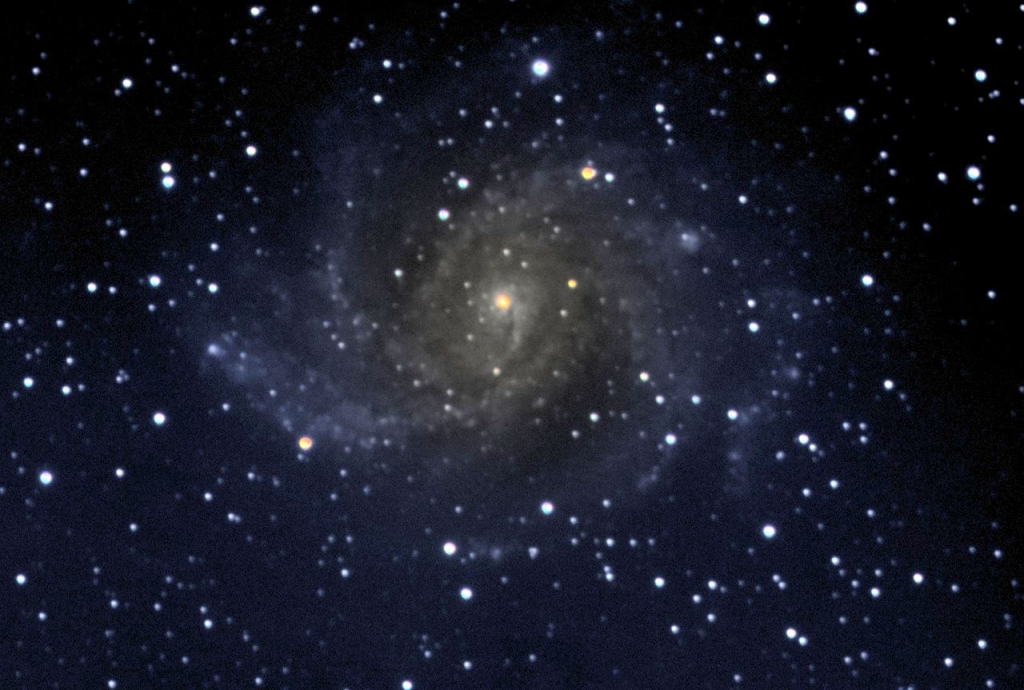 NGC 6946, nicknamed the Fireworks Galaxy, lies on the border of Cepheus and Cygnus constellations, about 25 million light-years away, and is seen almost face-on, showing off its loose, patchy spiral arms. It earned its nickname by hosting ten observed supernovae since 1917 - more than any other known galaxy - and its arms are still rich with the star-forming regions that produce them, visible here as faint mottled knots threaded through the disc. North is up and East is left.
* * *
Imaged on the night of 21-22 September 2026, between about 21:40 and 22:45 BST, with the John Cruickshank Telescope (GSO 16-inch Ritchey-Chretien) at the Anne H Cruickshank Observatory, University of Aberdeen (57.17 N, 2.10 W). Zeus 455M PRO camera, cooled to -20 C, on a tracking equatorial mount (EQ8-R Pro), run headless via a Python capture script.
- LRGB: 45 s subframes at gain 100, full sensor resolution (1x1 binning). Only frames from before dew
started forming on the optics partway through the night were used: 20 x L, 10 x R, 9 x G and 7 x B (about
34.5 minutes total), out of 120/60/59/58 taken across the whole night - a thin data set kept for a
dew-free result rather than a deeper but contaminated one.
- Field and scale: the crop shown is about 14.3 x 9.9 arcminutes (0.24 x 0.16 degrees) at about 0.24
arcseconds per pixel, cropped from the full frame (9576 x 6388 pixels native, 6800 x 5200 after an
initial working crop) around the galaxy.
- Processing: bias/dark/flat calibration; a flat field built from the target's own frames (median of
several dithered subs with the galaxy masked out and the hole filled by a large-radius blur) rather
than a twilight flat, because the twilight flat's vignetting did not match this pointing; frames
aligned by FFT cross-correlation (with 180-degree pier-flip detection, not needed for this data set)
and sigma-clip stacked; a smooth local background model fitted around a fixed galaxy-exclusion ellipse
and subtracted; colour balanced from field stars; an arcsinh stretch; then, for the web version, a
radial warm-centre/blue-outer colour grade, a black-point lift to darken the sky, and an unsharp-mask
sharpen; a vertical flip to standard North-up, East-left orientation.
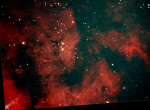
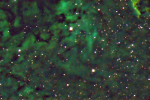
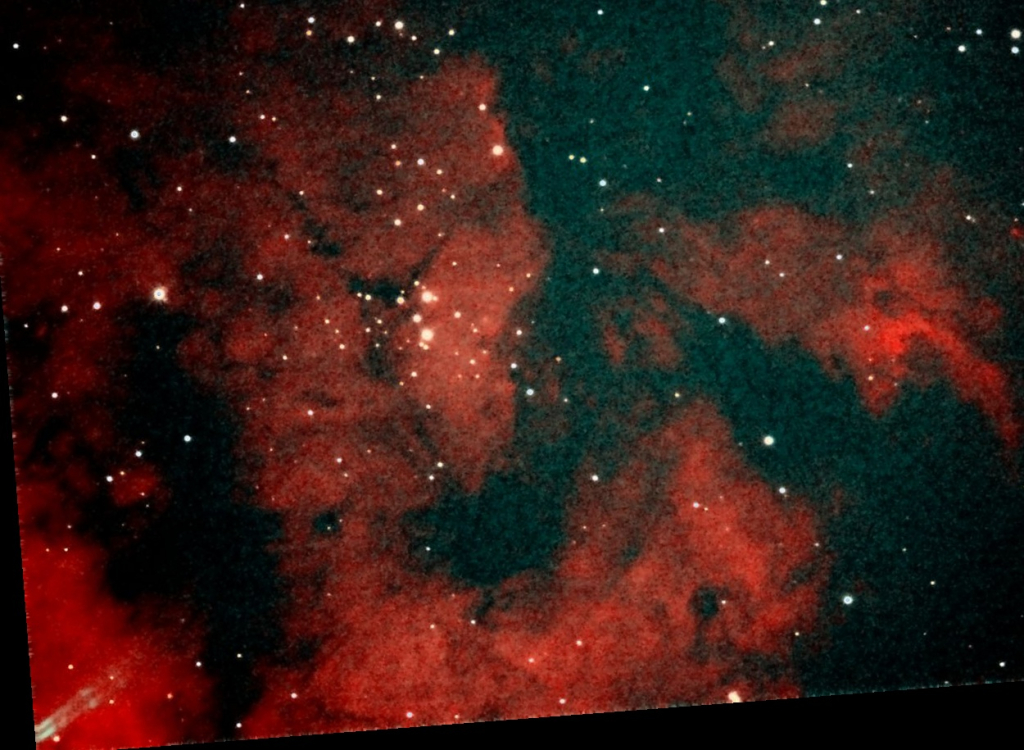 A section of the NGC 7822 nebula complex in Cepheus, 2,900 light-years away. The complex is popularly known as the Question Mark Nebula (or Cosmic Question Mark), after a question-mark shape that appears in wide-field images of the whole region; this image shows only a small part of it, about 0.54 x 0.40 degrees (roughly the width of the full Moon). Young, hot stars, including the bright cluster Berkeley 59 left of centre, are ionising the surrounding hydrogen gas and carving it into ridges, pillars and dark dust lanes. This natural-palette image maps hydrogen and sulphur emission to red and oxygen emission to teal, and the star colours come from broadband red, green and blue filters. An object (satellite?) trail crosses the lower-left corner; it has been left in as captured.
* * *
Imaged on 19 September 2026 (about 22:53 to 23:18 BST) with the John Cruickshank Telescope (GSO 16-inch Ritchey-Chretien) at the Anne H Cruickshank Observatory, University of Aberdeen (57.17 N, 2.10 W). Zeus 455M PRO camera, cooled to about -20 C, on a tracking equatorial mount (EQ8-R Pro). The field was centred on the catalogue position of NGC 7822 by plate-solving.
- Narrowband: Ha 5 x 90 s, OIII 5 x 90 s and SII 3 x 90 s, gain 300, 19.5 minutes in total.
- Star colours: 3 x 10 s each of Bessel R, G and B, gain 100.
- Field and scale: the image shown is 1250 x 915 pixels, about 0.54 x 0.40 degrees (33 x 24 arcminutes), at about 1.56 arcseconds per pixel. It was plate-solved and rotated so celestial north is up and east is left (standard orientation; the raw camera frame was tilted about 4.3 degrees off this) onto a padded canvas, so none of the original frame (including the object trail right at the bottom-left corner) was clipped by the rotation itself; the crop afterwards keeps nearly the full trail intact, right into the corner, trimming only as much of the padded black margin as needed elsewhere for a reasonable rectangular frame (a thin black sliver remains in the bottom-left and bottom-right corners outside the trail/nebula itself - genuinely outside the camera's original field, not cropped away by choice) - having already been cropped and reduced in size from the full-resolution frame (4788 x 3194 pixels, 0.64 x 0.43 degrees, about 0.48 arcseconds per pixel; that first crop removed the right-hand edge of the frame, about 13% of its width, and a thin border).
- Processing: frames aligned by sub-pixel phase correlation and averaged into a mean stack; natural palette maps Ha (with a little SII) to red and OIII to teal; star colours transferred from the Bessel R, G and B stacks to stars clearly above the noise (only the brighter stars show colour); moderate denoising; black point raised so the sky and dark lanes are near black; cropped, reduced in size, rotated to north-up and re-cropped, and saved as a JPEG for the web.
- Object (satellite?) trail: left in the image on purpose. The stacking does not reject outliers, so the trail from the frame(s) it crossed remains visible.
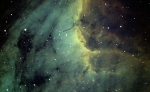
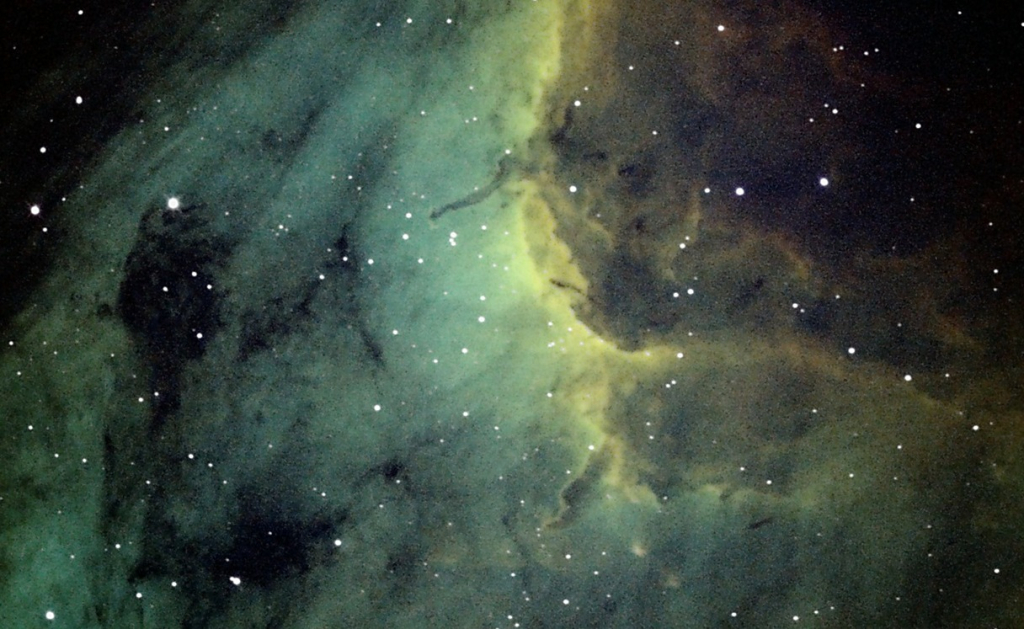 The Pelican Nebula (IC 5070) in Cygnus, 2,000 to 2,600 light-years away, in the "Hubble palette" -
hydrogen and sulphur emission mapped to the warm gold tones, oxygen emission to the teal/green, the
scheme popularised by Hubble Space Telescope images such as the Eagle Nebula's "Pillars of
Creation". The bright gold edge is the ionisation front, where ultraviolet light from young, hot
stars strips electrons from the surrounding hydrogen, and the dark pillars are denser gas being
eroded by that same radiation.
* * *
Imaged on 19 September 2026 with the John Cruickshank Telescope (GSO 16-inch Ritchey-Chretien) at
the Anne H Cruickshank Observatory, University of Aberdeen (57.17 N, 2.10 W). Zeus 455M PRO camera,
cooled to about -20 C, on a tracking equatorial (EQ8-R Pro). Same narrowband data as the natural-palette
version: Ha 5 x 90 s, OIII 5 x 90 s and SII 3 x 90 s, gain 300, 19.5 minutes in total.
- Channel mapping: SII to red, Ha to green, OIII to blue - the direct "Hubble palette" assignment,
rather than the natural-palette image's blend (Ha with a little SII to red, OIII to teal, star
colours from separate broadband R/G/B frames).
- Field and scale: 1216 x 747 pixels, about 0.59 x 0.37 degrees (35.7 x 21.9 arcminutes), at about
1.76 arcseconds per pixel. Built from the full-resolution composite (4788 x 3194 pixels), rotated
180 degrees to match the natural-palette version's orientation and plate-solved to true north-up
(see notes below), with a crop to remove a stacking artifact along two edges before reducing in
size for the web.
- Processing: light S-curve contrast increase, reduced in size, sharpened (an unsharp mask on
brightness only, with a threshold so background grain is boosted as little as possible) and saved
as a JPEG for the web. The source composite already had its own alignment, stacking and colour
balance from the original processing session, so this web build is a light touch compared with the
Dumbbell Nebula (M27) web images, which needed a fuller rebuild.
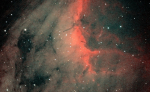
 The Pelican Nebula (IC 5070) in Cygnus, 2,000 to 2,600 light-years away. This cloud of glowing hydrogen sits next to the North America Nebula and is lit by young, hot stars that ionise the gas around them. The bright red edge is the ionisation front, where their ultraviolet light strips electrons from the hydrogen, and the dark pillars are denser gas being eroded by that radiation. This natural-palette image maps hydrogen and sulphur emission to red and oxygen emission to teal, and the star colours come from broadband red, green and blue filters.
* * *
Imaged on 19 September 2026 with the John Cruickshank Telescope (GSO 16-inch Ritchey-Chretien) at the Anne H Cruickshank Observatory, University of Aberdeen (57.17 N, 2.10 W). Zeus 455M PRO camera, cooled to about -20 C, on a tracking equatorial mount (EQ8-R Pro).
- Narrowband: Ha 5 x 90 s, OIII 5 x 90 s and SII 3 x 90 s, gain 300, 19.5 minutes in total.
- Star colours: 3 x 10 s each of Bessel R, G and B, gain 100.
- Field and scale: the image shown is 1216 x 747 pixels, about 0.59 x 0.37 degrees (35.7 x 21.9
arcminutes), at about 1.76 arcseconds per pixel. It is rotated 180 degrees from the full-resolution
image (4788 x 3194 pixels, about 0.48 arcseconds per pixel) and plate-solved to true north-up.
- Processing: frames aligned by sub-pixel phase correlation and averaged into a mean stack; natural palette maps Ha (with a little SII) to red and OIII to teal; star colours transferred from the Bessel R, G and B stacks to stars clearly above the noise; cropped to trim the stacking-edge artifact and match the SHO version's framing, reduced in size, rotated and saved as a JPEG for the web.
 The Dumbbell Nebula (M27, NGC 6853) in Vulpecula, 1,360 light-years away, in the "Hubble palette" -
the SII, Ha and OIII narrowband frames mapped to red, green and blue, the scheme popularised by
Hubble Space Telescope images of the Eagle Nebula's "Pillars of Creation". It is a planetary nebula:
the glowing shell of gas thrown off by a dying Sun-like star, whose hot, faint core (a white dwarf)
is all that remains of it. In this rendering the bright inner region is a pale lavender-white, the
shell a deep violet-blue, and the outer rim glows gold where the gas is most excited.
* * *
Imaged on 12 September 2026 (about 22:57 to 23:01 BST) with the John Cruickshank Telescope (GSO
16-inch Ritchey-Chretien) at the Anne H Cruickshank Observatory, University of Aberdeen (57.17 N,
2.10 W). Zeus 455M PRO camera, cooled to about -21 C, on a tracking equatorial mount (EQ8-R Pro). One 30 s
exposure each through the SII, Ha and OIII filters, gain 213 (the same raw frames as the
natural-palette version).
- Field and scale: 1188 x 822 pixels, about 0.25 x 0.17 degrees (15 x 10 arcminutes), at about 0.75
arcseconds per pixel. Reduced in size from the full 4788 x 3194 frame; then, 2026-10-10,
plate-solved against the full-resolution source and found tilted about 7.02 degrees off true
north, rotated onto a padded canvas so no original pixels were clipped, and re-cropped to remove
the resulting black edges.
- Processing: started from a combined SII/Ha/OIII image already aligned and colour-balanced by Siril
in the original processing session (see the editor notes below for the specific source file).
Cleaned up for
the web: a small boxy registration artifact around two stars (a dark rectangular halo, likely left
by a square-kernel operation in that session's processing chain) was removed by comparing each
pixel with a smooth local background estimate and pulling outliers back towards it, with the
original colour restored at every detected star core afterwards (see note below - the cleanup
step would otherwise have washed star colour towards white); the dark sky background had colour
faded to neutral, since it carried no real signal there and only showed as speckled noise; a light
multi-scale denoise on brightness only; contrast increased with an S-shaped curve; cropped,
reduced in size, then sharpened (an unsharp mask on brightness only, with a threshold so
background grain is boosted as little as possible); rotated to north-up and re-cropped; saved as
a JPEG for the web.
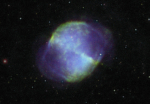
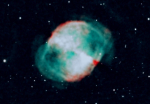
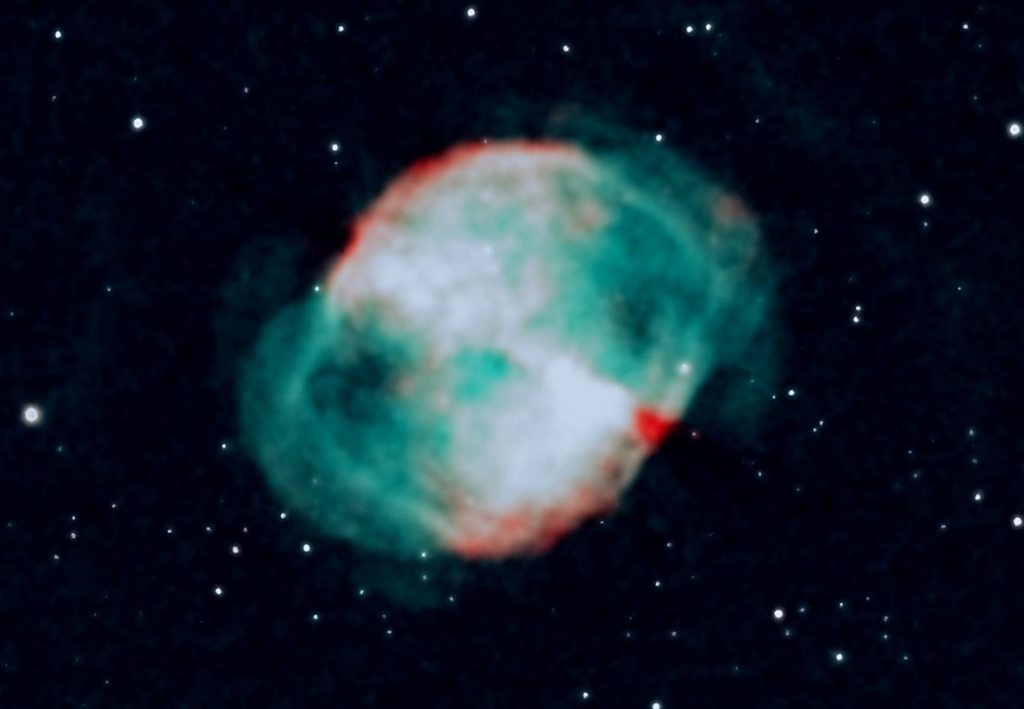 The Dumbbell Nebula (M27, NGC 6853) in Vulpecula, 1,360 light-years away. It is a planetary nebula: the glowing shell of gas thrown off by a dying Sun-like star, whose hot, faint core (a white dwarf) is all that remains of it. It was the first planetary nebula ever discovered, by Charles Messier in 1764, and the Sun will shed its own outer layers in the same way in about five billion years. In this natural-palette image the bright inner region appears white, the outer lobes teal, and the rim of the shell red, and the stars are shown white.
* * *
Imaged on 12 September 2026 (about 22:57 to 23:01 BST) with the John Cruickshank Telescope (GSO 16-inch Ritchey-Chretien) at the Anne H Cruickshank Observatory, University of Aberdeen (57.17 N, 2.10 W). Zeus 455M PRO camera, cooled to about -21 C, on a tracking equatorial mount (EQ8-R Pro).
- Narrowband: one 30 s exposure each through the SII, Ha and OIII filters, gain 213, 1.5 minutes in total. The nebula is bright enough that short exposures are enough.
- Field and scale: the image shown is 1188 x 822 pixels, about 0.25 x 0.17 degrees (15 x 10 arcminutes), at about 0.75 arcseconds per pixel (unchanged by the rotation below, which only re-crops the frame). It was cropped from the full frame (4788 x 3194 pixels, 0.64 x 0.43 degrees, about 0.48 arcseconds per pixel), keeping about 42% of its width and 47% of its height around the nebula, and reduced in size; then, 2026-10-10, plate-solved against the full-resolution data (see the editor notes below - the small web JPEG itself would not reliably plate-solve, too compressed/processed for reliable star matching) and found to be tilted about 7.02 degrees off true celestial north, so rotated onto a padded canvas (so no original pixels were clipped by the rotation itself) and re-cropped to remove the resulting black edges.
- Processing: the three frames were aligned by sub-pixel phase correlation and combined into a colour image, with the large-scale sky gradient removed; denoising that removes grain at three scales but keeps everything that stands out clearly from the noise (the arcs, the edges, the bright structure and the stars), so the sky and faint outer gas are smooth; stars shown white; contrast increased with an S-shaped curve; cropped, reduced in size, then sharpened (an unsharp mask on brightness only, with a threshold so the faint background grain is boosted as little as possible, and with the darkening side of the effect limited so stars do not get dark rings); rotated to north-up and re-cropped; saved as a JPEG for the web.
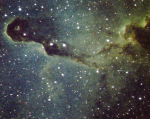
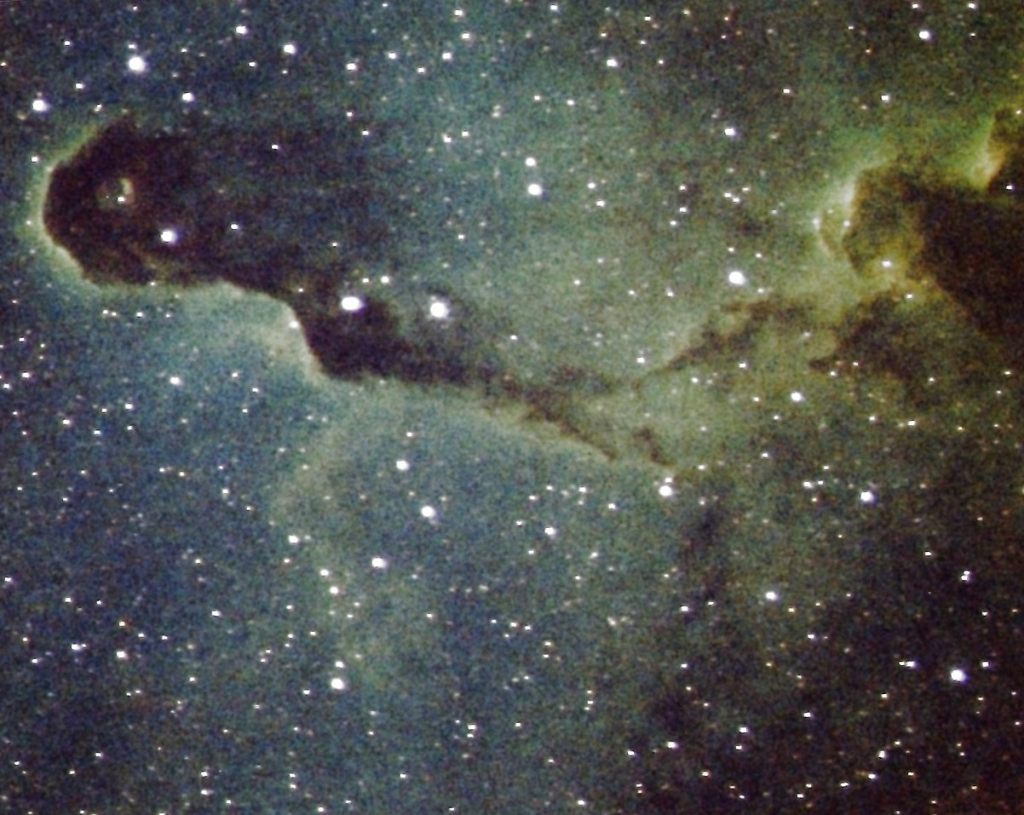 The Elephant's Trunk Nebula (IC 1396A) in Cepheus, 2,400 light-years away, in a narrowband palette.
It is a long, dense cloud of cold gas and dust, shaped like an elephant's head and trunk, that is
being eroded by the radiation and winds of hot, young stars in the surrounding region. Its dark body
soaks up the light behind it, while the ridge along its head and the edges of the cloud glow where
that radiation strikes them. New stars are forming inside dense clouds like this one. In this image
the glowing gas appears pale yellow-green along the edges of the trunk and in the bright cloud on the
right, against a dark teal background, and the stars are shown white.
* * *
Imaged on 18 September 2026 (about 21:25 to 21:27 BST) with the John Cruickshank Telescope (GSO
16-inch Ritchey-Chretien) at the Anne H Cruickshank Observatory, University of Aberdeen (57.17 N,
2.10 W). Zeus 455M PRO camera, cooled to about -20 C, on a tracking equatorial mount (EQ8-R Pro).
- Narrowband: one 90 s exposure each through the SII, Ha and OIII filters, gain 300, 4.5 minutes in
total - the three filtered exposures are combined directly into this colour image (there is no
separate broadband red/green/blue capture in this set).
- Field and scale: the image shown is 1202 x 957 pixels, about 0.47 x 0.37 degrees (28 x 22
arcminutes), at about 1.4 arcseconds per pixel (unchanged by the rotation below). It was cropped
from the full frame (4788 x 3194 pixels, 0.64 x 0.43 degrees, about 0.48 arcseconds per pixel),
keeping about 80% of its width (from 19% to 100% across) and nearly the full height, and reduced in
size; then, 2026-10-12, plate-solved (ASTAP, matching the field against the star catalogue) and
found tilted about 4.9 degrees off true celestial north, so rotated onto a padded canvas (so no
original pixels were clipped by the rotation itself) and re-cropped to the largest centred
rectangle clear of the resulting black edges, down from 1280 x 1056 to 1202 x 957. Re-solved
afterward to confirm the fix: residual twist under 0.1 degrees, same sky position as before, no
left-right or up-down flip.
- Processing: the three frames were aligned by sub-pixel phase correlation and combined into a
colour image; denoising; stars shown white; contrast increased with an S-shaped curve (mid-tones
and highlights brighter, faint sky darker); cropped, reduced in size, then sharpened (an unsharp
mask on brightness only, with a threshold so the faint background grain is boosted as little as
possible) and saved as a JPEG for the web; rotated to north-up and re-cropped as described above.
- **A note on colour:** this is one of the observatory's earlier narrowband data sets, from before an
exposure-method fix later in September 2026. A check found the SII and OIII frames almost
identical to one another, which two genuinely different gas lines should not be - so at least one
is probably mislabelled. The colours shown are real data, just not reliably matched to the right
gas, so this caption describes the colours seen rather than naming which gas is which.
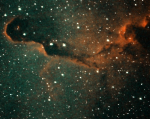
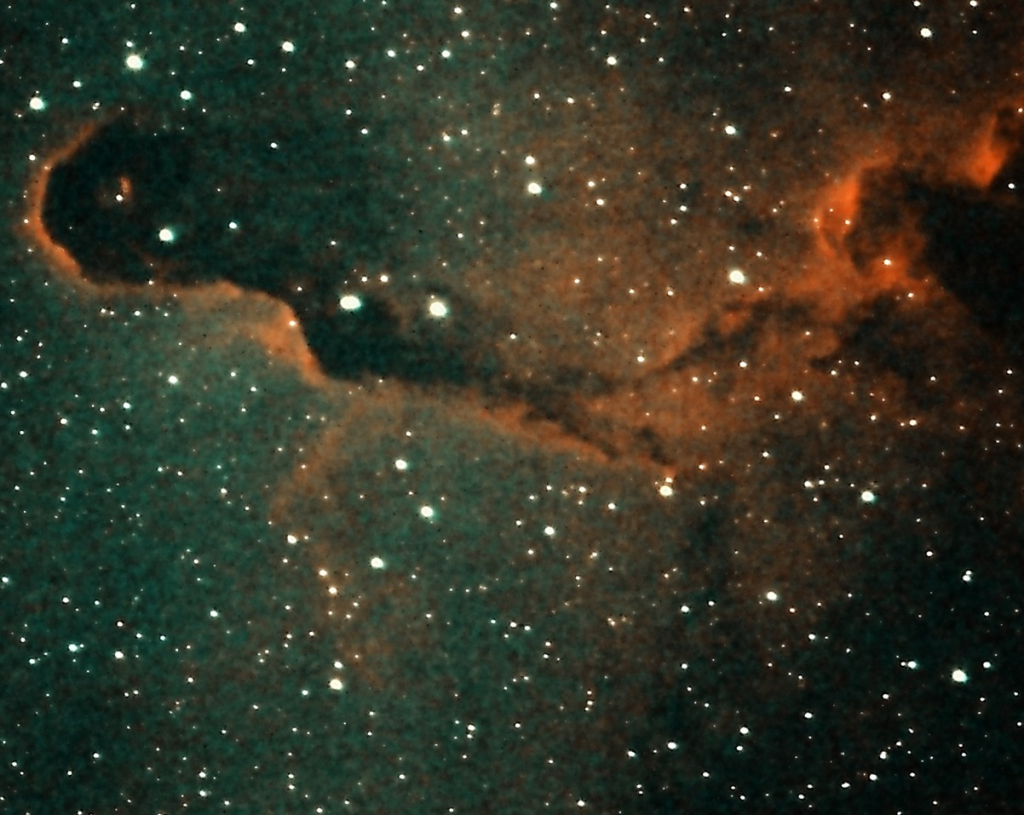 The Elephant's Trunk Nebula (IC 1396A) in Cepheus, 2,400 light-years away, in a natural-looking
palette. It is a long, dense cloud of cold gas and dust, shaped like an elephant's head and trunk,
that is being eroded by the radiation and winds of hot, young stars in the surrounding region. Its
dark body soaks up the light behind it, while the ridge along its head and the edges of the cloud
glow where that radiation strikes them. New stars are forming inside dense clouds like this one. In
this image the glowing gas appears orange-brown along the edges of the trunk and in the bright cloud
on the right, against a teal haze, and the stars are shown white.
* * *
Imaged on 18 September 2026 (about 21:25 to 21:27 BST) with the John Cruickshank Telescope (GSO
16-inch Ritchey-Chretien) at the Anne H Cruickshank Observatory, University of Aberdeen (57.17 N,
2.10 W). Zeus 455M PRO camera, cooled to about -20 C, on a tracking equatorial mount (EQ8-R Pro).
- Narrowband: one 90 s exposure each through the SII, Ha and OIII filters, gain 300, 4.5 minutes in
total - the same three exposures used for the narrowband-palette version, re-combined and
recoloured towards a more natural-looking palette rather than true broadband red/green/blue colour
(there is no separate broadband capture in this set).
- Field and scale: the image shown is 1202 x 957 pixels, about 0.47 x 0.37 degrees (28 x 22
arcminutes), at about 1.4 arcseconds per pixel (unchanged by the rotation below) - the same field
as the narrowband-palette version. It was cropped from the full frame (4788 x 3194 pixels, 0.64 x
0.43 degrees, about 0.48 arcseconds per pixel), keeping about 80% of its width (from 19% to 100%
across) and nearly the full height, and reduced in size; then, 2026-10-12, plate-solved (ASTAP,
matching the field against the star catalogue) and found tilted about 4.9 degrees off true
celestial north, so rotated onto a padded canvas (so no original pixels were clipped by the
rotation itself) and re-cropped to the largest centred rectangle clear of the resulting black
edges, down from 1280 x 1056 to 1202 x 957. Re-solved afterward to confirm the fix: residual twist
under 0.1 degrees, same sky position as before, no left-right or up-down flip.
- Processing: the three narrowband frames were combined and recoloured towards red; contrast
increased; cropped, reduced in size, and the red tones were shifted towards orange-brown (30% of
the red excess mixed into the green channel - a colour choice, it does not change where the glow
is); then sharpened (an unsharp mask on brightness only, with a threshold so the faint background
grain is boosted as little as possible) and saved as a JPEG for the web; rotated to north-up and
re-cropped as described above.
- **A note on colour:** this uses the same underlying SII/Ha/OIII exposures as the narrowband-palette
version, from before an exposure-method fix later in September 2026. A check found the SII and
OIII frames almost identical to one another, which two genuinely different gas lines should not
be - so at least one is probably mislabelled. The orange-brown shown is a deliberate colour choice
made to look natural, not a reliable map of which gas glows where.
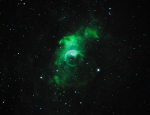
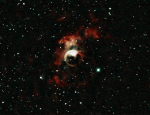
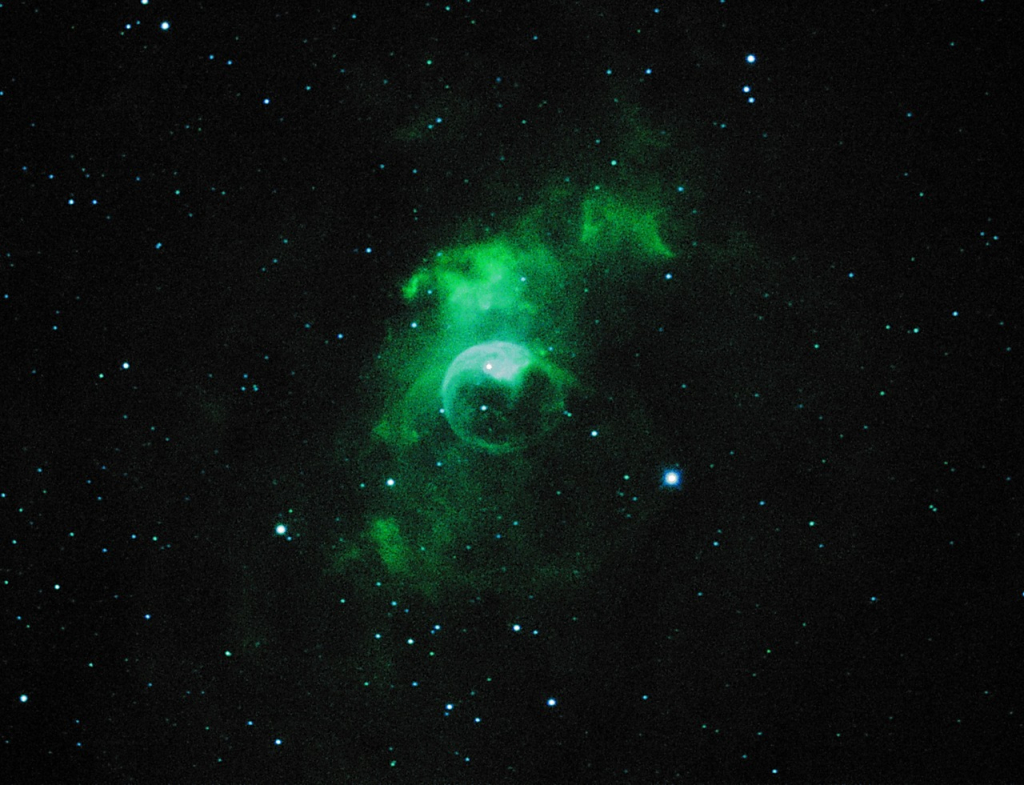 The Bubble Nebula (NGC 7635) in Cassiopeia, 7,100 light-years away. A single, very hot and massive
young star, seen inside the bubble, is blowing a powerful wind of particles into the cloud of gas
around it. That wind and the star's intense ultraviolet light have inflated a glowing shell of gas
several light-years across, which is brightest where it pushes against the surrounding cloud. This image uses the Hubble palette (SHO).
* * *
Imaged on 18 September 2026 (about 00:14 to 00:18 BST) with the John Cruickshank Telescope (GSO
16-inch Ritchey-Chretien) at the Anne H Cruickshank Observatory, University of Aberdeen (57.17 N,
2.10 W). Zeus 455M PRO camera, cooled to about -21 C, on a tracking equatorial mount (EQ8-R Pro). One 90 s
exposure each through the SII, Ha and OIII filters, gain 300, 4.5 minutes in total.
- Field and scale: 1280 x 981 pixels (74% of the full
frame's width, from 16% to 90% across, and the bottom 85% of its height), reduced in size to match.
- Processing: the dark sky background had colour faded to neutral (it carried no real colour signal,
only speckled noise); contrast increased with an S-shaped curve; cropped, reduced in size, then
sharpened (an unsharp mask on brightness only, with a threshold so background grain is boosted as
little as possible) and saved as a JPEG for the web.
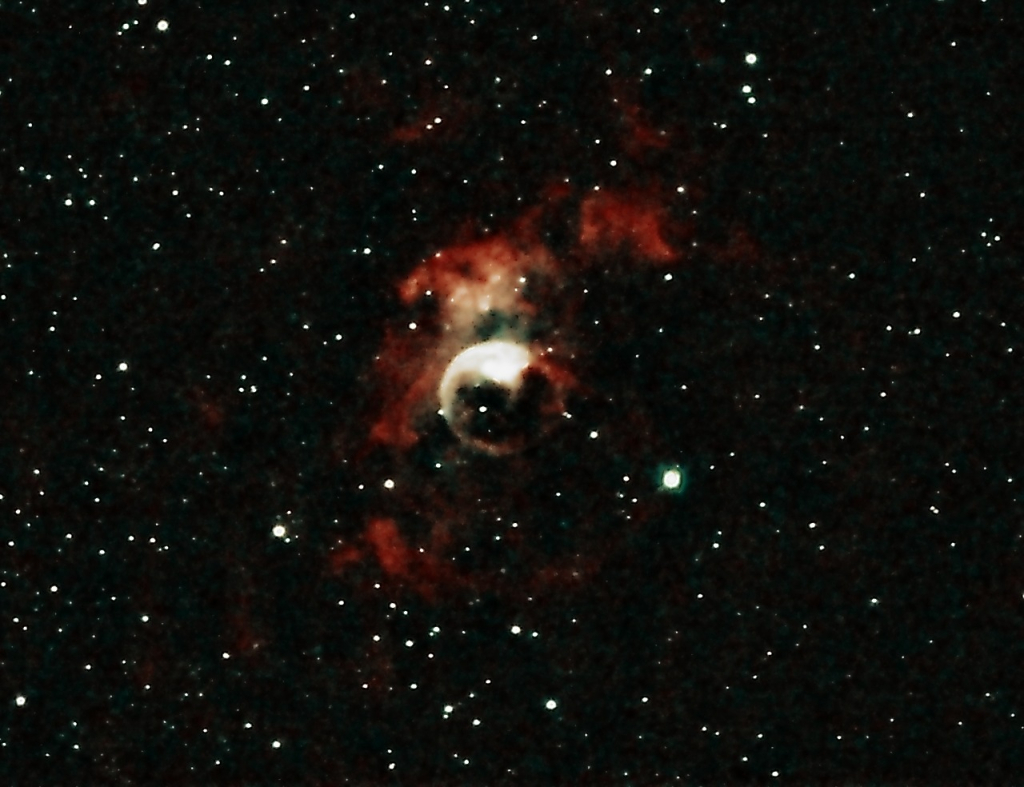 The Bubble Nebula (NGC 7635) in Cassiopeia, 7,100 light-years away. A single, very hot and massive young star, seen inside the bubble, is blowing a powerful wind of particles into the cloud of gas around it. That wind and the star's intense ultraviolet light have inflated a glowing shell of gas several light-years across, which is brightest where it pushes against the surrounding cloud. Red filaments of glowing gas and dark patches of dust surround the bubble. This natural-palette image shows the bubble in cream-white and the surrounding gas in a muted red, and the stars are shown white.
* * *
Imaged on 18 September 2026 (about 00:14 to 00:18 BST) with the John Cruickshank Telescope (GSO 16-inch Ritchey-Chretien) at the Anne H Cruickshank Observatory, University of Aberdeen (57.17 N, 2.10 W). Zeus 455M PRO camera, cooled to about -21 C, on a tracking equatorial mount (EQ8-R Pro).
- Narrowband: one 90 s exposure each through the SII, Ha and OIII filters, gain 300, 4.5 minutes in total.
- Field and scale: the image shown is 1280 x 984 pixels, about 0.47 x 0.36 degrees (28 x 22 arcminutes), at about 1.3 arcseconds per pixel. It was cropped from the full frame (4788 x 3194 pixels, 0.64 x 0.43 degrees, about 0.48 arcseconds per pixel), keeping about 74% of its width (from 16% to 90% across) and the bottom 85% of its height, and reduced in size.
- Processing: the three frames were aligned by sub-pixel phase correlation and combined into a colour image, with the large-scale sky gradient removed; denoising; stars shown white; contrast increased with an S-shaped curve (mid-tones and highlights brighter, faint sky darker); the teal glow that the OIII frame leaves around the brightest stars was removed; the red was toned down by taking 45% off the amount by which red exceeds green and blue (white and grey are untouched); cropped, reduced in size, then sharpened (an unsharp mask on brightness only, with a threshold so the faint background grain is boosted as little as possible) and saved as a JPEG for the web.
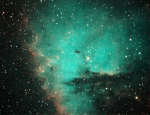
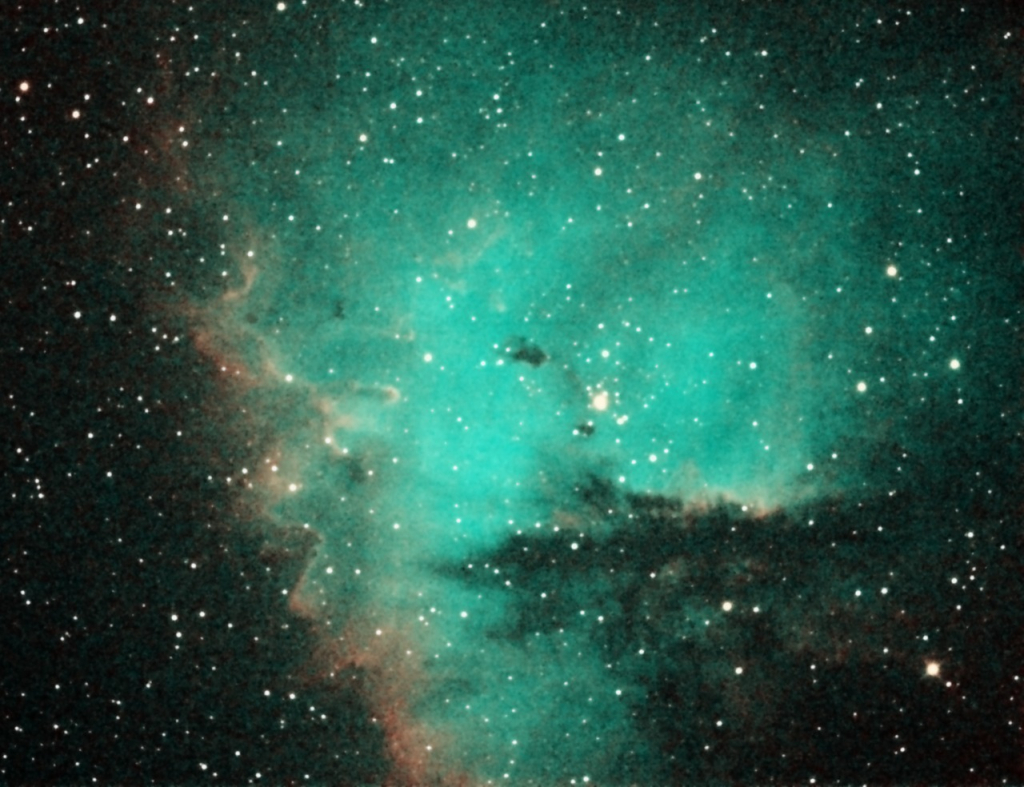 The Pacman Nebula (NGC 281) in Cassiopeia, 9,200 light-years away. It is a huge cloud of glowing gas being lit and shaped by a small cluster of very young, hot stars (the cluster IC 1590) near its centre. Their ultraviolet light makes the gas glow, and their winds and radiation are carving it into ridges and pillars. Dark lanes of dust cut in from the lower right, giving the nebula its "mouth" and its Pac-Man look. The gas glows teal in this natural-palette image, with a warmer red-brown edge on the left where the cloud is densest.
* * *
Imaged on 18 September 2026 (about 01:55 to 02:00 BST) with the John Cruickshank Telescope (GSO 16-inch Ritchey-Chretien) at the Anne H Cruickshank Observatory, University of Aberdeen (57.17 N, 2.10 W). Zeus 455M PRO camera, cooled to about -22 C, on a tracking equatorial mount (EQ8-R Pro).
- Narrowband: one 90 s exposure each through the SII, Ha and OIII filters, gain 300, 4.5 minutes in total.
- Field and scale: the image shown is 1280 x 984 pixels, about 0.53 x 0.41 degrees (32 x 25 arcminutes), at about 1.5 arcseconds per pixel. It was cropped from the full frame (4788 x 3194 pixels, 0.64 x 0.43 degrees, about 0.48 arcseconds per pixel), removing the left-hand 16% and a thin strip at the top, and reduced in size.
- Processing: the three frames were aligned by sub-pixel phase correlation and combined into a colour image; moderate denoising; stars shown white; contrast increased with a gentle S-shaped curve (mid-tones and highlights brighter, faint sky slightly darker); cropped, reduced in size and saved as a JPEG for the web.
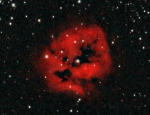
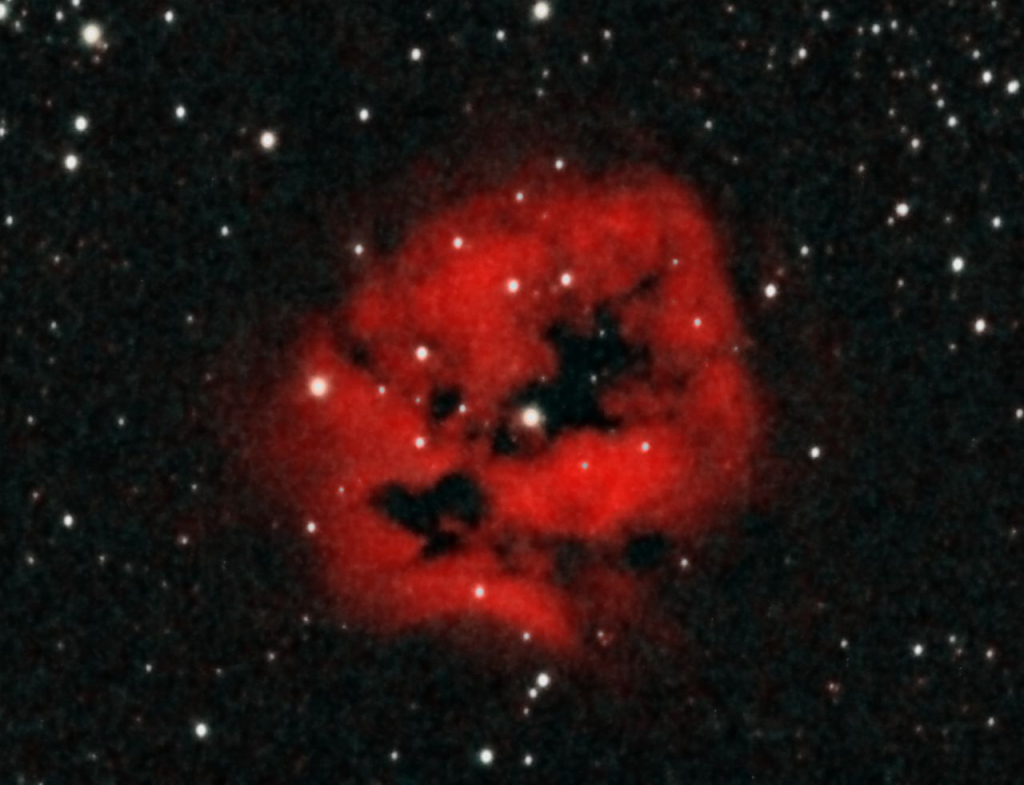 The Cocoon Nebula (IC 5146) in Cygnus, over 2,500 light-years away. It is a cloud of hydrogen gas lit from within by a young, hot star at its centre, whose ultraviolet light makes the gas glow red. The dark, ragged patches are dense dust lanes in front of the glow, and the nebula sits at the end of a long dark dust lane, Barnard 168, that stretches away beyond this frame. Stars form in clouds like this one. This natural-palette image shows hydrogen and sulphur emission as red and oxygen emission as teal, and the stars are shown white. The Cocoon is almost all hydrogen, so it looks nearly all red.
* * *
Imaged on 19 September 2026 (about 22:00 to 22:23 BST) with the John Cruickshank Telescope (GSO 16-inch Ritchey-Chretien) at the Anne H Cruickshank Observatory, University of Aberdeen (57.17 N, 2.10 W). Zeus 455M PRO camera, cooled to about -20 C, on a tracking equatorial mount (EQ8-R Pro).
- Narrowband: Ha 5 x 90 s, OIII 5 x 90 s and SII 3 x 90 s, gain 300, 19.5 minutes in total.
- Star colours: 3 x 10 s each of Bessel R, G and B, gain 100, were also taken, but this version shows the stars white, so they are not used here.
- Field and scale: the image shown is 1280 x 981 pixels, about 0.31 x 0.24 degrees (19 x 14 arcminutes), at about 0.88 arcseconds per pixel. It was cropped, rotated by 90 degrees and reduced in size from the full-resolution frame (4788 x 3194 pixels, 0.64 x 0.43 degrees, about 0.48 arcseconds per pixel). The crop is the right-hand part of the frame, where the nebula sits.
- Processing: frames aligned by sub-pixel phase correlation and averaged into a mean stack; natural palette maps Ha (with a little SII) to red and OIII to teal; stars shown white; denoised so that the noise in the faint gas does not show; cropped, rotated, reduced in size and saved as a JPEG for the web.
 The Northern Lagoon Nebula (NGC 7538) in Cepheus, 9,100 light-years away. It is a large cloud of glowing gas where new stars are being born. The brightest region at its heart is lit by hot, young stars, whose ultraviolet light makes the surrounding gas shine, while dense clumps deeper in the cloud are still collapsing to form more stars, some of them very massive. In this natural-palette image the bright core appears cream-white, fading to red at its edges, and the stars are shown white.
* * *
Imaged on 18 September 2026 (about 03:05 to 03:08 BST) with the John Cruickshank Telescope (GSO 16-inch Ritchey-Chretien) at the Anne H Cruickshank Observatory, University of Aberdeen (57.17 N, 2.10 W). Zeus 455M PRO camera, cooled to about -21 C, on a tracking equatorial mount (EQ8-R Pro).
- Narrowband: one 90 s exposure each through the SII, Ha and OIII filters, gain 300, 4.5 minutes in total.
- Field and scale: the image shown is 1280 x 985 pixels, about 0.36 x 0.28 degrees (22 x 17 arcminutes), at about 1.0 arcseconds per pixel. It was cropped from the full frame (4788 x 3194 pixels, 0.64 x 0.43 degrees, about 0.48 arcseconds per pixel), keeping about 57% of its width and 65% of its height around the nebula, and reduced in size.
- Processing: the three frames were aligned by sub-pixel phase correlation and combined into a colour image; denoising; stars shown white; the sky darkened; contrast increased with an S-shaped curve (mid-tones and highlights brighter, faint sky darker); cropped, reduced in size, then sharpened (a fairly strong unsharp mask on brightness only, with a threshold so the faint background grain is boosted as little as possible, and with the darkening side of the effect limited so faint stars in the bright gas do not get dark rings) and saved as a JPEG for the web.
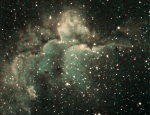
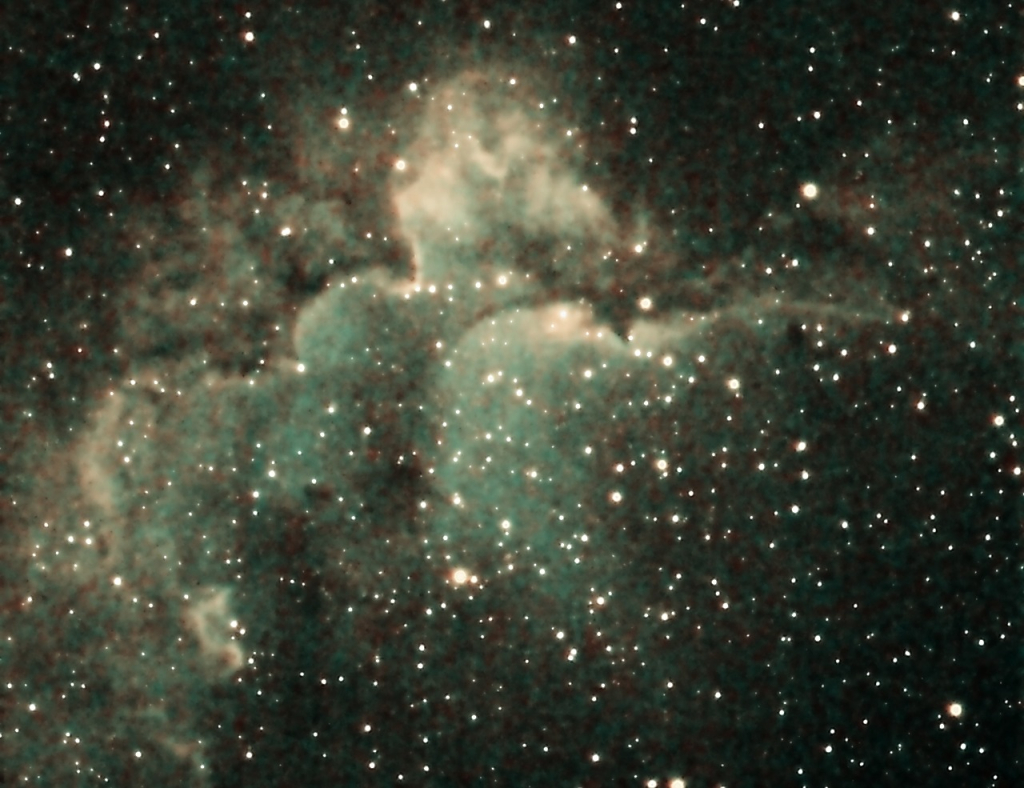 The Wizard Nebula (NGC 7380) in Cepheus, 7,200 light-years away. It is a cloud of gas lit by a cluster of young, hot stars at its heart. Their ultraviolet light makes the gas glow, and their winds and radiation are sculpting it into the ridges, cavities and dark lanes seen here. The gas appears in soft teal and cream tones in this natural-palette image, and the stars are shown white.
* * *
Imaged on 18 September 2026 (about 02:49 to 02:53 BST) with the John Cruickshank Telescope (GSO 16-inch Ritchey-Chretien) at the Anne H Cruickshank Observatory, University of Aberdeen (57.17 N, 2.10 W). Zeus 455M PRO camera, cooled to about -22 C, on a tracking equatorial mount (EQ8-R Pro).
- Narrowband: one 90 s exposure each through the SII, Ha and OIII filters, gain 300, 4.5 minutes in total.
- Field and scale: the image shown is 1280 x 985 pixels, about 0.43 x 0.33 degrees (25 x 20 arcminutes), at about 1.2 arcseconds per pixel. It was cropped from the full frame (4788 x 3194 pixels, 0.64 x 0.43 degrees, about 0.48 arcseconds per pixel), keeping a strip 51% of its width (from about 15% to 67% across) and the full height, turned 90 degrees anticlockwise, and reduced in size.
- Processing: the three frames were aligned by sub-pixel phase correlation and combined into a colour image; denoising; stars shown white; contrast increased with an S-shaped curve (mid-tones and highlights brighter, faint sky darker); cropped, rotated, reduced in size, then sharpened (an unsharp mask on brightness only, with a threshold so the faint background grain is boosted as little as possible) and saved as a JPEG for the web.
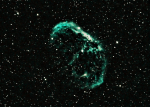
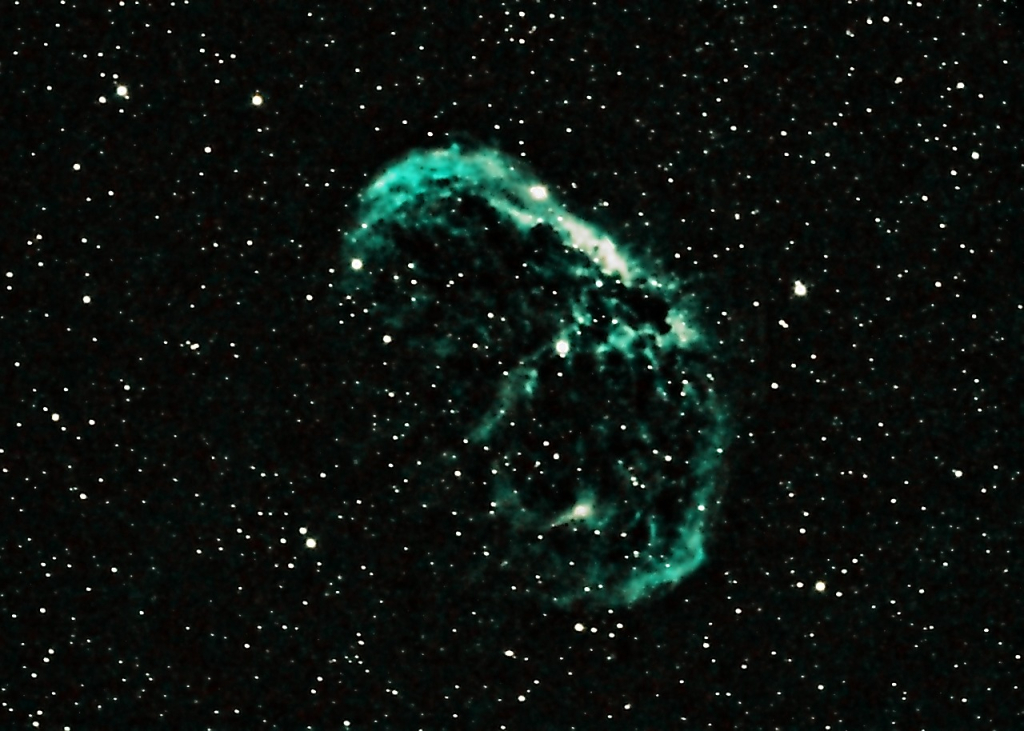 The Crescent Nebula (NGC 6888) in Cygnus, 5,000 light-years away. It is a shell of gas blown into space by a massive, ageing star near its centre, a Wolf-Rayet star. The star is shedding its outer layers in a fierce wind that ploughs into slower gas it threw off earlier, heating it until it glows and piling it up into the thin, curling sheets and filaments seen here. Stars like this one live only a few million years and end in a supernova. The glowing gas appears teal in this natural-palette image, and the stars are shown white.
Imaged on 17 September 2026 (about 22:44 to 22:46 BST) with the John Cruickshank Telescope (GSO 16-inch Ritchey-Chretien) at the Anne H Cruickshank Observatory, University of Aberdeen (57.17 N, 2.10 W). Zeus 455M PRO camera, cooled to about -21 C, on a tracking equatorial mount (EQ8-R Pro).
- Narrowband: one 90 s exposure each through the SII, Ha and OIII filters, gain 300, 4.5 minutes in total.
- Field and scale: the image shown is 1280 x 914 pixels, about 0.60 x 0.43 degrees (36 x 26 arcminutes), at about 1.7 arcseconds per pixel. It was cropped from the full frame (4788 x 3194 pixels, 0.64 x 0.43 degrees, about 0.48 arcseconds per pixel), keeping the right-hand 93% of its width and the full height, and reduced in size.
- Processing: the three frames were aligned by sub-pixel phase correlation and combined into a colour image, with the large-scale sky gradient removed; denoising; stars shown white; contrast increased with an S-shaped curve (mid-tones and highlights brighter, faint sky darker); cropped, reduced in size, then sharpened (an unsharp mask on brightness only, with a threshold so the faint background grain is boosted as little as possible) and saved as a JPEG for the web.
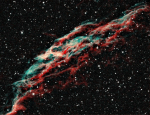
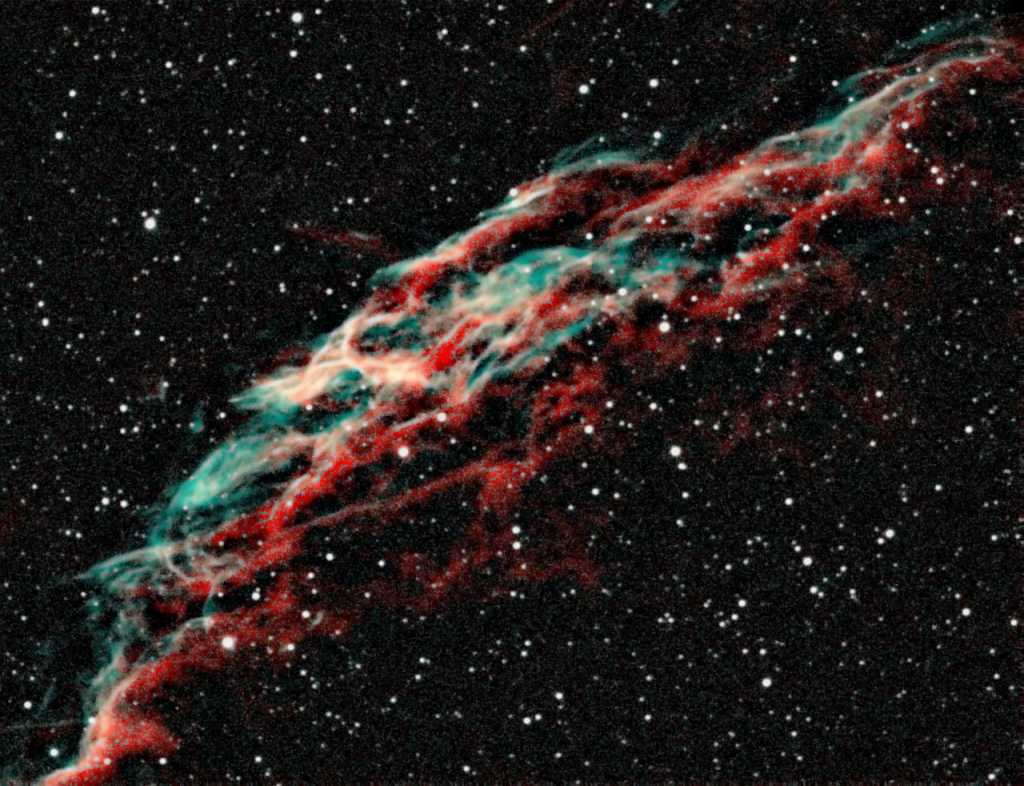 The Eastern Veil Nebula (NGC 6992) in Cygnus, 1,470 to 2,400 light-years away. It is a small section of the Cygnus Loop, the expanding debris of a massive star that exploded as a supernova thousands of years ago. The blast wave is still ploughing through the thin gas around it, heating and compressing it into the long, glowing, tangled filaments seen here, which are sheets of gas viewed edge-on. This natural-palette image shows hydrogen and sulphur emission as red and oxygen emission as teal, and the stars are shown white.
* * *
Imaged on 18 September 2026 with the John Cruickshank Telescope (GSO 16-inch Ritchey-Chretien) at the Anne H Cruickshank Observatory, University of Aberdeen (57.17 N, 2.10 W). Zeus 455M PRO camera, cooled to about -20 C, on a tracking equatorial mount (EQ8-R Pro).
- Natural palette: SII 5 x 90 s, Ha 5 x 90 s and OIII 5 x 90 s, gain 300, 22.5 minutes in total, taken between about 22:47 and 23:41 BST.
- SHO palette: one 90 s exposure each through the SII, Ha and OIII filters, gain 300, 4.5 minutes in total, taken about 23:36 to 23:41 BST (these are also the last of the five frames per filter in the natural image).
- Field and scale: both images are about 0.55 x 0.42 degrees (33 x 25 arcminutes) at about 1.55 arcseconds per pixel: 1280 x 982 pixels (natural) and 1280 x 988 pixels (SHO). They were cropped from the full frame (4788 x 3194 pixels, 0.64 x 0.43 degrees, about 0.48 arcseconds per pixel), keeping the right-hand 87% of its width and the full height, and reduced in size. The frame is centred on NGC 6992 (checked by plate solving) and is turned about 5 degrees from north-up.
- Processing (natural): frames aligned by sub-pixel phase correlation and averaged into a mean stack per filter; natural palette maps Ha (with a little SII) to red and OIII to teal; sky made neutral and denoised; stars shown white.
- Processing (SHO): the three frames were aligned (by matching stars) and combined into a colour image, with the sky background evened out and the colours balanced.
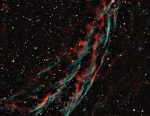
 The Western Veil Nebula (NGC 6960, the "Witch's Broom") in Cygnus, 2,100 to 2,400 light-years away. It is a small section of the Cygnus Loop, the expanding debris of a massive star that exploded as a supernova thousands of years ago. The blast wave is still ploughing through the thin gas around it, heating and compressing it into the long, glowing, delicate filaments seen here, which are sheets of gas viewed edge-on. This natural-palette image shows hydrogen and sulphur emission as red and oxygen emission as teal, and the stars are shown white.
* * *
Imaged on 18 September 2026 (about 22:28 to 22:33 BST) with the John Cruickshank Telescope (GSO 16-inch Ritchey-Chretien) at the Anne H Cruickshank Observatory, University of Aberdeen (57.17 N, 2.10 W). Zeus 455M PRO camera, cooled to about -20 C, on a tracking equatorial mount (EQ8-R Pro).
- Exposures: one 90 s exposure each through the SII, Ha and OIII filters, gain 300, 4.5 minutes in total, for the natural image; the SHO image, saved at 22:35 shortly after they were taken, is understood to use the same three frames.
- Field and scale: both images are about 0.55 x 0.42 degrees (33 x 25 arcminutes) at about 1.55 arcseconds per pixel: 1280 x 994 pixels (natural) and 1280 x 977 pixels (SHO). They were cropped from the full frame (4788 x 3194 pixels, 0.64 x 0.43 degrees, about 0.48 arcseconds per pixel), keeping the left-hand 86% of its width and the full height, and reduced in size. The frame is centred at 20h 46.2m +30 deg 26' (checked by plate solving) and is turned about 5 degrees from north-up.
- Processing (natural): frames aligned by sub-pixel phase correlation; natural palette maps Ha (with a little SII) to red and OIII to teal; sky made neutral and denoised; stars shown white.
- Processing (SHO): the three frames were aligned and combined into a colour image with the sky background evened out and the colours balanced.
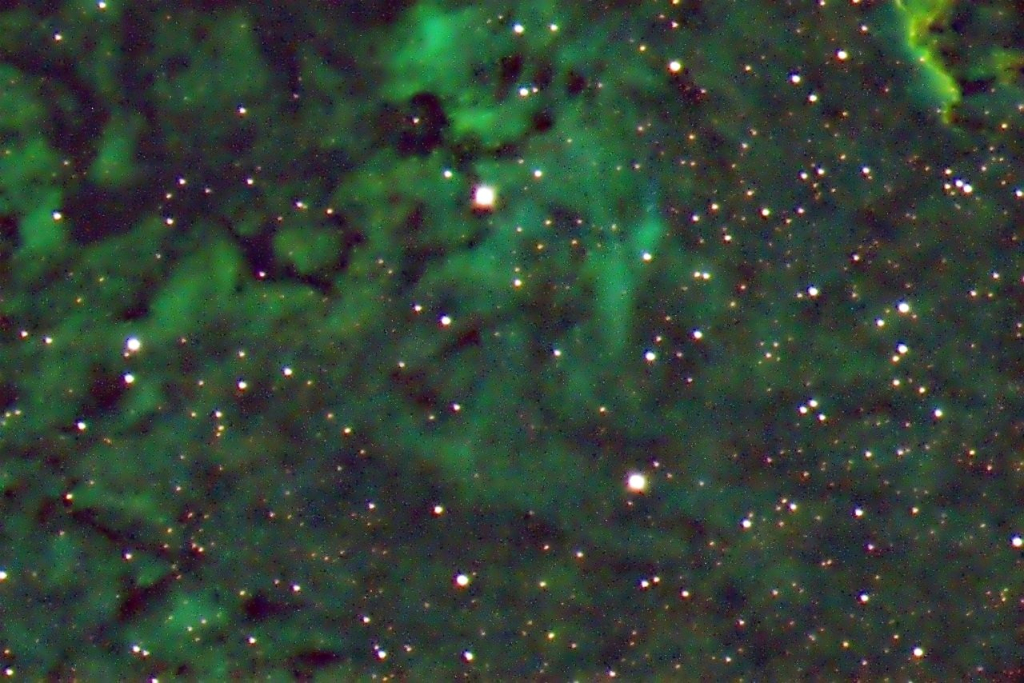 The Cygnus Wall, the brightest stretch of the North America Nebula (NGC 7000) in Cygnus, 2,600 light-years away. The nebula is a vast cloud of glowing hydrogen gas, and this "wall" marks the edge where the gas is densest and most intensely lit by young, hot stars nearby. Their ultraviolet light makes the gas shine and is slowly carving the cloud into the ridges, filaments and dark, dusty lanes seen here, in a region where new stars are still forming. This is a Hubble-palette (SHO) image, in which sulphur, hydrogen and oxygen emission are each given a colour of their own; here the hydrogen glows green.
* * *
Imaged on the night of 18 to 19 September 2026 (about 23:58 to 00:03 BST) with the John Cruickshank Telescope (GSO 16-inch Ritchey-Chretien) at the Anne H Cruickshank Observatory, University of Aberdeen (57.17 N, 2.10 W). Zeus 455M PRO camera, cooled to about -19 C, on a tracking equatorial mount (EQ8-R Pro).
- Narrowband: one 90 s exposure each through the OIII (23:58), Ha (00:00) and SII (00:01) filters, gain 300, 4.5 minutes in total.
- Field and scale: the image shown is 1280 x 854 pixels, the whole frame, about 0.64 x 0.43 degrees (38 x 26 arcminutes), at about 1.8 arcseconds per pixel (the full-resolution frame is 4788 x 3194 pixels, about 0.48 arcseconds per pixel). The frame is not cropped.
- Processing: the three frames were aligned and combined into a Hubble-palette colour image, with the sky background evened out and the colours balanced; reduced in size to 1280 pixels wide and saved as a JPEG for the web. On 20 September the JPEG was brightened (a brightness curve that lifts the faint gas and dark lanes, with a slight rise in colour strength), its faint colour speckle in the darker areas was smoothed, and light noise reduction was applied to the brightness (only detail that stands out clearly from the grain is kept, so stars and the outlines of the gas remain), and that surviving detail was then strengthened to sharpen the picture (bright edges fully, dark ones only a little), so the sharpening does not amplify the grain.
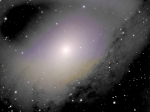
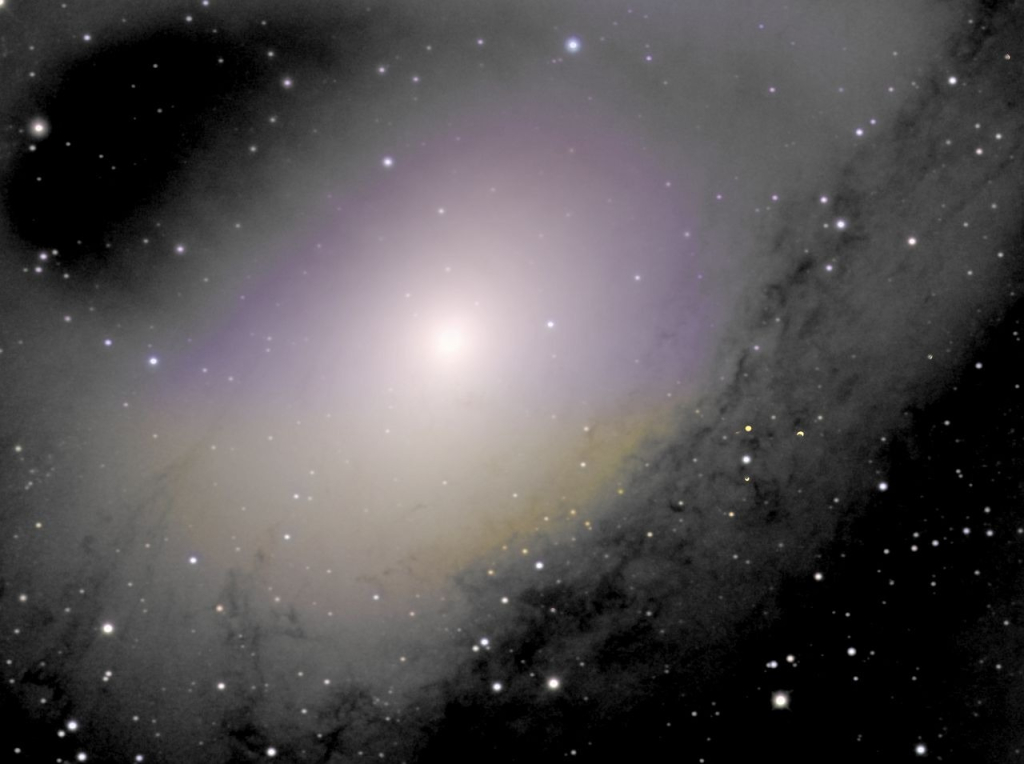 The bright central bulge of the Andromeda Galaxy (M31), our nearest large neighbouring galaxy, about 2.5 million light-years away. This is a close-up of just the core, not the whole galaxy - M31 itself spans about three degrees on the sky, roughly six times the width of the full Moon, far more than this telescope's single frame can cover due to its high 800x magnification. Dust lanes from the galaxy's spiral disc cross in front of the glowing bulge, and the purple-and-yellow colouring across it is the result of colour dispersion in Earth's atmosphere at the time of observation.
* * *
Imaged overnight on 21-22 September 2026 (about 23:39 BST to 03:19 BST, alternating with the nearby companion galaxy M32) with the John Cruickshank Telescope (GSO 16-inch Ritchey-Chretien) at the Anne H Cruickshank Observatory, University of Aberdeen (57.17 N, 2.10 W), on a tracking equatorial mount (EQ8-R Pro), by ACO AI autonomous and remote control. Zeus 455M PRO camera, cooled to about -20 C.
- LRGB composite: 12 luminance (no filter), 6 Bessel R, 6 Bessel G and 6 Bessel B frames, each a 45 s exposure at gain 100, 2x2 binned (22.5 minutes of total exposure across the four channels). Taken across several short imaging rounds through the night, re-centring and refocusing periodically; frames affected by passing cloud were rejected before stacking.
- Field and scale: the image shown is 1280 x 955 pixels, about 0.17 x 0.13 degrees, at about 0.48 arcseconds per pixel.
- Orientation: plate-solved directly from a frame in the stack (ASTAP), which found the frame already close to north-up (within about a degree) but with east to the right - a mirror image of the real sky. This image has been flipped left-right to give the standard north-up, east-left orientation shown here.
- Processing: bias, dark and twilight-sky flat calibration; frames aligned by star cross-correlation and combined with an outlier-rejecting (sigma-clipped) stack; R/G/B additionally re-registered to L in a window around the nucleus to correct a small (1-2 pixel) misalignment found there; sky background removed with a low-order surface fit; colour balanced against the frame's own stars; combined into an LRGB image with a softened, reduced-saturation colour blend near the core and given an asinh (arcsinh) stretch.
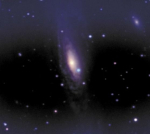
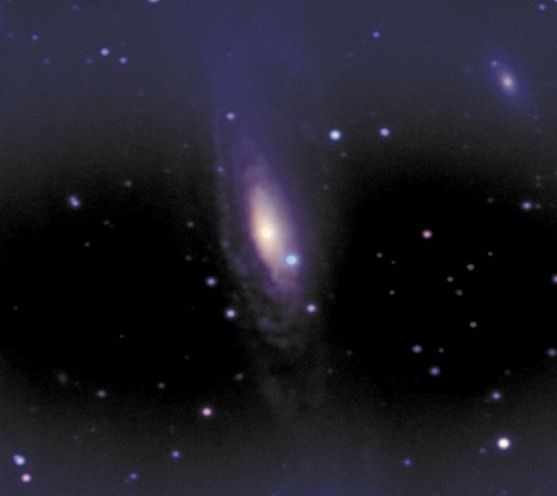 The spiral galaxy NGC 7331 in the constellation Pegasus, about 40 million light-years away. It is close to our own Milky Way in size and structure, so this is close to how our Galaxy might look from the outside. It is tilted steeply to our line of sight, though not quite edge-on, so its dusty spiral disc appears as a narrow oval around a bright central bulge, with dark dust lanes crossing in front of the core. The small companion galaxy at upper right is a real, physically associated companion of NGC 7331, not the more distant background group visible in wider versions of this image.
* * *
Imaged overnight on 21-22 September 2026 (about 21:35 BST to 01:36 BST) with the John Cruickshank Telescope (GSO 16-inch Ritchey-Chretien) at the Anne H Cruickshank Observatory, University of Aberdeen (57.17 N, 2.10 W), on a tracking equatorial mount (EQ8-R Pro), by ACO AI autonomous and remote control. Zeus 455M PRO camera, cooled to about -20 C.
- LRGB composite: 24 luminance (no filter), 12 Bessel R, 12 Bessel G and 13 Bessel B frames, each a 45 s exposure at gain 100, 2x2 binned (about 45 minutes of total exposure across the four channels). Taken across many short imaging rounds through the night, re-centring and refocusing periodically; frames affected by passing cloud were rejected before stacking.
- Field and scale: the image shown is 557 x 496 pixels, about 0.074 x 0.066 degrees, at about 0.48 arcseconds per pixel - trimmed in further from the previous 800 x 519 pixel crop to cut the noisier outer edges, though it still includes both of the dark artefact patches (see the editor notes).
- Orientation: plate-solved directly from a frame in the stack (ASTAP), which found south at the top and west to the right in the raw file - a mirror image of the real sky, not what you would see looking at it directly. This crop has been rotated 180 degrees (north to the top) and flipped left-right (east to the left) to correct both, the same correction applied to the earlier version of this file. A meridian flip partway through the night put the telescope on the other side of the mount; all 24 of the luminance frames that were kept for this stack (out of 60 captured, the rest rejected for cloud) are from after that flip.
- Processing: bias, dark and twilight-sky flat calibration; frames aligned by star cross-correlation and combined with an outlier-rejecting (sigma-clipped) stack; sky background removed with a low-order surface fit; colour balanced against the frame's own stars; combined into an LRGB image and given an asinh (arcsinh) stretch.
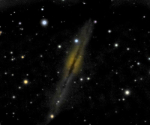
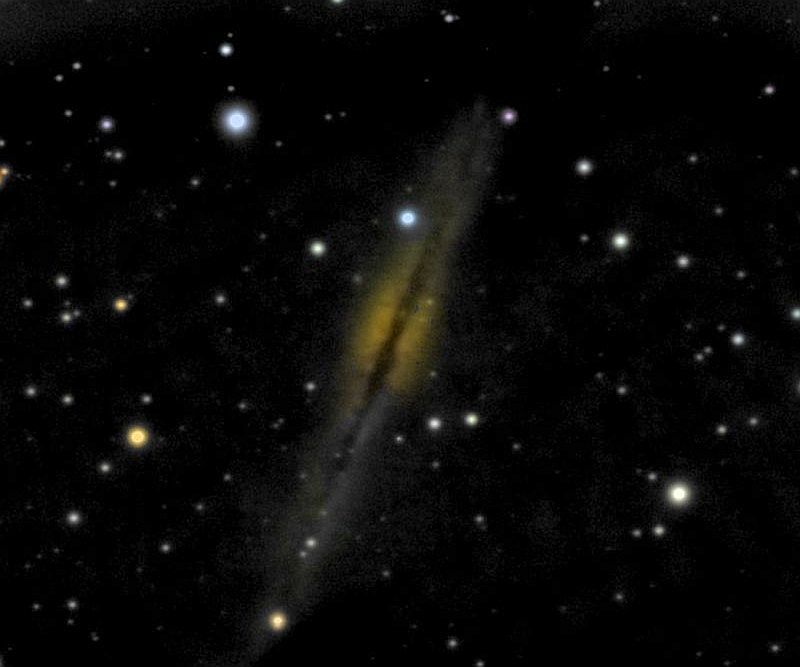 The edge-on spiral galaxy NGC 891, in the constellation Andromeda, about 30 million light-years away. Seen exactly side-on, its dusty spiral disc is bisected by a dark, knotted lane of dust and gas silhouetted against the glowing starlight behind it - the same kind of dust lane that runs through our own Milky Way's disc, which is why NGC 891 is often used as a stand-in for what our Galaxy might look like from far outside its plane.
North is up and east is to the left in this image, the standard orientation and handedness for an astronomical photograph.
* * *
Imaged overnight on 21-22 September 2026 (about 03:44 BST to 04:24 BST) with the John Cruickshank Telescope (GSO 16-inch Ritchey-Chretien) at the Anne H Cruickshank Observatory, University of Aberdeen (57.17 N, 2.10 W), on a tracking equatorial mount (EQ8-R Pro), by ACO AI autonomous and remote control. Zeus 455M PRO camera, cooled to about -20 C.
- LRGB composite: 20 luminance (no filter), 10 Bessel R, 10 Bessel G and 10 Bessel B frames, each a 45 s exposure at gain 100, 2x2 binned (37.5 minutes of total exposure across the four channels).
- Field and scale: the image shown is 800 x 667 pixels, about 0.107 x 0.089 degrees, at about 0.48 arcseconds per pixel - a tight crop around the galaxy, replacing an earlier, narrower crop of the same file.
- Orientation: plate-solved directly from the processed stack (ASTAP), which found south at the top and west to the right in the raw file - a mirror image of the real sky. This file has been rotated 180 degrees and flipped left-right to give the standard north-up, east-left orientation shown here, the same correction applied to NGC 7331 and M32 elsewhere in this album.
- Processing: bias, dark and twilight-sky flat calibration; frames aligned by star cross-correlation and combined with an outlier-rejecting (sigma-clipped) stack; sky background modelled locally (not the low-order whole-frame fit used for the other targets in this set - see the editor notes) and subtracted; colour balanced against the frame's own stars; combined into an LRGB image and given an asinh (arcsinh) stretch; background darkened and lightly sharpened in this particular crop.
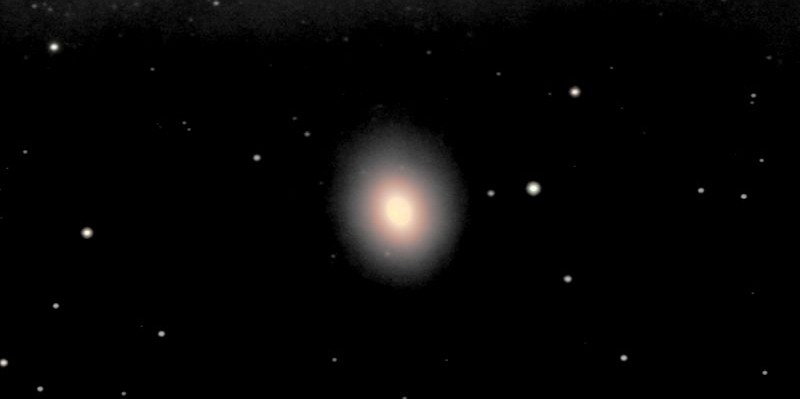 M32, a compact dwarf elliptical galaxy and close companion of the Andromeda Galaxy (M31), about 2.5 million light-years away. Unlike M31's sprawling spiral disc, M32 is small, dense and smooth - a tightly packed ball of old, reddish stars with no dust lanes or spiral structure of its own. Some astronomers think it may once have been a larger spiral or disc galaxy, stripped down to its compact core by repeated close encounters with M31 over billions of years, though that is one interpretation rather than settled fact. The bright point to its right is an unrelated foreground star in our own galaxy, not a second companion.
* * *
Imaged overnight on 21-22 September 2026 (about 23:49 BST to 02:50 BST, alternating with the nearby M31 core) with the John Cruickshank Telescope (GSO 16-inch Ritchey-Chretien) at the Anne H Cruickshank Observatory, University of Aberdeen (57.17 N, 2.10 W), on a tracking equatorial mount (EQ8-R Pro), by ACO AI autonomous and remote control. Zeus 455M PRO camera, cooled to about -20 C.
- LRGB composite: 12 luminance (no filter), 6 Bessel R, 6 Bessel G and 6 Bessel B frames, each a 45 s exposure at gain 100, 2x2 binned (22.5 minutes of total exposure across the four channels). Frames affected by passing cloud were rejected before stacking.
- Field and scale: the image shown is 800 x 399 pixels, about 0.107 x 0.053 degrees, at about 0.48 arcseconds per pixel - a tight crop around the galaxy.
- Orientation: plate-solved directly from the processed stack (ASTAP), which found south at the top and west to the right in the raw file - a mirror image of the real sky. This file has been rotated 180 degrees and flipped left-right to give the standard north-up, east-left orientation shown here, the same correction applied to NGC 7331 elsewhere in this album.
- Processing: bias, dark and twilight-sky flat calibration; frames aligned by star cross-correlation and combined with an outlier-rejecting (sigma-clipped) stack; sky background removed with a low-order surface fit; colour balanced against the frame's own stars, with an added cap on the blue-to-green ratio; combined into an LRGB image and given an asinh (arcsinh) stretch.
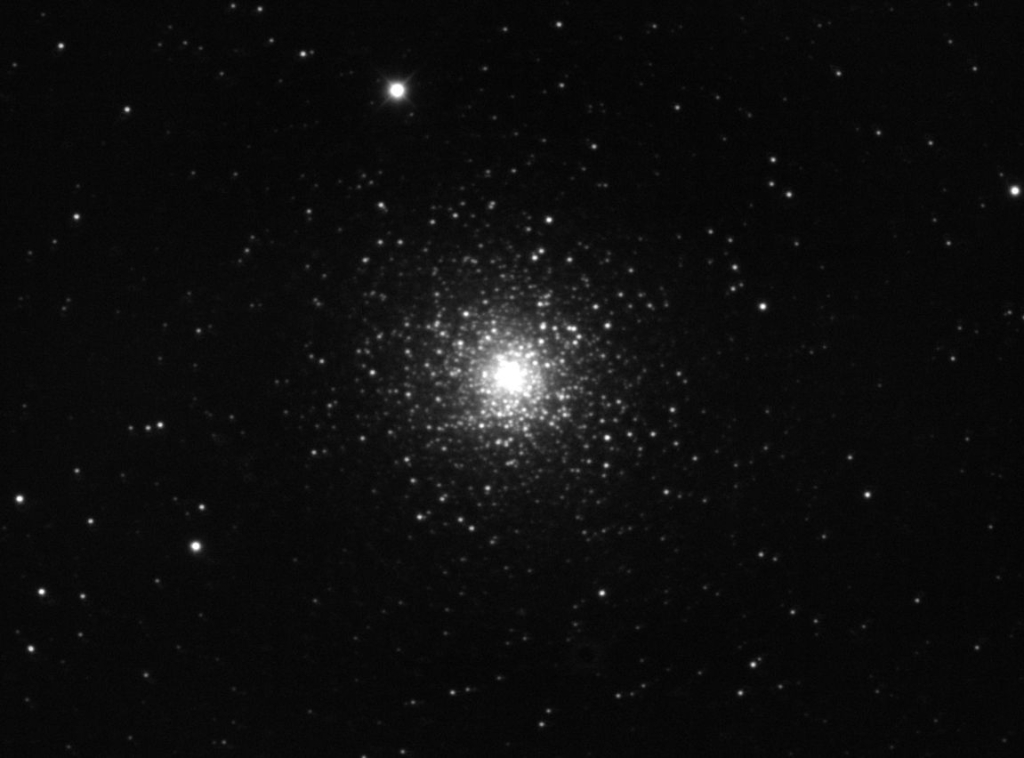 Messier 15 (NGC 7078) in Pegasus, about 33,000 light-years away. It is a globular cluster: a dense,
roughly spherical swarm of several hundred thousand stars, bound together by gravity and among the
oldest objects in the galaxy, at around 12 billion years old. M15 is one of the most tightly packed
globular clusters known - it is undergoing what's called core collapse, where the cluster's centre
has contracted into an exceptionally dense core, visible here as the bright, tightly concentrated
knot of stars at the middle of the surrounding halo. It was discovered by Jean-Dominique Maraldi in
1746.
* * *
Imaged on 30 September-1 October 2026 (about 23:00 to 00:00 BST) with the John Cruickshank Telescope (GSO/StellaLyra 16-inch Ritchey-Chretien) at the Anne H Cruickshank Observatory, University of Aberdeen (57.17 N, 2.10 W). Zeus 455M PRO camera, cooled to about -20 C, on a tracking equatorial mount (EQ8-R Pro).
- Luminance only: 11 x 20 s exposures (no filter), stacked.
- Field and scale: the image shown is 1,151 x 852 pixels, about 0.37 x 0.27 degrees (22 x 16
arcminutes), at about 1.15 arcseconds per pixel. It was cropped from the full frame (9,576 x 6,388
pixels, 0.64 x 0.43 degrees, about 0.24 arcseconds per pixel), keeping about 58% of its width and
64% of its height around the cluster, and reduced in size.
- Processing: calibrated against a master bias and dark (16 bias and 16 dark frames from the same
night, matched exposure and temperature); frames selected by star count; aligned by phase
correlation, with an automatic 180-degree rotation check and correction for a meridian/pier flip
that happened partway through the run; combined with a sigma-clipped mean; a smooth low-order
background gradient removed; stretched with an arcsinh curve; background darkened further for the
web version; rotated by a small, precisely-computed amount (0.5 degrees) to put North exactly up,
based on an astrometric plate solve of one of the frames - the un-rotated frame was already very
close to the standard North-up/East-left orientation, needing only this small correction and no
flip.
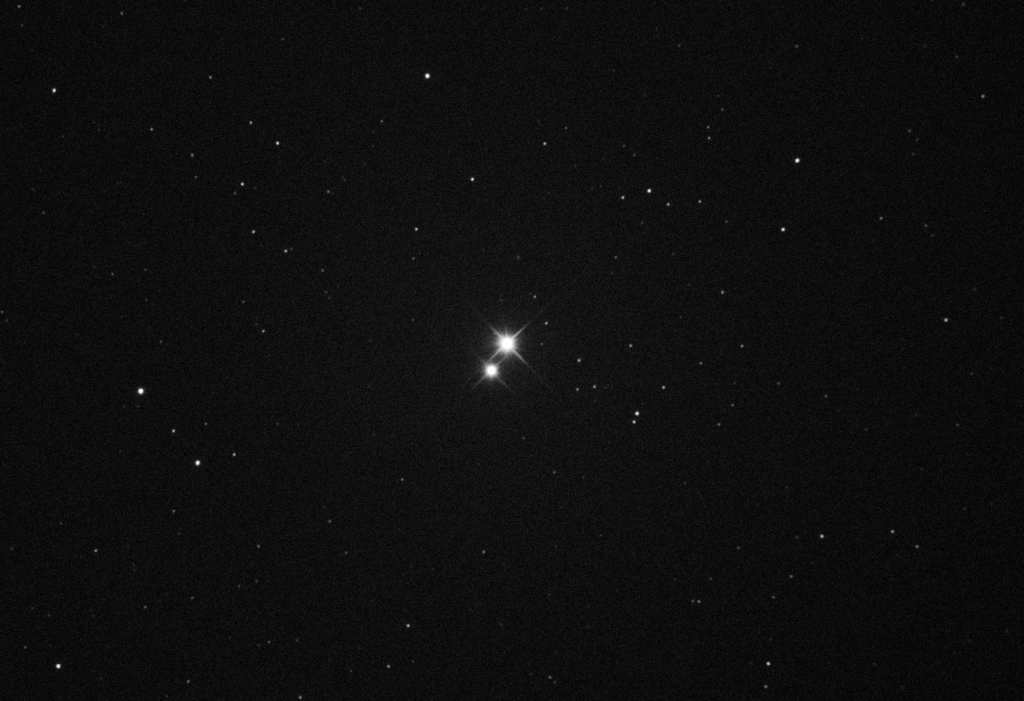 The double star Zeta Lyrae in the constellation Lyra, over 150 light-years away, about two degrees from the brilliant star Vega. The two stars shown here, the brighter one with diffraction spikes at upper right and its fainter companion at lower left, are separated by only about 44 arcseconds, less than 1/40 of the width of the full Moon. They can be split with binoculars on a dark night. The rest of the picture is a rich field of much fainter and more distant stars.
* * *
Imaged on 1 September 2026 at about 23:10 BST with the John Cruickshank Telescope (GSO 16-inch Ritchey-Chretien) at the Anne H Cruickshank Observatory, University of Aberdeen (57.17 N, 2.10 W), by remote control. Zeus 455M PRO camera on a tracking equatorial mount (EQ8-R Pro).
- Exposure: one frame of 1.07 seconds at high gain (465), with no filter, so the picture is black and white. The camera was not cooled for this frame.
- Field and scale: the image shown is 1769 x 1211 pixels, about 0.40 x 0.27 degrees (24.0 x 16.4 arcminutes), at about 0.81 arcseconds per pixel. It was cropped from the full frame (9576 x 6388 pixels, 0.64 x 0.43 degrees, about 0.24 arcseconds per pixel) and reduced in size; then, 2026-10-11, plate-solved (ASTAP, matching the field against the star catalogue) and found tilted about 7.9 degrees off true celestial north, so rotated onto a padded canvas (so no original pixels were clipped by the rotation itself) and re-cropped to the largest centred rectangle clear of the resulting black edges, down to 1769 x 1211. Re-solved afterward to confirm the fix: residual twist under 0.1 degrees, same sky position as before, no left-right or up-down flip.
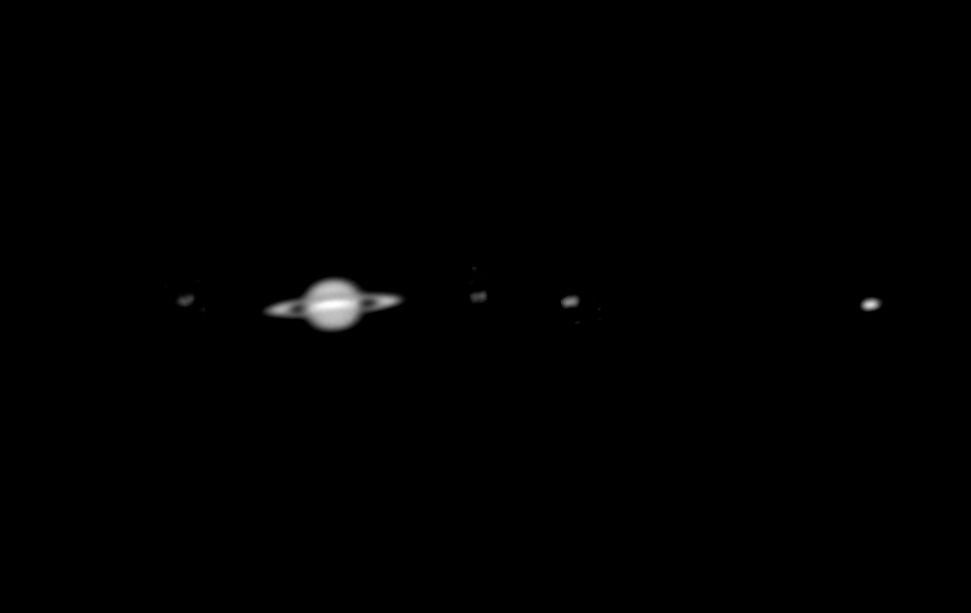 Saturn and four of its moons, viewed from Aberdeen. From left to right the moons are Dione, Tethys, Rhea and Titan. Titan, at the far right, is the largest of them, bigger than the planet Mercury, and the only moon in the Solar System with a thick atmosphere. Saturn's rings are tilted only a few degrees towards us at present, so they appear as a thin bright line across the planet, and the shadow of the rings and the pale cloud bands on the globe can just be made out. Saturn was only about 27 degrees above the horizon, so the light had to pass through a lot of turbulent air and the picture is softer than the telescope could otherwise deliver.
* * *
Imaged on 11 September 2026 (about 22:59 to 23:04 BST) with the John Cruickshank Telescope (GSO 16-inch Ritchey-Chretien) at the Anne H Cruickshank Observatory, University of Aberdeen (57.17 N, 2.10 W), by remote control. Zeus 455M PRO camera, cooled to about -13 C, on a tracking equatorial mount (EQ8-R Pro). The telescope was pointed at Saturn by the observatory's AI (ACO AI) using plate-solving navigation and target synchronisation.
- Exposures: a video of 874 frames, each 10.5 milliseconds, with no filter (black and white) and the gain at zero, recorded at about 3.4 frames per second over about 4.3 minutes. Each frame is 905 x 498 pixels, cropped from the sensor.
- Stack: the frames were aligned and the sharpest were averaged (the file name records 150 frames chosen from 830 aligned frames), which reduces the effect of the atmosphere on the planet's detail.
- Field and scale: the image shown is 971 x 613 pixels, about 5 x 3 arcminutes, at about 0.3 arcseconds per pixel, estimated from the size of Saturn's rings. The original frames are at 0.48 arcseconds per pixel.