Students in the School of Social Science are very active in seeking out opportunities for internships, graduate schemes and other employment options post-degree.
Click on the names to read more about some of their experiences during and after their degrees at the University of Aberdeen.
- Mahendran Balakrishnanv - Head of Innovation at a social innovation lab
-
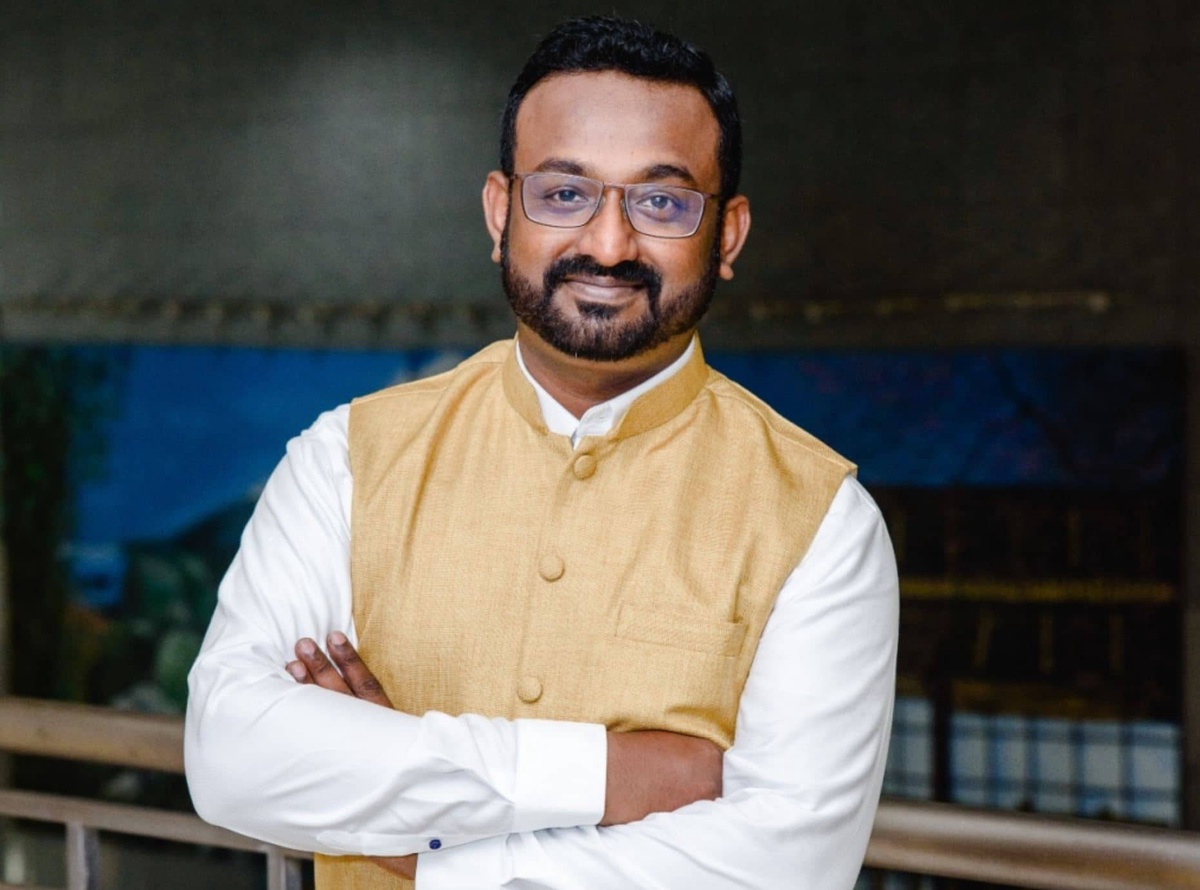
After graduating in 2016 with an MSc in International Relations from the University, Mahendran returned to Malaysia to work with national oil company, Petronas, before taking on the role of Head of Innovation with SEEd.Lab, a social innovation lab that trains and upskills young people to create their own social enterprises.
In addition to his role at SEED.Lab, Mahendran is also a trustee of YellowHouse Kuala Lumpur, a not-for-profit grassroots community organisation that helps improve the lives of homeless and refugee communities.
Mahendran said: “My experience at the University of Aberdeen was not only enriching but, in many ways, pushed me towards my ultimate passion of contributing to society. It broadened my understanding of social challenges and helped me to evaluate new ways of thinking, which I now share with my students during our coaching sessions at SEED.Lab. By translating all that I learned into sustainable solutions, I have been able to help reduce unemployment among young people in Malaysia.
“The whole experience and journey of studying in the UK was truly inspiring and during my time at the University I saw how people came together to collectively help the more vulnerable parts of society. The University's multicultural setup and experienced, innovative professors gave me the confidence to go further and inspired me to turn my ideas into a reality and I'm very thankful and humbled that I was nominated for this award. I hope that by sharing my story I can inspire more young people to follow their passion in creating a positive impact for others.”
Read more about Mahendran's awarded success here .
- Sophia Burnaasefi - internship with the Embassy of the Islamic Republic of Afghanistan
-
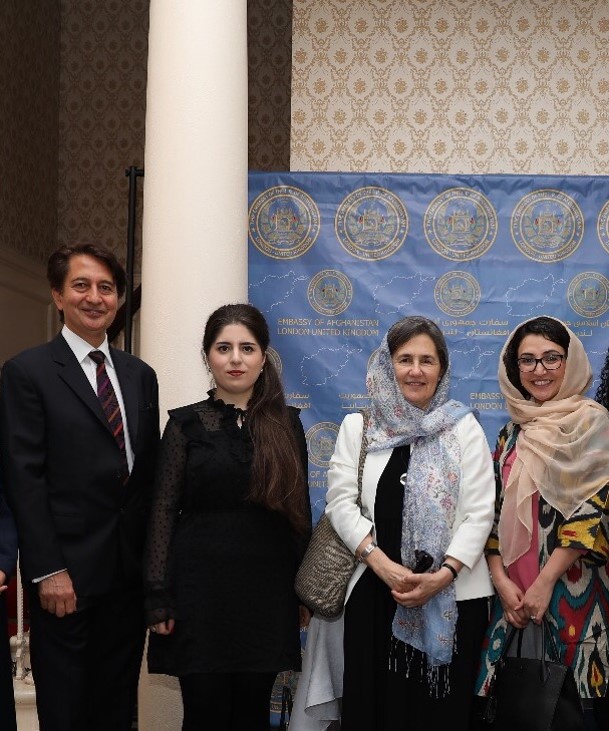
I carried out a 4 months internship with the Embassy of the Islamic Republic of Afghanistan in London at the Ambassadors office of the Embassy. My duties involved monitoring and conducting research on Afghan-UK relations, organising state visits and social events, assisting correspondences of the diplomats, editing and drafting talking points for the ambassadors speeches. I particularly enjoyed working in such a multicultural team, the exposure to the diplomatic field, and being part of important projects and conferences. These allowed me to put my knowledge into practise which was very rewarding. I am lucky enough to be continuing my internship at the embassy this summer as well, and I am excited to learn and experience more!
- Struan Charters - university experience and career highlights
-

I studied for an MA (Hons) in Politics and International Relations at the University of Aberdeen from 2009 to 2013.
Whilst at Aberdeen I received a thorough education of core concepts in political and international relations by experts and high profile commentators in the field. This brought to life current events such as the Scottish, UK and US elections, as well as the Arab Spring. I developed a keen interest in international conflict; I studied the Kashmir conflict in detail and received the Janet McMurtrie Prize for the best essay in International Relations with a particular focus on a developing country. Since my degree a highlight was a trip to Jaipur for a friend's wedding where I also visited Kashmir. I have also volunteered at a refugee camp in Greece, seeing first-hand some of the issues discussed in classes.
Whilst at Aberdeen I really enjoyed getting involved with and being on the committee of the University's Politics and International Relations Society, which was associated with, but independent to my degree. Memorable events included trips to Edinburgh, London, Berlin and The Hague with visits to associated political institutions.
Aberdeen also instilled in me a keen interest in public policy, and I subsequently completed an MSc (Research) in Public Policy and Administration at the London School of Economics and Political Science. I stayed in London after my postgraduate degree, working in a public sector consultancy role. I've also worked back home in the Highlands in a policy role in the Highland Council, as an adviser in a Citizens Advice Bureau, and as a constituency assistant with the Scottish Parliament.
I am currently based in Dublin, having previously managed a community complex in Donegal. I work in the Investment Projects and Programmes Office, part of the Department of Public Expenditure and Reform within the Irish Civil Service. The IPPO is tasked with overseeing national infrastructure policy. My role includes work around reporting, analysing and communicating infrastructure delivery across government, tracking the progress of projects and programmes under the National Development Plan. My key duties have included the co-ordination and writing of high-level reports, government level briefing documents as well as the development of innovative, citizen focused tools such as a tracker and interactive map documenting all major projects and programmes across the country.
Aberdeen has provided a very strong foundation both inside and outside of lecture halls and the skills for me to embark on a career focused on public service, with a breadth of experiences and skills that I continue to develop.
- Tadas Cilcius - Head of Operational Risk at an e-money institution
-
Tadas Cilcius is the Head of Operational Risk at DiPocket, a fast growing e-money institution. He is responsible for leading strategic business projects, performing impact assessments, tracking all our interactions with customers and corporate clients, and arranging trainings for operational colleagues and senior leaders.
Tadas was a section editor for The Gaudie student newspaper, which was one of his most exciting experiences of student life; "I remember myself in the first year looking at the newspaper and thinking how great it would be to write for it."
As his course progressed, he got more and more involved with the student newspaper. By his 4th year he was elected as the Life and Style Editor, which allowed him to forward the vision of student lifestyle by introducing the student community to new societies, volunteering opportunities and surprising career paths undertaken by fellow classmates.
"I had always wanted to study in English and at a university with great ancient traditions which also combines modern learning methods. I found that Aberdeen was just that - great medieval buildings blended in with modern and tech-savvy architecture, creating a dynamic atmosphere for international students."
Read more about Tadas in his interview with Alumni Relations here .
- Molly Davidson - internship at NATO
-
Molly Davidson, who is studying a PhD in Politics and International Relations, was selected from more than 4,000 applicants across NATO's 30 member countries and will begin a six-month internship at NATO's headquarters in Brussels from 1 March 2021.
Commenting on her selection for the programme, Molly said: “I feel both delighted and fortunate to be offered such a great role with NATO and I'm looking forward to moving to Brussels within the next few weeks. I previously completed a nine-month internship with the United Nations in New York and hope I can bring my experience and knowledge to the defence and security sector which I have a particular interest in.” more
- Daniel Eden - skills from the degree
-
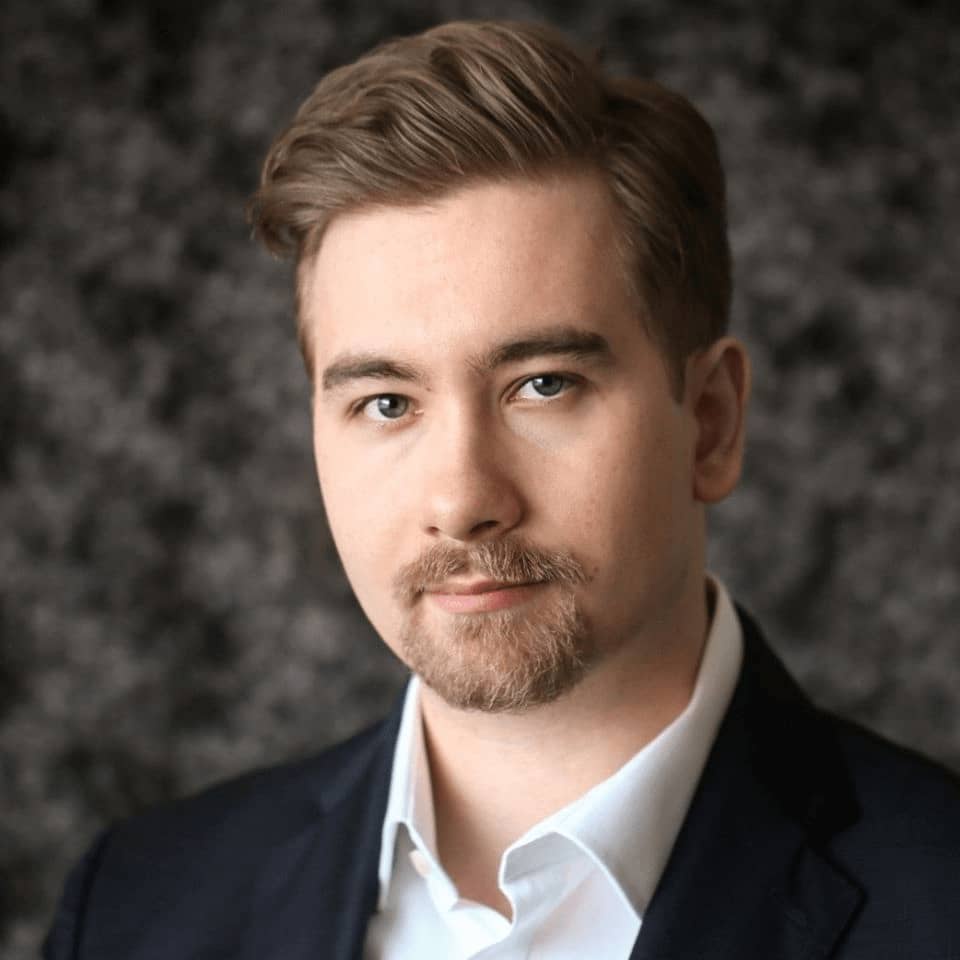
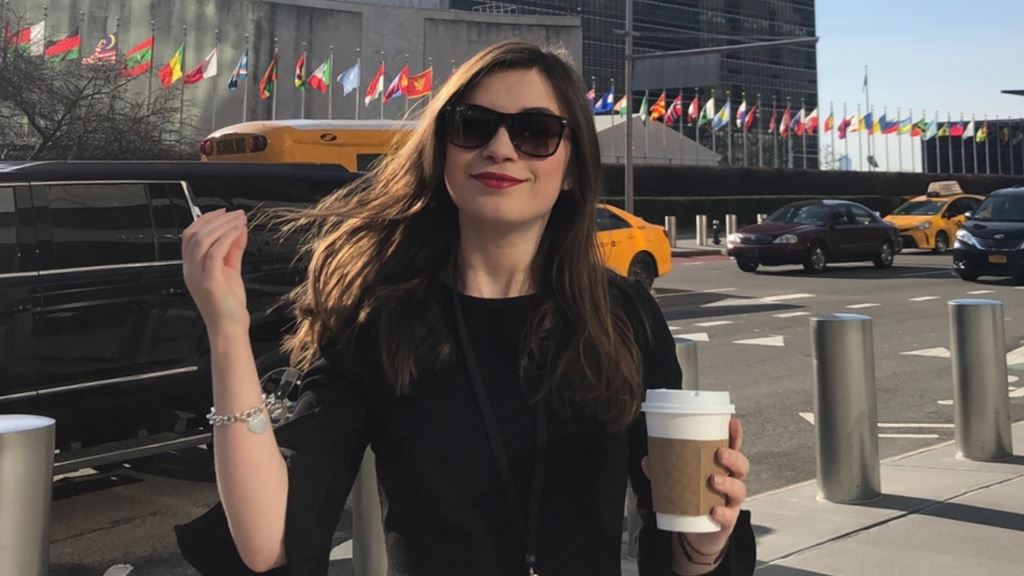
Over the course of 5 years, I completed two degrees at the University of Aberdeen - an MA in Politics & International Relations and an MSc in Strategic Studies and Management.
After graduating from my Master's, I applied to Santander's graduate scheme, and I have been with the company for nearly 6 months.
In that time, I have been drawing heavily on the skills and lessons that I learned at the University of Aberdeen. My degrees were largely based in the School of Social Science, and they have provided me with a skill set useful in any environment. At the end of the day, the strength of social science degrees lies in the fact that they develop one's critical thinking and the ability to form and present articulate arguments. As one scholar puts it, subjects like these teach people to read, think, and write.
By researching and understanding the facts, we can identify challenges and opportunities, and chart a viable way forward. Writing our ideas down challenges us to put our thoughts into words and allows us present a persuasive case. This is a skill that allows one to bring people together and make everyone work towards a common purpose. Being able to do that is incredibly valuable both in business and in politics. That is why social science degrees are so versatile and open up so many doors.
At Santander, I have been involved in a number of projects. The aims of our projects vary but one thing always stays the same - if you are implementing change, you have to get the people on board. It can be the most amazing idea in theory, but if the people on the ground don't embrace it, it will never work. That is why it has been so crucial to be able to articulate my ideas clearly and succinctly, and why my degrees have proven so useful.
- Gabriela Faria - founder of a non-profit organisation
-
It is less than three years since Gabriela Faria graduated with a first class honours degree in Politics and International Relations from the University of Aberdeen, but already she has achieved more than many will in a lifetime.
Just nine months after graduating, Gabriela (25) officially founded the Lisbon Project, a non-profit organisation that exists to protect and integrate the lives of migrants and refugees in her home city. A year later, she married husband Ruben, and since then she has given birth to daughter Jade. She and Ruben also pastor an international church in Lisbon called Riverside.
Born in South Africa, but raised in Portugal, Gabriela began her studies at the University in 2012, and Aberdeen soon became her home from home.
“I got my first proper job, I opened a bank account and paid rent for the first time - by the end of the first semester, I was already a different person. I come from a very sunny, colourful town called Cascais so it was a challenge to face the cold and rain, but the people I met in Aberdeen brought so much light to my every day.”
Gabriela enjoyed her studies and the flexibility of the course, which she found challenging and interesting.
“Looking back, I love to remember those days that I had to ride my bicycle to classes, study hard for exams, go to work, and still try to be a good friend. But I also remember those sunny days when we all hit Seaton park for a picnic or had bonfires at the beach, and dancing the night away with some of my best friends.”
During her course, Gabriela completed internships in Africa and Asia, the plan being to get a job following graduation using the experience she had gained. That all changed, however, when she returned home to Portugal in the summer of 2016.
“I started meeting migrant and refugee families facing extremely difficult situations. Although there was a bureaucratic response to immigration, there was no human response, no place where people could go, ask questions and feel heard, be spoken to in their language, be treated as more than a file or a number.
“So, two months after graduation, I started an NGO and seven months after that we officially registered the Lisbon Project as a non-profit organisation.”
The Lisbon Project was an effort to mobilise the private sector in order to have a more human, quicker and more efficient response to the migration challenges faced by the city and, in just three years, it has become a well-established organisation that has assisted more than 600 registered migrants and refugees, and mobilised more than 200 volunteers.
The project serves the migrant and refugee community primarily through different programmes: education, employment, housing, legal aid, health and wellbeing, social store and co-communities. At any given time, a team of about 50 volunteers and 10 corporate partners provides access to a range of services such as language classes, CV editing, skills training courses, legal advice, health care assistance, fitness opportunities, provision of essential food and living items, as well as community building activities.
“My job is to make sure we are attentive to the needs of our community, listening to needs rather than assuming we know them and to make sure we are coming up with sustainable solutions, as well as mobilising the local community to serve as donors, partners or volunteers in order to make it all happen.
“We are financially dependent on private grants and donations, which made it all seem impossible at the start, but our motto, which is written all over our office, is 'It only seems impossible until it is done'.
“I had no previous experience in project management, much less leading an organisation of this dimension, but I have learned on the job. I have had incredible support from men and women who are older and have far more work experience, who have been generous and humble enough to provide me with their counsel, for which I am very grateful.”
To those thinking of studying at Aberdeen, Gabriela has these words of encouragement: “Your education at university is so much more than the theory you are being taught - it also teaches you how and what to prioritise in life, it is shaping your character defining values of commitment, hard work and integrity, it is challenging you in ways that stretch you and take you to another level of maturity and depth.
“Have fun, enjoy being a student and all that that entails, create memories with your friends, and travel on your breaks. And when you graduate, look around you, see the needs of others as an opportunity to create change, however that may look.”
- Luisa Freutel - internship with the Mexican Council on Foreign Relations
-
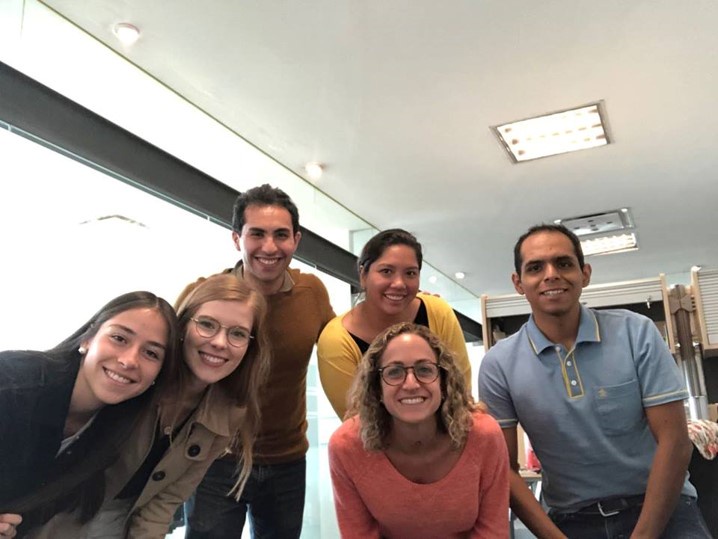
Last summer I did a three-month unpaid internship at the Mexican Council on Foreign Relations (COMEXI) in Mexico City. COMEXI is an NGO that focusses on the analysis, study, and debate of major global trends and their impact on Mexico. I was working in the Media and Communication department, which gave me a perfect insight into social media work and political communication. My main task was to promote COMEXI on all their social media channels. Therefore, I created infographics, videos, and posts. Furthermore, I helped to organize events, to analyze most recent news, to do political research, and to implement different (media) strategies. My favourite part of my internship has been the events. Once we were invited to have a debate with the Turkish ambassador in his residence. Another time we organized an event in cooperation with McKinsey and Co. about Cybersecurity. My time in Mexico has been very beneficial to me. Not just because I've met amazing people, also because I figured out, that I'm a creative person and that later I would like to work in something political communication-related.
- Kevin Guyan - equality, diversity and inclusion researcher
-
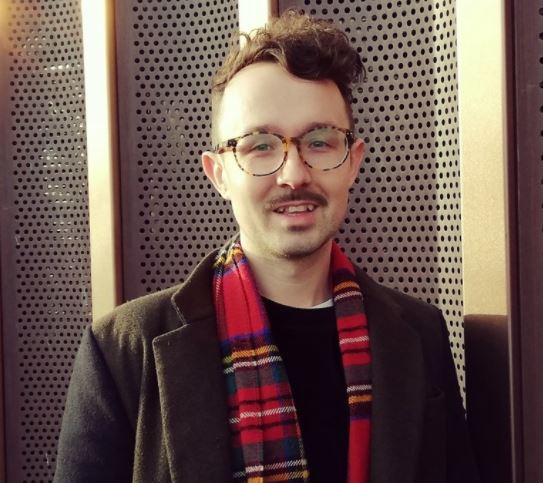
After graduating with am MA in History and International Relations from the University of Aberdeen in 2011, Kevin went on to complete a PhD in History before embarking on a career in equality, diversity and inclusion research. Kevin Guyan discusses his research into Scotland's 2022 census and the collection of gender, sex and sexuality data
- Isabelle Hampton-Zabotti - internships with the Public Engagement with Research Unit (PERU)
-
My name is Isabelle and I am a student at the University of Aberdeen and will be going onto my third year of study. I take English and Sociology and I am a part of the University’s student newspaper, The Gaudie. I interned with the Public Engagement with Research Unit (PERU) who are a team within the Research and Innovation section of the University office. I was tasked with finding a process for the collection and management of data from researchers who take part in PERU’s public engagement event. This is data regarding their gender, age, ethnicity, as well as other personal characteristics, and is used to meet Equality, Diversity, and Inclusion targets. I had an academic interest in this as a Sociology student because we had to find a middle ground between acknowledging distinct differences in personal characteristics (particularly with ethnicity) while also making sure that we are not compromising staff and students' right to anonymity and privacy. As a person of colour, I could personally recognise the importance of finding this balance. I appreciated how the project was challenging in this regard and had some very interesting conversations surrounding diversity and inclusion, and what that can look like in practice.
At the beginning, I found the number of meetings a little overwhelming (and all the acronyms I needed to learn), but I quickly got used to them. The meetings were a very important part of the project because we first had to find out how other teams were handling reporting on EDI characteristics in their events. What we concluded was that many teams did not have a process in place, and that the project turned out to be more needed than we originally thought. We also had a number of meetings with the data protection team, who patiently helped guide us through the murky waters of data protection. We had to update them with every change made to the process to make sure that we still abided by the University’s data protection policy.
At the same time, we looked into what programs were best for the management of the data. While Excel is used across the University, it is not the most ideal for collaboration. Early on in the internship we were introduced to PowerBI, which is a program that allows the creation of visuals from data imputed. I received training for the programs and got to work with dummy data, which was challenging at first, but I enjoyed learning how to use the program.
Finally, I created a report with the recommendations that we devised over the ten weeks, and it has been sent to numerous teams and individuals, and hopefully will be implemented and adapted to fit their needs. The final report was made with Canva, where I was able to be creative with the layout and the designs. Throughout the internship the support the project received was encouraging, and the feedback was invaluable for its progression. Overall, I am so thankful for the experience and for the guidance from my manager and team, and I look forward to what’s coming next.
- Mie Astrup Jensen - PhD in Gender & Sexuality Studies and Hebrew & Jewish Studies
-
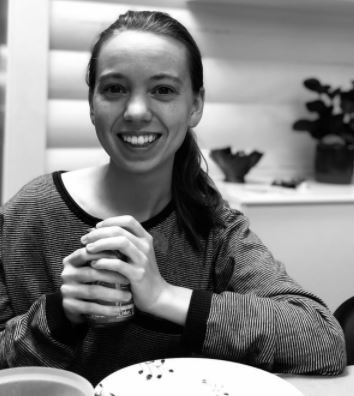
I graduated from the University of Aberdeen with an MA in Sociology (2019) and an MRes in Social Science (2020), and I am now doing a PhD at UCL in Gender & Sexuality Studies and Hebrew & Jewish Studies focusing on lesbian, bi, and queer Jewish women's lived experiences in Israel and England.
After I completed my IB I decided to move to Scotland since I could do courses in sociology, anthropology, and religious studies. My undergraduate courses introduced me to a new world. I still remember my first-year sociology lecture on gender and how I sat on the edge of the seat. Terms like gender performativity, democratic relationships, and sexual scripts sparked my interest. Yet, it took a while before I found a way to combine religious studies and social science. I found the religious scriptures and traditions intriguing, but I wanted to understand contemporary lived experiences.
The sociology department gave me space to explore - especially during my Master's degree. I ambitiously did a cross-cultural qualitative study where I interviewed progressive rabbis on how they on make synagogues LGBTQ+ friendly. I also did a quantitative project on correlations between gender and experiences of antisemitism. Originally, I had been invited to continue my work with the rabbis for my dissertation, but due to COVID-19, synagogues were not open. Instead, my literature-based thesis provided the basis for my PhD. I was fortunate to secure ESRC funding for my PhD, which I started at UCL in September 2020.
- Kirsty Kernohan - internship at Dumfries Museum
-
.jpg)
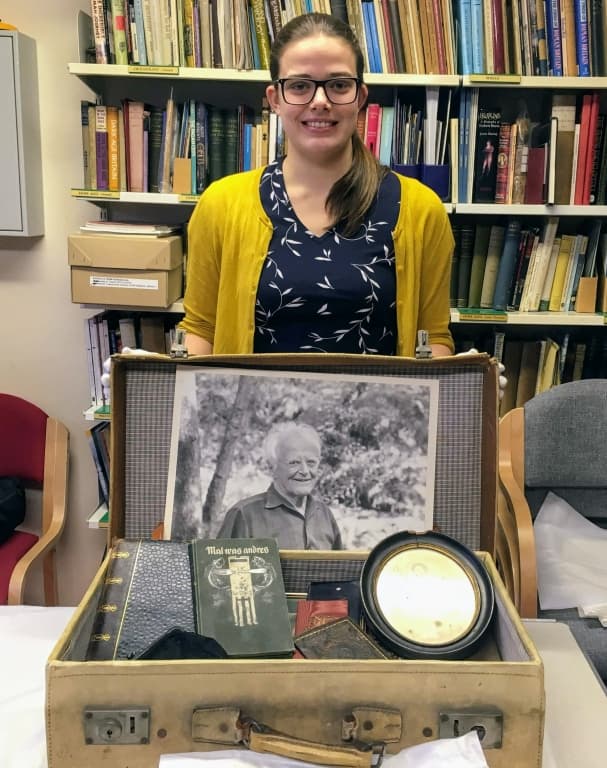
Kirsty Kernohan, PhD student in anthropology, had the opportunity to work as an intern at Dumfries Museum. This project was supported by the Scottish Graduate School for Arts and Humanities who allowed her to take time away from her PhD research to complete the internship.
During Kirsty's time at the museum she worked with the Dr Werner Kissling collections, which include ethnographic photographs taken across Scotland, particularly Eriskay and South Uist as well as Dr Kissling's correspondence.
Kirsty recalls her experiences; "I worked to document newly acquired objects and photographs, updating the museum's database. I also curated several online exhibitions of Dr Kissling's photographs".
These online exhibition can be found at: http://www.futuremuseum.co.uk/collections/people/key-people/collectors-explorers/dr-werner-kissling.aspx
For Kirsty, the most rewarding part of the project was putting together a collaborative collection of reminiscences about Dr Kissling:
"I spoke to people who remembered Dr Kissling and we worked together to produce final written pieces. The result was a diverse collection of stories which will be kept in the museum for future research and community use".
Kirsty had not only a unique experience to further her educational experience while studying anthropology but also had the ability to develop skills working in the museum sector:
"Throughout this internship I was able to use the experiences from my PhD fieldwork in a new setting. I also developed new skills specific to working in a museum, with the support of the incredible staff in Dumfries."
- Matthew MacCulloch - Civil Service Summer Diversity Internship Programme
-
From the moment I received the confirmatory email from the UK Civil Service that my application to the Summer Diversity Internship Programme (SDIP) for the summer of 2021 had been successful, I immediately knew that this was a fantastic opportunity. As someone who had not been in employment up until that time, I was very excited to have the privilege of gaining first-hand work experience within the governmental sector, and I was determined to make the very most of it! I subsequently outline in this blog article my journey through the application process to the internship itself, and how it greatly enhanced my personal development.
I began my application for the SDIP programme in October 2020. The application process was conducted entirely on a remote basis due to the pandemic, with a series of psychometric assessments and additional information forms over the course of October and November, followed by a telephone interview in mid-December. I was notified that my application had been successful in April 2021. During the application process, I had been asked to outline my preferences for the policy areas in which I was interested, and I was informed that I had been allocated to one of my secondary preferences – the Department of Environment, Food and Rural Affairs (Defra) – the following month in May. After a series of pre-employment checks and a helpful set of initial meetings with my line manager, I began my internship in mid-July.
The responsibilities that I undertook during this internship were predominantly administration and planning related. Due to the sensitive nature of the work, I am unable to go into too much detail, but I will note that I played a role in creating and updating a range of documents and papers, as well as attending a variety of meetings (one of which was my introduction to minute taking!). I, along with two other SDIP interns, even successfully organised for our team an online away-day, which included a general knowledge quiz that I had a fun and fulfilling time creating! Ultimately, completing these assignments allowed me to provide an important contribution to Defra, whilst the feedback that I received enabled me to learn more about the best approaches for performing tasks in working environments. I should also note that my internship was conducted on an entirely online-basis as that arrangement was the most suitable in my case, but interns also have the option of conducting their internships on at least a partly-in-person basis as well, illustrating the flexibility of the Civil Service’s work-life-balance approach. I therefore found serving as an SDIP intern to be a very rewarding role that provided me with the scope for further enhancing my working skills going forward.
Additionally, I participated in multiple information sessions and workshops delivered by experienced civil servants, which covered topics such as equality, diversity and inclusion, crisis management, and many more subjects of great importance to the Civil Service. I was also assigned to a mentor, who provided me with excellent advice about how to improve my working skills and personal confidence and was thus a great source of support to me during my internship. Moreover, I participated in a series of very helpful online information sessions with UpReach – an external partner of the Civil Service – which covered the application process for the Fast Stream graduate programme. This included a full online simulation of the Fast Stream Assessment Centre, in which I completed a leadership assessment, a teamwork assessment, and written assessment in the same way that the real assessment centre works, thus greatly informing my understanding of the process for applying to the Fast Stream programme. Subsequently, I found the support network available to interns to be very comprehensive and effective, and once again recommend the SDIP programme as excellent in the context of training and support.
In consideration of this, I regard my time as an SDIP intern in the Civil Service as a major personal milestone, as it was my first professional working experience and allowed me to gain a greater understanding of where my strengths lay, and how I could improve and enhance my skills going forward. Thus, I am very grateful to have had the opportunity that the Civil Service gave me, and I recommend the Summer Diversity Internship Programme and the Fast Stream to all students and graduates who are interested in working in public service.
- Viktorija Nesterovaite - internship with United Nations Office on Drugs and Crime (UNODC)
-
At just 28 years of age, Aberdeen graduate Viktorija Nesterovaite is one of the youngest members of staff at the United Nations, managing anti-corruption projects that stretch across Africa, South-East Europe and Central Asia, making societies and the lives of people better on a daily basis.
In 2015, just two months after her graduation, Viktorija moved to Vienna to take up an internship at the United Nations Office on Drugs and Crime (UNODC), setting the foundations for her international career.
She says: “The internship was crucial to my professional development as it provided me with experience of working for an international organisation, added focus to my portfolio and equipped me with technical skills and knowledge of project management.
“I would strongly encourage students who want to follow an international career to consider internships and placements. The UN is very competitive and it is hard to get a place there, but perseverance and hard work goes a long way. It was my way in.”
Following her internship, Viktorija moved to Oxford to work as a project assistant for an international development Non-Governmental Organisation (NGO). Eight months later, she returned to UNODC as a consultant at the Civil Society Team and, in August 2019, was appointed to the role of project officer.
Originally from Lithuania, Viktorija chose to attend the University of Aberdeen because it offered her an opportunity to study both International Relations and French, and a chance to spend her third year studying in Réunion Island as an ERASMUS programme exchange student.
She recalls: “The years flew by very quickly. In addition to studying, I worked part-time for an NGO called Autism Initiatives, and for Aberdeen City Council. Both work and full-time studies kept me extremely busy.
“When I moved to Aberdeen in 2010, the city was very lively because the universities and the oil and gas industry attracted an international crowd. The restaurants and bars were always full of people, and striking a conversation was so easy, especially with the Scots - I love how down to earth and funny they are.
“I found Old Aberdeen exceptionally beautiful and historic and spent a lot of time studying or relaxing by King's College, where trees bloom in late spring adding beauty to an already lovely spot. Some days, I would study at the newly built library, which brought a modern feel to the campus and outstanding views of the city.
“My course provided a good mix of lectures and seminars and the IR-related modules covered a wide range of relevant topics. The French grammar classes, especially, were very good and got me from the beginner to intermediate level in a short period in time. I now speak French, Russian and English as part of my everyday job, a valuable skillset that has contributed to my professional growth.”
At the UNODC, Viktorija works across different areas of the programme cycle, from project development, to monitoring and evaluation. The projects she manages contribute to the implementation of the United Nations Convention against Corruption (the only legally binding universal anti-corruption instrument) and bring the many voices of NGOs to the international debate, and increases their dialogue with Member States.
“The field of anti-corruption affects people at different layers of society. In my line of work, I interact with governments, civil society and the private sector, as well as different international organisations and entities. My direct counterparts are mostly representatives from the ministries of justice and other anti-corruption bodies and NGOs.
“No two days are ever the same and my job is rewarding and purposeful, not only because of the mandate of the organisation, but also for the inspiring stories and feedback I get from people I work with on the ground.
“The UN family in Vienna is very international and brings a multitude of expertise under one roof. Every day, as I walk in the building, I see the flags of all Member States - a reminder of how big the world is and how much there is to do.”
- Tomás Pizarro-Escuti - contribution to the UN General Assembly
-
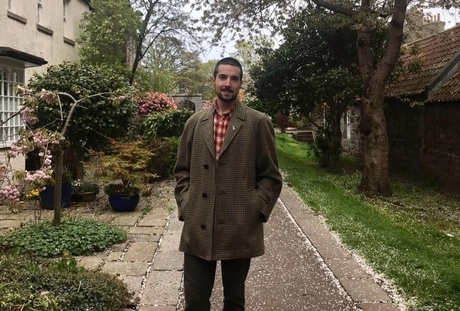
An Aberdeen student has spoken at the United Nations 75 Global Peace Inter-Generational Dialogue for Scotland and has now been invited to contribute to a high-level meeting of the UN General Assembly.
Tomás Pizarro-Escuti, who is in the fourth year of a degree in History and International Relations, represented the University of Aberdeen at the Dialogue which explored the pressing global issues affecting communities across the country.
It provides a forum for young future leaders to communicate with current leaders on their aspirations for what a better world should look like and offer inputs on how to shape it.
Tomás is the Head Coordinator of the Student Climate Network and as Co-founder of the Climate Academy, a project aimed at teaching primary school children about climate-related issues.
He talked on global inequality and climate activism. The intergenerational dialogue was also used to contribute views to shape a high-level General Assembly meeting to commemorate the 75th anniversary of the United Nations on September 21 on the theme, 'The Future We Want, the UN We Need: Reaffirming our Collective Commitment to Multilateralism'. Tomás has also been invited to a UN Global Meeting in October with the Secretary-General, António Guterres.
Tomás said: “I had the opportunity to express my concern about states not fulfilling their Paris Agreement Accord pledges. The Intergovernmental Panel on Climate Change has warned the world that if the global greenhouse emissions do not fall by 45 per cent by 2030, reaching net zero in 2050, it is unlikely that the Paris Agreement will reach its goal. At the moment, the vast majority of the countries are not meeting their Paris Agreement targets, and the UK is no exception.
“I was humbled, grateful, and honoured to represent the University and Scotland. I was very nervous, and I had to study a lot because I was not sure what they would ask me or what they would expect me to talk about.
“This experience was very challenging for me because English is not my mother tongue but it helped me to get out of my comfort zone.
“After the panel, I was told that I would be invited to a UN Global Meeting in October with the Secretary-General, António Guterres and that I would also be invited to participate in a forum for sustainable development.”
- Joshua Pizzuto-Pomaco - internship with the Cruickshank Botanical Garden
-
My name is Josh Pizzuto-Pomaco, and I am a third year Politics and Theology student. This summer I interned in the School of Biological Sciences, helping the Friends of the Cruickshank Botanic Garden (FCBG) develop and design a website and social media presence.
I heard of the job by chance, while I was interviewing Careers Adviser Alisdair McKibben for a podcast that I host for The Gaudie student newspaper. I applied just two days before the deadline, so I wasn’t sure what to expect. I had never worked in a desk job before and wondered how it would go. Would I get along with my supervisors? Would I be able to manage my time effectively? For the most part, I think I’ve answered these questions affirmatively.
I began my work on 6th June, spending the first several weeks researching other Friends groups and investigating how their digital footprints compared to FCBG. During this time, I met regularly with the Treasurer/Membership Secretary Julie and Keeper of the Garden David, exchanging ideas and strategies for improving our media presence.
By the end of June, we had taken special interest in the website of the Friends at Sheffield Botanic Garden. We were impressed by the craftsmanship shown and reached out to the Friends to see who had designed their site. The Friends in Sheffield were very helpful and pointed us to their web designer, a woman named Katy.
In early July, Julie and I met with Katy over Zoom and offered her the job of designing our new website. She accepted, and the work soon began. Over the next month, we were tasked with compiling photos, text, and content for each page we decided to include on the website (over 20).
The work moved slowly at times, especially when sorting through the multitude of documents we needed to properly label and identify. Yet, we persisted and ultimately submitted all of the content on schedule.
As of 29th August, when I am writing this, the website is nearly complete. Thanks to the hard work of everyone involved, I believe we have produced a website which will attract viewers and engage with our community. The website can be found at https://www.fcbgaberdeen.org.uk/.
Reflecting on my experiences this summer, I am incredibly grateful for the opportunity entrusted to me by Julie and David. This summer taught me a lot about working in a professional environment, an invaluable skill to learn while at university. I had to be accountable to my superiors while being able to work together as a team with others. I had to learn to be patient when waiting for emails or taking photos in the Garden.
All in all, it has been a very good summer, and I definitely recommend the internship programme to all students at the University. I’ll take the skills I learned this summer with me as I join the workforce and begin my future career.
- Arianna Sahraie - internship with the Estates & Facilities Directorate
-
My name is Arianna, and I am going into my final year of Business Management and International Relations. Upon completing my third year I was looking to gain an internship and came across the Aberdeen Internship Programme at the University. After applying I was accepted to be the Communications Intern within the Estates & Facilities Directorate with the title of the internship being: “The single biggest problem in communication is the illusion that it has taken place”.
From understanding what ‘Directorate’ meant prior to my interview, the time flew to the first day of the internship at the beginning of June. As someone who has worked in the healthcare industry with members of the public, the thought of working in an office environment was daunting, however upon reflection I had nothing to worry about. After meeting the interns of 2022, I met with my line manager to determine what the plans were for the next 10 weeks. I was set the following four tasks:
- Understand what hard-to-reach staff want from the Directorate
- Update the Estates & Facilities Website
- Develop a Staff Newsletter Template
- Take new photographs of campus
The E&F Directorate consists of Operations, Facilities Services, Planning & Development, Student Accommodation and Catering & Commercial Services in addition to Sustainability and Health & Safety. It was important for me to gain a baseline understanding of the current levels of communications across all departments and identify any areas of improvement. In doing so, I met with harder-to-reach staff including meeting with cleaning staff at 5am to learn about what they wanted from the Directorate in terms of receiving information. These meetings were crucial to understand what the expectation is from staff and their honest opinions about what current levels of communications are like.
Soon after, I began to work on the E&F website. After completing OpenText CMS training I looked at our current website and our competitor universities’ webpages to gain an understanding of what others do. After planning the changes I would make, and ensuring that they were possible, I went ahead and worked on implementing these changes. The images below show the before (left) of the landing page of the website (the page you see as soon as you click on the Estates & Facilities tab), and the after (right) is the new landing page.
One method that had been previously used to improve communications to all staff within the Directorate was through a staff newsletter. Part of my internship was to redesign this newsletter, creating a more reader-friendly format and that is what I did! It was important to me to make it as inclusive as possible whilst keeping it short and sweet. This was easier said than done because the Directorate covers such a vast range of departments and over 400 members of staff so to keep it short proved to be a difficulty.
Upon reflection of the past ten weeks, there has not been one aspect of the internship that has not been enjoyable. The role has been very independent which I thoroughly enjoyed as it meant I could take more control on how I went about achieving each goal. The guidance and support I received from each member of staff within the Directorate has been second to none and I am incredibly grateful to have been given this opportunity. The Internship programme has been very well organised and run from day one, and I would truly recommend this programme to anyone looking to gain some work experience. Everything I have learned over the past ten weeks has been so valuable and I will take with me to future employment.
- Arthur Vincent - founder of a non-profit
-
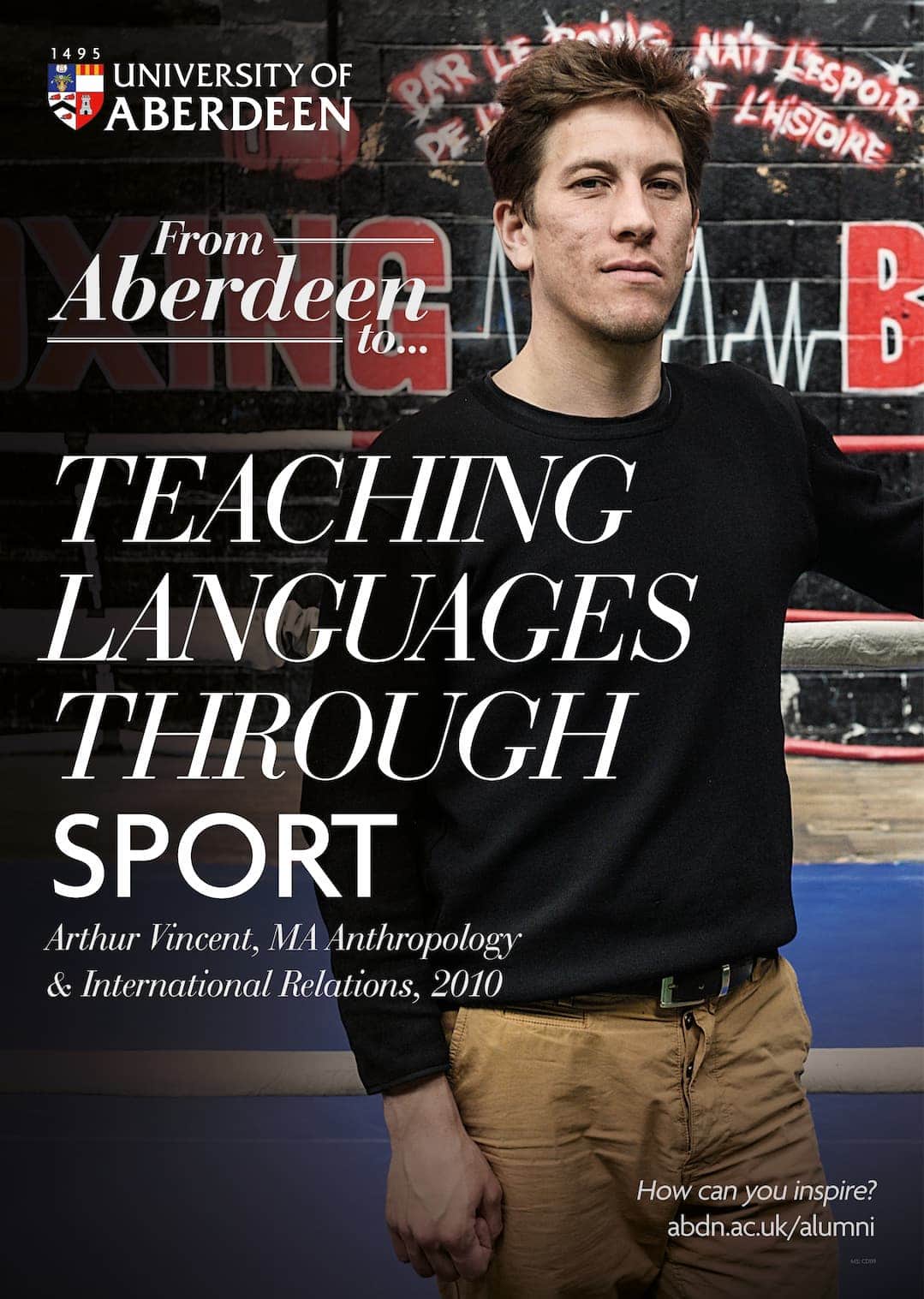
Arthur Vincent is an MA in Anthropology & International Relations graduate from 2010. He currently resides in Aubervilliers, France and founded a non-profit which teaches languages through sport to athletes from underserved areas. Read an interview transcript with Arthur Vincent here . View Arthur's alumni relations promotional poster here .
- Oscar Voss - internship at the European Council on Foreign Relations (ECFR)
-
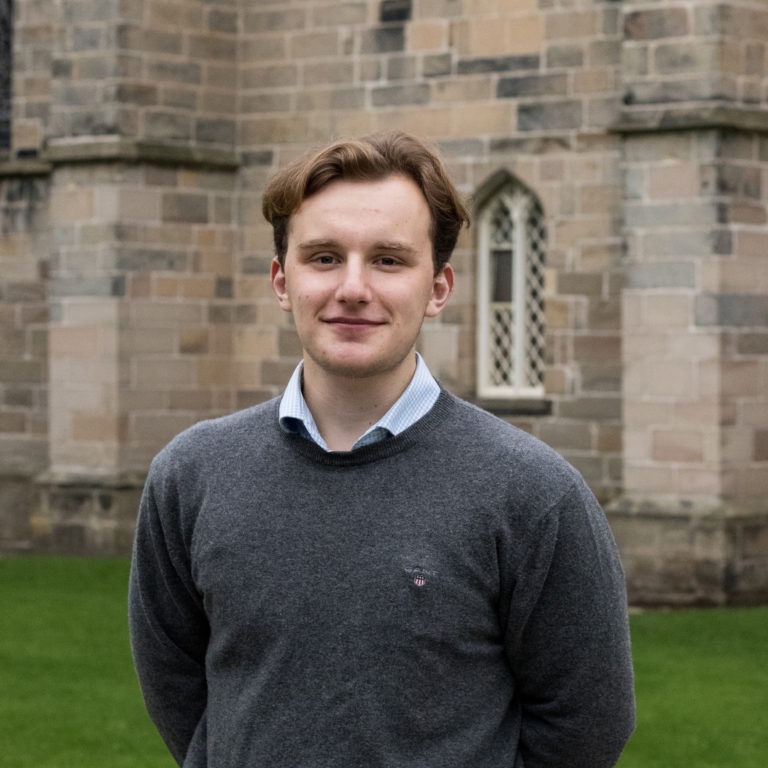
Oscar is grateful for the academic opportunities at the University of Aberdeen and its dedicated staff. He highly recommends students interested in European politics to take Dr Tabur's third-year politics course "The EU: Contemporary Challenges". Whereas he had previously held a general interest in politics, the course's academic rigour cultivated his specific interest in European politics.
"Coming to university I had a broad and general interest in politics. Your course changed my outlook on things and I now know that that my career after studying will be dealing with European related issues." - Oscar Voss
- James Withers - career highlights
-
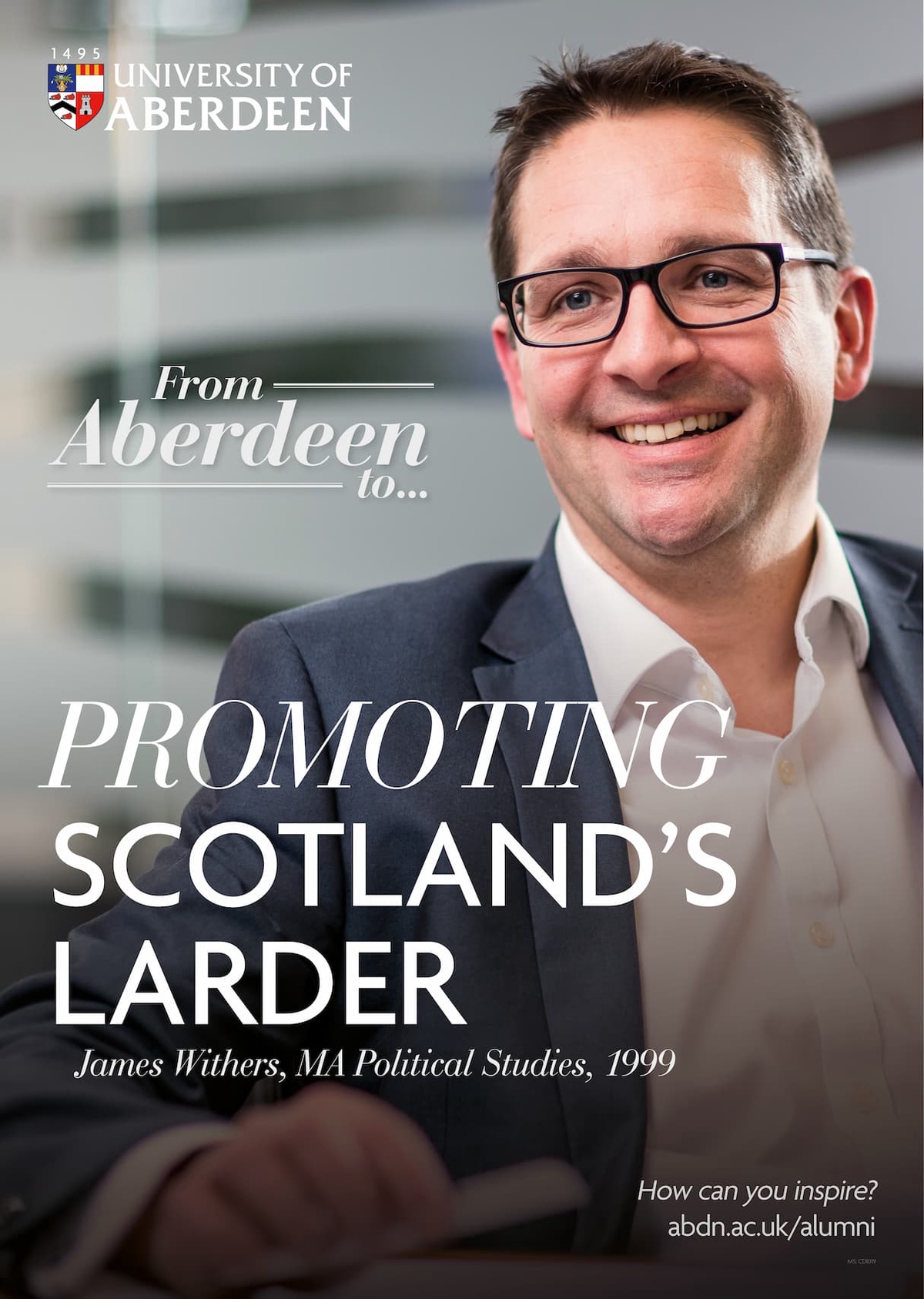
A SOCIABLE SUCCESS STORY - ALUMNI PROFILE: JAMES WITHERS
James Withers says his time at the University was phenomenal and four of the best years of his life. “The one word that sums up my time at Aberdeen is social. I played rugby for the University and for Aberdeenshire and I was very aware that my course allowed me to enjoy all aspects of University life to the full.”
Despite having unconditional offers from Edinburgh and St Andrews, James' visit to Aberdeen on a glorious sunny day, when Kings College looked so inviting, and the students were all enjoying themselves lounging on the grass, sealed his choice of Aberdeen as the University for him. James has definitely been the right person in the right place at the right time as far as his career is concerned. He graduated in 1999, (MA Politics), just as the Scottish Parliament was established, and joined the National Farmers' Union for Scotland (NFUS) graduate trainee scheme as their Parliamentary Adviser. “It didn't matter to NFUS that up until that point I'd never been on a farm, as they of course have a large number of farmers to talk to. What they didn't have was any idea how to engage with the new Parliament, and of course, neither did anyone else! I was able to bring a very fresh (aged 22) pair of eyes to the way NFUS engaged with a range of audiences and will always be grateful for the fantastic opportunity and support they gave me.” Undertaking a number of roles for the NFUS, James was appointed Deputy Chief Executive in November 2005 and Chief Executive in 2008. During his time at NFUS, James represented the organisation at round table discussions about establishing an overarching body, supported by the Scottish Government, that would take the lead on the economic development of the food and drink industry. This body, subsequently known as Scotland Food and Drink, was born in 2007. When the post of Chief Executive became vacant in 2011, James was again in the ideal place to take it on. “I was ready for a change, having been at NFUS for 11 years, and I wanted to get beyond the farm gate. I also knew all the key players in the development of Scotland Food and Drink.”
“The most amazing thing about Scotland Food and Drink is that it exists at all! To get such a range of organisations round the table and working in partnership with Government to grow the sector had never been achieved before. Now, with a small backroom staff of 20, we have 330 member companies, partnerships with all the right organisations, and are well on our way to achieving that ambitious target of growing the industry to a value of £12.5 billion by 2017. The opportunities for Scottish food and drink in markets such as India, China and the Far East is enormous. We want to follow the whisky industry model - we are offering a high quality product, sustainably produced.
“The big challenge for our food producers is going to be how to produce more, with less inputs. Scotland is never going to be a low cost producer. For the home market we need to change the view of some people that 'best value' equals 'cheapest' and help them to think that 'best value' can also mean 'produced to highest standards of welfare and lowest environmental footprint.”
When Scotland Food and Drink was established it was clear that there just wasn't enough research and development taking place to support the innovation that would drive the economic development of the sector. “Among the big trends in the industry are sustainability, innovation in healthier foods, and good quality convenient food. The University's Rowett Institute of Nutrition and Research, which has a 100 year track record in nutrition research, is doing a great job in contributing to these areas and it is clear to me that the need for the type of research carried out by the Rowett is probably greater now than at any other time.” If you want to find out more about the food and drink industry in Scotland, and about James in particular, then follow him on Twitter. An enthusiastic and entertaining tweeter, James manages to blend some more personal tweets with his role at SFD, in a way that perhaps few without his background and experience would be able to do. “I find that Twitter is simply the most time efficient social media platform. I was originally really sceptical of it, but now I can't remember the last time I picked-up on a major news story anywhere other than on Twitter. Of course, it can attract the loony fringe, and I know that there are some topics which if I tweet about will immediately produce a spat of replies, but by and large Twitter excels at the getting, and communicating of news.”
Finally, James has a message for academics wanting to engage with the policy and political audiences: “You really need to think about the clarity of your message - keep it short and sharp. Politicians everywhere are simply drowning in information. Academics are very good at churning out loads of information such that their message gets lost, and they aren't always clear what they want from their MSP either.”