
Developing evidence-informed approaches to culture change, through support for evaluation strategies within and across research cultures. This will allow us to assess the engagement with and impact of our activities, and make progress through iteration.
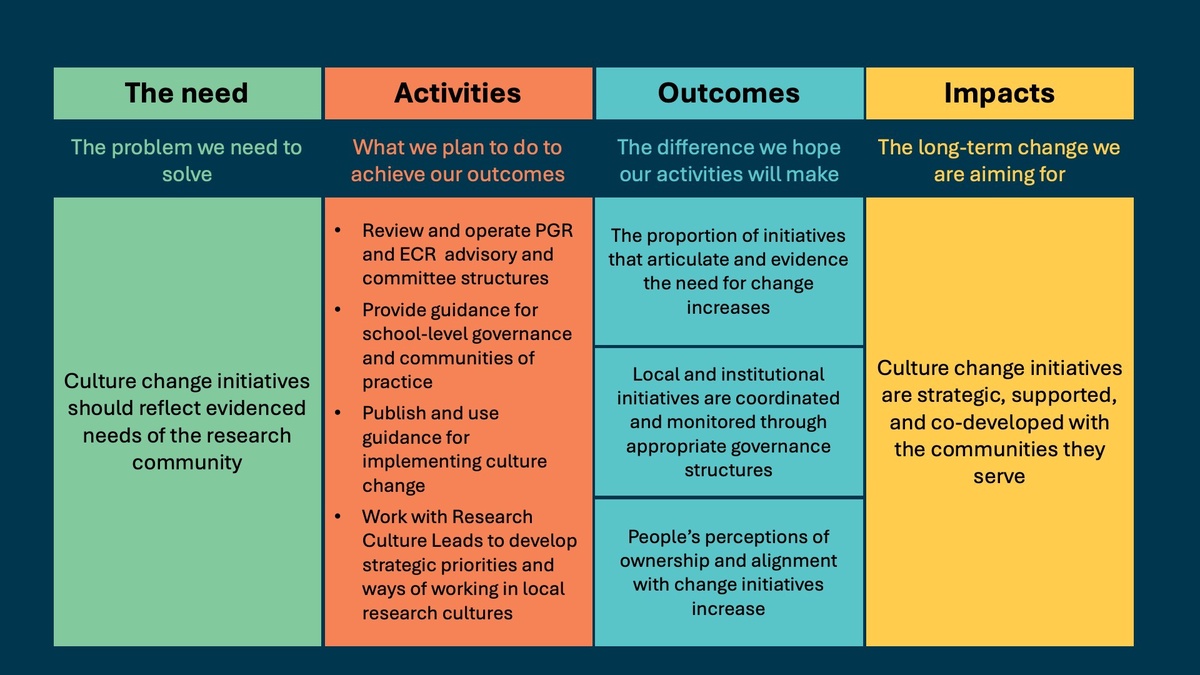
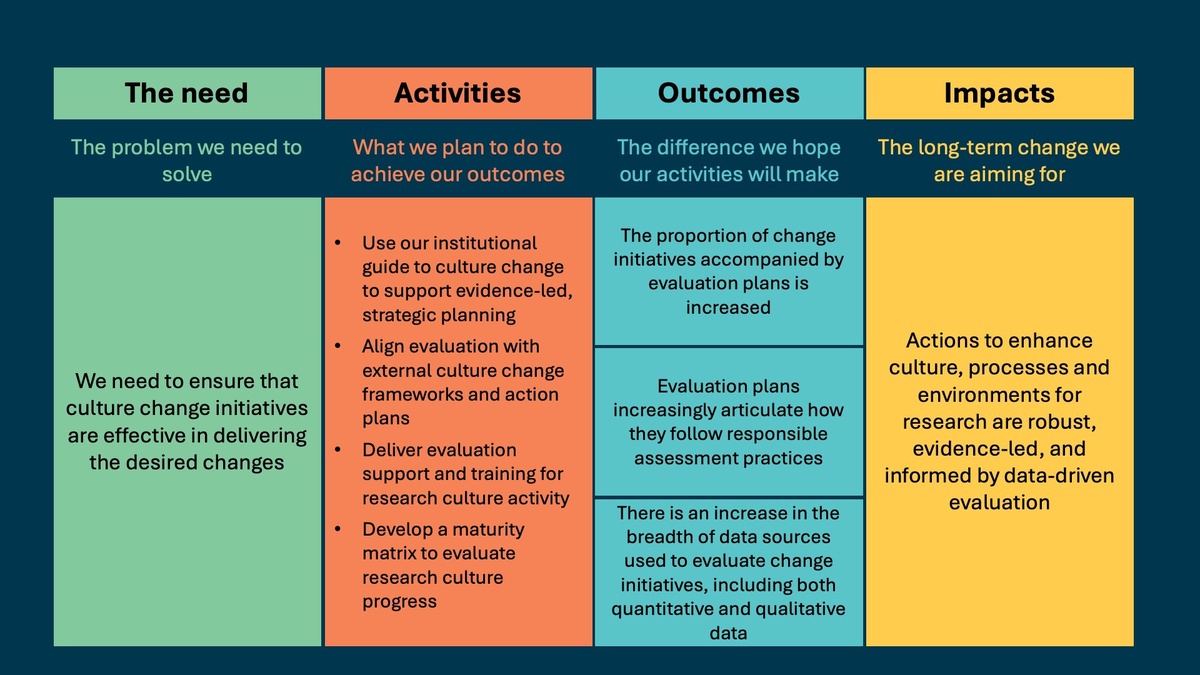
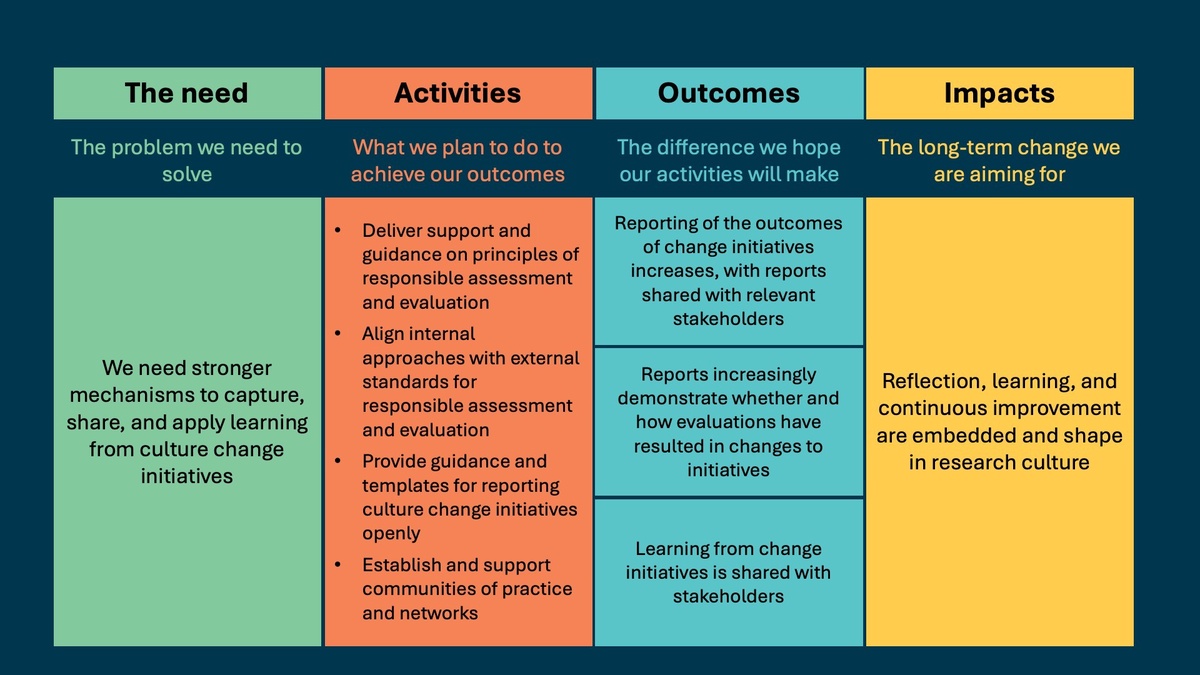
We identified three key institutional needs to address to foster and support developing evidence-informed approaches to culture change. The logic models below describe how we intend to address each need and the changes that we will see as a result. These needs are underpinned by evidence drawn from consultation across the University and from a range of recent institutional surveys.
Strategic Evidence Led Change Logic Model
Evaluation of Culture Change Logic Model
Learning and Continuous Improvement Logic Model
- Current activities and initiatives
-
Maturity Matrix: we will develop a maturity matrix for research culture to provide a structured framework to enable the assessment of progress at institutional, School, discipline, UoA and even individual research group level. By focusing on key areas such as openness, integrity, inclusivity, leadership, collaboration, and innovation, and breaking these complex themes down into manageable pathways, the matrix will support the assessment of progress so far, and offer a clear route to follow in making further improvements. The maturity matrix will be developed during 2025.
- Sector Standards
-
The PCE indicators project will provide insight into how the REF exercise will ask HEIs to describe and evaluate their research culture work. The sector report is expected in November 2024.
- Reports and Underpinning Evidence
-
Institutional CEDARS 2025 Report
This report summarises the University of Aberdeen’s results from taking part in the 2025 Culture, Employment and Development of Academic Researchers Survey (CEDARS). CEDARS is a UK-wide survey run by Vitae that gathers evidence about people’s experiences of working in research. Our report highlights key strengths and challenges, sets out six recommendations for action, and explains who will be responsible for monitoring progress against these recommendations.
Institutional Research Cultures Consultation Report
This report summarises the findings from consultation undertaken between April 2024 and December 2025 by the University of Aberdeen’s Research Cultures and Development Team to inform development of the institutional Research Cultures Strategy. Drawing on discussions with Heads of Schools, Directors of Research, School governance groups, open School meetings and Padlet contributions, it synthesises five recurring themes and the enabling conditions needed to strengthen research culture. The report provides an evidence base to support shared understanding across the University and to inform implementation and evaluation of the institutional Research Cultures Strategy.
- External links and resources
-
SCOPE Framework for Research Evaluation: developed by the International Network of Research Management Societies (INORMS), the SCOPE framework is a five-stage model designed to guide responsible research evaluation. It assists research managers and evaluators in planning and conducting assessments that align with core values and contextual considerations.
The National Coordinating Centre for Public Engagement (NCCPE): is the national body which champions the public engagement agenda and influences culture change within and across HEIs.
EDGE Tool: Developed by the NCCPE the EDGE tool is a maturity matrix self-assessment tool to help institutions and individuals to take stock and plan future work. This is a useful guide as we explore developing a maturity matrix for research culture.